
Credit-Based Travel: Unlocking Affordable Stays Worldwide

SwappaHome Editorial Team
Home Exchange & Slow Travel Editorial
Credit-Based Travel: Unlocking Affordable Stays Worldwide !Travelers exchanging keys outside city apartment Booking a hotel room in London or New...
Credit-Based Travel: Unlocking Affordable Stays Worldwide
 Travelers exchanging keys outside city apartment
Booking a hotel room in London or New York often stretches your travel budget thin. Many younger homeowners and travelers now seek smarter, more authentic ways to explore destinations like France, Canada, or Italy without draining their savings. Credit-based travel turns strangers into trusted neighbors, letting you earn and spend hospitality credits while experiencing local culture. This guide clears up confusing myths and shows how credit swapping works practically for adventurous people looking to maximize value from every trip.
Table of Contents
- Defining Credit-Based Travel and Common Misconceptions
- Types of Credit-Based Home Swapping Systems
- How Credit Earning and Booking Work
- Security, Verification, and Member Responsibilities
- Risks, Costs, and Key Differences From Alternatives
- Understanding Your Risk Tolerance
Key Takeaways
| Point | Details |
|---|---|
| Credit-Based Travel Model | This system allows travelers to earn credits by hosting others, enabling a peer-to-peer exchange without direct monetary transactions. |
| Flexibility in Hosting and Traveling | Members have control over their availability and do not have to travel immediately after hosting, allowing for a more personalized experience. |
| Community Trust and Verification | Security is established through a thorough member verification process and ongoing reviews, fostering a reliable environment for both hosts and guests. |
| Understanding Risks and Costs | It's essential to assess your risk tolerance and consider the unique cost structure of credit-based travel compared to traditional lodging options. |
Defining Credit-Based Travel and Common Misconceptions
Credit-based travel flips the traditional hotel booking model on its head. Instead of paying money for each night of accommodation, you earn credits by opening your home to other travelers, then spend those credits to stay in their homes around the world. It's a peer-to-peer exchange system where the currency isn't dollars or euros, but trust and reciprocal hospitality. Think of it like a global favor bank where everyone deposits and withdraws based on their travel needs. On platforms like SwappaHome, the math is straightforward: one credit equals one night. You list your home, verify your identity, and when someone stays with you, you earn credits. When you're ready to travel, you book another member's home using your accumulated credits. No money changes hands in the actual exchange, and that's precisely what makes this system fundamentally different from traditional travel booking.
However, misunderstandings about credit-based travel run surprisingly deep. The most persistent misconception is that credit-based systems always involve some hidden monetary component. People often assume that if they're not paying upfront, they must be paying somewhere else, or that the credits themselves have cash value. The reality is that home swapping operates as a non-commercial hospitality exchange rooted entirely in peer-to-peer trust and reciprocity. You're not buying anything. You're participating in a community where the value derives from mutual generosity and the opportunity to experience travel authentically. Another common misconception involves how people manage their credit budgets. Research shows that travelers receiving credits tend to engage in risk-averse behavior, conserving credits early in the year out of uncertainty about future needs. This natural caution, while understandable, can actually limit your travel opportunities. Many members worry they'll need to "save" their credits for a bigger trip later, so they don't book smaller adventures. What actually happens is that you end up taking fewer trips overall because you're holding onto credits waiting for the perfect moment that may never come.
There's also confusion about flexibility and commitment. Some prospective members believe that joining means you're locked into hosting travelers constantly or that you must travel regularly to "earn back" what you give. The truth is more fluid. You control your listing entirely. Your home can be available during specific months that work for you, completely unavailable during others, or anything in between. You're not obligated to match every night someone stays with you with an immediate night you spend away. The credit system builds over time, and many members accumulate credits across multiple stays throughout their lives. The beauty of this approach is that you participate on your own terms, whether you travel twice a year or once every three years.
Pro tip: Before joining, spend time on the platform exploring available homes in places you actually want to visit, and calculate roughly how many nights your home could realistically host annually based on your comfort level. This gives you a realistic sense of how quickly you'll accumulate usable credits for your travel goals.
Types of Credit-Based Home Swapping Systems
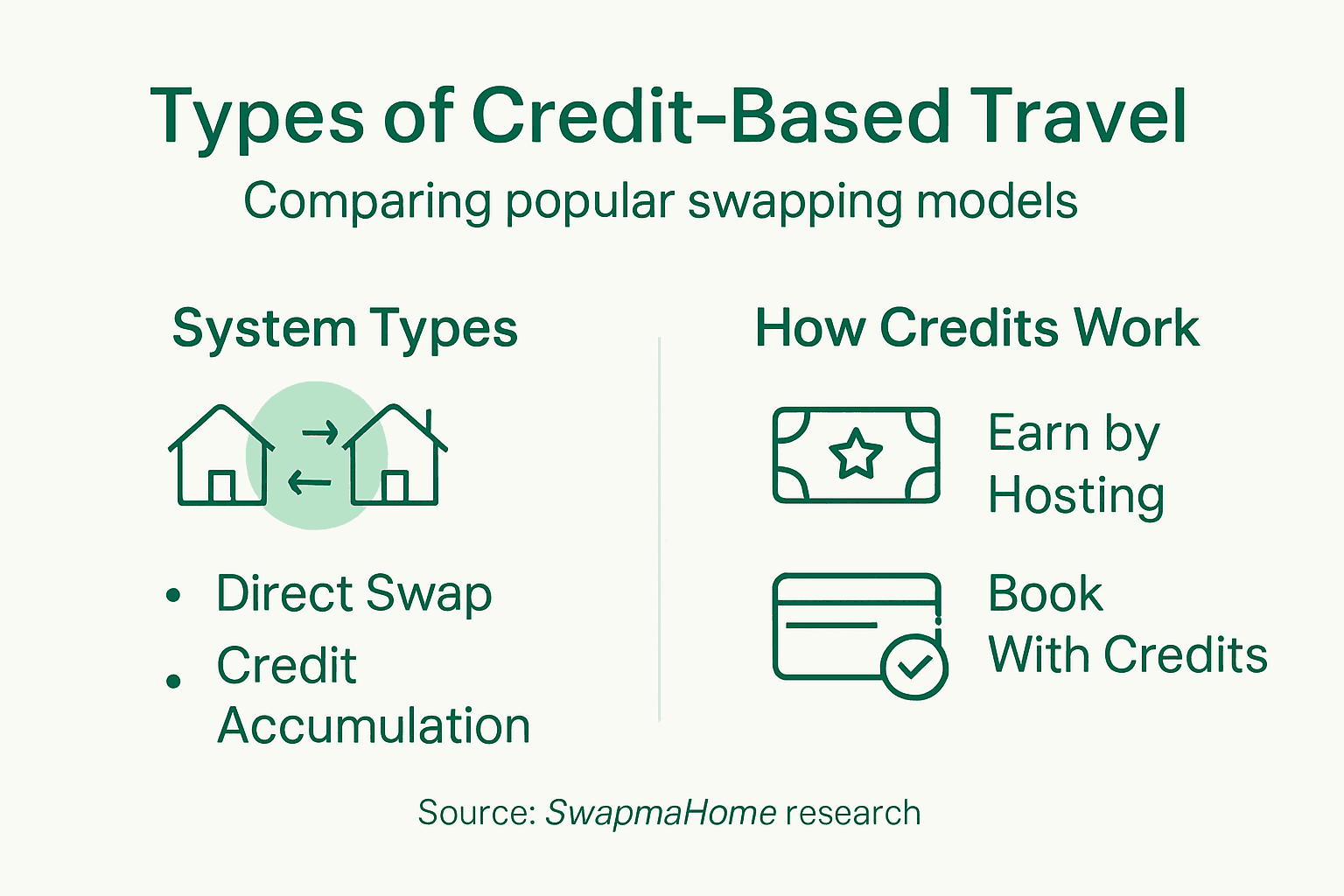
Credit-based home swapping isn't a one-size-fits-all model. Different platforms and communities operate with distinct mechanics, and understanding these variations helps you choose a system that matches your travel style and hosting comfort level. The most straightforward approach is the direct swap, where you exchange homes with another member for the same number of nights. You host Sarah from Barcelona for seven nights in your Toronto home, and she hosts you in hers. No credits involved, just a simple back-and-forth arrangement. This works beautifully when both parties have compatible travel dates and trust each other's homes equally. However, direct swaps require careful coordination and can be limiting if your travel schedule doesn't align neatly with available swap partners.
 Infographic comparing credit-based travel systems
Then there's the credit-accumulation system, which is what makes platforms like SwappaHome genuinely flexible. Instead of needing to find someone who wants your home at the exact moment you want theirs, you earn credits whenever anyone stays with you. Those credits sit in your account until you're ready to book. You might host three different families throughout the year, accumulating nine credits total, then use all nine credits during a two-week summer vacation in the south of France. The beauty here is that credit-based reciprocal exchanges eliminate the pressure to travel immediately after hosting. You gain control over the timing, which is crucial for people with unpredictable schedules or those who need to save up their hospitality currency over several months. Some platforms also offer hybrid models that blend both approaches. You might do occasional direct swaps with friends while also earning and spending credits separately. This flexibility appeals to members who want options without committing exclusively to one format.
A third variation gaining traction is the hosted stay with credit earnings system, where you earn credits not just from people staying in your home but also by being a houseguest yourself. Some networks reward active community participants with bonus credits or special privileges. The underlying principle across all these systems remains rooted in trust-dependent peer-to-peer exchanges where members value authenticity and genuine hospitality over transactional convenience. What separates credit-based systems from traditional vacation rentals is that every participant is both host and traveler. You're investing in a community where your willingness to open your home directly enables others to experience travel affordably, creating a reciprocal cycle. The specific mechanics matter less than understanding which system philosophy aligns with how you want to travel and host.
Pro tip: Before committing to a platform, test the system by hosting one or two guests first, then booking a short trip to see how the credit earning and spending process actually feels in practice.
How Credit Earning and Booking Work
The mechanics of earning and spending credits are refreshingly straightforward, though understanding the nuances helps you maximize your travel potential. When you list your home on SwappaHome, you're essentially creating an asset that generates credits. Each night someone stays in your home equals one credit deposited into your account. A guest from Germany spends five nights in your Austin apartment? You earn five credits. Those credits don't expire or lose value, and they belong entirely to you. The platform handles verification and matching, ensuring that hosts and guests are legitimate community members. Once credits land in your account, they become your passport to accommodations anywhere in the SwappaHome network. You can use them whenever suits your schedule, whether that's next month or next year.
 Woman checking credit-earning travel website at home
Booking with your credits mirrors traditional vacation rental platforms, except money never changes hands. You browse available homes in your target destination, check availability calendars, and request a swap for your desired dates. The property owner reviews your profile, reads your reviews from previous stays, and decides whether to accept. If they say yes, your credits are held pending the stay. After both parties complete their exchanges, the credits are finalized in both accounts. The beauty of this system lies in how it encourages strategic thinking about travel timing. Unlike paying money upfront for a single trip, your credit balance creates ongoing travel opportunities. Some members track their earning patterns to understand how many hosting nights typically translate into their ideal vacation length. One family might discover that hosting guests every other month generates enough credits for a two-week European adventure annually.
What makes credit-based systems particularly effective is that dynamic pricing mechanisms aren't applied here in the traditional sense. One night equals one credit, universally. A beachfront home in Croatia costs the same number of credits as a countryside cottage in Poland or a city apartment in Amsterdam. This flat-rate structure eliminates the frustration of surge pricing and makes budget planning genuinely reliable. Members also learn through experience how to optimize their earnings and spending. Some strategically host during peak seasons when demand is highest, accelerating their credit accumulation. Others book during shoulder seasons when more homes are available, stretching their credits further. The system rewards both generous hosts and flexible travelers.
Pro tip: Track your home's availability patterns over three months to identify your peak hosting season, then concentrate your guest bookings during those months to build credits faster for your desired travel window.
Here’s a summary of key steps involved in earning and spending travel credits:
| Step | What Happens | Considerations |
|---|---|---|
| List Your Home | Create detailed listing | Set accurate availability |
| Host a Guest | Guest stays, you earn credits | Reviews build reputation |
| Accumulate Credits | Credits added to your account | Credits do not expire |
| Book a Stay | Use credits to reserve home | Host reviews your profile |
| Complete Stay | Stay finalized, credits used | Mutual review exchange |
| Repeat Process | Host or travel as needed | Maximize peak periods for hosting |
Security, Verification, and Member Responsibilities
Trust forms the foundation of credit-based travel, but trust built on a platform requires real security measures. SwappaHome doesn't operate on blind faith. Every member undergoes a verification process designed to confirm identity and establish credibility within the community. When you join, you provide documentation that gets reviewed by the platform team. Your name, address, and background information are cross-checked against databases. Some platforms use identity verification services that scan government-issued documents and confirm you are who you claim to be. This upfront vetting screens out bad actors before they ever gain access to the network. It's the difference between a legitimate community and a free-for-all where anything goes. The verification step takes time, but it's the security investment that protects both your home and your stay in someone else's.
Once verified, members remain accountable through ongoing reputation systems. Every guest leaves a review after their stay, detailing their experience honestly. Did they treat the home with respect? Were the kitchen and bathroom clean? Did they follow house rules? Host reviews are equally transparent. Members with consistently positive reviews build social capital within the network. Someone considering whether to accept your booking request will read what previous hosts have written about you. This creates powerful incentive alignment. You want to be a considerate guest because your behavior directly impacts your ability to book future accommodations. You want to be a gracious host because your home's reputation determines which guests you attract. The system turns individual accountability into collective security. Multi-factor authentication and encryption protocols protect sensitive information like payment methods and contact details, while member reviews create a transparent record of actual behavior.
Your personal responsibilities extend beyond just showing up. As a host, you're responsible for clearly communicating house rules, ensuring your home is in the condition you advertised, and treating guests with respect. As a guest, you're responsible for following those rules, maintaining cleanliness, and respecting the host's space as if it were your own. Both parties should document the home's condition at check-in using photos, noting any existing damage or issues. This protects everyone. If something gets broken or goes missing, there's a clear record of what the home looked like beforehand. SwappaHome provides dispute resolution mechanisms when conflicts arise, but the best disputes are prevented through clear communication and honest expectations on both sides. Think of it this way: you're not renting to a stranger. You're welcoming a member of your community into your home. They're doing the same for you.
Pro tip: Before hosting or visiting, take detailed photos and write down specific house rules you care about most, then share them clearly in your listing and in direct messages with swap partners to prevent misunderstandings.
Risks, Costs, and Key Differences From Alternatives
Credit-based travel isn't risk-free, and understanding potential downsides helps you make an informed decision. The most significant risk involves credit imbalance. What happens if you're an introvert who loves hosting briefly but rarely travels? Your home might accumulate credits you never use. Conversely, frequent travelers who struggle to keep their homes available find themselves short on credits when they want to book. The system assumes relatively balanced participation from members, but real life rarely aligns perfectly. Another real concern is property damage or guest behavior issues. While verification and reviews mitigate this, bad experiences happen. A guest might leave your home less clean than advertised, or worse, cause actual damage. Unlike traditional vacation rentals where you can charge cleaning fees or damage deposits, credit-based systems depend on community standards and dispute resolution. This requires more trust tolerance than many people possess.
The cost structure of credit-based travel differs fundamentally from alternatives. Hotels charge nightly rates that surge during peak seasons, sometimes doubling or tripling. Airlines charge premium prices for last-minute bookings. Vacation rental platforms take commission cuts from hosts. Credit-based systems eliminate these transaction costs entirely, but they introduce different expenses. There are no nightly fees, but there are platform costs. SwappaHome sustains itself through membership fees or optional premium features. The real cost comparison depends on your travel frequency and hosting capacity. Someone traveling twice yearly while hosting three times annually breaks even financially but gains travel experiences at virtually zero accommodation cost. Someone who travels constantly but rarely hosts finds themselves unable to afford their travel lifestyle through credits alone. Credit allocation and recognition processes determine whether members can actually access the value they theoretically accumulate.
Compared to traditional alternatives, credit-based travel offers distinct trade-offs. Hotels provide consistency, housekeeping, and zero responsibility. You pay money and expect service. Vacation rentals offer independence and local living but cost significant money upfront. Credit-based swaps provide authentic cultural exchange and zero accommodation costs but require you to open your home to strangers and accept some risk. Airbnb and VRBO won't cancel your booking two weeks before arrival, but swap partners occasionally do. You can't demand refunds or charge service fees in disputes. Yet if you value affordability, community, and authentic travel experiences over convenience and control, credit-based systems deliver uniquely. The flexibility of not needing to travel on a fixed schedule, combined with the cost elimination, appeals to budget-conscious travelers willing to accept slightly less certainty and control.
Here's a comparison of credit-based travel with traditional hotel stays and vacation rentals:
| Criteria | Credit-Based Swapping | Hotels | Vacation Rentals |
|---|---|---|---|
| Payment Structure | Uses earned credits | Pays nightly cash rate | Pays nightly cash rate |
| Flexibility | Host/travel on own schedule | Fixed reservation dates | Fixed reservation dates |
| Community Involvement | Peer-to-peer, social trust | Minimal, transactional | Some reviews, less community |
| Risk of Property Damage | Community standards, reviews | Minimal risk, professional staff | Deposits and owner rules |
| Cost Predictability | No surge pricing | Prone to seasonal surges | Price varies by demand |
| Authentic Local Experience | High, live like a local | Standardized experience | Varies, local immersion possible |
| Responsibility as Guest | High—care for home, follow rules | Low, guest services manage | Medium, depends on owner policies |
Understanding Your Risk Tolerance
Before committing, honestly assess what risks concern you most. Do property damage scenarios keep you awake? Are you comfortable with occasional guest cancellations? Can you handle a guest using your coffee maker differently than you prefer? Some people thrive in this environment. Others find the uncertainty paralyzing. Neither response is wrong, but clarity helps you decide whether credit-based travel suits your temperament and lifestyle.
Pro tip: Calculate your personal break-even point by estimating annual hosting nights multiplied by your local average hotel rate, then compare that to your typical annual travel spending to see if credit-based swapping creates real financial value for your situation.
Discover How Credit-Based Travel Can Transform Your Next Vacation
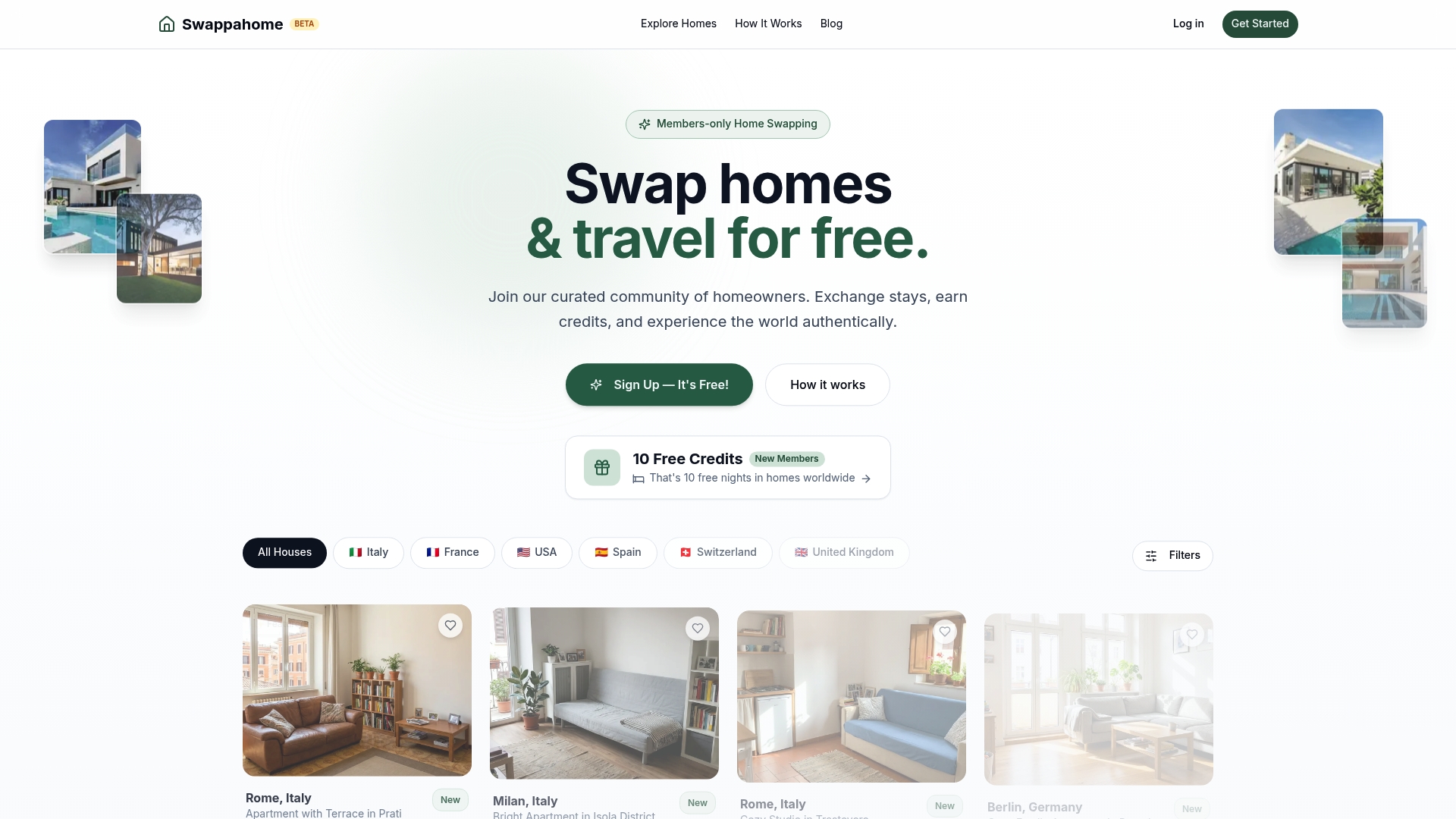
The challenge most travelers face is balancing affordability with authentic experiences while managing the risks and complexities of home swapping. This article highlights critical pain points like credit balance uncertainty, trust concerns, and scheduling flexibility. At SwappaHome, we understand these hurdles and provide a curated, verified community where you can confidently list your home, earn credits, and unlock stays worldwide. Our simple credit-based system empowers you to travel on your own terms without the pressure to host or travel immediately. With one credit equaling one night, you will always know your travel potential and how to maximize your earned credits.
 https://swappahome.com
Take control of your travel budget and experience global destinations through genuine hospitality. Join SwappaHome today to explore our verified listings, start earning credits effortlessly, and plan your next authentic trip without traditional costs. Don't wait to turn your home into a travel asset visit SwappaHome now and begin your journey toward affordable, risk-managed, and flexible travel designed for you.
Frequently Asked Questions
What is credit-based travel?
Credit-based travel is a peer-to-peer accommodation exchange system where you earn credits by hosting other travelers in your home. You can later use those credits to stay in other members' homes around the world, without exchanging money for the actual accommodation.
How do I earn and use credits in a credit-based travel system?
You earn credits by hosting guests in your home—one night equals one credit. These credits accumulate in your account and can be used to book stays at other members' homes when it suits your travel plans.
What are the key differences between credit-based travel and traditional vacation rentals?
Credit-based travel eliminates monetary transactions, relying instead on a system of trust and reciprocity. Unlike traditional vacation rentals that charge upfront fees, you earn and spend credits, making it a more community-focused and cost-effective option.
What if I don't have enough credits to book a desired stay?
If you run low on credits, you can choose to host more guests to accumulate them. You also have the flexibility of how and when you host, allowing you to balance earning credits with your travel needs.
Recommended

Published by
SwappaHome
SwappaHome Editorial Team
Home Exchange & Slow Travel Editorial
The SwappaHome Editorial Team brings together travel research, home-exchange community insights, and platform data to produce practical guides for first-time and experienced home swappers. Every article cites real platforms, current market rates, and verifiable city-level facts so readers can make informed decisions without guessing.
Ready to try home swapping?
Join SwappaHome and start traveling by exchanging homes. Get 7 free credits when you sign up!