
Key Terms of Home Exchange Platforms Explained

SwappaHome Editorial Team
Home Exchange & Slow Travel Editorial
Key Terms of Home Exchange Platforms Explained !Family planning home exchange trip in living room Booking a hotel for every trip quickly eats into...
Key Terms of Home Exchange Platforms Explained
 Family planning home exchange trip in living room
Booking a hotel for every trip quickly eats into your savings, but home exchange platforms turn travel into a true community experience. Instead of paying nightly rates, you join a global network of verified homeowners open to swapping their living spaces for yours. This non-monetized peer-to-peer accommodation sharing model creates authentic, affordable stays and builds trust by connecting people from different backgrounds. Discover how this approach fosters deeper cultural exchanges and puts meaningful travel within reach for those who value connection over transaction.
Table of Contents
- What Home Exchange Platforms Really Mean
- Types of Exchanges and Credit Systems Explained
- Essential Terms: Listings, Credits, and Bookings
- Member Verification, Trust, and Community Insights
- Legal, Safety, and Common Pitfalls to Note
Key Takeaways
| Point | Details |
|---|---|
| Home Exchange Overview | Home exchange platforms facilitate non-monetized arrangements where homeowners swap their living spaces, providing authentic experiences and enhancing travel connections. |
| Types of Exchanges | Understanding exchange models, such as reciprocal swaps and credit systems, is crucial for flexibility and accommodating varying travel plans. |
| Essential Terms | Familiarize yourself with key terms like listings, credits, and bookings to maximize your home exchange experience and attract compatible partners. |
| Safety and Legal Awareness | Before engaging in exchanges, research local regulations and secure adequate insurance coverage to protect yourself and your property. |
What Home Exchange Platforms Really Mean
Home exchange platforms operate as something quite different from traditional travel booking sites. Rather than buying accommodations, you're entering into a reciprocal arrangement where non-monetized peer-to-peer accommodation sharing replaces currency transactions entirely. Think of it as a global community of homeowners who agree to temporarily swap living spaces. You list your home, someone else lists theirs, and when your preferences align, you trade places for a set period. No money changes hands. No hotel chain profits from your stay. Instead, you gain access to authentic, lived-in spaces while someone else enjoys yours. This model fundamentally shifts how people think about travel accommodations and what value really means in the modern world.
What makes this approach powerful is how it addresses multiple needs simultaneously. When you exchange homes with another family, you're not just securing affordable lodging. You're engaging in what researchers call the sharing culture within temporary accommodation arrangements, where trust, reciprocity, and community engagement become central. You get to experience a destination as locals do, cooking in someone's kitchen, understanding their neighborhood rhythms, accessing their preferred restaurants and parks. The host who welcomes you into their space gains the same authentic experience in return. This goes beyond economics into the social and psychological dimensions of travel—you're building connections across borders and cultures while reducing your travel costs substantially. The platform simply facilitates these connections, handling the verification, profile creation, and trust-building mechanisms that make strangers comfortable enough to exchange their most personal spaces.
Understanding this concept matters because it changes how you approach travel entirely. You're not a temporary customer consuming a service; you're a community member participating in a system designed around reciprocity and genuine exchange. The platform earns your loyalty by maintaining standards and vetting members thoroughly, not by convincing you to spend more money. This alignment of interests means the platform's success depends on your satisfaction and trustworthiness. For budget-conscious travelers aged 30 and up, this represents a meaningful departure from decades of hotel dependency. You're not just saving money on accommodations—you're reimagining what authentic travel looks like when it's built on mutual benefit rather than commercial transactions.
Pro tip: Before you even list your home or book a stay, spend time reading other members' profiles and exchange reviews on the platform to understand community standards—this gives you insight into the culture you're joining and helps you craft a profile that attracts compatible exchange partners.
Types of Exchanges and Credit Systems Explained
Home exchange platforms offer different approaches to swapping homes, and understanding these distinctions helps you choose what works best for your travel style. The most straightforward model is reciprocal direct exchange, where two homeowners swap homes at the same time. You go to their place while they visit yours simultaneously. This works beautifully when your schedules align perfectly and you want the simplest arrangement possible. However, life rarely cooperates that neatly. Maybe your ideal travel window doesn't match anyone else's. Maybe you want to visit multiple homes across different seasons. This is where credit based systems become invaluable. Instead of requiring simultaneous swaps, credit systems let you earn credits by hosting visitors in your home, then spend those credits to book stays elsewhere whenever you want. You could host someone in June, earn credits, and use those credits to stay somewhere in October. This asynchronous approach gives you flexibility that direct swaps simply cannot match.
The credit system works like a community currency designed specifically for home exchanges. When someone stays in your home for one night, you earn one credit. That credit holds value indefinitely on the platform, allowing you to book accommodation at any other member's home when it suits you. Some platforms offer initial credits to new members as an incentive to get started. The beauty of this model is that it expands participation dramatically. You do not need to find the perfect matching swap partner. You do not need synchronized vacation schedules. You just need to open your home to visitors and accumulate credits at your own pace. Some members prefer hosting over traveling, so they build up credits they gift to family members or friends. Others use credits sporadically, saving them for that one special trip they have been planning. The flexibility transforms home exchange from a puzzle requiring exact matches into a system that adapts to real human life.
Beyond direct swaps and credit systems, some platforms incorporate hospitality exchanges, which blur the lines between home exchanges and other accommodation types. These might involve staying in someone's guest cottage, apartment, or even receiving hospitality services in exchange for the same. The distinctions matter because they affect how you plan and what to expect. A direct reciprocal swap means you are trusting someone with your entire home while living in theirs. A credit system still involves that trust but removes the timing pressure. Understanding which model a platform uses helps you evaluate whether it matches your comfort level and travel patterns. For established homeowners aged 30 and up with families or pets, the credit system often proves most practical because it accommodates irregular schedules and varying hosting preferences.
Here's a comparison of the main home exchange models available on online platforms:
| Exchange Type | Description | Best For | Flexibility |
|---|---|---|---|
| Reciprocal Exchange | Simultaneous direct swaps between two homes | Aligned travel dates and preferences | Low |
| Credit System | Host and earn credits, use for future stays | Busy families, irregular travel plans | High |
| Hospitality Exchange | Stay as guest, may include services offered | Short visits, social-oriented hosts | Moderate |
Pro tip: Before committing to a platform, calculate roughly how often you could realistically host visitors annually, then estimate how many credits that would generate versus how many you would likely need for your desired trips, ensuring the economics work in your favor.
Essential Terms: Listings, Credits, and Bookings
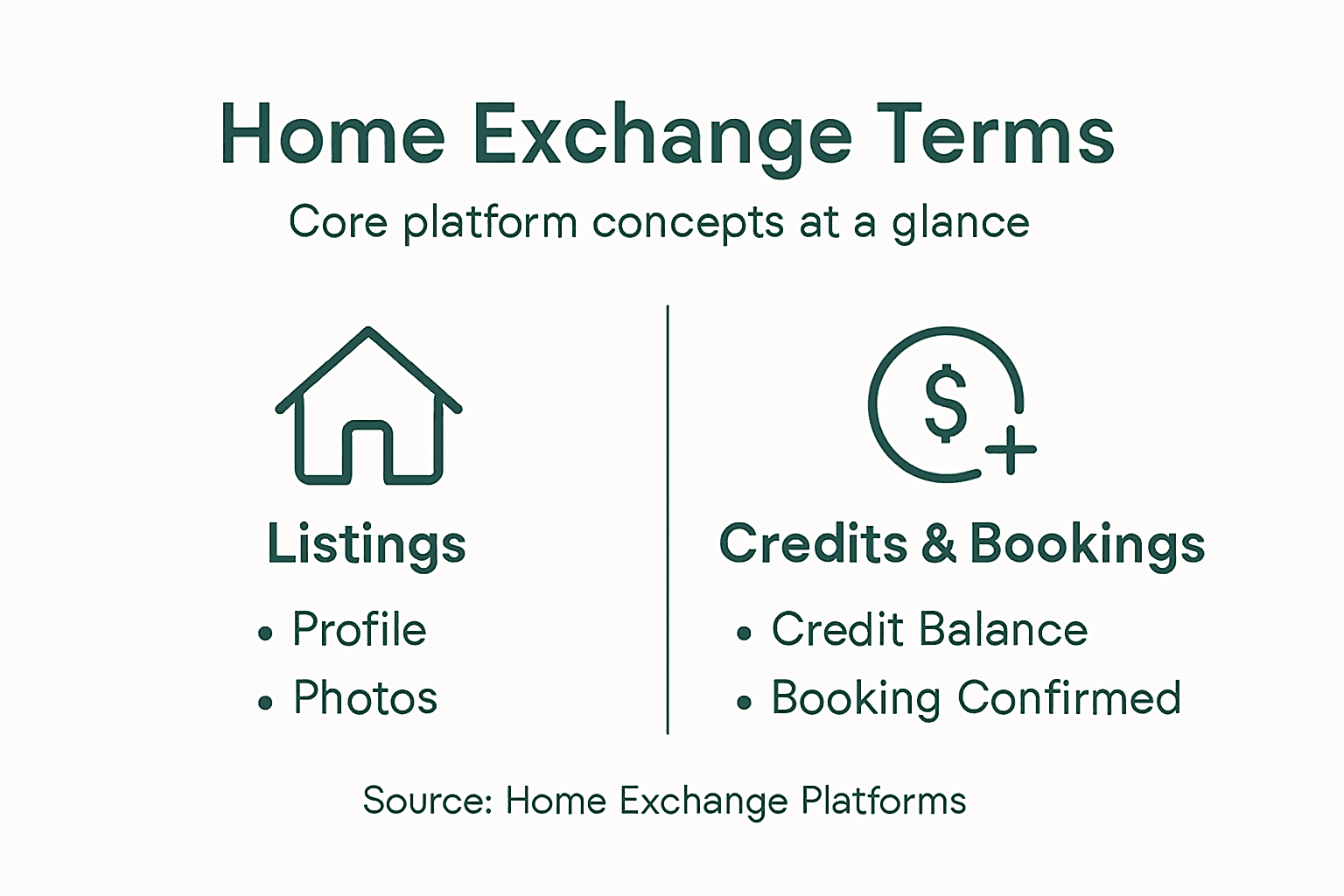
When you start using a home exchange platform, three core terms shape everything you do. A listing is your home's digital storefront. It includes photographs of your bedrooms, kitchen, and outdoor spaces, a detailed written description of what guests will find, your availability calendar, and your preferences for who you will host. Think of it like creating a resume for your home. You are not just showing off the building itself, but communicating the experience of living there. A good listing answers the questions potential exchange partners will ask: How many bedrooms? What amenities do you offer? Are pets welcome? Can guests use your car? What neighborhood features matter most? Strong listings attract compatible matches because they set clear expectations upfront.
 Infographic explains home exchange platform terms
Credits function as the virtual currency that powers the entire system. When someone stays in your home for a night, you earn one credit. That credit never expires and holds equal value across the platform regardless of your home's location or size. This means a night in a small townhouse in Toronto counts the same as a night in a beachfront villa in Spain. You accumulate credits at your own pace, then spend them whenever you find a home listing that matches your travel plans. Some people build a large credit reserve over several years of hosting, banking them for future trips. Others maintain a steady balance, hosting roughly as often as they travel. The credit system removes the pressure of finding an exact reciprocal match, which means you have vastly more options than you would with direct swaps alone.
Bookings are the confirmed arrangements where everything becomes official. Once you find a listing you want, contact the host, and both parties agree to the exchange, you submit a booking request. The host accepts, dates are locked in, and suddenly that vacation becomes real. A booking creates accountability on both sides. You know exactly when you will arrive, how many nights you will stay, and which home will be yours. The host knows the same about you. This clarity prevents misunderstandings and builds the trust that makes home exchange work. Bookings also generate a history on your profile, showing other community members that you follow through on your commitments. That track record becomes invaluable because verified, reliable members attract better exchange opportunities and more hosting inquiries from quality guests.
To clarify platform essentials, here's a quick reference for home exchange terminology:
| Term | Meaning | Key Functionality |
|---|---|---|
| Listing | Online profile for your home | Attracts compatible exchange partners |
| Credit | Virtual currency earned for hosting stays | Enables booking flexibility |
| Booking | Confirmed arrangement to swap or stay | Secures travel and builds reputation |
Pro tip: Create a listing even if you travel frequently, since each host stay earns credits that expand your future booking options, and aim for at least five high-quality photos plus detailed descriptions of what makes your home special to attract serious, compatible exchange partners.
Member Verification, Trust, and Community Insights
Home exchange differs fundamentally from hotel stays because you are inviting strangers into your home and trusting them with your belongings, family photos, and personal space. This reality makes member verification absolutely essential. Reputable platforms implement multiple layers of verification to ensure community safety. This includes identity checks where members prove who they are through government-issued documents, background screening to flag any concerning histories, and email confirmation to establish basic contact legitimacy. These are not optional nice-to-haves. They form the foundation that separates legitimate home exchange communities from risky alternatives. When you join a platform with rigorous verification standards, you gain peace of mind knowing that other members have been vetted similarly. This mutual vetting creates a baseline of trustworthiness that direct peer-to-peer arrangements simply cannot match.
 User checking member verification and reviews online
Beyond initial verification, trust mechanisms rely on community reviews and member ratings that accumulate over time. After each exchange, both the host and guest leave reviews detailing their experience. How did the host treat the home? Was the listing accurate? Did the guest leave things clean? These public reviews become your reputation currency. A member with dozens of five-star reviews signals reliability to potential exchange partners. Conversely, negative reviews raise red flags. This review system creates accountability that monetary penalties alone cannot achieve. You cannot simply ignore a bad review or hide from criticism. Everyone in the community sees your track record, which motivates members to treat each other and each other's homes with genuine respect. Over time, this builds a culture where behavior standards are genuinely high because your reputation directly affects your access to future exchanges.
The community insights that emerge from home exchange reflect something deeper than transaction mechanics. Members are united by shared values around authenticity, sustainability, and genuine cultural connection. People drawn to home exchange typically reject the transactional nature of traditional tourism. They want to cook meals in someone's kitchen, understand local neighborhoods, and build actual relationships rather than consume hotel services anonymously. This creates a self-selecting community where members already share core values about respect, reciprocity, and care. You are not just exchanging homes with random people. You are participating in a community of verified individuals who fundamentally believe in the principle that authentic travel comes from genuine human connection, not commercial transactions. This cultural alignment makes the platform work in ways that pure verification mechanisms alone could never achieve.
Pro tip: Write detailed, honest reviews after every exchange and encourage your exchange partners to do the same, since a robust review history with specific details about your home care and hospitality attracts better-quality hosts and secures premium booking opportunities.
Legal, Safety, and Common Pitfalls to Note
Home exchange operates in a complex legal landscape that varies dramatically by country and region. Before you list your home or book an exchange, understand that local rental laws, tax obligations, and property regulations may apply to your situation. Some jurisdictions classify home exchanges as short-term rentals subject to licensing requirements or occupancy restrictions. Others have specific regulations about who can stay in residential properties and for how long. Your homeowner's insurance might not cover guests staying in your home through an exchange platform, which creates a significant gap if something goes wrong. These are not hypothetical concerns. They directly affect your legal liability and financial exposure. Research your local regulations before you commit to hosting, and consider consulting a lawyer if you live in a jurisdiction with strict short-term rental rules.
Safety extends beyond legal compliance into practical protection. Insurance coverage becomes critical because standard homeowner policies often exclude coverage for paying guests or exchanges. Some platforms offer optional insurance or partner with providers to cover liability during exchanges, but you should never assume coverage exists. Verify what protections are actually in place before welcoming someone into your home. Additionally, common pitfalls involving miscommunication and unfulfilled agreements create real problems. Someone books your home describing their place as "spacious and renovated," but it arrives looking nothing like the photos. Or a guest promises to leave your home in the same condition and instead leaves it damaged or dirty. Without standardized legal frameworks, resolving these disputes becomes frustratingly difficult. Clear written agreements before each exchange, detailed photographic documentation of both homes, and explicit communication about expectations become your primary protection mechanisms.
Scams represent another pitfall requiring vigilance. Sophisticated fraudsters pose as legitimate members, sometimes creating compelling fake profiles with stolen photos. They might book your home, then fail to appear while their accomplice damages property, or they might convince you to communicate outside the platform where protections disappear. Always verify member details independently, never share payment information outside the platform, and report suspicious activity immediately. Privacy concerns also matter. Hosting strangers in your home means they will see where you store valuables, understand your security systems, and potentially learn your address before verification is complete. Consider removing personal documents, valuables, and sensitive information before guests arrive. Request that guests sign community guidelines acknowledging respectful behavior expectations. These precautions transform home exchange from a risky gamble into a manageable practice.
Pro tip: Document your home's condition with timestamped photos before every exchange, store copies off-site, and require guests to do a walkthrough with you virtually or in person to agree on the home's current condition before they assume responsibility for it.
Unlock the Full Potential of Home Exchange with Swappahome
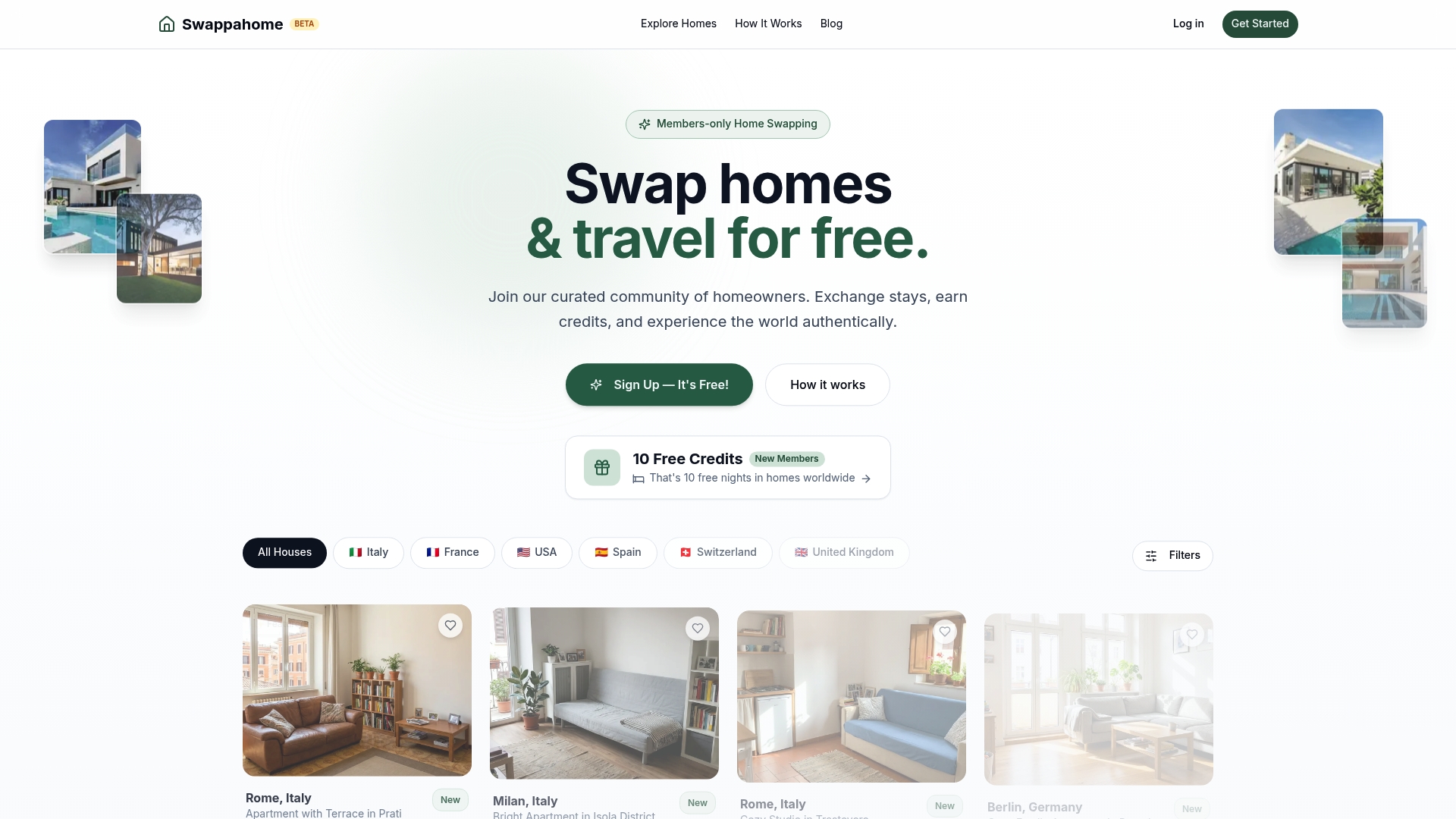
Understanding key home exchange terms like listings, credits, and bookings is essential for making authentic travel affordable and seamless. The article highlights challenges such as finding trustworthy exchange partners and coordinating schedules, especially for busy homeowners aged 30 and up. Swappahome addresses these pain points by offering a verified community where you can list your home, earn credits, and book stays without the hassle of monetary transactions or syncing exact travel dates.
With Swappahome you gain
- Access to a global network of verified homeowners committed to trust and reciprocity
- A simple credit system that lets you host when convenient and travel when ready
- Detailed listings that showcase homes and set clear expectations
Discover how Swappahome transforms complex home exchange concepts into an intuitive, secure experience designed to fit your lifestyle and travel goals.
 https://swappahome.com
Ready to start your journey with an easy-to-use platform that puts community, safety, and flexibility first Discover more at Swappahome and begin listing your home or finding your next authentic stay today. Learn all about credits and bookings in detail by visiting Swappahome's main page to take control of your travel plans now.
Frequently Asked Questions
What is a home exchange platform?
A home exchange platform is a service that enables homeowners to swap living spaces without monetary transactions, allowing them to experience local lifestyles while traveling.
How do credit systems work in home exchange?
Credit systems allow homeowners to earn credits by hosting guests in their homes, which they can then use to book stays at other members' homes without needing simultaneous swaps.
What are the key elements of creating a strong home listing?
A strong home listing includes high-quality photos, a detailed description of the home's features, availability, and preferences for hosting guests, which helps attract compatible exchange partners.
How are members verified on home exchange platforms?
Members are typically verified through identity checks, background screenings, and email confirmations to ensure a level of trust and safety within the community.
Recommended

Published by
SwappaHome
SwappaHome Editorial Team
Home Exchange & Slow Travel Editorial
The SwappaHome Editorial Team brings together travel research, home-exchange community insights, and platform data to produce practical guides for first-time and experienced home swappers. Every article cites real platforms, current market rates, and verifiable city-level facts so readers can make informed decisions without guessing.
Ready to try home swapping?
Join SwappaHome and start traveling by exchanging homes. Get 7 free credits when you sign up!