
Points-based travel: unlock global stays and real savings

SwappaHome Editorial Team
Home Exchange & Slow Travel Editorial
Points-based travel: unlock global stays and real savings !Woman planning points-based global travel at kitchen table > TL;DR: > > - Points-based...
Points-based travel: unlock global stays and real savings
 Woman planning points-based global travel at kitchen table
TL;DR:
- Points-based travel allows flexible, independent home exchanges without requiring simultaneous swaps.
- Users earn points by hosting and engaging on platforms, then use them to book stays worldwide.
- It fosters authentic local experiences and human connections, beyond just cost savings.
Points-based travel: unlock global stays and real savings
Most people assume home swapping means finding someone who wants to stay in your home at the exact same time you want to stay in theirs. That mental picture stops a lot of homeowners before they even start. Points-based travel completely dismantles that assumption. Instead of coordinating a two-way swap, you host guests, earn credits, and spend those credits wherever and whenever you want. It is a flexible, affordable model that turns your home into a passport, and it is changing the way budget-conscious travelers see the world. This guide walks you through exactly how it works, who benefits most, and what to watch out for along the way.
Table of Contents
- Defining points-based travel
- How points-based travel works: mechanics and value
- Who gets the most from points-based travel?
- Common challenges and what to watch out for
- Why points-based travel is more than just a travel hack
- Ready to try points-based travel?
- Frequently asked questions
Key Takeaways
| Point | Details |
|---|---|
| Points-based travel defined | You can travel using points instead of swapping homes directly for unmatched flexibility. |
| Earn and spend points | Host guests, get bonuses, and use points to stay in homes worldwide without a direct exchange. |
| Affordable cultural exchange | Membership fees are low compared to hotel stays, giving you better access to authentic experiences. |
| Watch for platform rules | Points values, transfer rules, and activity requirements vary by platform and can affect your experience. |
Defining points-based travel
Points-based travel, in the context of home and hospitality exchanges, is a system where hosts earn a form of digital currency every time they open their home to a guest. Those points, credits, or keys (the label depends on the platform) are then spent to book stays in other members' homes, anywhere in the network, with no need for a direct two-way arrangement.
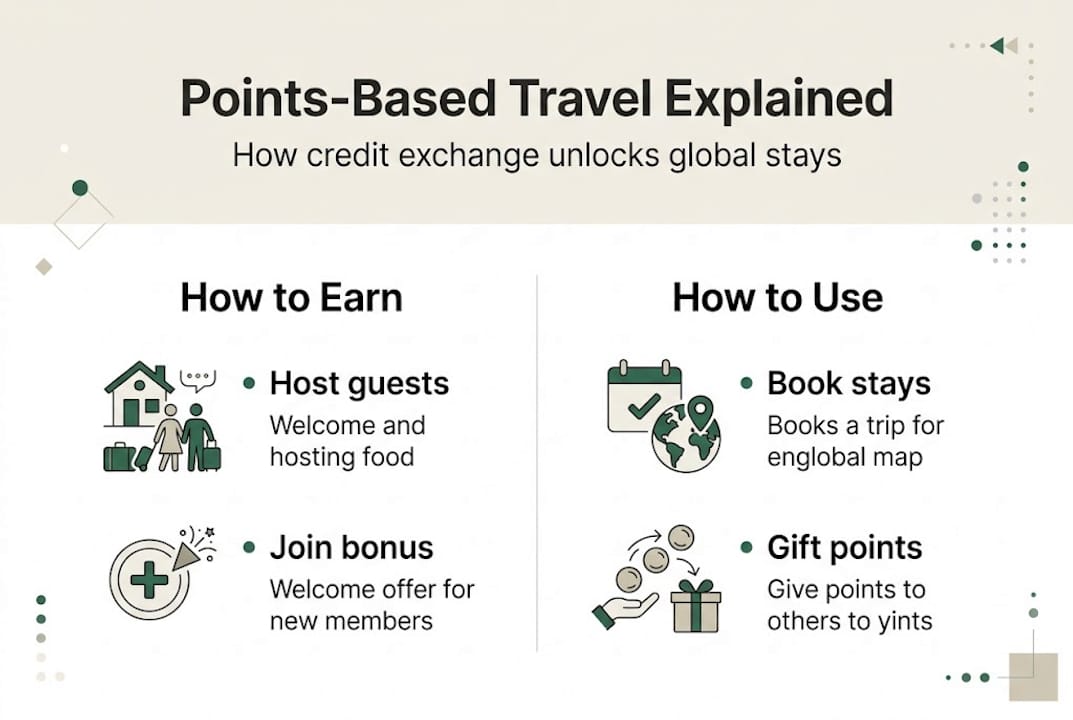 Infographic about how points-based travel works
This stands in sharp contrast to the classic reciprocal swap, where two households agree to stay in each other's homes, usually during the same period or in a closely timed back-and-forth arrangement. Reciprocal swaps are elegant when they work, but they require both parties to want compatible destinations, compatible dates, and compatible lifestyles all at once. The odds of that alignment happening spontaneously are low, especially if you have an irregular schedule or an unusual home location.
Reciprocal swap vs. points-based exchange
| Feature | Reciprocal swap | Points-based exchange |
|---|---|---|
| Coordination needed | High (two schedules must align) | Low (host and guest are separate) |
| Flexibility | Limited | Very high |
| Points or currency | Not required | Central to the system |
| Best for | Fixed schedules, popular locations | Irregular travelers, any location |
| Risk of cancellation impact | High (affects both parties) | Low (only affects one side) |
The major platforms each use their own terminology. Understanding how points systems work across different networks helps you choose the right fit. HomeExchange uses GuestPoints and targets a broad, mainstream audience. ThirdHome uses Keys and focuses on luxury second homes. Swappahome uses credits, with a strong emphasis on budget travel and authentic cultural exchange. Each platform's currency functions differently in terms of value per night, earning rates, and booking rules.
The benefits of points-based systems extend beyond convenience. You can host during times that work for your life, and you can travel during times that suit your destination wish list. You are not dependent on another homeowner's availability or willingness to visit your city.
- Host on your own timeline without waiting for a match
- Accumulate points quickly by hosting frequently
- Book across hundreds of destinations without reciprocal obligation
- Earn bonus points through referrals and profile completion
- Maintain full control over your hosting calendar
Understanding the credit system in home exchange is the fastest shortcut to making smart decisions on any platform.
Pro Tip: Points-based platforms are especially powerful for travelers with unpredictable work schedules. Because you host and travel independently, a last-minute work trip or a sudden vacation window does not derail your exchange plans the way it would in a reciprocal arrangement.
How points-based travel works: mechanics and value
Now that the concept is clear, let's look at the actual moving parts. Understanding the mechanics will help you get real value out of the system fast, rather than stumbling through trial and error.
You earn points in several ways. The most straightforward method is hosting guests in your home. Every night a verified guest stays earns you points. The exact number depends on your home's size, location, and the platform's pricing algorithm. Beyond hosting, most platforms layer in additional earning opportunities: referral bonuses when you bring a friend onto the platform (HomeExchange referral bonuses range from 250 to 2500 GuestPoints), profile completion rewards for adding photos and detailed descriptions, and welcome bonuses for new members.
Here is what a typical points-based booking looks like, step by step:
- List your home on the platform with detailed photos, amenity descriptions, and your house rules.
- Set your hosting availability on a calendar.
- Guests request to stay during an available window.
- You accept the request, and points transfer to your account after their stay.
- You search for a destination you want to visit and find a listing that appeals to you.
- You send a stay request with your desired dates.
- Points are deducted from your balance when the host accepts.
- You travel, stay, and enjoy the experience.
Welcome bonuses make the first step easier. New members often receive 750 to 1050 GuestPoints on HomeExchange, with Swappahome offering similar credit bundles. These bonuses are often enough for one or two nights before you have hosted anyone at all.
Annual fee and value breakdown
| Platform type | Annual membership fee | Welcome bonus | Exchanges covered |
|---|---|---|---|
| Budget focus (e.g., Swappahome) | ~$175/year | Starter credits | Unlimited |
| Mainstream (e.g., HomeExchange) | ~$185-235/year | 750-1050 GuestPoints | Unlimited |
| Luxury (e.g., ThirdHome) | Varies by tier | Keys based on property | Unlimited |
The annual fee model is one of the most attractive aspects of affordable travel with points. You pay once, and after that, every exchange you make is essentially free accommodation. A family that takes two international trips per year and replaces hotel costs entirely could save thousands of dollars on a single membership.
 Man checking home exchange fees on tablet
The key insight here is that points do not work like airline miles that lose value through inflation. One credit on Swappahome equals one free night, full stop. The how the credit system works page lays out exactly what that means for planning your travel budget.
Who gets the most from points-based travel?
Not everyone benefits equally from points-based home exchange. Understanding where the model fits best helps you decide whether it is the right tool for your travel goals.
Homeowners with desirable properties get an outsized advantage. A home near a major city, a beach, a ski resort, or a cultural landmark earns more points per night because demand is higher. But even a rural farmhouse or a suburban family home can generate strong hosting interest if it is presented well and priced reasonably.
Families traveling on a budget find enormous value in points-based exchanges. Hotel rooms for four people in a European city can easily cost $250 to $400 per night. A home exchange eliminates that cost entirely, and it usually includes a kitchen, more space, and a neighborhood feel that no hotel can replicate. Several families have reported savings of over $5,000 in a single trip by exchanging instead of booking conventional accommodation.
Digital nomads and remote workers benefit from the scheduling flexibility. Because you host and travel on separate timelines, you can take a four-week workcation in Lisbon or Bangkok without needing someone from those cities to simultaneously want to stay in your home.
Culture-first travelers who want to live like locals rather than tourists find that home exchange puts them in residential neighborhoods, not tourist corridors. You shop at local markets, use local transit, and interact with neighbors in a way that hotel guests almost never do.
Pro Tip: Hosting during off-peak periods, like shoulder season or midweek blocks, often earns you the same points with less competition from other hosts. You can then spend those points during peak season at a destination you love, effectively buying high-demand travel at low-demand prices.
Strategies that consistently maximize value for homeowners include hosting frequently in smaller bursts, stacking referral bonuses, and keeping your profile fully updated with seasonal photos. Travelers who explore the advantages of membership travel platforms also benefit from community features like verified reviews and curated listings that reduce the guesswork in choosing a destination.
A quick self-check to see if points-based travel suits you:
- Do you own a home or have a space you can offer guests?
- Is your travel schedule flexible rather than locked to specific weeks?
- Do you prefer authentic neighborhood experiences over resort-style hotels?
- Are you comfortable hosting strangers in a verified, community-based setting?
- Do you want to travel more often without proportionally increasing your accommodation budget?
If you answered yes to three or more of those, points-based travel is almost certainly a good fit.
Common challenges and what to watch out for
Points-based travel is genuinely powerful, but going in with a clear view of the friction points will save you frustration and protect your investment.
1. Points value is not uniform across all listings. A home in central Paris earns and costs more points per night than a studio apartment in a smaller city. Points value varies by home size, location, and amenities, so it pays to research the typical cost of stays in your target destinations before you start hosting. Otherwise, you may accumulate points expecting to visit Tokyo and find your balance falls short.
2. Transfers can be irreversible. Some platforms do not allow you to cancel a points transfer once it has been completed. If a booking falls through after points have moved, recovery depends entirely on the platform's policy. Always read the refund and cancellation rules before confirming a stay request.
3. Inactivity can affect your account. Points rarely expire outright, but many platforms expect regular activity. If you go dormant for an extended period, your points balance or membership status could be affected. Staying active, even by updating your listing or responding to inquiries, generally keeps accounts in good standing.
4. Visa and stay limits are real constraints. For travelers planning extended stays in Europe, the Schengen Area 90/180 day rule applies regardless of how you are accommodated. Points-based travel does not grant any special immigration status. If you plan to stay longer than 90 days across Schengen countries in any 180-day period, you need the appropriate visa.
5. Not every listing is created equal. Verified platforms filter out a lot of risk, but you should still read reviews carefully, check response rates, and communicate clearly with hosts before committing points to a booking.
"The biggest mistake new members make is treating points like a fixed currency with a universal exchange rate. A point spent in a high-demand city during peak season costs far more than the same point in a rural location midweek. Learning the market before you commit is the single most important habit."
Taking time to understand how to maximize your exchange value through smart listing practices and strategic booking timing protects your points and your travel experience.
Why points-based travel is more than just a travel hack
Here is what most articles on this topic miss entirely. Points-based travel is often framed as a clever way to cut accommodation costs, and that framing, while accurate, dramatically undersells what actually happens when you participate in these systems.
When you stay in someone's home in Oaxaca, Osaka, or Oslo, you are not just sleeping cheaply. You are living inside a local life. You are reading the books they left on the shelf, cooking in their kitchen, maybe feeding their cat. That level of intimacy with a place and a culture is genuinely transformative, and it does not happen in hotels regardless of how many stars they have.
The global home swapping networks that make this possible are built on mutual trust and community, not transactions. The points are just the mechanism. What actually gets exchanged is something much harder to quantify: respect, curiosity, and genuine human connection across borders.
We think the traveler who joins only to save money is leaving the most important benefit on the table. The ones who get the most out of these systems are the ones who host generously, communicate openly, and approach each exchange as a relationship, not a transaction.
Ready to try points-based travel?
You have seen how the system works, who benefits most, and how to avoid the common pitfalls. The next move is simple: start exploring what is actually available.
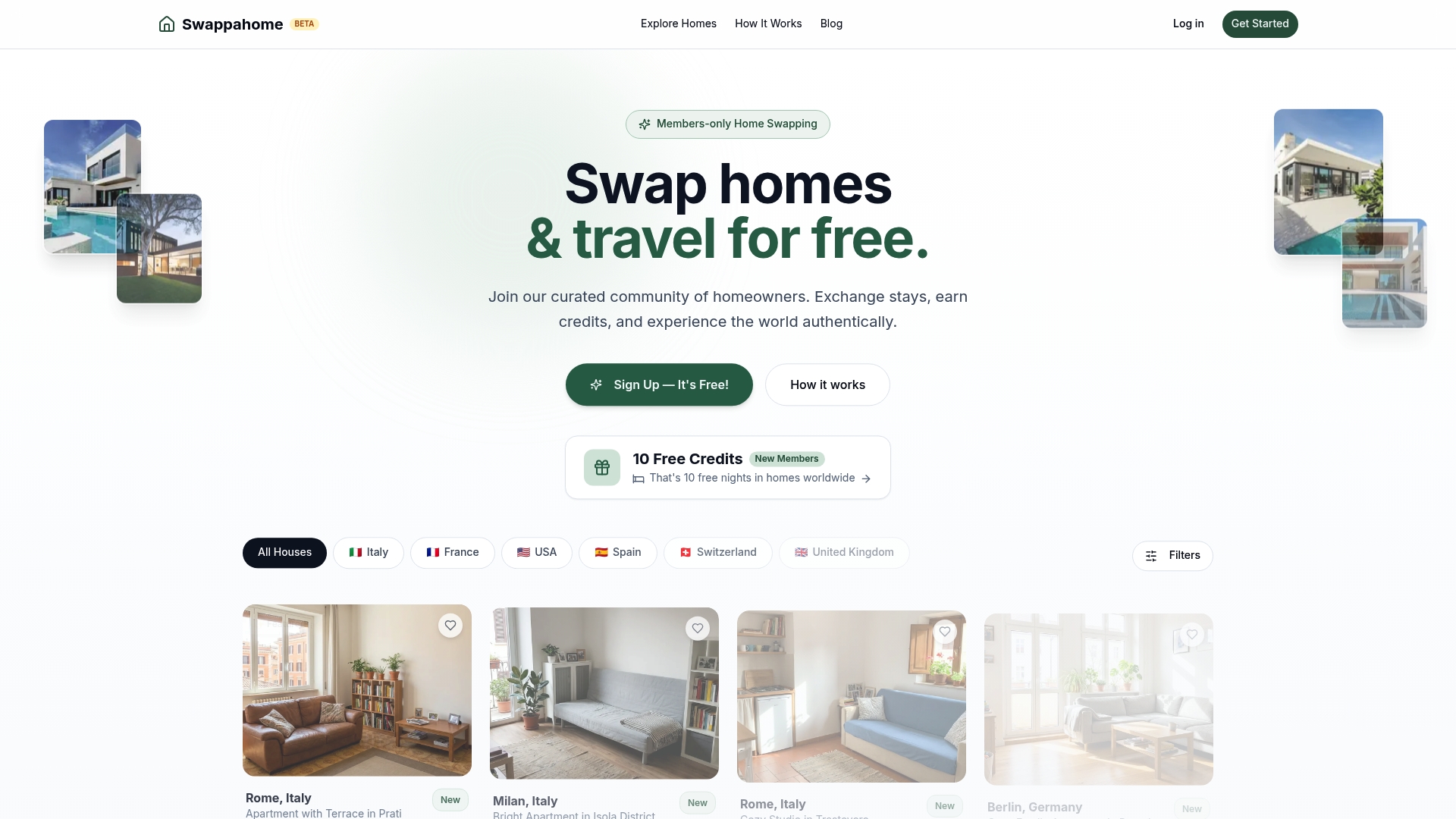 https://swappahome.com
Swappahome gives new members free starter credits so you can browse and even book before you host your first guest. The platform's verified community means you are connecting with real homeowners who care about their spaces and their guests. Browse the current home exchange listings to see exactly what kinds of homes are available in the places you want to visit. Your home is already an asset. Points-based travel just gives it a passport.
Frequently asked questions
How do you earn points on home exchange platforms?
You earn points primarily by hosting guests in your home, but platforms also award them for joining bonuses, referring friends (typically 250 to 2500 points per referral), and completing your profile with photos and descriptions.
Can points expire or be lost?
Points rarely expire outright, but most platforms expect periodic activity such as bookings or profile updates to keep your account and balance in good standing.
What are the main costs involved in points-based travel?
The primary expense is the annual membership fee, which typically runs $175 to $235 per year and covers unlimited exchanges once paid.
Do I need to host before I can travel with points?
No. Most platforms award welcome bonus credits to new members, typically 750 to 1050 points on mainstream platforms and similar amounts on budget-focused ones like Swappahome, so you can often book your first stay before hosting anyone.
Recommended
- Travel points systems explained: flexible, affordable travel | SwappaHome Blog
- 7 Practical Examples of Point-Based Travel for Homeowners | SwappaHome Blog
- Credit-Based Travel: Unlocking Affordable Stays Worldwide | SwappaHome Blog
- Exchange-Based Travel: Unlocking Authentic, Affordable Stays | SwappaHome Blog

Published by
SwappaHome
SwappaHome Editorial Team
Home Exchange & Slow Travel Editorial
The SwappaHome Editorial Team brings together travel research, home-exchange community insights, and platform data to produce practical guides for first-time and experienced home swappers. Every article cites real platforms, current market rates, and verifiable city-level facts so readers can make informed decisions without guessing.
Ready to try home swapping?
Join SwappaHome and start traveling by exchanging homes. Get 7 free credits when you sign up!