
Accommodation Exchange Models: Transforming Global Travel

SwappaHome Editorial Team
Home Exchange & Slow Travel Editorial
Accommodation Exchange Models: Transforming Global Travel !Couple video calling to arrange home swap Choosing the right home swapping system can feel...
Accommodation Exchange Models: Transforming Global Travel
 Couple video calling to arrange home swap
Choosing the right home swapping system can feel confusing when every platform promises affordable travel but delivers a different experience. For Millennial homeowners craving genuine cultural exchange without steep costs, understanding accommodation exchange models is crucial. This article breaks down direct swaps, points-based exchanges, and rental options, showing how each model impacts your flexibility, cost, and travel planning so you can match your unique needs to the right community.
Table of Contents
- Accommodation Exchange Models Defined And Debunked
- Core Variations In Exchange Models Today
- How Point-Based Home Swapping Works
- Legal, Safety, And Ethical Obligations For Members
- Risks, Limitations, And Common Pitfalls Revealed
Key Takeaways
| Point | Details |
|---|---|
| Understanding Exchange Models | Accommodation exchange models vary significantly; knowing the difference between direct swaps and points-based systems is crucial for effective travel planning. |
| Flexibility in Travel | Points-based systems provide unmatched flexibility, allowing travelers to host guests and redeem points independently of strict timing constraints. |
| Legal and Ethical Responsibilities | Members must comprehend their legal obligations and ethical standards within the exchange community to ensure safety and proper conduct. |
| Awareness of Risks | Home swapping presents risks, including property damage and personal safety concerns, which require thorough consideration and precaution before participation. |
Accommodation Exchange Models Defined and Debunked
Accommodation exchange models have become a legitimate way for homeowners to travel affordably, yet confusion surrounds how they actually work. Many people lump all home-sharing platforms together, assuming they operate identically. The reality is far more nuanced, with distinct models serving different traveler needs and preferences.
The core distinction separates platforms into three primary categories:
- Direct reciprocal swaps: Two homeowners exchange homes simultaneously for matching time periods
- Points-based systems: Members earn credits by hosting guests, then use those credits independently
- Rental and booking platforms: Traditional paid accommodations with no exchange component
These aren't interchangeable. A points-based exchange system eliminates the synchronization problem that plagues direct swaps. With point-based models, you're not dependent on finding someone traveling to your exact location at your exact time. Host someone in July, earn points, and use those points for a December trip to a completely different destination.
Understanding the Exchange Mechanics
Direct reciprocal swaps create a simple value exchange: your home for theirs, simultaneously. This works brilliantly for couples with matching vacation schedules but becomes logistically complicated when timing misaligns. One family wants summer; another needs winter.
Points-based systems solve this timing problem entirely. Members provide accommodation and receive credits representing the value of that stay. Those credits become currency within the platform, applicable whenever and wherever available homes exist.
 Person earning credits via exchange platform
The research shows that accommodation portals employ diverse business models, distinguishing between platforms enabling genuine swaps versus rental arrangements disguised as exchanges.
Common Misconceptions Worth Dispelling
Myth one: home exchange requires perfect matching. False. Point-based systems operate flexibly, allowing mismatched stay lengths through credit adjustments.
Myth two: only vacation homeowners participate. Reality: primary residence owners comprise the majority of participants, offering authentic neighborhood experiences rather than resort-style stays.
Myth three: exchanges limit you to similar properties. Actually, member networks span from city apartments to countryside estates, rural cottages to urban penthouses.
Myth four: the process involves complex negotiations. Modern platforms streamline this entirely through user-friendly interfaces, verification systems, and transparent point calculations.
Point-based accommodation models eliminate scheduling conflicts that make direct swaps impractical for busy homeowners with irregular calendars.
Why This Distinction Matters for Your Travel
Understanding these models directly impacts your travel options and costs. With reciprocal swaps, you're locked into simultaneous exchanges. With points-based systems, you gain complete flexibility. You host in June, travel in October, stay as long as your points allow.
Verified member platforms add another critical layer. Screening processes protect both homeowners and guests, distinguishing legitimate exchange communities from unvetted rental marketplaces.
Pro tip: Start by understanding which model aligns with your travel style—if your vacation dates shift unpredictably, prioritize point-based systems over fixed reciprocal exchanges.
Core Variations in Exchange Models Today
Today's accommodation exchange landscape features several distinct operational models, each catering to different traveler preferences and lifestyle situations. Understanding these variations helps you select the platform that actually fits your travel patterns rather than forcing yourself into someone else's model.
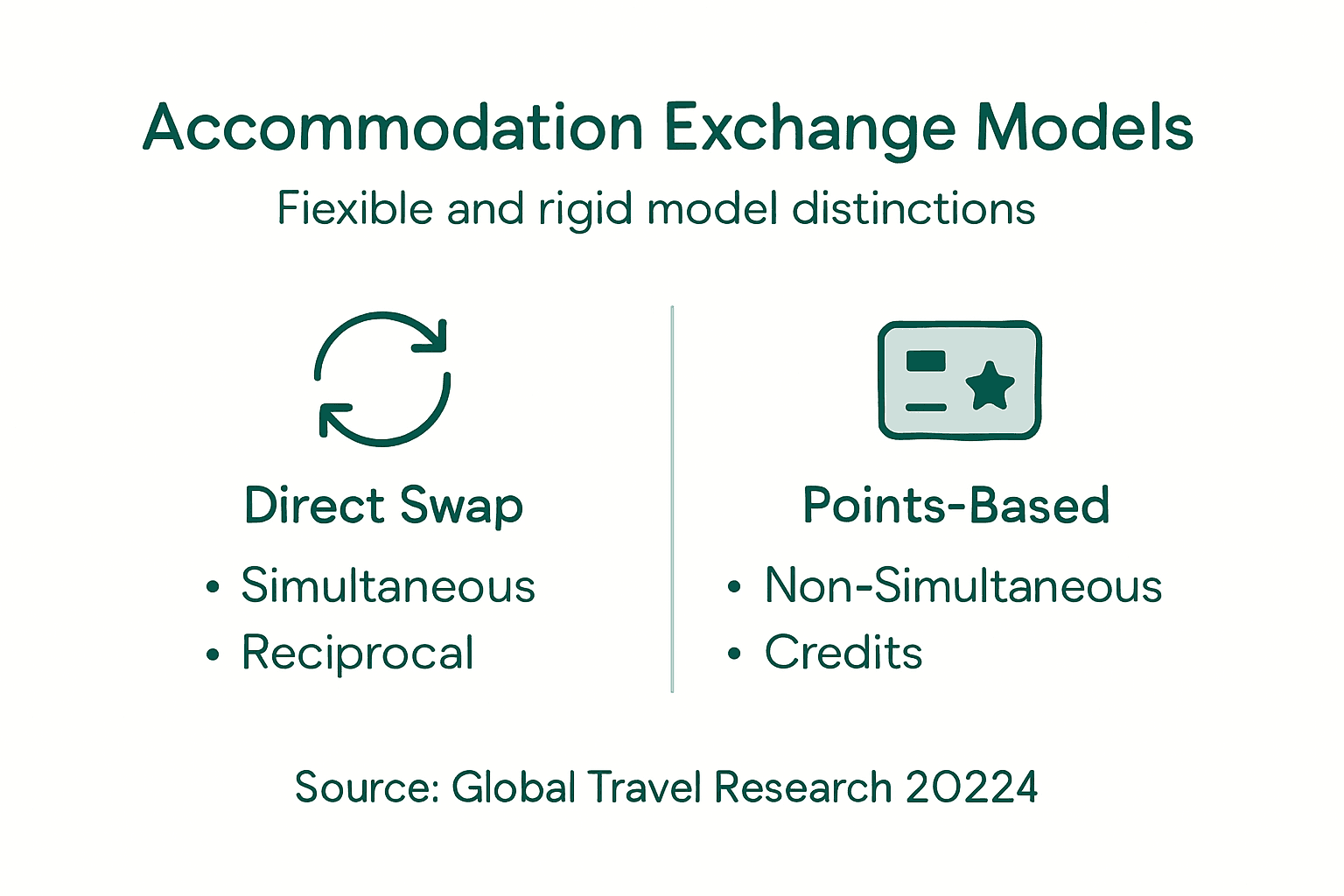 Infographic with main exchange model types
The fundamental split divides into two camps: those requiring simultaneous exchanges and those allowing flexibility through time-shifted transactions. This distinction fundamentally changes how you plan, book, and travel.
Here’s a comparison of the main accommodation exchange models and how they impact travelers:
| Model Type | Scheduling Flexibility | Money Exchange | Best For |
|---|---|---|---|
| Direct Swaps | Requires matched dates | No, value is reciprocal | Fixed vacation periods |
| Points-Based Systems | Travel anytime after hosting | No, points as currency | Irregular or flexible schedules |
| Rental Platforms | High, book any time | Yes, pay for booking | Travelers without exchange homes |
| Work-for-Stay Models | Dates by host/guest agreement | No money, labor-based | Long-term or experiential stays |
Simultaneous vs. Non-Simultaneous Exchanges
Simultaneous swaps demand perfect timing. You and your exchange partner travel at the same moment, swapping homes directly. Both families occupy each other's properties during overlapping weeks. This creates a clean, straightforward exchange but requires finding someone with matching schedules—a constraint that eliminates many potential matches.
Non-simultaneous exchanges introduce temporal flexibility. Host someone in March, travel in September. Your guest arrives while you're away; you depart when you return. Reciprocity-oriented sharing accommodations operate through this model, where mutual benefit unfolds across different timeframes rather than simultaneously.
For busy professionals and families with rigid commitments, this flexibility proves invaluable. Your kid's school schedule doesn't dictate your hosting timeline anymore.
Work-for-Stay and Hybrid Models
Some platforms blend accommodation exchange with labor contribution. Members exchange living space for housework, property maintenance, or local services. You stay free, but you contribute effort rather than hosting reciprocally.
This model appeals to younger travelers, sabbatical-takers, and those seeking immersive local experiences. You're not just staying; you're genuinely participating in community life.
Hybrid models combine multiple approaches:
- Points-based plus direct swaps simultaneously
- Exchange credits with optional paid upgrades
- Work-for-stay opportunities alongside traditional swaps
- Mixed-income participant networks
Rental vs. Exchange Platforms: The Critical Difference
The gap between rental and exchange platforms represents a fundamental operational divide. Rental platforms monetize every transaction. Exchange platforms eliminate monetary flow entirely, replacing it with reciprocal value or point-based systems.
This shapes everything: member motivation, trust dynamics, community culture, and your cost structure. Rental platforms maximize host income. Exchange platforms maximize mutual benefit.
Matching Systems and Member Compatibility
Different models employ distinct matching approaches:
- Algorithm-based: Automated suggestions based on property type, location, and guest preferences
- Manual browsing: Browse listings and initiate contact directly
- Concierge-assisted: Staff help coordinate matches for premium members
- Community voting: Members vote on prospective participants
Each method produces different satisfaction levels and trust dynamics.
Non-simultaneous exchange models eliminate the scheduling friction that makes direct swaps impractical for most working professionals with unpredictable calendars.
Evaluating Which Model Serves You Best
Your choice depends on your specific travel reality:
- Fixed annual vacation weeks? Simultaneous swaps work fine.
- Irregular schedule? Non-simultaneous or points-based systems are essential.
- Long-term relocation or sabbatical? Work-for-stay models become attractive.
- Preference for spontaneity? Exchange platforms with flexible point systems beat locked schedules.
Pro tip: Before joining any platform, clarify whether it uses simultaneous exchanges, non-simultaneous swaps, or points-based systems—this single factor determines whether the model actually accommodates your real travel patterns.
How Point-Based Home Swapping Works
Point-based home swapping transforms accommodation exchange by decoupling timing from value. Instead of coordinating simultaneous exchanges with a single partner, you host guests on your schedule and accumulate credits redeemable anywhere within the network.
This system solves the fundamental problem plaguing direct swaps: finding someone traveling to your exact location at your exact time. Point-based models eliminate that friction entirely.
The Core Mechanics
The process operates on a straightforward principle: one night equals one point. When someone stays in your home, you earn credits representing that stay's value. Those credits become your currency within the platform, applicable to any available property whenever you travel.
You're not locked into exchanges with specific people. You're not limited to destinations where other members happen to own homes. You're investing points into a shared pool and withdrawing them whenever you choose.
How point-based home swapping systems work depends on transparent platform calculations. Some assign equal point value to all nights regardless of property size or location. Others weight values by demand, seasonality, or amenities.
The Hosting Phase
Hosting drives the entire cycle. When guests book your property, you earn points equivalent to their stay length. A one-week hosting period generates seven points. A two-week stay generates fourteen points.
You control hosting frequency and guest screening. Some homeowners host monthly; others once yearly. The platform handles reservations, guest communication, and verification while you maintain complete authority over your property.
Hosting also builds community trust. Members see your hosting history—positive experiences increase your credibility as a guest and as a host.
The Booking Phase
Once you accumulate sufficient points, booking becomes simple. Browse available properties globally. Check calendar availability. Submit a request specifying your desired dates.
The point deduction happens upon successful booking. Spend five points for a five-night stay anywhere in the network. Extended travel requires accumulated credits—a month-long journey requires thirty points.
The flexibility here proves revolutionary. Membership-based platforms assign value to homes and credits, enabling you to redeem points across vastly different property types and geographic regions.
Key Benefits Over Direct Swaps
Point-based systems deliver advantages that direct reciprocal exchanges cannot:
- Timing flexibility: Host whenever convenient; travel whenever desired
- Broader options: Access thousands of homes rather than finding one compatible partner
- Extended travel: Accumulate points for longer trips spanning multiple properties
- Community scale: Participate in networks encompassing global destinations
- Genuine reciprocity: Everyone hosts; everyone travels; everyone benefits
Common Questions Clarified
Do points expire? Most platforms maintain active points indefinitely for participating members, though policies vary.
Can unused points transfer? Typically yes, as long as your membership remains active and you comply with platform standards.
What happens if demand exceeds supply? Popular properties book quickly during peak seasons, so advance planning becomes necessary.
Point-based systems separate hosting from traveling completely, allowing members to maintain different schedules and travel independently rather than coordinating with single exchange partners.
Pro tip: Calculate your realistic hosting capacity before joining—if you host twice yearly, target platforms where your two hosts generate enough points for your desired travels, rather than assuming unlimited point accumulation.
Legal, Safety, and Ethical Obligations for Members
Home swapping isn't a casual handshake arrangement. As a member of an accommodation exchange platform, you assume real legal and ethical responsibilities that protect everyone involved. Understanding these obligations prevents disputes, ensures safety, and maintains the community trust that makes exchanges possible.
Your obligations extend beyond your own property into broader legal and cultural frameworks. Different jurisdictions impose varying requirements, and platforms themselves establish community standards that members must respect.
Legal Compliance Requirements
Your first obligation involves understanding local laws governing short-term accommodations. Many jurisdictions require permits, tax registration, or insurance notifications when you host guests. Some cities cap hosting days annually or restrict which properties can participate.
Visa and residency laws apply equally to guests staying in your home. While you're not responsible for verifying guest documentation, hosting someone without proper legal status can expose you to liability. Verify membership status and ask clarifying questions when something feels uncertain.
Legal responsibilities in international exchanges include compliance with visas, health regulations, and data protection. These obligations form the foundation for safe exchanges worldwide.
Insurance complications arise frequently. Standard homeowner policies typically exclude paying guests. You need to notify your insurer or obtain specific coverage for hosted stays. This protects you financially and ensures claims aren't denied because you failed to disclose hosting activity.
Safety and Screening Standards
Verified platforms conduct background checks and screening processes. These protections exist for everyone—hosts and guests alike. Your participation signals trust in the system, but you retain responsibility for your own safety assessments.
Conduct independent due diligence. Review member ratings, hosting history, and guest reviews. Trust your instincts. Decline bookings that trigger concern. No platform guarantees perfect safety; you're the final decision-maker.
Document property conditions before and after guests arrive. Photograph damages, note missing items, and establish clear house rules. This protection cuts both directions—guests deserve the same documentation clarity.
Ethical Obligations
Ethical conduct transcends written rules. It means:
- Respecting guest autonomy: Grant access to advertised amenities without intrusion
- Honoring descriptions: Don't misrepresent property conditions or neighborhood characteristics
- Protecting privacy: Secure personal data and never share guest information externally
- Following platform guidelines: Comply with community standards even when inconvenient
- Maintaining honesty: Report damages accurately and resolve disputes transparently
Roles and responsibilities in accommodations emphasize equitable treatment, safety standards, and maintaining confidentiality. These principles apply directly to home swapping relationships.
Cultural respect matters tremendously. You're hosting people from different backgrounds. Honor their preferences, accommodate reasonable requests, and communicate clearly about house rules and expectations.
Legal and ethical obligations protect everyone in the exchange network—they're not bureaucratic burdens but the foundation of trust that makes global home swapping sustainable.
Your Responsibilities as Host and Guest
When hosting, you're responsible for:
- Property maintenance and advertised amenities
- Guest safety and emergency contact information
- Clear communication about check-in/check-out procedures
- Honest descriptions preventing guest disappointment
When traveling as a guest, you're responsible for:
- Respecting host property and boundaries
- Following house rules and local regulations
- Reporting damages promptly and honestly
- Treating the home as if it were your own
Pro tip: Document everything in writing—house rules, property conditions, access instructions—before guests arrive, creating clarity that prevents misunderstandings and disputes later.
For clarity, here’s a summary of host and guest responsibilities in exchange platforms:
| Role | Core Responsibility | Essential Action | Outcome Sought |
|---|---|---|---|
| Host | Property safety & maintenance | Communicate house rules | Satisfied, responsible guest |
| Guest | Respect property & policies | Report issues transparently | Trust, positive reviews |
| Both | Uphold platform standards | Accurate information | Community trust and safety |
Risks, Limitations, and Common Pitfalls Revealed
Home swapping sounds ideal until reality intrudes. While the model offers genuine advantages, significant risks and limitations exist that deserve honest examination. Understanding these challenges prevents costly mistakes and helps you make informed decisions about whether this approach suits your situation.
No accommodation model is risk-free. Exchanges introduce complications that hotels eliminate through standardization and professional management. Recognizing these tradeoffs helps you prepare adequately.
Financial and Property Risks
Property damage represents the most tangible concern. Guests may accidentally break items, damage walls, or leave the home in poor condition. Your homeowner insurance likely won't cover these losses. You're dependent on guest integrity and platform dispute resolution, which sometimes fails.
Dispute resolution proves frustratingly slow. If a guest damages your home and refuses accountability, platforms typically investigate rather than immediately compensate you. Recovery takes weeks or months.
Liability exposure creates another financial concern. If someone injures themselves on your property, they may pursue legal action. Your homeowner policy might exclude liability when paying guests are involved. This exposure requires explicit insurance coverage or significant financial risk.
Perceived risks in accommodation exchanges include financial, physical, social, and psychological dimensions. These risks negatively affect participation willingness and require substantive mitigation strategies.
No-shows create financial complications too. You reserve dates for hosting, block your own travel plans, then guests cancel last-minute. You lose hosting points and cannot recover easily.
Safety and Security Concerns
You're inviting strangers into your home. While platforms conduct verification, screening cannot guarantee trustworthiness. Theft, vandalism, or intentional property damage remain possible despite member reviews and ratings.
Your personal security matters equally. Guests see your neighborhood layout, security systems, and valuables. Some homeowners report feeling unsafe in their own homes afterward, wondering if guests collected information for later burglary.
Personal data vulnerability extends beyond your property. Platforms collect extensive information—addresses, payment details, family photos—creating privacy concerns if breaches occur.
Risk perception in accommodation selection identifies crime, poor lighting, and unsafe environments as significant concerns. Safety awareness varies widely among members, creating inconsistent standards.
Practical Limitations
Property access complications arise frequently. What if guests arrive early? What if they lose keys? You're responsible for emergency access during times that inconvenience you.
Utility overages and wear-and-tear accelerate property aging. Frequent guest turnover means constant cleaning, linens, and minor repairs. Cumulative costs reduce the economic benefit significantly.
Matching limitations persist despite point-based systems. Popular properties book instantly during peak seasons. Unpopular properties languish vacant. Seasonal properties face long off-season gaps. Geographic isolation means fewer available exchanges.
Scheduling conflicts create real complications:
- Peak-season properties book months ahead
- Off-season properties attract minimal interest
- Extended stays prove harder to arrange than short visits
- Last-minute travel needs often go unfulfilled
Financial, physical, and psychological risks in home swapping require honest assessment before participation, particularly if your property holds significant emotional or monetary value.
Communication and Expectation Gaps
Picture quality mismatches frustrate guests constantly. Photos emphasize attractive angles, hide dated kitchens, and downplay neighborhood noise. Guests arrive disappointed, then leave negative reviews damaging your reputation.
Cultural differences create misunderstandings about cleanliness standards, noise levels, and property usage. What seems obviously wrong to you might feel acceptable to someone from a different background.
Language barriers complicate communication. Disputes escalate when neither party fully understands the other's position.
Pro tip: Before joining, list specific property limitations—"no parties," "tight parking," "dated appliances"—honestly and completely, preventing guest disappointment and negative reviews that undermine your long-term platform success.
Unlock Flexible and Secure Travel with Swappahome's Point-Based Exchange System
The article highlights the crucial challenges many travelers face with accommodation exchanges including rigid scheduling demands, complicated reciprocal swaps, and uncertainty around safety and trust. If you have an irregular calendar or want the freedom to host and travel on your own terms Swappahome offers a solution built around a simple point-based system. Earn credits by hosting verified members and redeem them anytime for stays in thousands of verified homes worldwide. This eliminates the stress of matching vacation dates and opens access to authentic local experiences across continents.
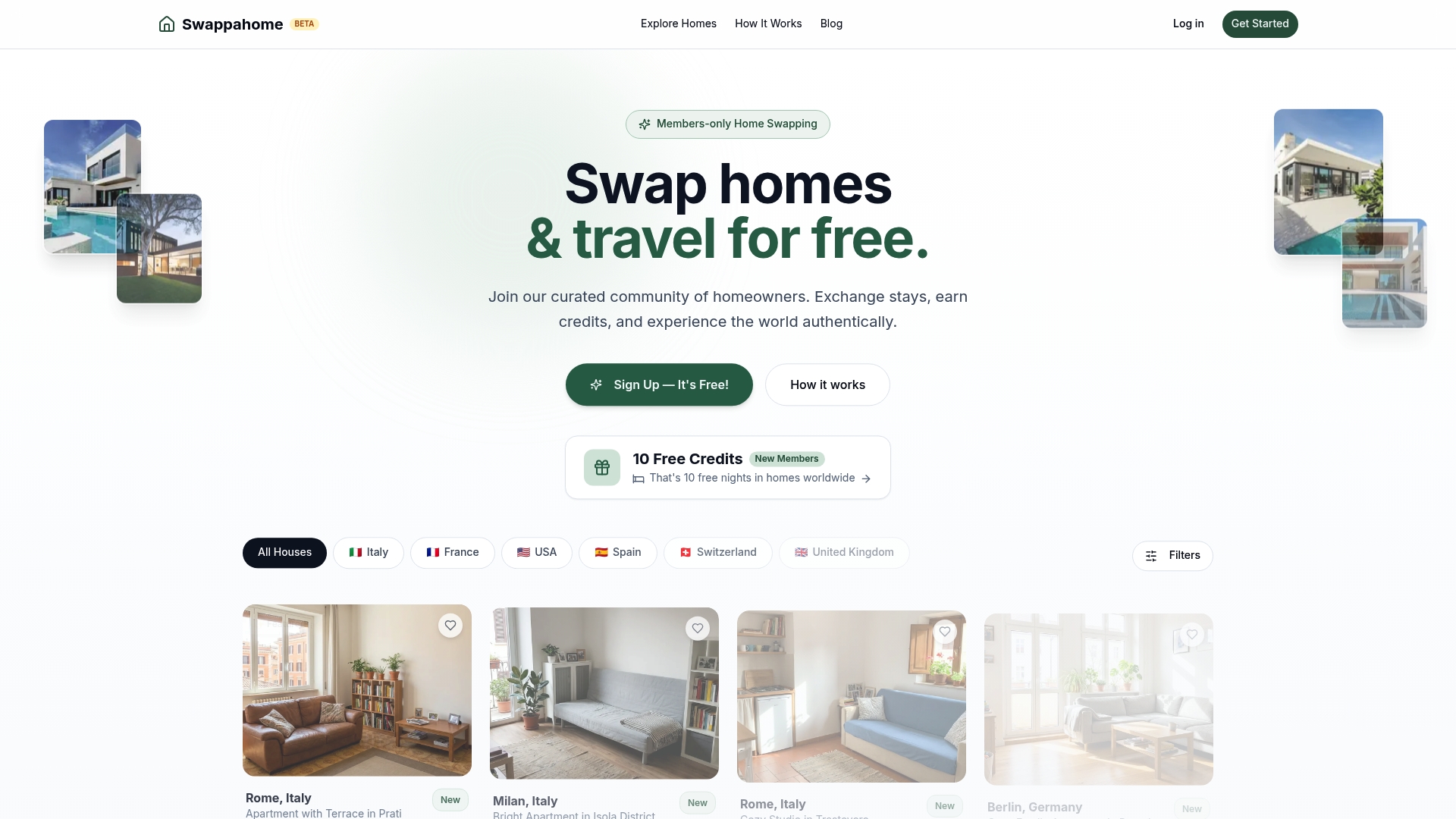 https://swappahome.com
Experience the freedom that a trusted, members-only platform brings. Swappahome curates a community focused on transparency and safety easing concerns about legal and ethical obligations discussed in the article. Visit Swappahome to start listing your home, earn free credits, and plan your next trip without hotel costs or scheduling conflicts. Embrace authentic travel with confidence and flexibility by joining Swappahome’s home swapping platform today.
Frequently Asked Questions
What are the main types of accommodation exchange models?
The main types of accommodation exchange models are direct reciprocal swaps, points-based systems, and rental and booking platforms. Each model serves different traveler needs, with points-based systems offering more flexibility.
How do points-based home swapping systems work?
Points-based home swapping systems allow members to earn credits by hosting guests, which they can then use to book stays at different properties. This decouples timing from value, providing greater flexibility than direct swaps.
What legal responsibilities do home exchangers need to be aware of?
Home exchangers must understand local laws related to short-term accommodations, including permits, insurance requirements, and compliance with safety regulations. These obligations help ensure safe and lawful exchanges.
What are the potential risks associated with home swapping?
Potential risks include property damage, liability exposure, safety concerns with guests, and communication gaps. It's important to assess these risks carefully before participating in accommodation exchanges.
Recommended
- Global Home Exchange: Transforming Affordable Travel | SwappaHome Blog
- Sustainable Travel Through Home Exchange: Real Impact | SwappaHome Blog
- 7 Inspiring Examples of Sharing Economy Travel for Homeowners | SwappaHome Blog
- Home Swapping vs Rentals: Real Savings for Travelers | SwappaHome Blog
- Guest House Trends 2026 – What Matters Now

Published by
SwappaHome
SwappaHome Editorial Team
Home Exchange & Slow Travel Editorial
The SwappaHome Editorial Team brings together travel research, home-exchange community insights, and platform data to produce practical guides for first-time and experienced home swappers. Every article cites real platforms, current market rates, and verifiable city-level facts so readers can make informed decisions without guessing.
Ready to try home swapping?
Join SwappaHome and start traveling by exchanging homes. Get 7 free credits when you sign up!