Alternatives to Traditional Hotels: Your 2026 Guide

SwappaHome Editorial Team
Home Exchange & Slow Travel Editorial
Alternatives to Traditional Hotels: Your 2026 Guide !Couple reviewing travel lodging options > TL;DR: > > - Many travelers are discovering that...
Alternatives to Traditional Hotels: Your 2026 Guide
 Couple reviewing travel lodging options
TL;DR:
- Many travelers are discovering that alternative accommodations like home exchanges, farm stays, and boutique hostels offer authentic experiences, savings, and local immersion unavailable in traditional hotels. The evolving market emphasizes flexibility, cost efficiency, and personalization, making select options more suitable based on trip length, group size, and preferences for local culture. Choosing the right alternative requires understanding your priorities and travel style, often resulting in higher satisfaction and a deeper connection to your destination.
Booking a hotel is the path of least resistance. You know what you're getting: a bed, a lobby, and a minibar you'll quietly ignore. But that predictability comes at a price, and not just the nightly rate. Millions of travelers are discovering that alternatives to traditional hotels offer something hotels genuinely can't: local immersion, meaningful savings, and experiences that actually make the trip. Whether you're curious about home exchanges, farm stays, or a well-designed hostel, this guide breaks down every real option worth knowing in 2026.
Table of Contents
- Key takeaways
- Alternatives to traditional hotels: what the market looks like now
- Home exchange and home sharing
- Farm stays, eco-lodges, and boutique accommodations
- Hostels, serviced apartments, and group stays
- How to choose the right alternative for your trip
- My honest take on the lodging shift
- Travel free with Swappahome
- FAQ
Key takeaways
| Point | Details |
|---|---|
| Hotels aren't the only reliable option | Alternative accommodations range from verified home swaps to boutique properties with rich local character. |
| Home exchange cuts costs dramatically | Non-monetary home swapping can eliminate your lodging budget almost entirely while placing you in real neighborhoods. |
| Hostels have evolved significantly | Modern hostel options include private rooms and community spaces that appeal far beyond the backpacker demographic. |
| Farm stays require careful research | Choose between agriculturally authentic operations and hospitality-focused farms based on your comfort expectations. |
| Matching lodging to your style matters | The right alternative accommodation depends on trip length, group size, desired experience, and price transparency. |
Alternatives to traditional hotels: what the market looks like now
The alternative accommodation segment is no longer a fringe category. It has matured into a recognized part of the travel industry, driven by travelers who prioritize authenticity, flexibility, and value over standardized comfort. The types of alternative accommodations available today span an enormous range, from short-term rentals in city apartments to working farms in rural Tuscany to verified home swap communities with members across dozens of countries.
Several forces are reshaping where people sleep when they travel:
- Authenticity demand. Travelers increasingly want to feel like they're actually in a place, not just near it. A hotel room in Paris looks roughly the same as a hotel room in Phoenix. A rented apartment or a home exchange in Montmartre does not.
- Cost sensitivity. Hotel rates have climbed steadily, and travelers are doing the math. Short-term rentals and home exchanges remove or reduce accommodation costs that can represent 30 to 50 percent of a total trip budget.
- Flexible length of stay. Serviced apartments and vacation rentals work better for stays beyond three or four nights. Hotels charge per night regardless of how long you stay. Most alternatives reward longer bookings.
- Industry convergence. The lines between hotel and alternative lodging are blurring. Major platforms now list both. Major hotel brands are launching apartment-style urban properties to compete directly with vacation rental platforms.
Still, 61% of U.S. travelers prefer hotels primarily for amenities like pools and room service, and 76% believe hotels offer more transparent pricing. That gap between perception and reality is exactly where alternatives have room to grow and where informed travelers gain the most advantage.
Home exchange and home sharing
Home exchange is the oldest alternative to hotels that most travelers have never seriously considered. The model is simple: you offer your home to someone while you stay in theirs. No money changes hands for accommodation. What you save is the full nightly rate, every single night. Home swapping and sharing economy models enable significant savings alongside deeper cultural immersion and access to real local neighborhoods, not tourist corridors.
The benefits go beyond the financial:
- You land in a home, not a room. That means a kitchen, a living room, often a neighborhood feel that no hotel can replicate.
- Local knowledge is built in. Hosts typically leave recommendations, and the home itself reflects how people actually live in that city or country.
- Verified community platforms add trust. Platforms like Swappahome require member verification and operate on a credit system where one credit equals one free night. New members receive starting credits just for joining.
- Flexible timing. Simultaneous swaps (you stay in their home while they stay in yours at the same time) and non-simultaneous swaps (using credits to book stays independently) give you scheduling flexibility that rigid hotel booking cannot.
The main challenge with home exchange is planning lead time. Popular destinations book out months in advance, especially in summer and around holidays. This is not a last-minute travel strategy. It rewards organized travelers who commit to a destination early.
Pro Tip: Before your first swap, take time to read your host's recent exchange reviews and send a personal message introducing yourself. Swappahome hosts consistently report that warm introductions lead to better communication and more generous local tips.
For a practical breakdown of how non-monetary stays work in 2026, the non-monetary travel guide on the Swappahome blog covers the logistics in detail, including credit systems, simultaneous versus non-simultaneous exchanges, and what to do if plans change.
Farm stays, eco-lodges, and boutique accommodations
These three categories share a common thread: the stay itself becomes part of the experience. You are not just sleeping somewhere. You are somewhere.
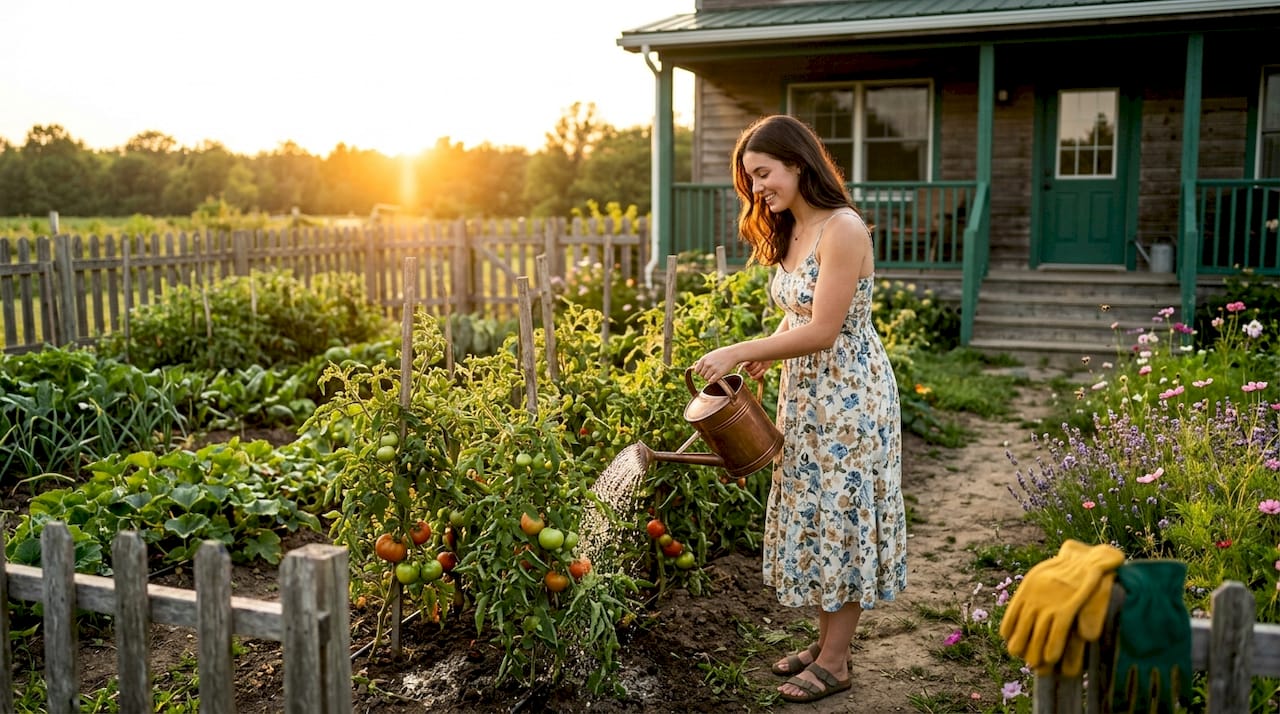 Guest tending vegetable garden at farm stay
Farm stays and agritourism
Farm stay listings grew about 77% over five years on major platforms, and bookings at top farm properties now rival popular national park lodges during peak season. The demand is real, but so is the variation in what "farm stay" actually means.
Farm stays divide into two distinct models: agriculturally authentic operations where guests participate in actual farm work, harvest cycles, and rustic routines, and hospitality-focused farm properties that use the rural setting as backdrop while delivering comfort-first amenities. Neither is wrong. But booking the wrong type for your expectations is a fast path to disappointment.
| Type | What to expect | Best for |
|---|---|---|
| Working farm stay | Hands-on participation, rustic conditions, limited Wi-Fi | Families, slow travelers, food enthusiasts |
| Boutique farm property | Rural setting, full amenities, curated experience | Couples, weekend getaways, remote workers |
| Eco-lodge | Off-grid or low-impact design, nature immersion | Sustainable travel options seekers, wildlife travelers |
| Glamping site | Comfortable tents or cabins, outdoor feel with soft beds | First-time campers, groups wanting unique lodging experiences |
Pro Tip: Always read the farm stay listing for the phrase "working farm" specifically. Properties that use it literally mean guests help with chores. Properties that use it loosely mean there are chickens somewhere on the grounds. Ask the host directly if the distinction matters to you.
Boutique accommodations
Boutique hotels emphasize individuality, local culture integration, and personalized guest experiences in ways that standard chain hotels structurally cannot. They are typically small, often housed in historically significant or architecturally distinct buildings, and managed by people who actually care about the guest's experience because their reputation depends on it.
The trade-off is price. Boutique accommodations frequently cost as much as or more than a mid-range chain hotel. What you gain is not a discount. It is a meaningfully better quality of stay in a property that reflects local culture rather than erasing it. For travelers who care about design, locality, and personal service, boutique is often the strongest hotel-adjacent option available.
Hostels, serviced apartments, and group stays
Budget-conscious travel does not have to mean sacrifice. The options in this category have quietly become some of the most practical lodging solutions available, especially for solo travelers and groups.
Modern hostel options
The hostel of 2026 looks nothing like the cramped bunk rooms that defined the category two decades ago. Hostels now include more private rooms alongside well-designed common spaces, and they attract a far wider demographic than traditional backpackers. Many urban hostels now feature rooftop bars, co-working spaces, and curated social programming.
For group travel specifically, hostels provide better flexibility and pricing transparency than hotel blocks. They offer exclusive-use dorm configurations, private rooms, shared kitchens, and group coordinator support, without the hidden resort fees and mandatory minimums that hotel group contracts typically carry.
Here is a quick cost and comfort comparison:
| Accommodation type | Average nightly cost | Private room option | Kitchen access | Social opportunity |
|---|---|---|---|---|
| Traditional hotel | $150 to $300+ | Yes | Rarely | Low |
| Hostel | $25 to $80 | Yes (modern hostels) | Often | High |
| Serviced apartment | $80 to $180 | Yes | Always | Low to medium |
| Home exchange | $0 (credit-based) | Yes | Always | High |
Serviced apartments for longer stays
The serviced apartment market reached $138.3 billion in 2025, growing at a 12.7% annual rate, with roughly 58% of demand coming from business travelers. The reason is simple. Nightly hotel rates compound painfully over a two-week stay. A serviced apartment with inclusive utilities, weekly pricing, a full kitchen, and laundry access cuts that cost significantly while reducing the psychological fatigue of living out of a hotel room. For leisure travelers planning stays beyond five nights, a serviced apartment is often the most practical choice most travelers never think to price out.
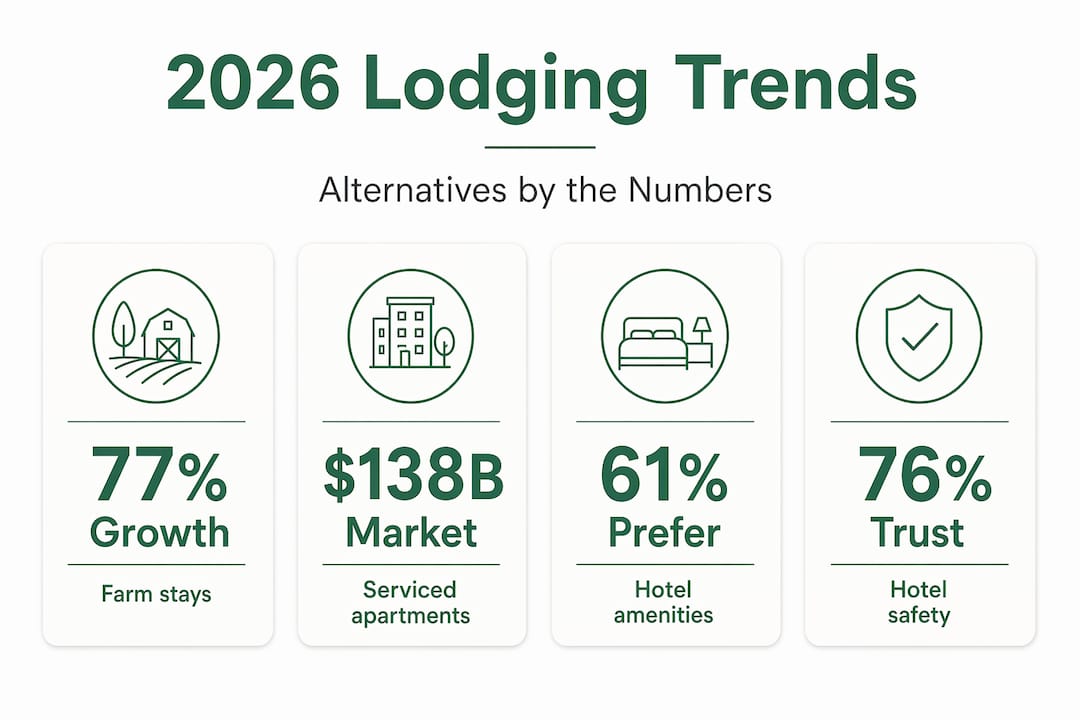 Infographic highlighting alternative lodging statistics
How to choose the right alternative for your trip
The best alternative accommodation is the one that matches your actual travel style, not the one that sounds most interesting in theory. Work through these questions before you book:
- How long is your stay? Under three nights, a boutique hotel or hostel makes logistical sense. Over five nights, a home exchange, vacation rental, or serviced apartment almost always wins on cost and comfort.
- What's your group makeup? Solo travelers get the most from hostels and home stays. Families benefit from vacation rentals and home exchanges where kids have space to spread out. Groups of eight or more should price hostel exclusive-use blocks before accepting hotel group rates.
- Do you want to cook? If yes, cross any option without kitchen access off the list. Hotels almost never offer it. Home exchanges, serviced apartments, and farm stays almost always do.
- How important is local immersion? Boutique accommodations and homestay services score highest here. Chain hotels and generic short-term rentals in tourist districts score lowest, regardless of their star rating.
- What is your price ceiling? Home exchange is the only category that can realistically bring your nightly accommodation cost to zero. If budget travel trends in 2026 matter to you, that ceiling should be your starting point, not your fallback.
Avoid the common mistake of defaulting to the option you already know. Most travelers who try a home exchange for the first time report wishing they had done it sooner. The same is true for first-time farm stays and well-chosen boutique properties. The unfamiliarity is the feature, not the risk.
My honest take on the lodging shift
I've watched travelers talk themselves out of perfectly good alternative accommodations because the word "hotel" carries a kind of psychological insurance. If something goes wrong at a hotel, it feels like the hotel's fault. If something goes wrong at a home exchange or farm stay, it feels like your own decision.
That's a real feeling, but it's not an accurate risk assessment. In my experience, verified home exchange platforms have lower complaint rates than anonymous short-term rental platforms, and boutique hotels handle problems faster than chains precisely because there's no corporate escalation path to hide behind.
What I've seen consistently is that travelers who try alternatives once almost never go back to defaulting to hotels. The quality of experience is simply higher when the accommodation itself has character. A serviced apartment in Lisbon where you shop at the local market. A farm stay in Vermont where the host leaves fresh eggs outside your door. A home exchange in Tokyo where the bookshelf alone tells you more about the city than any guidebook would.
My advice: pick one alternative for your next trip and commit to it fully. Not as an experiment, but as a deliberate choice. You'll learn more about how you travel, what you actually need, and what you've been overpaying for.
— Swappa
Travel free with Swappahome
 https://swappahome.com
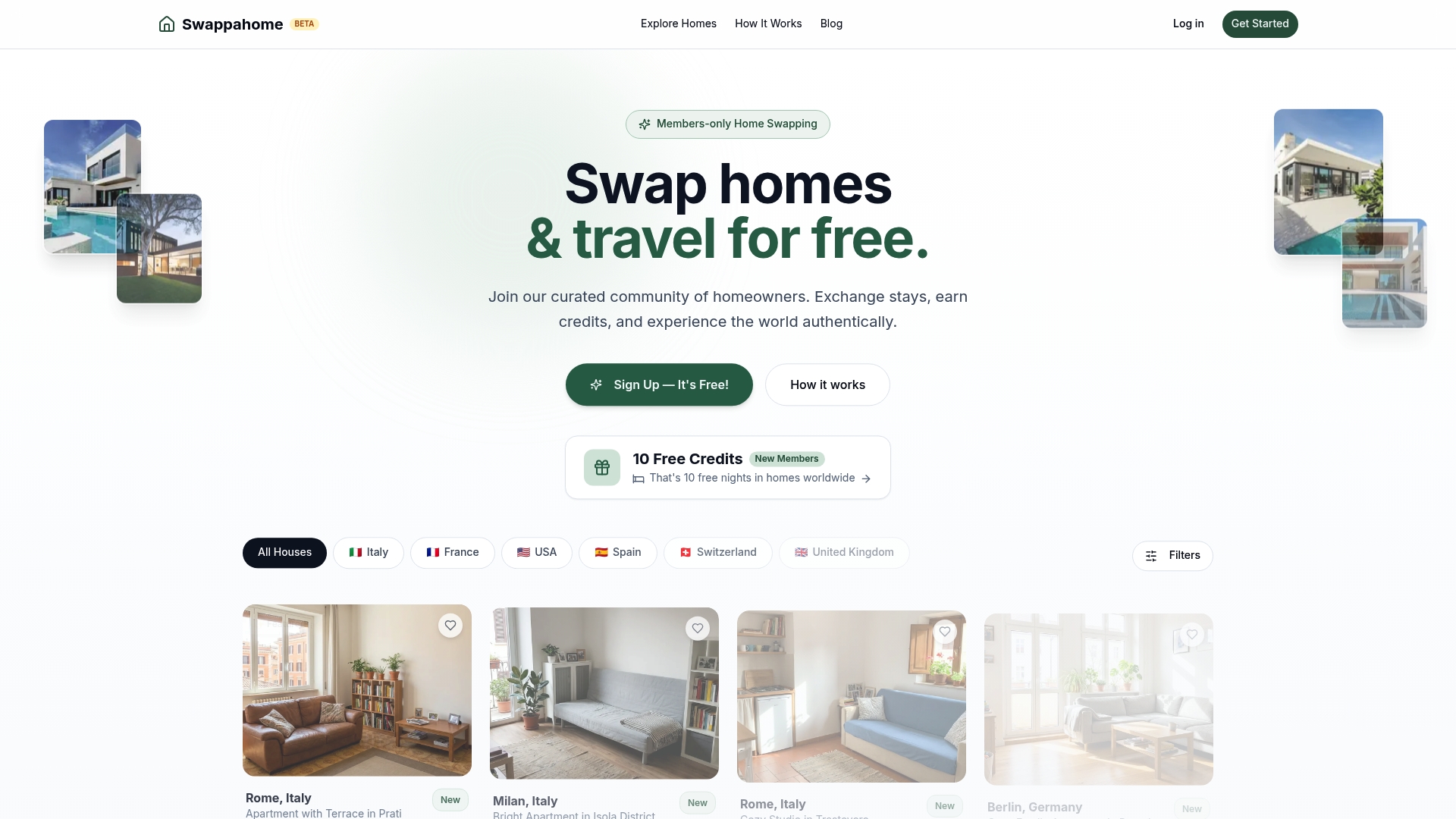
Swappahome is a members-only home swapping platform built for travelers who want real stays in real homes, without the nightly rate. The model is credit-based: list your home, earn credits when you host, and spend those credits on stays anywhere in the network. One credit equals one free night. New members receive starter credits just for joining. If you're ready to stop paying for walls and start experiencing places the way people actually live in them, explore available homes across dozens of countries or join the Swappahome community and see what your home could unlock for your next trip.
FAQ
What are the best alternatives to traditional hotels?
The strongest alternatives include home exchanges, vacation rentals, serviced apartments, boutique accommodations, hostels, and farm stays. The best option depends on your trip length, group size, and whether you prioritize cost savings or unique lodging experiences.
How does home exchange work?
Home exchange platforms like Swappahome allow verified members to swap their homes using a credit system. You earn credits by hosting guests and spend those credits to stay in other members' homes, with no money exchanged for accommodation.
Are hostels only for backpackers?
Not anymore. Modern hostel options include private rooms, design-forward common spaces, and community programming that appeal to solo travelers, couples, and groups. Hostels also offer transparent group pricing that often beats hotel block rates.
When do serviced apartments make more sense than hotels?
Serviced apartments are typically more cost-effective for stays of five nights or longer. They include kitchen facilities, weekly pricing tiers, and utilities that reduce both cost and the fatigue of extended hotel stays.
What should I know before booking a farm stay?
Confirm whether the property is an actual working farm requiring guest participation or a hospitality-focused rural retreat. The two models differ significantly in comfort level and daily expectations, and listings don't always make the distinction obvious.
Recommended

Published by
SwappaHome
SwappaHome Editorial Team
Home Exchange & Slow Travel Editorial
The SwappaHome Editorial Team brings together travel research, home-exchange community insights, and platform data to produce practical guides for first-time and experienced home swappers. Every article cites real platforms, current market rates, and verifiable city-level facts so readers can make informed decisions without guessing.
Ready to try home swapping?
Join SwappaHome and start traveling by exchanging homes. Get 7 free credits when you sign up!