
Benefits of a Sharing Economy for Travelers

SwappaHome Editorial Team
Home Exchange & Slow Travel Editorial
Benefits of a Sharing Economy for Travelers !Traveler browsing sharing economy app outdoors > TL;DR: > > - The sharing economy allows individuals to...
Benefits of a Sharing Economy for Travelers
 Traveler browsing sharing economy app outdoors
TL;DR:
- The sharing economy allows individuals to share and access underused assets through digital platforms, offering cost savings and environmental benefits. Its effectiveness depends on the sharing model, with station-based car-sharing reducing CO2 emissions significantly, while free-floating options may increase driving. Trust and intentional spending are essential for maximizing financial, environmental, and cultural advantages.
The sharing economy is an economic model where individuals share, rent, or access underused assets through digital platforms, generating cost savings, environmental benefits, and cultural exchange. Known formally as the peer-to-peer or collaborative economy, this model has moved well beyond ride-sharing and food delivery. It now shapes how millions of people travel, live, and connect globally. The benefits of a sharing economy are most visible for travelers and homeowners who want affordable, authentic experiences without the overhead of traditional hotels or car ownership. Swappahome is one platform built entirely around these advantages, enabling verified homeowners to swap homes and travel for free.
How does the sharing economy foster sustainable living?
The sharing economy's strongest environmental case comes from station-based services. A 2024 Wuppertal Institute study found that station-based car-sharing reduces per-user vehicle kilometers traveled by 28–42% and CO2 emissions by 18–35% compared to private ownership. That is not a marginal improvement. It means one shared vehicle can replace multiple privately owned cars, cutting both manufacturing demand and road congestion at the same time.
Urban-scale data reinforces this picture. An empirical analysis of 296 cities from 2015 to 2017 found that sharing economy platforms contribute to an average urban carbon decline of 0.61%, driven by improved traffic efficiency and institutional coordination. The number sounds small, but applied across hundreds of cities simultaneously, the cumulative effect on global emissions is meaningful.
The environmental story is not entirely clean, though. Free-floating car-sharing services can actually increase driving by 8–15% by substituting for public transit or cycling rather than private car use. That finding matters because it shows the type of sharing model determines whether the environmental outcome is positive or negative.
The rebound effect is the other complication. A 2025 Joint Research Centre analysis found that 60–80% of savings from sharing get reallocated to other consumption, often higher-carbon activities like flights or electronics. Sharing a car does not automatically make someone a greener consumer if the money saved funds a long-haul flight. Intentional spending choices must accompany sharing habits for the net environmental gain to hold.
| Sharing model | Environmental outcome |
|---|---|
| Station-based car-sharing | CO2 emissions down 18–35% per user |
| Free-floating car-sharing | Driving can increase 8–15% |
| Urban platform adoption | Average 0.61% urban carbon decline |
| Rebound effect | 60–80% of savings spent on other consumption |
Pro Tip: Track where your sharing economy savings actually go. If the money freed up by skipping a hotel goes toward a connecting flight, the net carbon benefit shrinks fast. Redirect savings toward low-carbon experiences like local food tours or train travel instead.
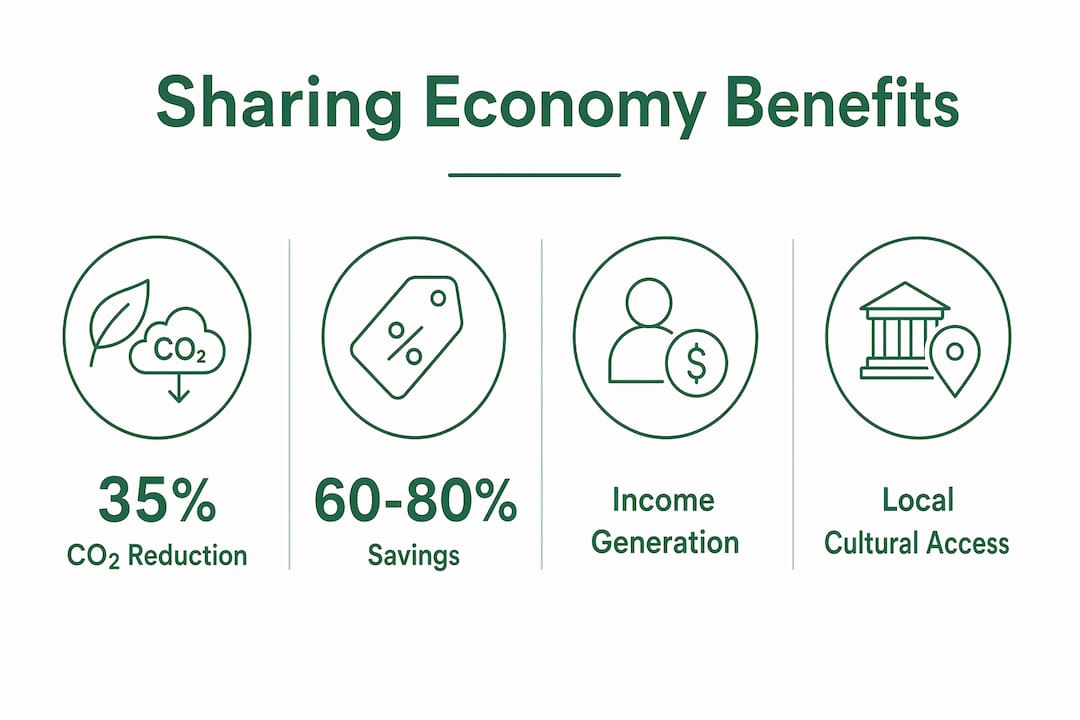 Infographic showing benefits of sharing economy for travelers
What financial benefits come from sharing economy participation?
The sharing economy creates real income for people who previously had no practical way to monetize what they already own. A Notre Dame Law Review analysis confirmed that the sharing economy enables asset monetization for people of modest means, expanding income opportunities and access to services historically limited to wealthier households. A spare bedroom, a parked car, or a vacation home can generate consistent income without requiring a business license or startup capital.
The cost savings side is equally concrete. Sharing economy participants reduce spending in shared product categories by 15–25%, according to a 2025 Joint Research Centre analysis. That reduction compounds across housing, transportation, and tools when someone commits to access over ownership.
The equalizing effect of these platforms is underappreciated. Sharing economy platforms give lower-income participants access to services and experiences that were previously out of reach. A family that cannot afford a second car can access one on demand. A traveler on a tight budget can stay in a well-located home rather than a budget motel on the city's edge.
Key financial advantages of sharing economy participation include:
- Reduced ownership costs. You pay for access when you need it, not for storage, insurance, and depreciation year-round.
- New income streams. Listing a home or vehicle generates revenue from an asset that would otherwise sit idle.
- Flexible participation. You control when and how much you share, making it compatible with full-time work or other income sources.
- Broader service access. Platforms give you access to premium assets, like well-furnished homes in prime locations, at a fraction of the ownership cost.
- Lower travel costs. Home exchange models like Swappahome eliminate accommodation costs entirely, replacing nightly rates with a credit-based swap system.
The sharing economy travel savings available through home exchange platforms represent one of the most dramatic examples of this financial shift. Accommodation is typically the largest travel expense, and removing it changes what trips are financially possible.
How does the sharing economy enhance travel through cultural exchange?
Sharing economy travel delivers something that hotels structurally cannot: genuine local life. When you stay in someone's home, you live in a real neighborhood, shop at local markets, and interact with residents rather than other tourists. That kind of immersion is what most travelers say they want but rarely find through conventional booking channels.
 Hosts welcoming traveler in shared home
Affordable access is the entry point. Home exchange platforms remove the nightly rate entirely, making destinations that would otherwise be too expensive financially viable. A week in Tokyo or Paris becomes a question of logistics rather than budget when accommodation costs drop to zero.
The cultural depth that follows is the real advantage. Hosts often leave local guides, restaurant recommendations, and neighborhood tips that no travel app replicates. Some platforms, including Swappahome, actively facilitate food and culture exchange experiences as part of the swap, turning a stay into a structured cultural encounter rather than just a place to sleep.
Trust is what makes these exchanges work at scale. Platform verification, user ratings, and structured dispute resolution give both hosts and guests confidence before any keys change hands. Here is how to evaluate a travel-focused sharing platform before committing:
- Check verification standards. Confirm the platform verifies identity documents, not just email addresses.
- Read recent reviews. Look for patterns across multiple stays, not just the most recent listing.
- Understand the credit or exchange system. Know exactly what you earn per night hosted and what you spend per night stayed.
- Review the dispute process. A clear, written process for resolving disagreements signals a mature platform.
- Look for community guidelines. Platforms with explicit behavioral standards attract more reliable members.
Pro Tip: Before your first home swap, host a guest first. The experience of welcoming someone into your home teaches you exactly what to look for when you arrive at someone else's. It also builds your review profile faster.
What role does digital trust play in sharing economy benefits?
Trust is not a soft concept in the sharing economy. It is the mechanism that determines whether the model works or collapses. Springer research confirms that digital trust combines structural, functional, and relational elements, all of which must be present for participants to engage confidently. Remove any one layer and participation drops.
Structural trust comes from the platform itself: identity verification, secure payment processing, and clear terms of service. Functional trust comes from the product working as described, meaning the home matches its listing, the car is in the stated condition. Relational trust builds over time through repeated positive interactions and consistent reviews.
Platform insurance is a critical structural element that travelers often overlook. Zurich insurance experts note that online platforms provide regulatory frameworks, payment processing, and dispute resolution that reduce risks compared to informal arrangements. Many platforms also include insurance coverage for rented or exchanged items, protecting both parties against damage. Reading the fine print matters here. Default coverage sometimes carries high deductibles that make minor repairs impractical to claim.
User reputation systems close the loop. Springer research also shows that consistent positive feedback is critical for sustained access to quality listings. Platforms that weight reputation heavily create a self-reinforcing quality standard. Members who behave well get access to better homes and more favorable exchange terms. Members who do not get filtered out over time.
The practical implication is that trust-building is a two-way responsibility. Leaving thorough, honest reviews after every exchange is as important as receiving them. Platforms where members treat reviews as optional tend to attract lower-quality participants across the board. Swappahome addresses this through a verified member model, where identity confirmation and community standards are prerequisites for access, not afterthoughts.
Key Takeaways
The sharing economy delivers measurable financial, environmental, and cultural benefits, but realizing them fully requires intentional platform choices and spending habits.
| Point | Details |
|---|---|
| Environmental gains are model-dependent | Station-based sharing cuts CO2 by 18–35%; free-floating models can increase driving. |
| Rebound effects reduce net savings | 60–80% of sharing savings often fund higher-carbon spending, requiring conscious redirection. |
| Financial inclusion is real | Asset monetization and reduced ownership costs expand access for modest-income participants. |
| Trust determines platform quality | Structural, functional, and relational trust all must be present for confident participation. |
| Home exchange eliminates accommodation costs | Credit-based swap platforms like Swappahome remove the largest travel expense entirely. |
Why I think most people underuse the sharing economy
Most travelers treat the sharing economy as a discount tool. They use it to shave costs and then spend those savings on the same kinds of trips they always took. That misses the deeper opportunity entirely.
The most valuable thing the sharing economy offers is not cheaper accommodation. It is access to a different kind of experience. When you stay in a verified home through a platform like Swappahome, you are not just saving money on a hotel. You are living in a neighborhood, using a real kitchen, and often connecting with a host who knows the city in ways no concierge does. That is a fundamentally different travel experience, and it is available at a fraction of the cost.
The rebound effect research is a genuine warning worth taking seriously. Saving 60–80% on accommodation and immediately spending it on a business-class upgrade or an extra flight undoes most of the environmental benefit. The sharing economy works best when you treat it as part of a broader set of choices, not a standalone fix.
I also think people underestimate how much their own behavior shapes the quality of what they get back. Platforms that use reputation systems reward members who show up as good guests and thoughtful hosts. The travelers who get access to the best homes are almost always the ones who have built strong review profiles by being excellent guests first. That is not luck. It is a system you can work deliberately.
The role of trust in travel networks is something worth understanding before you join any platform. The mechanics of how trust gets built and maintained directly affect the quality of exchanges you will access. Going in with that knowledge puts you ahead of most participants from day one.
— Swappa
Swappahome: home exchange built on sharing economy principles
Swappahome is a members-only home exchange platform that puts the sharing economy's core advantages into a single, structured system. Verified homeowners list their homes, earn credits for hosting, and use those credits to stay in other members' homes anywhere in the world. One credit equals one free night. New members receive free credits to get started.
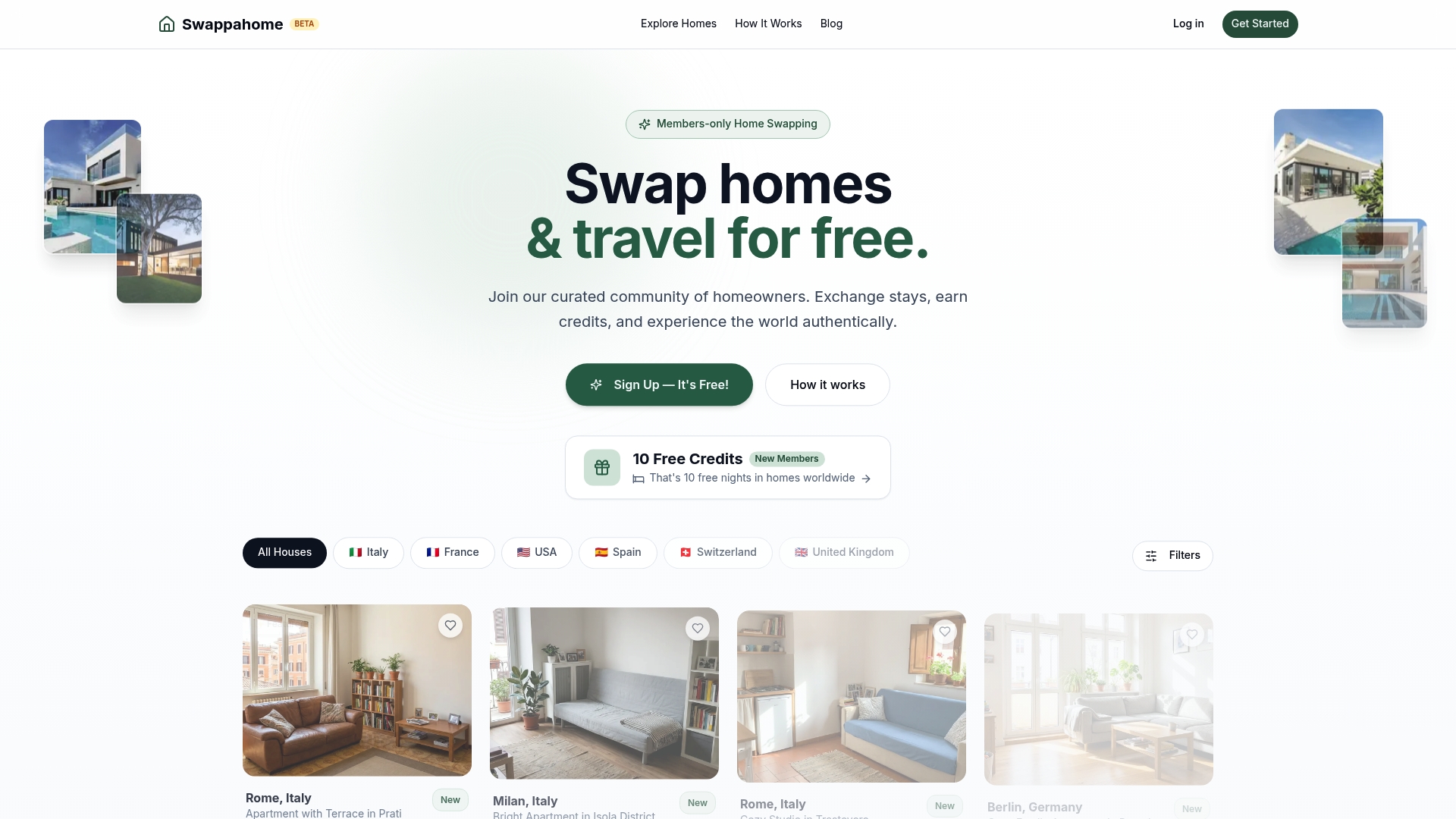 https://swappahome.com
The platform's verification process addresses the trust requirements that make or break peer-to-peer exchanges. Every member is confirmed before gaining access to listings, and the credit system removes monetary transactions from the equation entirely. You can browse verified homes across dozens of countries and find stays that would cost hundreds per night through conventional booking. For travelers who want affordable, authentic experiences grounded in real community connection, Swappahome offers a practical and well-structured entry point into sharing economy travel.
FAQ
What are the main benefits of a sharing economy?
The sharing economy reduces costs through shared access, generates income from underused assets, cuts environmental impact through better resource utilization, and enables cultural exchange through peer-to-peer travel platforms.
How does home exchange fit into the sharing economy?
Home exchange is a direct application of sharing economy principles. Homeowners swap stays using a credit system, eliminating accommodation costs and enabling authentic local experiences that hotels cannot replicate.
Does the sharing economy actually help the environment?
Station-based sharing models reduce CO2 emissions by 18–35% per user, but rebound effects can offset gains when savings fund higher-carbon spending. Net environmental benefit depends on how participants use the money they save.
How does digital trust work on sharing economy platforms?
Digital trust combines structural elements like identity verification, functional elements like accurate listings, and relational elements like user reviews. All three must be present for participants to engage with confidence.
Is the sharing economy financially beneficial for regular people?
The sharing economy enables asset monetization for people of modest means and reduces spending in shared categories by 15–25%, making it a genuine equalizing force across income levels.
Recommended

Published by
SwappaHome
SwappaHome Editorial Team
Home Exchange & Slow Travel Editorial
The SwappaHome Editorial Team brings together travel research, home-exchange community insights, and platform data to produce practical guides for first-time and experienced home swappers. Every article cites real platforms, current market rates, and verifiable city-level facts so readers can make informed decisions without guessing.
Ready to try home swapping?
Join SwappaHome and start traveling by exchanging homes. Get 7 free credits when you sign up!