
Defining Accommodation Exchange: Unlocking Free Stays

SwappaHome Editorial Team
Home Exchange & Slow Travel Editorial
Defining Accommodation Exchange: Unlocking Free Stays !Travelers relaxing in swapped home living room Booking another hotel room can quickly drain...
Defining Accommodation Exchange: Unlocking Free Stays
 Travelers relaxing in swapped home living room
Booking another hotel room can quickly drain even the best-planned vacation budget. For Canadian, American, and European homeowners, balancing travel dreams with financial realities often means sacrificing depth and authenticity. Accommodation exchange offers a community-centered alternative, allowing you to experience real neighborhoods and cultures without hefty costs. Discover how swapping homes opens doors to more meaningful journeys while saving money, fostering genuine connections, and supporting sustainable travel.
Table of Contents
- Defining Accommodation Exchange and Its Purpose
- Different Types of Accommodation Exchanges Explained
- How Credit-Based Home Swapping Works
- Rights, Safety, and Legal Responsibilities
- Comparing Accommodation Exchange to Traditional Travel
Key Takeaways
| Point | Details |
|---|---|
| Cultural Immersion | Accommodation exchanges provide authentic local experiences that enhance cultural understanding. |
| Cost Efficiency | Participants can save significantly on travel expenses compared to traditional lodging options. |
| Community Engagement | Home exchanges foster connections with locals, promoting stronger community ties. |
| Sustainable Travel | These models reduce environmental impact by utilizing existing housing resources effectively. |
Defining Accommodation Exchange and Its Purpose
Accommodation exchange represents a transformative approach to travel and housing that reimagines traditional lodging models. At its core, this innovative concept enables homeowners to swap living spaces temporarily without monetary transactions, creating opportunities for affordable, authentic travel experiences. Home exchanging has emerged as a significant alternative to commercial tourism, driven by collaborative consumerism and digital networking platforms.
The fundamental purpose of accommodation exchange extends beyond simple cost savings. It encompasses several key objectives:
- Cultural immersion through staying in authentic residential environments
- Resource optimization by efficiently utilizing existing housing infrastructure
- Community building across geographic and cultural boundaries
- Sustainable travel that reduces environmental impact compared to traditional hospitality models
Participants in home exchange platforms engage in reciprocal homestays that challenge conventional travel paradigms. Unlike hotel experiences, these exchanges offer genuine insights into local lifestyles, neighborhoods, and community dynamics. Sustainable housing management strategies suggest that such exchanges can potentially decrease per capita housing consumption while providing unique travel opportunities.
Community-driven platforms like Swappahome facilitate these exchanges through structured credit systems, enabling members to list their homes, earn accommodation credits, and book stays in other verified members' properties. This approach transforms travel from a transactional experience to a collaborative, trust-based interaction.
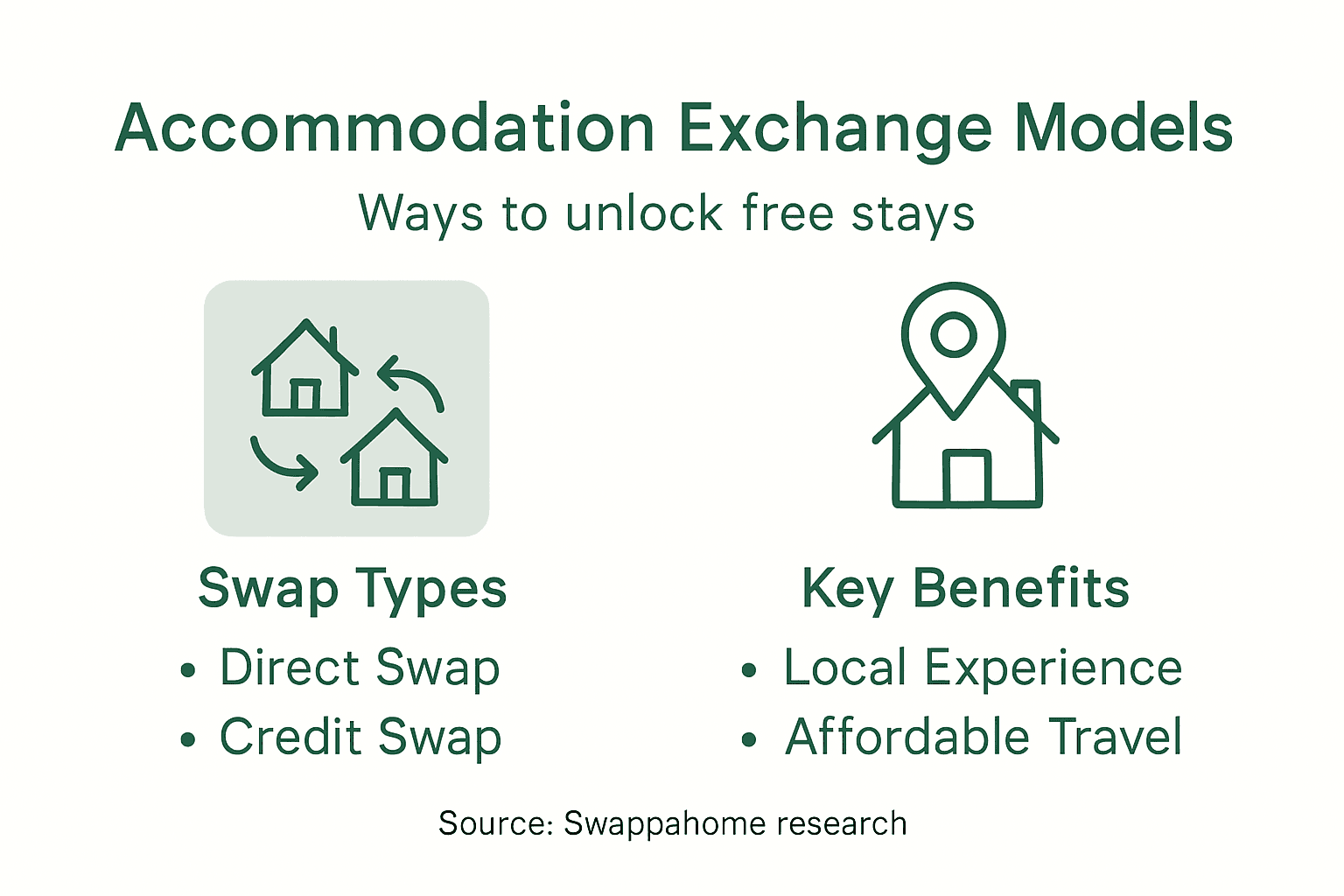 Infographic comparing exchange models and benefits
Pro tip: Before participating in your first home exchange, thoroughly review the platform's verification processes and establish clear communication guidelines with potential exchange partners.
Different Types of Accommodation Exchanges Explained
Accommodation exchanges represent a diverse landscape of housing swap opportunities, extending far beyond simple home-to-home trades. Accommodation options for exchange participants encompass multiple models designed to meet varied traveler needs and preferences, creating flexible alternatives to traditional lodging.
The primary types of accommodation exchanges include:
- Direct Home Swaps: Traditional one-to-one property exchanges between homeowners
- Indirect Exchange Systems: Credit-based platforms allowing non-simultaneous swaps
- Multilateral Exchanges: Networks enabling more complex swap arrangements involving multiple properties
- Partial Home Exchanges: Sharing specific living spaces like guest rooms or apartments
Each exchange type offers unique advantages for travelers seeking affordable and authentic experiences. Student accommodation models demonstrate the wide spectrum of potential exchange arrangements, ranging from university-managed housing to private shared living spaces.
Here is a summary of popular accommodation exchange models and their distinguishing features:
| Exchange Model | Swap Requirements | Duration Flexibility | Community Interaction |
|---|---|---|---|
| Direct Home Swap | Simultaneous exchange | Fixed dates | Moderate |
| Indirect Credit Swap | Flexible, not simultaneous | Varied | High |
| Multilateral Network | Multiple properties | Highly flexible | Very high |
| Partial Space Share | Guest room or apartment | Usually short-term | Moderate |
Collaborative platforms like Swappahome facilitate these exchanges by providing structured systems that match verified homeowners, manage credit allocations, and ensure transparent, secure interactions. These platforms transform traditional travel accommodations by prioritizing community trust and mutual benefit over transactional hospitality models.
Pro tip: Research multiple exchange platforms and understand their specific verification processes and membership requirements before committing to an accommodation exchange.
How Credit-Based Home Swapping Works
Credit-based home swapping represents a revolutionary approach to travel accommodation, transforming traditional exchange models by introducing flexibility and broader participation. Home swapping schemes increasingly use credit systems to incentivize participation, allowing travelers to earn and redeem credits across a dynamic network of potential stays.
The core mechanics of credit-based exchanges involve several key components:
- Credit Allocation: Members earn credits by hosting other travelers in their homes
- Flexible Redemption: Credits can be used independently of direct home switches
- Network Expansion: Platforms enable exchanges beyond simple one-to-one trades
- Scalability: Systems support diverse participants across different geographic regions
Unlike traditional home exchanges that require simultaneous and reciprocal swaps, credit-based platforms create a more dynamic ecosystem. Homeowners can host travelers and accumulate credits, which they can then use to stay in other properties at different times and locations, breaking the constraints of synchronized exchanges.
 Woman reviewing credit-based home swap details
Verification and Trust remain critical in these systems. Collaborative platforms like Swappahome implement rigorous member screening, property validation, and transparent credit management to ensure safe and reliable exchanges. This approach transforms accommodation swapping from a transactional model to a community-driven experience of mutual trust and shared benefit.
Pro tip: Maintain an updated, attractive property listing and respond promptly to exchange requests to maximize your credit-earning potential.
Rights, Safety, and Legal Responsibilities
Home exchanges involve complex legal considerations that extend beyond simple property swapping. Reasonable accommodation legal frameworks emphasize the critical importance of understanding rights, safety protocols, and mutual responsibilities to ensure secure and equitable interactions between participating homeowners.
Key legal considerations for accommodation exchanges include:
- Property Insurance: Verifying coverage for temporary occupants
- Liability Protection: Understanding potential legal risks and protections
- Privacy Rights: Maintaining personal boundaries during exchanges
- Consent and Documentation: Establishing clear written agreements
- Local Regulatory Compliance: Adhering to municipal housing regulations
Participant Protections are fundamental to creating trust within exchange networks. Digital platforms implement rigorous verification processes, including background checks, identity confirmation, and property validation to mitigate potential risks. Legal frameworks for accommodation underscore the importance of creating safe, dignified environments that respect individual rights and community standards.
Swappahome and similar platforms typically require members to sign comprehensive terms of service that outline specific legal obligations, recommended safety practices, and dispute resolution mechanisms. These agreements help establish clear expectations and provide structured support for participants navigating potential challenges during home exchanges.
Pro tip: Always communicate directly with potential exchange partners, request additional verification, and trust your instincts if something feels uncomfortable during the exchange process.
Comparing Accommodation Exchange to Traditional Travel
Peer-to-peer accommodation models represent a transformative approach to travel, challenging the conventional hospitality industry's standard offerings. Unlike traditional hotels and short-term rentals, accommodation exchanges provide a more immersive, personalized, and community-driven travel experience that fundamentally reshapes how travelers interact with destinations.
Key differences between accommodation exchange and traditional travel include:
- Cost Efficiency: Significant savings compared to hotel and rental expenses
- Cultural Immersion: Direct engagement with local living environments
- Personal Connection: Authentic interactions beyond transactional experiences
- Sustainability: Reduced environmental impact through resource sharing
- Flexibility: More adaptable and diverse accommodation options
Experiential Travel stands in stark contrast to standardized hospitality models. Student exchange programs demonstrate how alternative accommodations prioritize deep cultural understanding over mere convenience. Traditional travel typically offers uniform, predictable experiences, whereas accommodation exchanges provide unique, context-rich environments that challenge travelers' perspectives and foster genuine cross-cultural connections.
Below is a comparison of accommodation exchange and traditional travel arrangements:
| Aspect | Accommodation Exchange | Traditional Hotel/Rental |
|---|---|---|
| Price Structure | Minimal or no cash involved | Set nightly rates |
| Personalization | Tailored home experiences | Standardized rooms |
| Environmental Impact | Lower due to shared spaces | Higher from resource usage |
| Social Opportunities | Interaction with hosts | Limited social engagement |
Swappahome and similar platforms leverage technology to transform these exchanges from niche experiences to mainstream travel alternatives. By implementing robust verification processes, credit systems, and community guidelines, these networks create safe, reliable pathways for travelers seeking more meaningful, authentic interactions beyond conventional tourism models.
Pro tip: Research potential exchange partners thoroughly, maintain open communication, and approach the experience with flexibility and cultural curiosity.
Experience the Freedom of Accommodation Exchange with Swappahome
The challenge of finding affordable, authentic travel accommodations is real for many travelers who want to move beyond traditional hotels. As the article explains, accommodation exchange offers a unique solution by unlocking free stays through verified home swaps and credit systems. If you want to enjoy genuine cultural immersion, maximize your travel budget, and join a community built on trust, then Swappahome provides the perfect platform to start your home swapping journey.
 https://swappahome.com
Discover how Swappahome's easy-to-use credit-based system allows you to list your home, earn credits, and redeem them for free nights around the world. By joining this members-only community, you gain access to verified properties and secure exchanges that prioritize your safety and satisfaction. Don't wait to travel smarter and experience new cultures without spending a dime on accommodation. Visit Swappahome today to start your free stay journey and unlock a world of affordable travel opportunities.
Frequently Asked Questions
What is accommodation exchange?
Accommodation exchange is a travel model that allows homeowners to swap living spaces temporarily without monetary transactions, providing opportunities for affordable and authentic travel experiences.
How does credit-based home swapping work?
Credit-based home swapping allows members to earn credits by hosting travelers in their homes, which they can then use to stay in other properties at different times, offering flexibility beyond traditional reciprocal exchanges.
What types of accommodation exchanges are available?
There are several types of accommodation exchanges including direct home swaps, indirect credit swaps, multilateral exchanges, and partial space sharing, each offering unique benefits for travelers.
What legal considerations should participants be aware of during an accommodation exchange?
Participants should understand property insurance, liability protection, privacy rights, and ensure compliance with local regulations, while establishing clear agreements to safeguard rights and responsibilities.
Recommended

Published by
SwappaHome
SwappaHome Editorial Team
Home Exchange & Slow Travel Editorial
The SwappaHome Editorial Team brings together travel research, home-exchange community insights, and platform data to produce practical guides for first-time and experienced home swappers. Every article cites real platforms, current market rates, and verifiable city-level facts so readers can make informed decisions without guessing.
Ready to try home swapping?
Join SwappaHome and start traveling by exchanging homes. Get 7 free credits when you sign up!