
Defining Global Home Networks for Travelers and Homeowners

SwappaHome Editorial Team
Home Exchange & Slow Travel Editorial
Defining Global Home Networks for Travelers and Homeowners !Traveler setting up global home network devices > TL;DR: > > - A global home network...
Defining Global Home Networks for Travelers and Homeowners
 Traveler setting up global home network devices
TL;DR:
- A global home network connects multiple houses through encrypted tunnels with shared security policies. It improves security, manages numerous devices, and enhances home swapping experiences by ensuring reliable, protected connectivity. Proper planning, IP management, and VLAN segmentation are essential for a successful multi-site residential network.
A global home network is a unified architecture that connects multiple geographically dispersed residential networks so devices, data, and security policies work together across locations. Defining global home networks matters more than ever because the average household now runs 30 or more connected devices, up from roughly 10 in 2016. That tripling of device density changes everything about how homeowners and travelers must think about connectivity, especially those who participate in home swapping and cultural exchange. The right network architecture turns a scattered collection of routers into a single, manageable system.
What does defining global home networks mean for multi-location living?
Global home network architecture is the structured design of how routers, switches, access points, and security layers connect across two or more physical homes. The industry term for this concept is multi-site residential networking. The keyword phrase "defining global home networks" captures the same idea from a homeowner's perspective, and both terms are worth knowing.
Device density has tripled in the decade leading to 2026. That growth means a single consumer-grade router no longer handles the load reliably, let alone coordinates with a second home across the country or the world.
Modern home network architecture has evolved into three recognizable tiers:
- Basic residential: One router, one Wi-Fi network, no segmentation. Works for apartments with fewer than 15 devices.
- Structured residential: Dedicated routing hardware, managed switches, and multiple wired access points. Recommended for homes between 3,000 and 6,000 square feet to maintain stability across floors and zones.
- Multi-site residential: Two or more structured networks linked by encrypted tunnels, with unified management and shared security policies.
Home swappers and frequent travelers almost always need the structured or multi-site tier. A guest arriving at your home in Lisbon while you stay in their apartment in Chicago needs reliable Wi-Fi, not a troubleshooting session.
Pro Tip: Place wired access points on every floor of a large home rather than relying on wireless mesh nodes. A wired Ethernet backbone eliminates the speed degradation that wireless-only mesh systems suffer in multi-floor layouts.
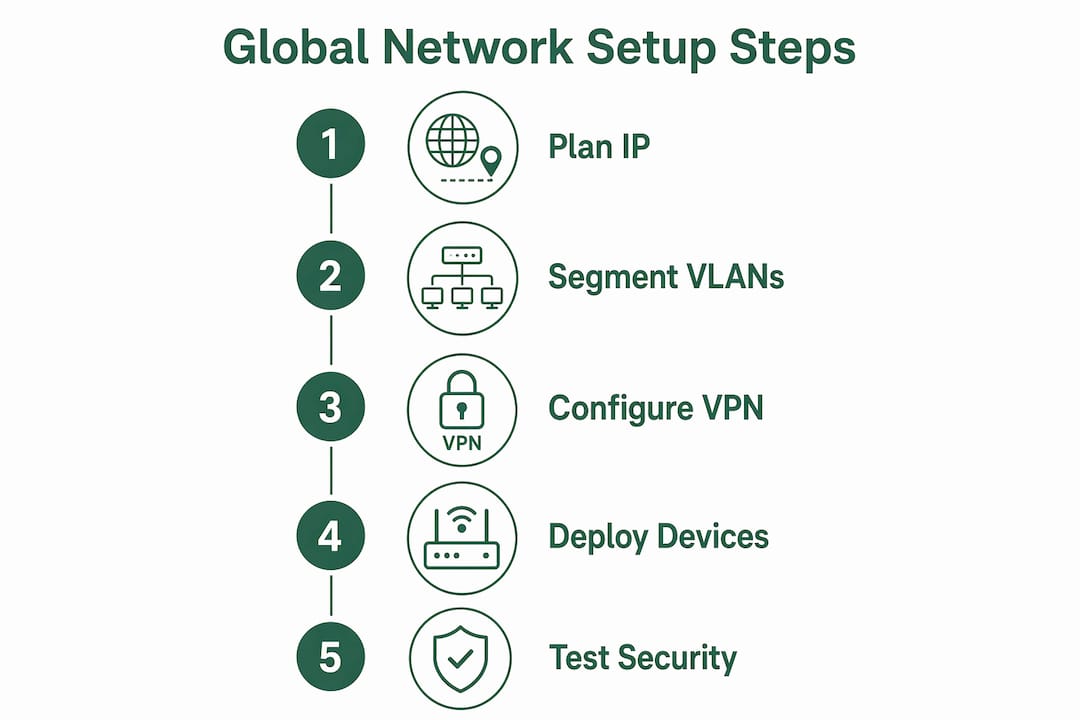 Infographic detailing global home network setup steps
How do you securely connect multiple homes into one network?
Connecting two or more homes into a single global network requires more than a shared password. The method you choose determines both security and reliability.
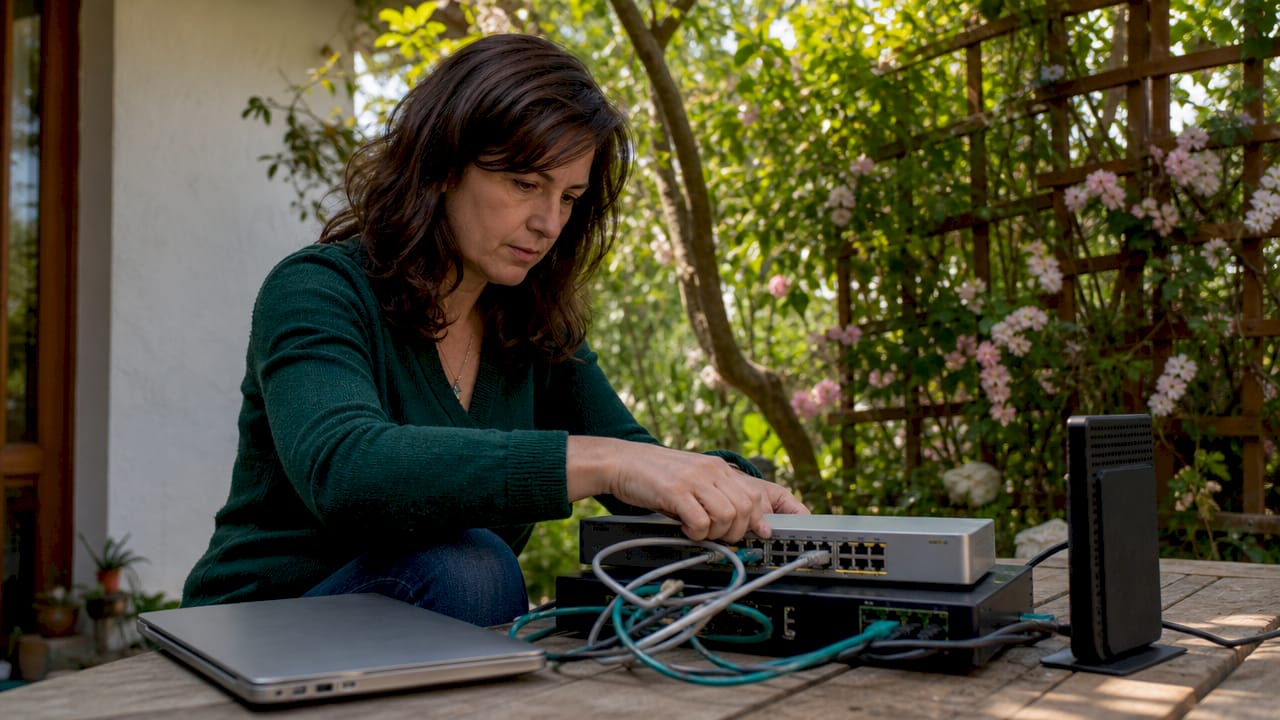 Technician configuring secure multi-home network
Most homeowners start with port forwarding, which opens specific ports on a router to allow remote access. Port forwarding creates real security vulnerabilities because it exposes your router's public IP address to the open internet. Mesh VPNs like WireGuard offer a far better alternative. They establish encrypted tunnels between sites without opening any inbound ports at all.
The practical steps for building a secure multi-site connection follow a clear sequence:
- Choose a VPN framework. Tools like Tailscale or WireGuard create encrypted, unified network interfaces across locations without exposing public IP addresses. Tailscale is particularly accessible for non-engineers because it handles key management automatically.
- Plan your IP address space. Overlapping subnets are the most common failure point in multi-site setups. If both homes use the default 192.168.1.x range, routing breaks immediately. Use non-standard private ranges such as 10.x.x.x or 172.16.x.x for each site to prevent subnet conflicts that cause routing failures.
- Pick a topology. Hub-and-spoke routes all traffic through one central site, which simplifies management but creates a single point of failure. Full mesh connects every site directly to every other site, which is more resilient but requires more configuration. For two or three homes, full mesh is the better choice.
- Test failure scenarios. Intentionally disable a VPN tunnel and observe what breaks. Graceful degradation means local services keep working even when the inter-site link goes down. If your smart thermostat stops responding every time the tunnel drops, the architecture needs adjustment.
Pro Tip: Assign each home a unique site identifier in your IP plan before you configure a single device. Changing IP schemes after deployment is far more disruptive than planning carefully at the start.
How does a global home network improve the home swapping experience?
A well-designed global home network does more than move data. It protects your personal devices, gives guests a reliable connection, and lets you manage your home remotely from anywhere in the world.
Network segmentation is the foundation of safe home swapping. VLAN segmentation isolates IoT devices from trusted personal devices, so a compromised smart bulb or guest laptop cannot reach your home server or personal files. A practical segmentation model for home swappers includes three separate network zones:
- Trusted network: Your personal laptops, phones, and NAS drives. Guests never touch this zone.
- Guest network: A separate SSID with internet access only. No visibility into your trusted devices or IoT systems.
- IoT network: Smart locks, thermostats, cameras, and appliances. Isolated from both guests and your personal devices, but manageable by you remotely through the VPN tunnel.
Remote control of smart home devices becomes genuinely useful in a swap context. You can adjust the thermostat in your Paris apartment from Tokyo, check that the front door locked after your guests arrived, or restart the router if the connection drops. Platforms like Swappahome connect verified homeowners globally, and a well-segmented network makes hosting those guests far less stressful.
Scalability matters as your swap network grows. Adding a third or fourth property to your global home network is straightforward if you planned the IP address space and VPN topology correctly from the start. Hosts who prepare their homes thoroughly, including network setup, consistently earn better reviews. The Swappahome host guide covers practical preparation steps that pair directly with good network hygiene.
For travelers exploring vacation rental communities, understanding what a well-configured guest network looks like helps you ask the right questions before you arrive.
What are the most common mistakes in global home network setups?
Most problems in multi-site home networks come from a small set of avoidable errors. Knowing them in advance saves hours of troubleshooting.
- Overlapping IP subnets. Using 192.168.1.x at every site is the single most common mistake. High-end hardware cannot fix poor IP planning. Rigorous address management is non-negotiable for multi-site success.
- Wireless-only backhaul. Wireless mesh nodes are convenient but unreliable in large or multi-story homes. A wired Ethernet backbone is the correct foundation for any structured residential network.
- No guest network isolation. Giving guests your main Wi-Fi password exposes every device on your network. A dedicated guest SSID with client isolation takes ten minutes to configure and eliminates that risk entirely.
- Skipping failure testing. Networks that have never been stress-tested fail at the worst moments. Disable your VPN tunnel intentionally, then verify that local services still function.
- Ignoring firmware updates. Routers with outdated firmware are the most common entry point for network intrusions. Set a monthly calendar reminder to check for updates.
| Common mistake | Correct practice | Impact if ignored |
|---|---|---|
| Overlapping subnets | Use unique ranges per site (10.x, 172.16.x) | Routing failures across all sites |
| Wireless-only mesh | Add wired Ethernet backhaul | Speed loss and high latency |
| No guest isolation | Separate SSID with client isolation | Full network exposure to guests |
| No failure testing | Disable tunnels and verify degradation | Catastrophic outages during swaps |
| Outdated firmware | Monthly update checks | Security vulnerabilities |
Pro Tip: Label every network port, switch, and access point with a physical tag the day you install it. When something breaks at 11 PM, you will be glad you did.
Key Takeaways
A global home network built on VLAN segmentation, mesh VPN tunnels, and careful IP planning is the most reliable foundation for secure multi-site living and home swapping.
| Point | Details |
|---|---|
| Device density demands structure | Homes now average 30-plus connected devices, requiring structured network architecture beyond a single router. |
| Mesh VPNs replace port forwarding | WireGuard and Tailscale create encrypted site-to-site tunnels without exposing public IP addresses. |
| IP planning prevents failures | Unique subnets per site (10.x.x.x or 172.16.x.x) prevent the routing conflicts that break multi-site networks. |
| Segmentation protects guests and hosts | Separate VLANs for trusted devices, guests, and IoT systems keep each group isolated and secure. |
| Test before guests arrive | Intentionally disabling tunnels and verifying graceful degradation prevents outages during home swaps. |
Why I treat home networks like infrastructure, not convenience
Most homeowners treat their router like a kitchen appliance. They plug it in, forget it exists, and only notice it when something stops working. That mindset works fine for a single apartment. It fails completely the moment you add a second home, a home swap guest, or a smart lock that needs remote management.
The shift I keep seeing among experienced home swappers is treating the network as infrastructure, the same way you treat plumbing or electrical. You plan it before you need it, you test it before guests arrive, and you document it so someone else can understand it. That last point matters more than people expect. A guest who cannot connect to Wi-Fi at 2 AM in your home is not going to read a manual. They are going to message you in a panic. A well-labeled guest network with a printed password card solves that problem before it starts.
The security angle is where most people underestimate the stakes. Giving a swap guest your main Wi-Fi password is the network equivalent of handing them a key to every room in your house. VLAN segmentation is not an advanced technique reserved for engineers. Every modern router that costs more than $150 supports it. The home exchange hosting guide on Swappahome walks through exactly this kind of preparation in plain language.
The travelers who get the most out of global home networks are the ones who prepared their own home first. When you understand what a good guest network feels like from the host side, you become a better guest too.
— Swappa
Swappahome and the connected home swapping community
Swappahome is a members-only platform where verified homeowners exchange stays using a simple credit system. One credit equals one free night, and new members receive free credits to get started. The platform connects homes across dozens of countries, which means your global home network setup directly affects the quality of experience you offer and receive.
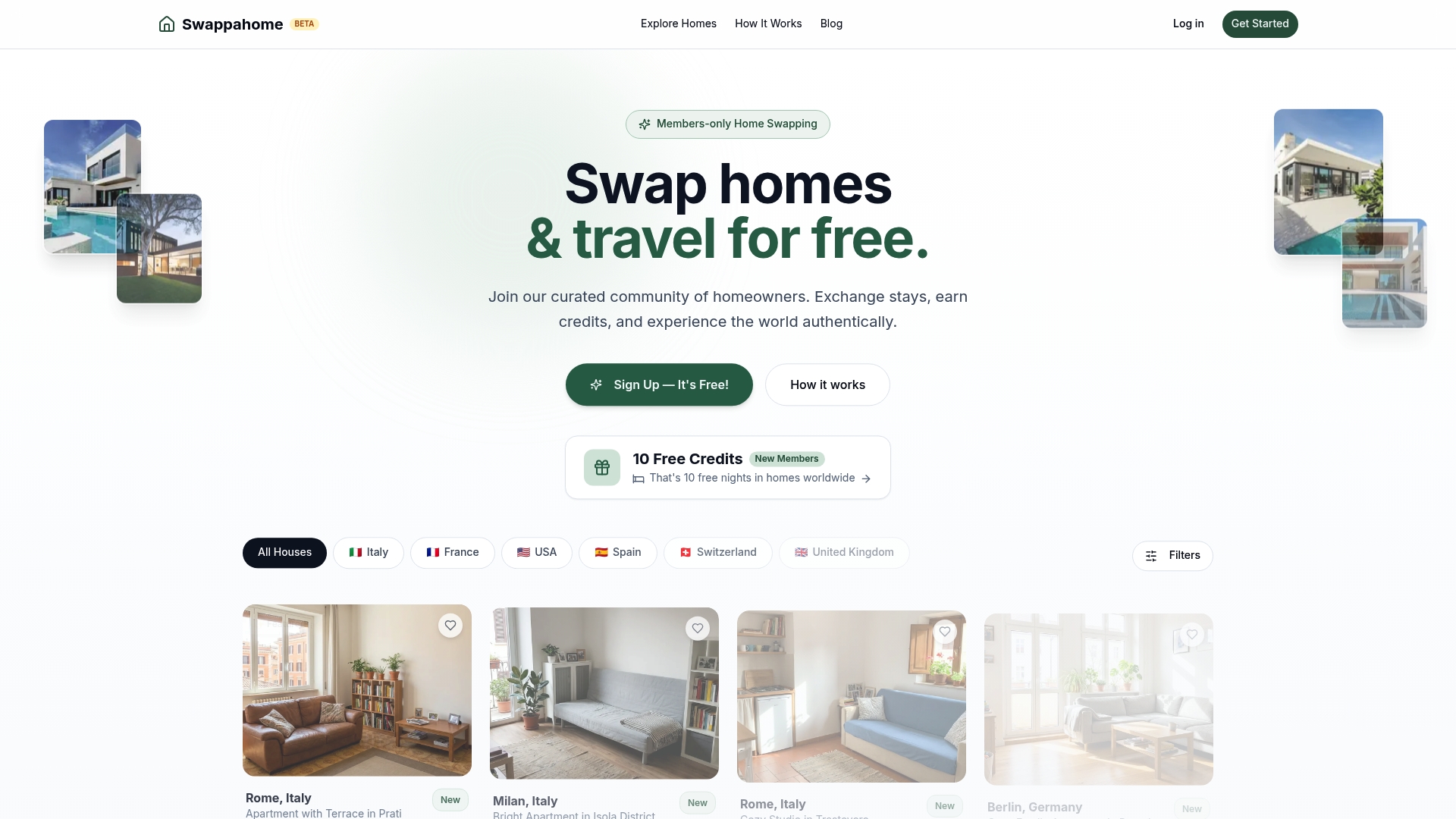 https://swappahome.com
Preparing your home network before listing on Swappahome is one of the most practical steps you can take. A segmented guest network, a documented Wi-Fi password, and remote access to your smart home devices signal to guests that you take hosting seriously. Travelers who explore verified listings on Swappahome can filter by location and availability, then connect with hosts who have prepared their homes for exactly this kind of exchange. Visit Swappahome to list your home and start building your global swap network today.
FAQ
What is a global home network?
A global home network is a multi-site residential network that connects two or more homes through encrypted tunnels, shared security policies, and unified device management. It allows homeowners to control devices and manage connectivity across locations as if they were on one local network.
Why is VLAN segmentation important for home swapping?
VLAN segmentation isolates guest devices, IoT systems, and personal devices into separate network zones. This prevents a guest or a compromised smart device from accessing your private files or trusted hardware.
What is the best VPN method for connecting multiple homes?
Mesh VPNs like WireGuard or Tailscale are the recommended approach. They create encrypted site-to-site tunnels without opening inbound ports, which is far more secure than traditional port forwarding.
How do I avoid IP conflicts across multiple home networks?
Assign each home a unique private IP range, such as 10.1.0.x for one site and 10.2.0.x for another. Avoid the default 192.168.1.x range at every location, since overlapping subnets cause immediate routing failures.
How does a well-configured network improve the home swap experience?
A dedicated guest SSID, remote smart home access, and clear Wi-Fi instructions give swap guests a reliable, secure connection from the moment they arrive. Hosts who prepare their homes thoroughly consistently report smoother exchanges and better guest feedback.
Recommended

Published by
SwappaHome
SwappaHome Editorial Team
Home Exchange & Slow Travel Editorial
The SwappaHome Editorial Team brings together travel research, home-exchange community insights, and platform data to produce practical guides for first-time and experienced home swappers. Every article cites real platforms, current market rates, and verifiable city-level facts so readers can make informed decisions without guessing.
Ready to try home swapping?
Join SwappaHome and start traveling by exchanging homes. Get 7 free credits when you sign up!