Digital Nomad Housing: Your Complete 2026 Guide

SwappaHome Editorial Team
Home Exchange & Slow Travel Editorial
Digital Nomad Housing: Your Complete 2026 Guide !Woman working in digital nomad coliving space > TL;DR: > > - Digital nomad housing offers mid-term,...
Digital Nomad Housing: Your Complete 2026 Guide
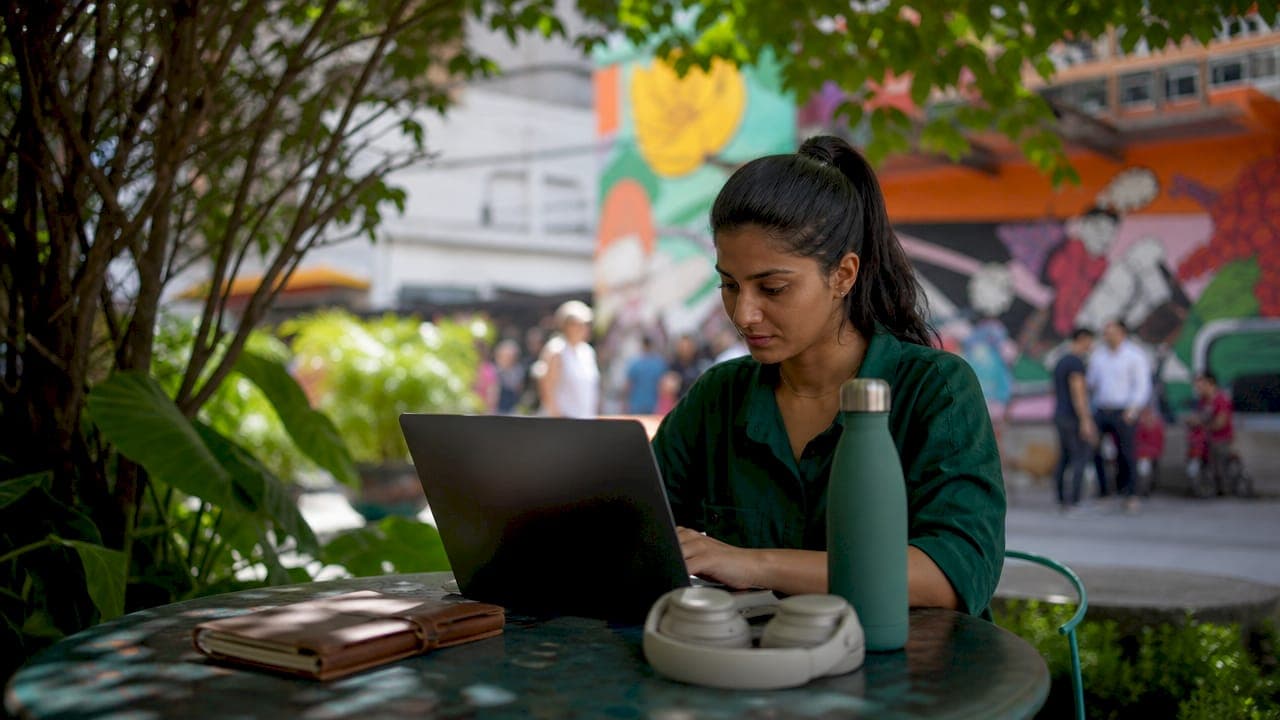
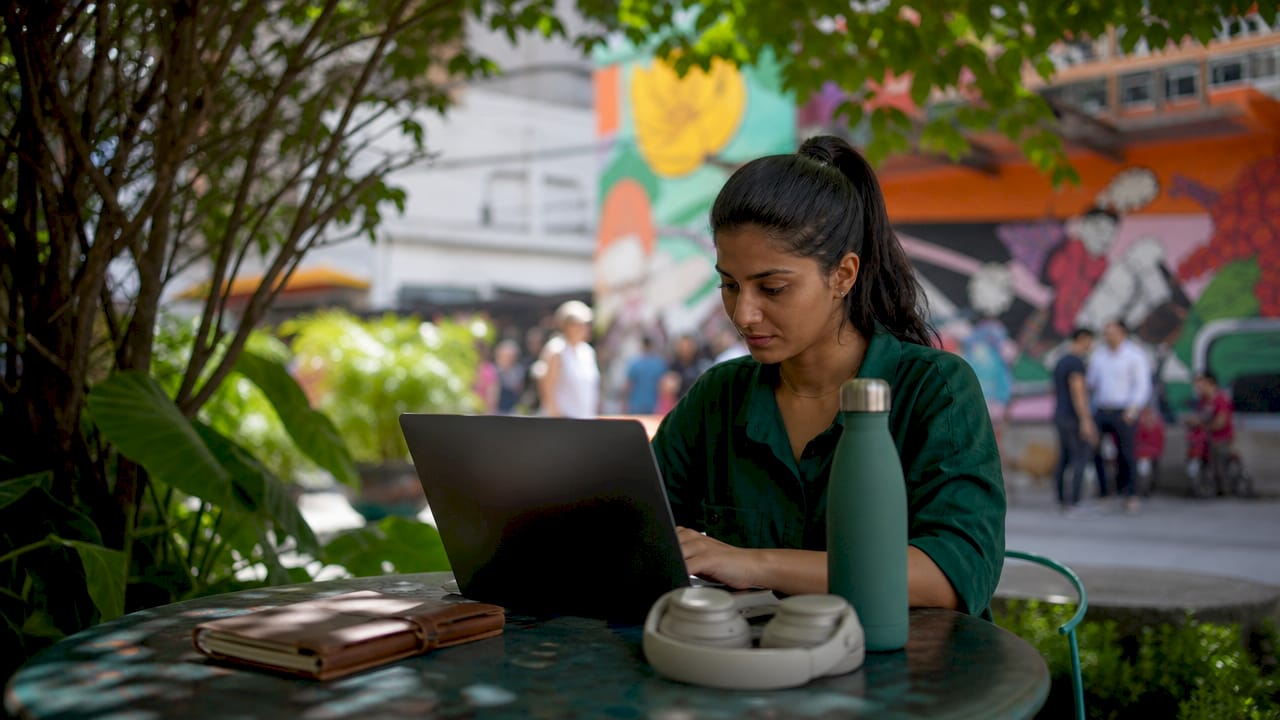 Woman working in digital nomad coliving space
TL;DR:
- Digital nomad housing offers mid-term, all-inclusive accommodation tailored for remote workers needing flexible stays.
- Most nomads rotate between coliving, furnished apartments, housesitting, and home swapping to balance cost, community, and productivity.
Digital nomad housing is a distinct category of accommodation designed for remote professionals who need flexible, mid-term stays with amenities like reliable internet, all-inclusive pricing, and community access. Unlike a hotel or a standard lease, this type of mid-term accommodation targets stays between one and six months. Platforms like Outsite, Airbnb, TrustedHousesitters, and Swappahome each serve this niche differently. The right choice depends on your work style, social needs, and budget. This guide breaks down every major option so you can make a clear, confident decision.
What is digital nomad housing, and who is it for?
Digital nomad housing is defined as accommodation built around the needs of location-independent workers who stay in one place for one to six months at a time. Standard leases demand guarantors, deposits, and year-long commitments. Short-term rentals like Airbnb cover a few nights or weeks but become expensive at scale. Mid-term rental platforms fill the gap by offering 30-day minimums with utilities and high-speed WiFi bundled into one monthly rate. That single-price model removes the friction of setting up local utilities, which is a real obstacle when you are moving every few months.
 Man arranging workspace in studio apartment
The audience for this type of accommodation is broad. It includes software developers, designers, writers, consultants, and anyone whose work requires only a laptop and a reliable connection. What unites them is a need for flexibility without the chaos of nightly hotel rates or the rigidity of a traditional lease.
What accommodation options are available for digital nomads?
Four main housing types dominate the digital nomad market. Each serves a different combination of budget, lifestyle, and work priorities.
-
Coliving spaces offer private rooms inside a shared building with common kitchens, lounges, coworking desks, and organized social events. Outsite is a well-known example, combining private rooms, coworking access, and community programming in one monthly fee. Coliving monthly rates start around $570 to $750, with utilities, cleaning, and gym access included. The all-in-one pricing makes budgeting straightforward.
-
Furnished apartments give you full control over your environment. You rent a private unit with furniture, a kitchen, and usually a dedicated workspace. Costs vary widely by city, but you pay for privacy and quiet. There are no shared spaces, no community events, and no built-in social network.
-
Housesitting is one of the most cost-effective options available. Platforms like TrustedHousesitters connect homeowners with travelers who care for a property and pets in exchange for free accommodation. The annual membership fee runs around $129 per year. That is the only cost if you secure sits consistently.
-
Home swapping lets two homeowners exchange their properties for a set period. Swappahome operates on a credit system where one credit equals one free night. You earn credits by hosting other members, then spend them on stays worldwide. The result is free accommodation with a local, lived-in experience that no hotel can replicate.
Pro Tip: If you are new to nomad life, start with a one-month coliving stay. The built-in community and coworking access reduce the learning curve of working remotely in a new city.
How do the costs and benefits compare among digital nomad housing options?
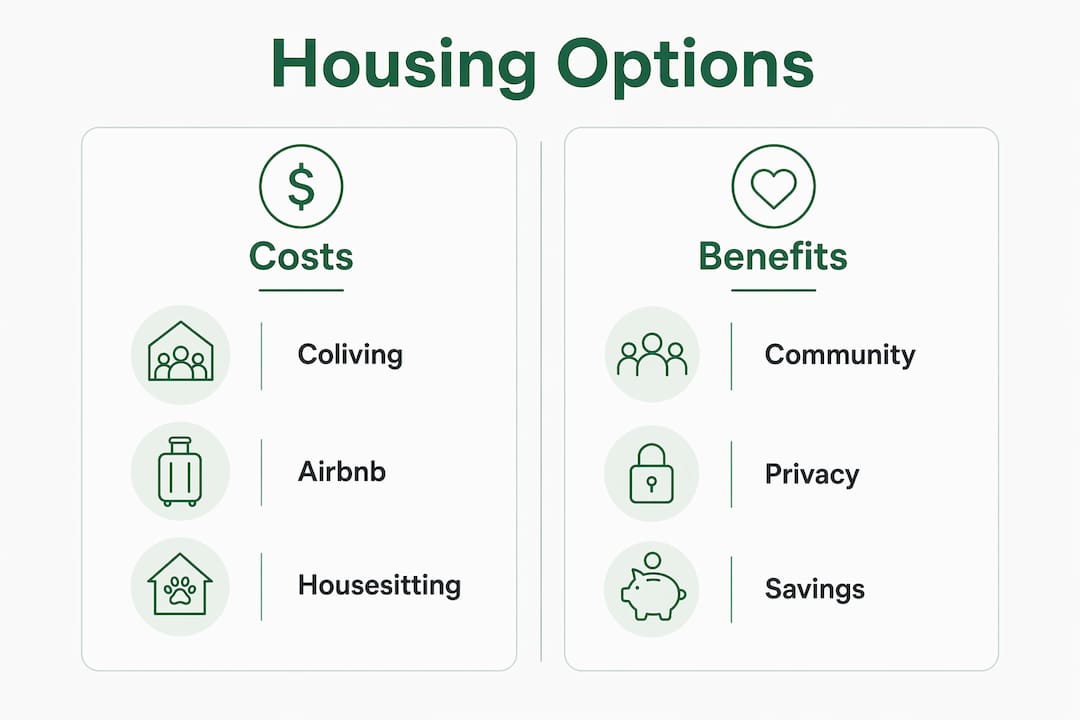 Infographic comparing digital nomad housing costs and benefits
Cost is never just the monthly rate. What is included, what is hidden, and what you give up all factor into the real value of any housing choice.
Airbnb monthly discounts often look attractive until you add cleaning fees and service charges. Nomad-specific platforms avoid this by building all costs into one transparent rate. That distinction matters when you are planning a three-month stay and need to forecast expenses accurately.
| Housing type | Typical monthly cost | What is included | Key trade-off |
|---|---|---|---|
| Coliving space | $570–$750 | Utilities, WiFi, cleaning, coworking, events | Less privacy, shared spaces |
| Furnished apartment | Varies by city | Furniture, kitchen, private workspace | No community, utilities often separate |
| Housesitting | ~$129/year membership | Free stay in exchange for property care | Dependent on sit availability |
| Home swapping | Credit-based, no cash | Free nights, local immersion | Requires owning a home to list |
The social premium of coliving is a real cost factor that most nomads underestimate. Loneliness is one of the top reasons people abandon the nomad lifestyle within the first year. A coliving membership fee that includes community events is not a luxury. It is a retention tool for your own mental health and productivity.
Housesitting offers the highest savings on paper, but availability is unpredictable. You cannot always find a sit in the city you want, during the month you need it. That uncertainty makes it a poor primary strategy but an excellent supplement.
Pro Tip: Always calculate the per-night cost of any monthly rental, then compare it to what you would pay for a coworking day pass plus a separate apartment. Coliving often wins on total value, not just price.
How do digital nomads choose housing based on work and social priorities?
Housing is a productivity investment, not just a line item on a budget. Poor ergonomics and unstable internet reduce daily work capacity and, over time, income potential. A cheaper apartment that costs you two hours of productivity per day is not actually cheaper.
Experienced nomads treat housing as a rotating strategy rather than a fixed choice. The typical pattern looks like this:
-
Furnished apartment for focused work phases. When you have a deadline, a client launch, or a period requiring deep concentration, a private apartment gives you control over noise, schedule, and workspace setup. There are no shared kitchens, no social obligations, and no distractions.
-
Coliving for social recharge periods. After two or three months of isolated apartment living, community-focused coliving restores social energy. Organized events, shared meals, and coworking spaces create natural opportunities to meet other remote workers without the effort of building a social life from scratch.
-
Housesitting for cost-saving stretches. A three-month housesit in a desirable location can eliminate rent entirely. That savings can fund a month of coliving or a flight to the next destination.
-
Home swapping for cultural immersion. Swapping homes through a platform like Swappahome places you in a real neighborhood, with a real kitchen and local context. It is the closest thing to actually living somewhere rather than visiting.
-
Rotation based on goals, not habit. Successful nomads typically spend three to four months housesitting, four to five months in furnished apartments, and two to three months in coliving spaces per year. That split optimizes cost, community, and productivity across a twelve-month cycle.
The key insight is that no single housing type serves all needs. Treating each option as a tool for a specific phase makes the whole system work.
What practical tips help find and book ideal digital nomad housing?
Finding good digital nomad accommodation requires using the right platforms and asking the right questions before you book.
-
Use platforms built for 30-day stays. Flatio and Outsite specialize in mid-term rentals and list properties sized for nomads. They avoid the guarantor and deposit requirements that block nomads from standard rental markets. Swappahome's home swap listings offer another route for homeowners who want cost-free stays.
-
Demand transparent pricing. Ask for the total monthly cost including utilities, cleaning, and any platform fees before committing. Hidden fees are the most common source of budget overruns in mid-term rentals.
-
Check the workspace before the bedroom. Desk height, chair quality, natural light, and internet speed matter more than interior design. Request a speed test result or a photo of the workspace setup. A reliable internet connection is non-negotiable for remote work.
-
Ask about community management in coliving. Not all coliving spaces are equal. Some have active community managers who organize events and introductions. Others are just shared apartments with a marketing label. Ask how many events run per month and what the average occupancy is.
-
Book early for popular locations. Cities like Lisbon, Chiang Mai, Medellín, and Tbilisi have strong nomad communities and high demand for quality housing. The best coliving spots and furnished apartments in these cities fill up weeks in advance.
-
Consider home exchange for New York and other high-cost cities. A home exchange in New York can eliminate what would otherwise be one of the most expensive accommodation costs in the world.
Key takeaways
Digital nomad housing works best as a rotating strategy that matches each accommodation type to a specific work or social goal, not as a single fixed choice.
| Point | Details |
|---|---|
| Mid-term focus | Digital nomad housing targets 1–6 month stays with all-inclusive pricing and flexible terms. |
| Four main options | Coliving, furnished apartments, housesitting, and home swapping each serve different needs and budgets. |
| Rotate strategically | Most experienced nomads split the year across housing types to balance cost, community, and productivity. |
| Coliving costs more than rent | Monthly rates of $570–$750 include utilities, coworking, and community, making total value competitive. |
| Housesitting saves the most | A $129 annual membership on TrustedHousesitters can eliminate rent costs for months at a time. |
What I have learned from years of watching nomads get housing wrong
Most nomads overprioritize price and underprioritize workspace. I have seen people book the cheapest apartment in a great city, only to spend their first week hunting for a café with reliable WiFi because the apartment's connection was unusable. That is not a savings. That is a tax on your time.
The second mistake is treating coliving as a permanent solution. It is not. The social energy that makes coliving valuable in month one becomes noise by month three. The nomads who thrive long-term are the ones who rotate deliberately. They use coliving to build a network, then retreat to a furnished apartment to do the actual work.
Home swapping is the most underused option in this space. Most people assume you need a premium property to participate. You do not. A clean, well-located home with good internet is enough to earn credits on a platform like Swappahome. Those credits then fund stays in cities that would otherwise be unaffordable. The home swapping model for nomads is genuinely one of the most cost-effective strategies available, and it comes with a cultural depth that no hotel or coliving space can match.
The nomads who last are not the ones who found the cheapest option. They are the ones who built a system.
— Swappa
Swappahome: free stays for nomads who own a home
Home swapping is one of the most cost-effective digital nomad living options available to homeowners. Swappahome is a members-only platform where verified homeowners list their properties, earn credits for hosting, and use those credits to stay in other members' homes worldwide at no cash cost.
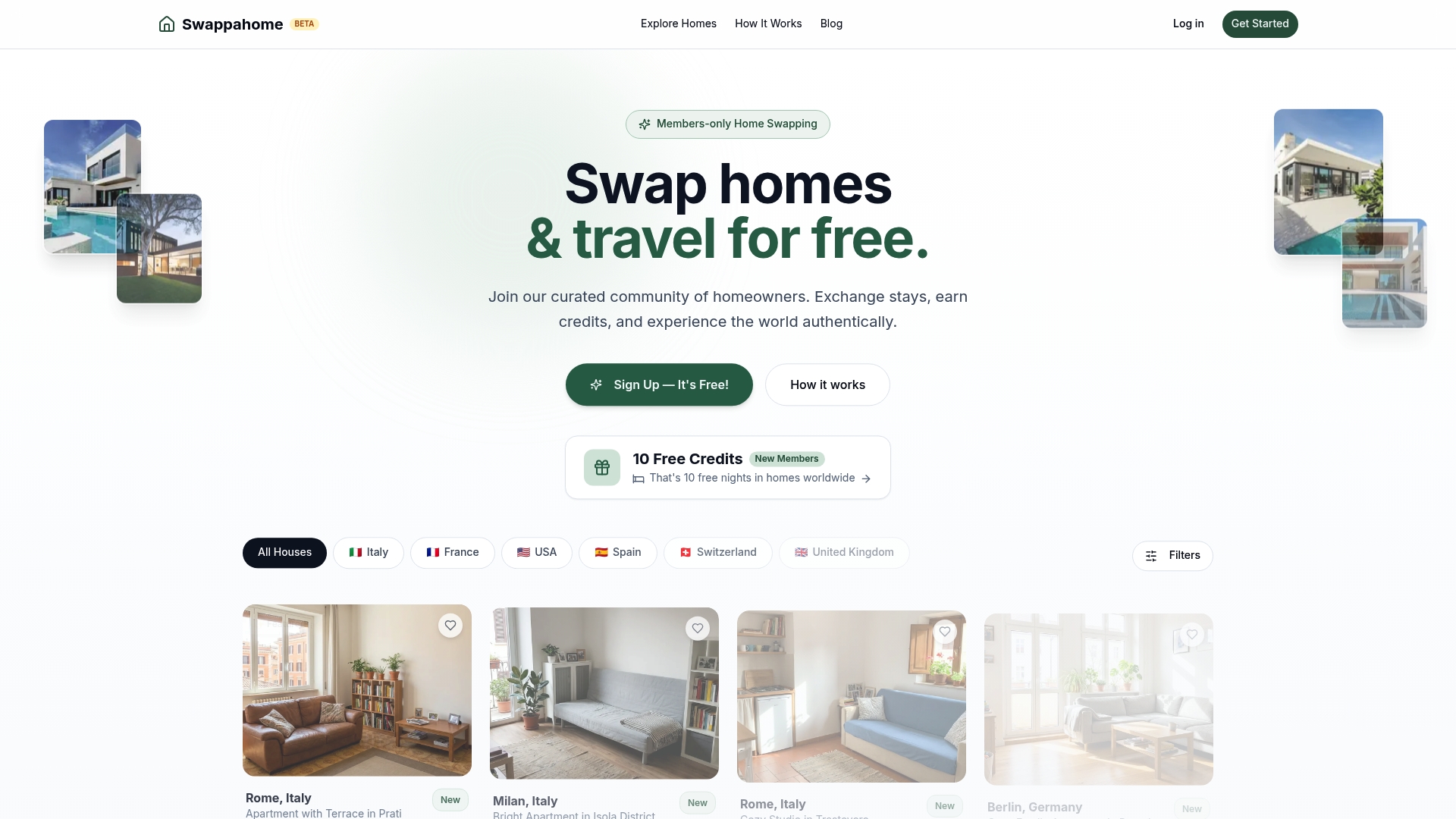 https://swappahome.com
One credit equals one free night. New members receive free credits to get started. The platform focuses on verified listings and a curated community, which means you are exchanging with real homeowners, not anonymous listings. For nomads who own property and want to reduce accommodation costs while experiencing cities like a local, Swappahome is the most direct path to free, authentic stays.
FAQ
What is digital nomad housing?
Digital nomad housing is accommodation designed for remote workers who need flexible, mid-term stays of one to six months. It typically includes all-inclusive pricing with utilities, high-speed WiFi, and features like coworking access or community events.
How much does digital nomad accommodation cost per month?
Coliving spaces start around $570 to $750 per month with utilities and coworking included. Housesitting through platforms like TrustedHousesitters costs roughly $129 per year in membership fees, with individual stays free of charge.
What is the best housing option for digital nomads who work remotely?
The best option depends on your current priority. Furnished apartments suit focused work phases. Coliving spaces suit social recharge periods. Housesitting and home swapping suit cost-saving stretches. Most experienced nomads rotate between all four across a twelve-month cycle.
How do I find digital nomad housing without a guarantor or long lease?
Platforms like Flatio and Outsite specialize in 30-day minimum stays and do not require guarantors or large deposits. Home swapping platforms like Swappahome offer credit-based stays with no cash transaction required.
Is home swapping a realistic option for digital nomads?
Home swapping is realistic for any nomad who owns a property. Platforms like Swappahome use a credit system where hosting earns credits redeemable for free nights globally. It is one of the few housing models that eliminates accommodation costs entirely while providing a local, lived-in experience.
Recommended

Published by
SwappaHome
SwappaHome Editorial Team
Home Exchange & Slow Travel Editorial
The SwappaHome Editorial Team brings together travel research, home-exchange community insights, and platform data to produce practical guides for first-time and experienced home swappers. Every article cites real platforms, current market rates, and verifiable city-level facts so readers can make informed decisions without guessing.
Ready to try home swapping?
Join SwappaHome and start traveling by exchanging homes. Get 7 free credits when you sign up!