Discover free accommodation networks for affordable travel

SwappaHome Editorial Team
Home Exchange & Slow Travel Editorial
Discover free accommodation networks for affordable travel !Woman searches home swap listings on laptop > TL;DR: > > - Home swapping platforms enable...
Discover free accommodation networks for affordable travel
 Woman searches home swap listings on laptop
TL;DR:
- Home swapping platforms enable free accommodation through verified memberships and property exchanges.
- Trust, honest communication, and clear expectations are vital for successful home swaps.
- This model offers authentic local experiences and significant savings for organized, culturally curious travelers.
Most people assume that "free" travel accommodation is either a scam or a fantasy reserved for people with the right connections. The reality is more interesting. Free accommodation networks are home swapping platforms where homeowners trade stays through annual memberships rather than per-night fees, making genuine cost-free lodging possible for ordinary travelers. These platforms connect budget-conscious homeowners across the globe who want to see the world without draining their savings on hotels. This guide breaks down exactly how they work, what you gain, and what you need to watch out for.
Table of Contents
- What is a free accommodation network?
- How does home swapping actually work?
- Why trust matters in free accommodation networks
- Pros and cons of free accommodation networks
- The truth about free accommodation networks: What nobody tells you
- Ready to try home swapping? Start your journey with SwappaHome
- Frequently asked questions
Key Takeaways
| Point | Details |
|---|---|
| Home swapping basics | Free accommodation networks let you exchange homes directly for budget travel and cultural immersion. |
| Trust is everything | Choosing networks with verified members and reviews ensures safer, more enjoyable stays. |
| Not truly cost-free | Most platforms require annual fees and possible costs for cleaning or insurance. |
| Best for flexible travelers | Those with adaptable plans and open communication get the most out of home swapping. |
What is a free accommodation network?
A free accommodation network is a structured system that lets homeowners exchange their properties with other verified members, eliminating per-night accommodation costs entirely. Think of it as a global neighborhood where every house on the street is potentially your next vacation home.
Rather than paying for a hotel or a short-term rental, you offer your home to another member while staying in theirs. The appeal of home swap travel lies in the simplicity: one annual membership fee replaces hundreds or even thousands of dollars in accommodation costs across an entire year of travel.
Most free accommodation networks share a few key features:
- Membership verification: Members submit identity documents and profile details to prove they're real homeowners or long-term residents
- Review systems: After each exchange, both parties leave reviews, creating a track record that builds trust over time
- Exchange structures: Some platforms use direct swaps (simultaneous stays), while others use credits or points for non-simultaneous exchanges
- Communication tools: Built-in messaging allows you to get to know your exchange partner before committing to a stay
Understanding how platforms work in detail can save you a lot of confusion when you sign up for the first time. It's also worth getting familiar with home exchange terms before you dive in, since words like "simultaneous swap," "hospitality exchange," and "credit-based system" all mean different things.
Here's a quick comparison of common network features to help you understand what to look for:
| Feature | Direct swap platforms | Credit-based platforms |
|---|---|---|
| Timing | Both parties travel simultaneously | Flexible, travel independently |
| Flexibility | Lower (must align schedules) | Higher (earn and spend credits freely) |
| Best for | Couples, retirees with open calendars | Families, remote workers |
| Fee structure | Annual membership | Annual membership plus credits |
| Trust mechanism | Profile reviews, ID verification | Reviews, verified listings |
The credit-based model, like the one used by SwappaHome, is especially practical. You earn one credit for each night you host a member in your home, and you spend one credit for each night you stay in someone else's. This removes the need to find a perfect schedule match, which is often the biggest logistical hurdle for first-time swappers.
How does home swapping actually work?
With a clear definition in mind, let's walk through the practical steps involved in arranging a home swap.
The process is more straightforward than most people expect. Here's how a typical exchange unfolds from start to finish:
- Create your listing. Add detailed photos, a description of your home, and information about your neighborhood. The more honest and inviting your listing, the more interest you'll attract.
- Set your availability. Mark the dates when your home is available for guests and when you'd like to travel.
- Browse other listings. Search for homes in destinations that interest you, filtering by size, amenities, and availability.
- Send a request or earn credits. On credit-based platforms, you host first to build credits, then spend them to book stays. On direct swap platforms, you negotiate a simultaneous exchange with another member.
- Communicate with your exchange partner. This is important. Talk through expectations, house rules, parking, pets, and any quirks about your property.
- Confirm the exchange. Once both parties agree, the booking is confirmed and both listings are updated.
- Prepare your home. Clean thoroughly, leave a guide with local tips, and arrange key handover.
- Travel and enjoy. Stay in your host's home, leave it as you found it, and leave an honest review afterward.
There are some important edge cases to be aware of before you sign up. Renters need landlord approval and must review their lease agreements carefully. Rural areas can have limited availability because most listings cluster in cities and popular destinations. Damage insurance is typically not provided by the platform itself, so you should rely on your own homeowner's insurance or your host's coverage. Cleaning fees are sometimes negotiated separately between exchange partners, so clarify this upfront.
A cleaning checklist before every exchange is one of the simplest ways to protect your relationship with your host community. Guests who leave homes spotless consistently earn better reviews and more future bookings.
Pro Tip: If you're a renter and want to join a home swap network, start by having an honest conversation with your landlord. Frame it around the fact that a verified, screened traveler will be staying temporarily rather than an unknown stranger. Many landlords are open to it once they understand the process.
Why trust matters in free accommodation networks
Of course, offering your home to a stranger involves trust. Here's how free accommodation networks foster safe, positive exchanges.
Trust is the real currency of home swapping. Without it, the entire model collapses. This is why the best platforms invest heavily in profile verification, communication tools, and community standards rather than just listing volume.
Verified profiles are the first layer of safety. Members who submit identity documents and link social profiles give potential exchange partners something concrete to evaluate. Flexible dates also improve your chances of finding a great match, since rigid date requirements dramatically narrow the pool of available partners.
"Home swapping works because it's built on mutual respect, not money. When you invite someone into your home, you're making a human connection that no hotel can replicate." This is the mindset that separates successful swappers from frustrated ones.
Here's what the most experienced exchangers consistently do to build trust:
- Complete every section of their profile, including a personal bio, photos of themselves, and a description of their neighborhood
- Respond to messages quickly, ideally within 24 hours, to show reliability
- Request video calls before committing to exchanges with new members
- Read reviews carefully, paying attention to how hosts describe their guests, not just how guests rate the stay
- Ask specific questions, such as whether the neighborhood is walkable, whether there's parking, and whether any appliances have quirks
The contrast with transactional platforms like Airbnb is significant. On Airbnb, the relationship between host and guest is purely financial. On a free accommodation network, both parties are equally vulnerable, which paradoxically creates stronger accountability. You can learn more about building safety and community within these networks, and it's worth reading up on home swapping safety before your first exchange. You'll also find practical safety tips that cover everything from securing valuables to handling unexpected situations.
Home swapping is particularly well-suited to families and remote workers. Families benefit from having full kitchens, multiple bedrooms, and private outdoor space at no extra cost. Remote workers get reliable Wi-Fi, a real desk, and the ability to stay longer in one place without the cost spiraling out of control.
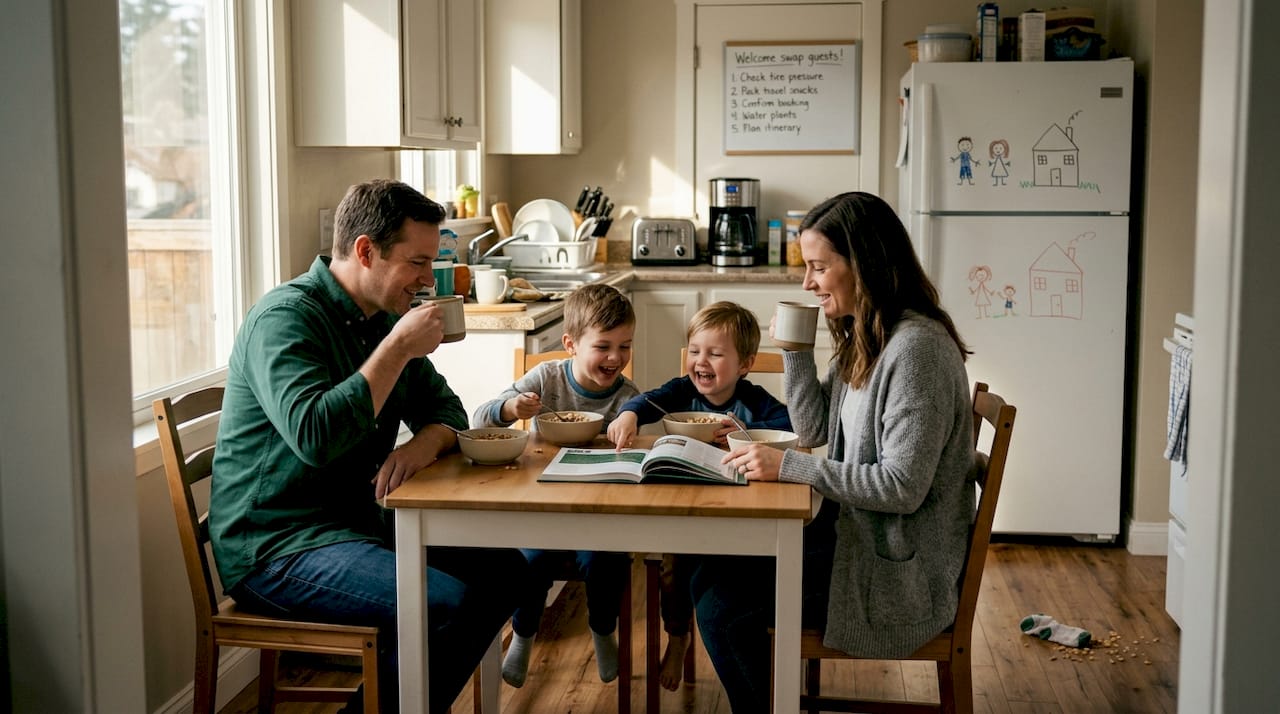 Family enjoying breakfast during home swap
Pros and cons of free accommodation networks
With trust and process explored, you may be weighing up whether home swapping is worth it. Here's a clear look at both sides.
No travel model is perfect, and home swapping is no exception. The key is knowing exactly what you're getting into so your expectations match reality.
Key advantages that experienced swappers highlight include:
- Dramatic cost savings, often eliminating the single largest travel expense entirely
- Living in real neighborhoods instead of tourist zones, which leads to more authentic experiences
- Meeting like-minded travelers who share your values around community and exchange
- Access to larger, more comfortable spaces than similarly-priced hotel rooms
- The opportunity to discover cities the way locals live in them
These benefits are well-documented, with regular swappers reporting meaningful savings on accommodation costs annually. For families traveling for two or three weeks, the financial difference between a home swap and a hotel can easily run into thousands of dollars.
Key drawbacks to consider include:
- Higher planning effort compared to booking a hotel room
- Reduced spontaneity because swaps usually require advance coordination
- Cleaning your home to a high standard before every exchange
- Managing the small but real risk of damage or misuse
- Finding matches in less popular destinations can take longer
| Pros | Cons |
|---|---|
| Zero per-night accommodation cost | Requires advance planning |
| Authentic local experience | Less flexibility for last-minute trips |
| Larger space (kitchen, garden) | Cleaning responsibility before each swap |
| Cultural connections and friendships | Limited listings in rural or remote areas |
| Ideal for families and long stays | No platform-provided damage insurance |
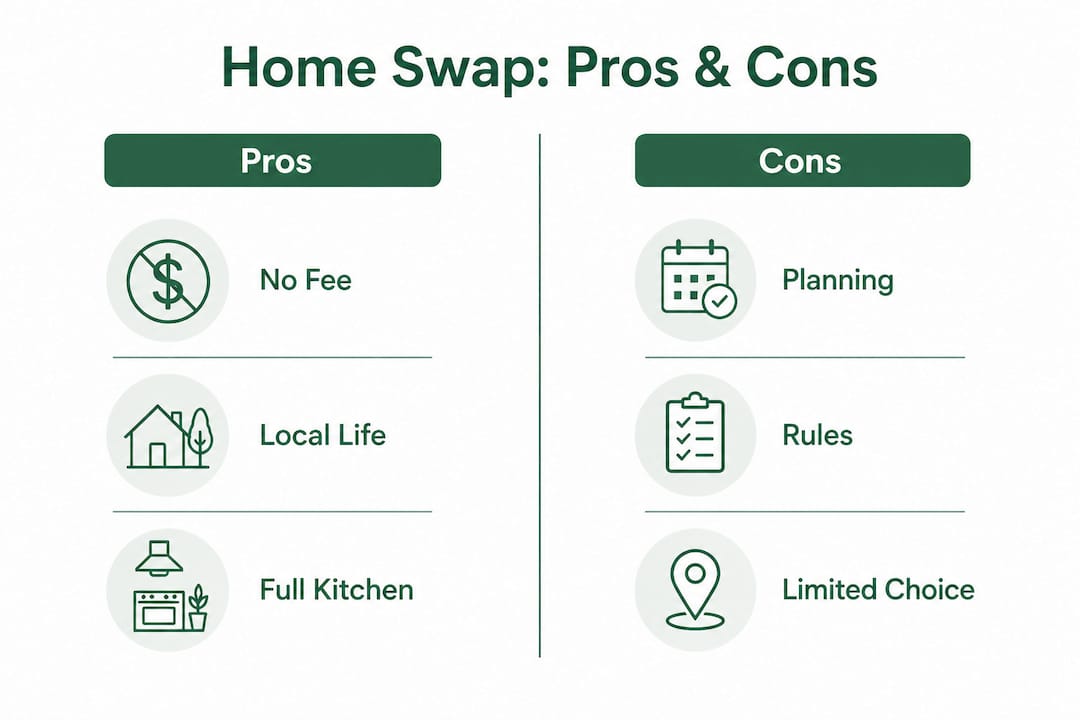 Infographic comparing pros and cons of home swapping
If you want to see how this model stacks up financially in detail, the comparison of home swapping vs Airbnb breaks down the real numbers clearly. You can also check out a roundup of the top exchange platforms to understand what different services offer in 2026 before deciding where to list your home.
The bottom line is that home swapping rewards people who are organized, communicative, and genuinely curious about other people's lives. If that sounds like you, the trade-offs are minor compared to the gains.
The truth about free accommodation networks: What nobody tells you
Here's something that first-time swappers rarely hear upfront: the best exchanges have almost nothing to do with logistics. They happen when both parties are genuinely excited about discovery, not just free lodging.
Most guides focus on the mechanics, the credits, the listings, the reviews. What they skip is the mindset shift that makes experienced swappers so enthusiastic. When you treat a home swap as a transaction ("I give you my house, you give me yours"), you optimize for the wrong things. You fixate on whether your listing is "worth" as much as theirs. You hesitate to reach out to homes in unfamiliar cities. You hold back personal touches from your welcome notes.
When you treat it as a cultural adventure, everything changes. You start reaching out to homes in cities you've never thought to visit. You leave local restaurant recommendations, not because you have to, but because you want to share something real. You come back with stories instead of just photos.
Transparency plays a critical role here. The most successful swappers are brutally honest in their listings. They mention the noisy neighbor, the temperamental oven, the neighborhood that's up-and-coming but still rough around the edges. This sounds counterintuitive, but honest listings attract better guests because those guests arrive with accurate expectations and tend to be more forgiving of minor issues.
Adaptability is the other key trait. Your exchange partner's home will not be yours. The shower might have weak pressure. The bed might be softer than you prefer. The kitchen might lack one tool you rely on at home. Travelers who thrive in home swaps treat these differences as part of the experience, not as failures of the system.
The community-building strategies that work best are also the most human ones. Write a personalized welcome message. Offer to answer questions about your city. Set ground rules early, not because you distrust your guest, but because clarity upfront prevents misunderstanding later. These habits, more than any platform feature, are what turn a first-time swap into a lifelong travel habit.
Ready to try home swapping? Start your journey with SwappaHome
If this guide sparked something, here's your practical next step.
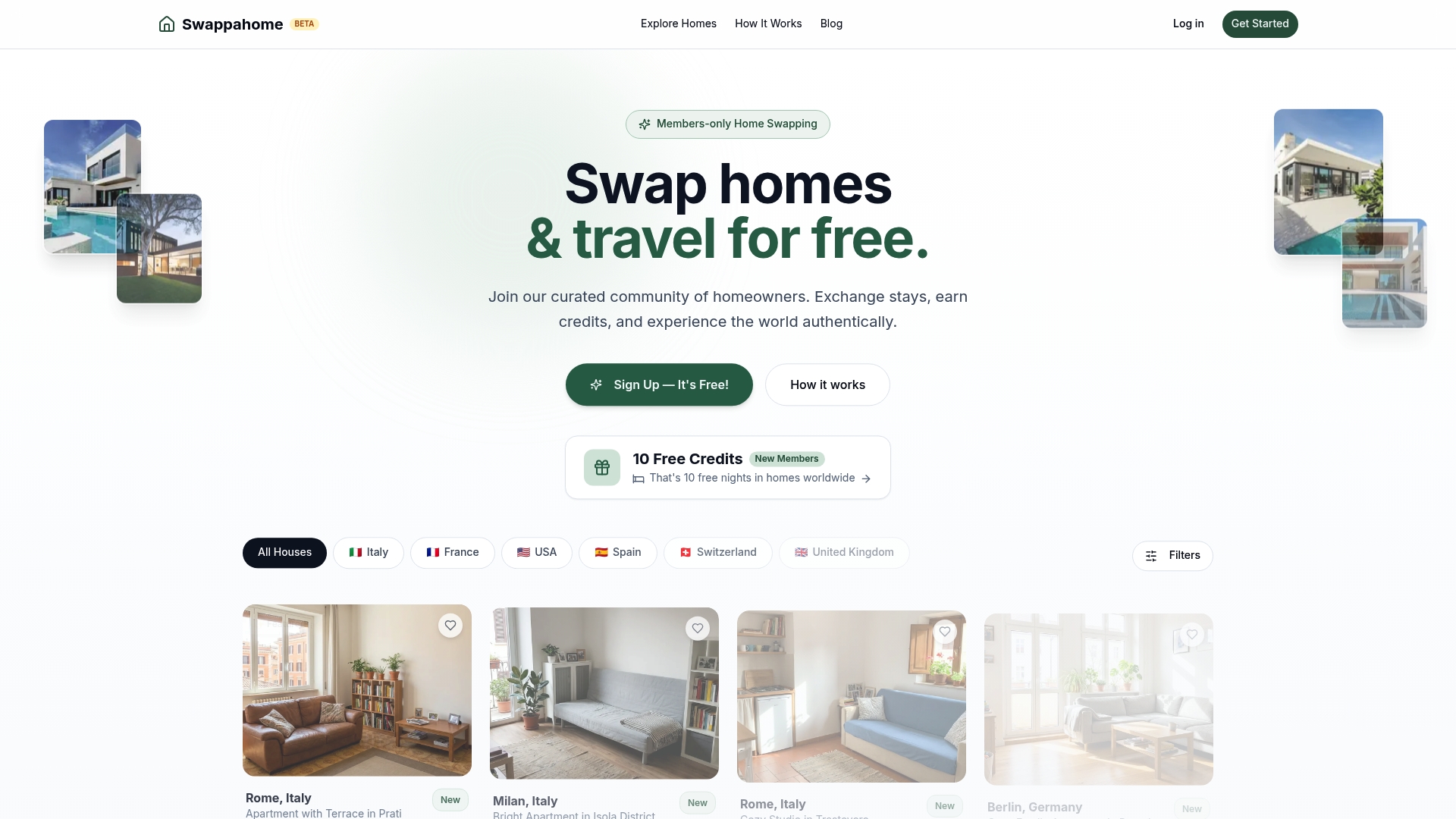 https://swappahome.com
SwappaHome is a members-only home swapping platform that connects verified homeowners around the world through a simple, credit-based system. One credit equals one free night. New members receive starter credits to get their first stay underway even before they've hosted anyone. You can browse home listings across dozens of countries right now to get a feel for what's available in the places you want to visit. Every listing is backed by SwappaHome's commitment to member verification and community standards, all of which you can read about on the SwappaHome trust and safety page. Authentic travel doesn't have to cost a fortune. It just needs the right community around it.
Frequently asked questions
Do you have to own your home to join a free accommodation network?
Not always, but renters need landlord approval and must comply with local lease rules before listing their space on any platform.
Are there costs involved with using these networks?
Most networks charge an annual membership fee instead of per-night costs, and cleaning fees may apply separately depending on what you negotiate with your exchange partner.
Is insurance provided by home swap networks?
Damage insurance is not included on most platforms, so you should rely on your existing homeowner's insurance or confirm coverage with your host before the exchange begins.
How can you ensure your safety during a home swap?
Use platforms that offer verified profiles and reviews, communicate thoroughly with your exchange partner before confirming, and set clear house rules from the start to avoid misunderstandings.
Recommended
- Top 8 Free Accommodation Solutions for Travelers 2026 | SwappaHome Blog
- 7 Smart Ways to Save on Accommodation While Traveling | SwappaHome Blog
- How travel networks unlock affordable home swapping worldwide | SwappaHome Blog
- Top 4 Budget Travel Exchange Services in 2026 | SwappaHome Blog
- Understanding Lisbon on a Budget: A Tourist's Guide

Published by
SwappaHome
SwappaHome Editorial Team
Home Exchange & Slow Travel Editorial
The SwappaHome Editorial Team brings together travel research, home-exchange community insights, and platform data to produce practical guides for first-time and experienced home swappers. Every article cites real platforms, current market rates, and verifiable city-level facts so readers can make informed decisions without guessing.
Ready to try home swapping?
Join SwappaHome and start traveling by exchanging homes. Get 7 free credits when you sign up!