Essential Safety Tips for Home Exchanging Success

SwappaHome Editorial Team
Home Exchange & Slow Travel Editorial
Essential Safety Tips for Home Exchanging Success !Couple reviewing home exchange security Finding a trustworthy way to explore new places without...
Essential Safety Tips for Home Exchanging Success
 Couple reviewing home exchange security
Finding a trustworthy way to explore new places without breaking the bank is a priority for many European homeowners. Swapping your home for an authentic travel experience brings incredible value, but concerns over safety and privacy can quickly dampen your excitement. By focusing on platform security and member verification, clear communication, and careful property preparation from the start, you can unlock stress-free exchanges and create memories instead of worries.
Table of Contents
- Step 1: Assess Platform Security And Member Verification
- Step 2: Communicate Clearly With Exchange Partners
- Step 3: Prepare And Safeguard Your Property
- Step 4: Set Up Emergency Info And Local Contacts
- Step 5: Verify Arrival, Departure, And House Condition
Quick Summary
| Important Insight | Clear Explanation |
|---|---|
| 1. Ensure Platform Security | Verify multi-factor authentication, member background checks, and security protocols before using a home exchange platform. |
| 2. Communicate Transparently with Partners | Use clear language, respond promptly, and establish mutual understanding to foster trust with exchange partners. |
| 3. Prepare Your Home Safely | Lock away valuables, secure sensitive documents, and create a welcoming environment for your exchange partner while ensuring your property remains protected. |
| 4. Develop an Emergency Plan | Compile a list of local emergency contacts and procedures to ensure safety and streamline communication in case of emergencies during the exchange. |
| 5. Document Property Condition Thoroughly | Use photographs and condition reports before and after the exchange to prevent potential disputes and ensure transparency about your home. |
Step 1: Assess Platform Security and Member Verification
Before embarking on your home exchange adventure, you need a rock-solid strategy to verify platform security and member credentials. Understanding how to thoroughly evaluate a platform's safety mechanisms will protect you from potential risks and ensure a smooth, trustworthy experience.
Start by examining the platform's security framework. OWASP Application Security Verification Standard recommends checking several critical authentication layers. Look for these core verification elements:
- Multi-factor authentication requirements
- Background checks for registered members
- Profile verification processes
- User review and rating systems
- Detailed member profile transparency
- Secure data encryption protocols
To determine a platform's credibility, investigate its comprehensive security controls. Pay attention to how thoroughly they validate user identities. Reputable platforms typically implement rigorous screening methods like government ID verification, social media cross-referencing, and detailed personal background checks.
Beyond basic checks, review the platform's specific security infrastructure. Examine their data protection policies, understand how they handle personal information, and confirm they use industry-standard encryption technologies. Platforms committed to member safety will transparently communicate their security approach.
Pro Tip: Always screenshot and save communication records with potential exchange partners as an additional personal safety precaution.
Step 2: Communicate Clearly With Exchange Partners
Successful home exchanges rely on clear, transparent, and proactive communication between potential partners. Your ability to establish trust, share expectations, and navigate potential cultural differences will make or break your home exchange experience.
Communicating with partners effectively requires strategic and thoughtful approaches. Here are key strategies to ensure smooth and meaningful dialogue:
- Use clear and concise language
- Be responsive and timely in your messages
- Ask specific and direct questions
- Share detailed information about your home and expectations
- Establish mutual understanding of exchange terms
- Confirm details in writing
When initiating communication, start by creating a comprehensive profile that highlights your personality, home characteristics, and exchange preferences. Include high-quality photos, describe your neighborhood, and be transparent about house rules. During initial conversations, focus on building rapport and understanding each other's motivations for home exchanging.
Open and honest communication is the foundation of a successful home exchange partnership.
Remain professional yet friendly, ask clarifying questions, and demonstrate genuine interest in your potential exchange partner's background and home. Listen actively, show respect for cultural differences, and be willing to adapt your communication style to ensure mutual comfort and understanding.
Pro Tip: Create a standardized communication template with key questions to help you consistently gather essential information from potential exchange partners.
Step 3: Prepare and Safeguard Your Property
Preparing your home for an exchange requires strategic planning and comprehensive safety measures. You'll need to protect your personal belongings, secure your living space, and create a welcoming environment for your exchange partner while maintaining your property's integrity.
Home safety guidelines recommend a systematic approach to property preparation. Here are critical steps to safeguard your home:
- Lock away personal valuables
- Secure sensitive documents
- Create designated safe storage areas
- Remove breakable items
- Prepare emergency contact information
- Child-proof or pet-proof spaces as needed
Start by conducting a thorough walkthrough of your home. Identify areas that require special attention, such as personal spaces that should remain off-limits. Consider investing in a small lockable cabinet or room where you can store irreplaceable items, important documents, and personal mementos. Remove fragile items, expensive electronics, and anything with significant personal or monetary value.
Your home's security is only as strong as its weakest point of protection.
Prepare a comprehensive house manual that includes essential information like wifi passwords, appliance instructions, neighborhood tips, and local emergency contacts. This not only helps your exchange partner feel welcome but also demonstrates your commitment to a smooth, transparent exchange experience.
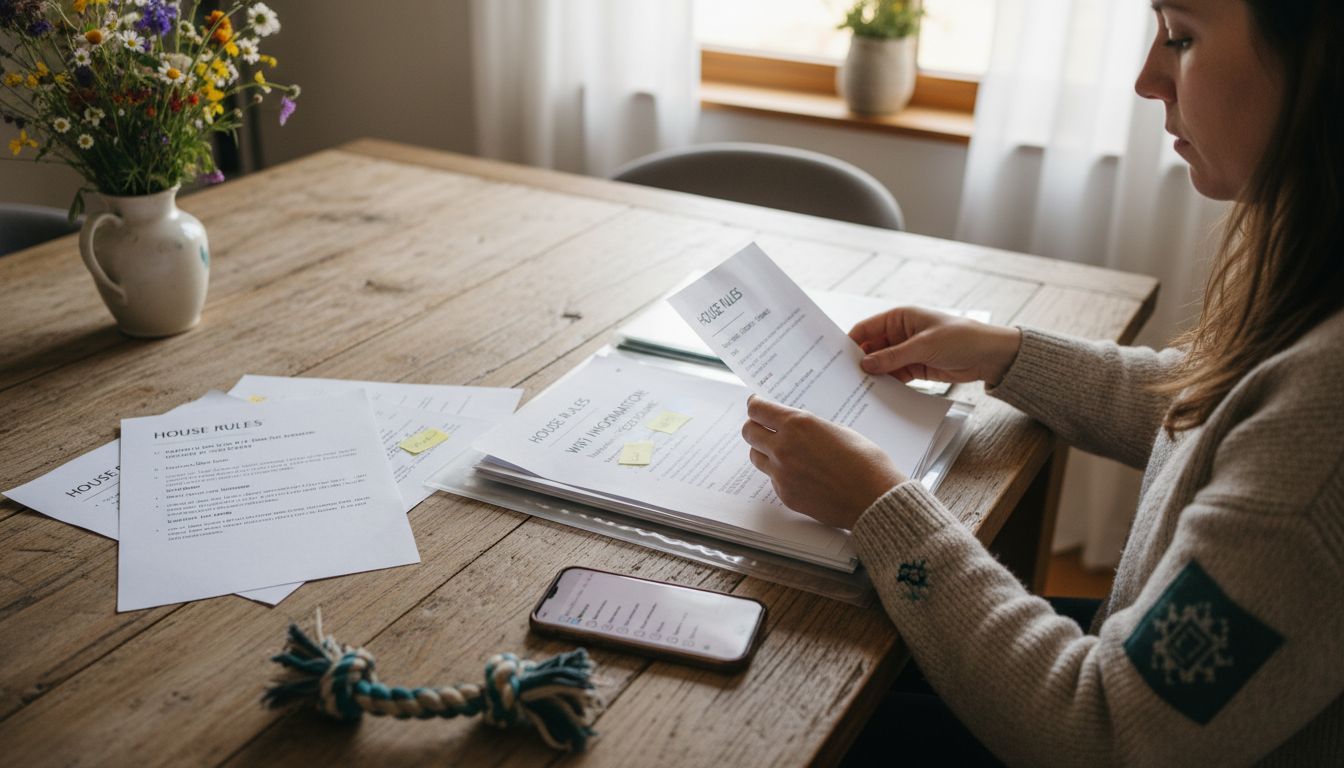 Preparing house manual for exchange guests
Pro Tip: Take high-quality photos of your home's condition before the exchange and create a detailed inventory of valuable items for your personal records.
Step 4: Set Up Emergency Info and Local Contacts
Creating a comprehensive emergency preparedness plan is crucial for ensuring your safety and providing peace of mind during a home exchange. Your goal is to develop a clear, accessible communication strategy that covers potential emergency scenarios and local resources.
Emergency communication planning requires a strategic and thorough approach. Compile an emergency contact list that includes:
- Local emergency services numbers
- Nearest hospital contact information
- Local police station details
- Trusted neighbor or emergency contact
- Family or personal emergency contacts
- Insurance and medical provider numbers
According to FEMA's planning guidelines, your emergency document should be comprehensive and easily accessible. Create a physical and digital copy of your emergency information packet. Include detailed evacuation routes, local shelter options, and step-by-step instructions for handling potential emergencies specific to your area.
A well-prepared emergency plan can make the difference between confusion and quick, effective action.
Consider creating a sealed envelope or digital folder with critical information for your exchange partner. This should include medical information, local emergency protocols, important contact numbers, and any specific instructions about your home or neighborhood. Make sure the information is clear, concise, and easy to understand for someone unfamiliar with your local area.
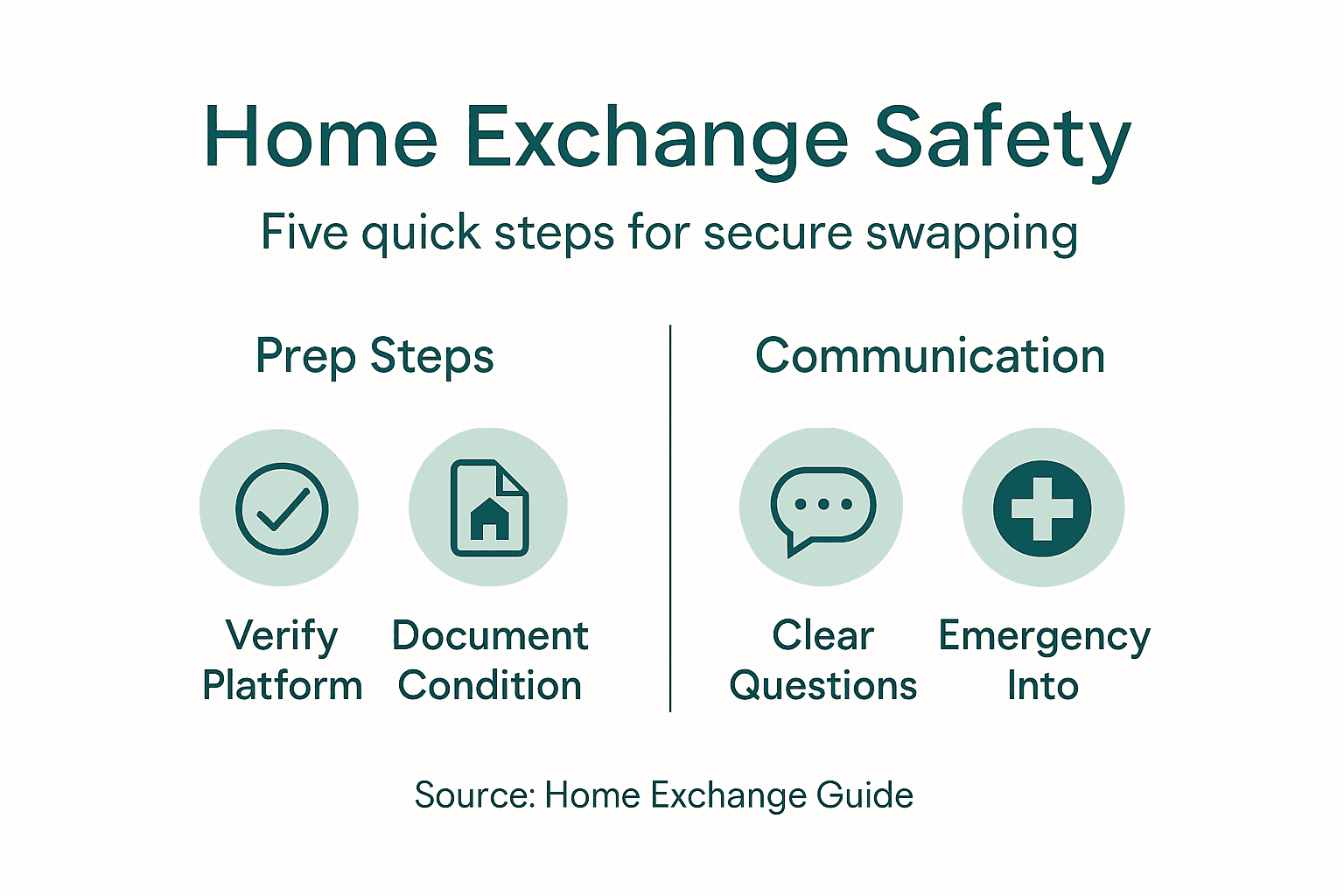 Infographic with home exchange safety steps
Below is a summary of useful emergency contact categories to include in your plan:
| Contact Type | Example Information | Why It's Important |
|---|---|---|
| Medical Assistance | Nearest hospital address | Fast access in emergencies |
| Police Services | Local station phone number | Report suspicious activity |
| Trusted Neighbor | Name and cell number | Immediate local support |
| Insurance Provider | Policy number, hotline | Quick claims processing |
Pro Tip: Translate your emergency document into the most likely language of your exchange partner to ensure clear communication during unexpected situations.
Step 5: Verify Arrival, Departure, and House Condition
Successful home exchanges depend on meticulous documentation and clear communication about your property's condition before and after the exchange. Your primary goal is to protect both parties and ensure a transparent, smooth experience that minimizes potential misunderstandings.
International arrival verification requires systematic documentation of your exchange partner's stay. Develop a comprehensive checklist that covers multiple aspects of house condition and exchange logistics:
- Photograph entire home before arrival
- Create detailed condition report
- Document existing wear and tear
- Note functional status of appliances
- Verify all key locations
- Record meter readings for utilities
Prepare a thorough welcome packet that includes a standardized condition assessment form. This document should have space for noting any pre-existing damages, appliance functionality, and overall home condition. Encourage your exchange partner to complete this form upon arrival and departure, creating a mutual record of the property's state.
Transparent documentation protects both the homeowner and exchange partner from potential disputes.
Schedule a virtual or in-person walkthrough if possible, either before the exchange or immediately upon arrival. This allows you to personally verify the home's condition and address any immediate concerns. Use timestamped photographs and written documentation to create an irrefutable record of the property's condition.
Here's a quick reference comparing common home exchange documentation methods:
| Method | Main Benefit | Potential Drawback |
|---|---|---|
| Physical Welcome Packet | Easy to access offline | Can be lost or damaged |
| Digital Folder | Easy to update, shareable | Requires device access |
| Standardized Condition Form | Ensures consistent records | May require translation |
| Timestamped Photos | Provides visual proof | Large file sizes possible |
Pro Tip: Create a digital folder with dated, high-resolution images of your home's condition, including close-ups of any existing scratches or wear to provide complete transparency.
Secure Your Home Exchange Journey with Swappahome
Home exchanging offers a fantastic way to experience new cultures while saving on accommodation costs. However, as highlighted in "Essential Safety Tips for Home Exchanging Success," challenges such as verifying member identities, safeguarding your property, and managing clear communication can cause uncertainty and risk. You want a trusted platform that values security, transparency, and a welcoming community.
Swappahome is designed specifically to address these concerns. With verified homeowners, a streamlined credit system, and an emphasis on transparent exchanges, Swappahome removes much of the guesswork. Feel confident in your safety preparations when you use a trusted network that supports detailed member verification and clear communication guidelines. Explore how easy and secure home exchanging can be by visiting Swappahome's Home, learn more about our commitment to safety and community, and start earning credits to enjoy worry-free stays worldwide.
 https://swappahome.com
Join Swappahome today and transform your travel experience with peace of mind, genuine cultural exchange, and verified homes across the globe. Secure your next adventure now at Swappahome.
Frequently Asked Questions
How can I verify the security of a home exchange platform?
To verify the security of a home exchange platform, examine its authentication mechanisms, such as multi-factor authentication and background checks for members. Look for transparent data protection policies and ensure they use strong encryption technologies to safeguard your personal information.
What should I communicate with my exchange partner before the swap?
Before the swap, communicate clearly about your home expectations, house rules, and any specific requirements you may have. Ask direct questions about their preferences and share detailed information about your home, such as amenities and neighborhood features.
What are the best practices for safeguarding my home during an exchange?
To safeguard your home during an exchange, lock away personal valuables and secure sensitive documents. Conduct a thorough walkthrough to identify items that should be removed or stored safely and create a welcoming environment for your exchange partner.
How can I prepare an emergency plan for my home exchange?
To prepare an emergency plan, compile a list of local emergency contacts, such as nearby hospitals and police stations. Include important phone numbers and specific instructions for your home, ensuring that both you and your exchange partner can access this information easily.
What documentation should I maintain regarding my property condition?
Maintain thorough documentation of your property's condition by taking high-resolution photos before the exchange and completing a condition report. Include detailed notes on any existing wear and tear and ensure both you and your exchange partner have access to this documentation to avoid misunderstandings.
Recommended
- Security in Home Swapping: What Homeowners Must Know | SwappaHome Blog
- 7 Steps to a Secure Home Swap Verification Checklist | SwappaHome Blog
- 7 Essential Tips for Your Home Swap Etiquette Checklist | SwappaHome Blog
- Home Swap Security: How to Protect Your Property | Complete Guide
- Things I wish I knew before doing a safari | Peak Planet
- Cycle Tour Safety – What Every Liverpool Visitor Needs

Published by
SwappaHome
SwappaHome Editorial Team
Home Exchange & Slow Travel Editorial
The SwappaHome Editorial Team brings together travel research, home-exchange community insights, and platform data to produce practical guides for first-time and experienced home swappers. Every article cites real platforms, current market rates, and verifiable city-level facts so readers can make informed decisions without guessing.
Ready to try home swapping?
Join SwappaHome and start traveling by exchanging homes. Get 7 free credits when you sign up!