
Exchange-Based Travel Examples for Authentic, Free Stays

SwappaHome Editorial Team
Home Exchange & Slow Travel Editorial
Exchange-Based Travel Examples for Authentic, Free Stays !Woman browsing home swapping options at kitchen table > TL;DR: > > - Exchange-based travel...
Exchange-Based Travel Examples for Authentic, Free Stays
 Woman browsing home swapping options at kitchen table
TL;DR:
- Exchange-based travel allows travelers to trade accommodations, labor, or cultural participation instead of paying cash. Home swapping, work exchanges, cultural programs, and house-sitting provide authentic experiences and significant savings by eliminating hotel costs. These options focus on cultural immersion, community, and flexibility, often requiring clear communication and responsible participation.
Exchange-based travel is defined as any arrangement where travelers trade accommodation, labor, or cultural participation in place of cash payment for a place to stay. The industry term for this category is "reciprocal travel exchange," and it covers everything from home swapping and work exchanges to structured cultural programs. Platforms like Swappahome, WWOOF, and Workaway have turned these arrangements into accessible, repeatable systems. The result: travelers stay in real homes, on real farms, and in real communities without paying hotel rates.
1. What are popular exchange-based travel examples?
Home swapping is the most direct form of exchange-based travel. You offer your home to another traveler while staying in theirs, either simultaneously or through a credit system. Platforms like Swappahome use a point-based model where one credit equals one free night, letting you bank stays and redeem them on your own schedule.
The financial case is strong. One traveler saved roughly $17,900 over multiple trips abroad through home swapping. That figure shows how quickly accommodation costs compound across multi-week trips, and how completely a swap eliminates them.
Home swapping also delivers something hotels cannot: a real neighborhood experience. You cook in someone's kitchen, walk their local streets, and live the way residents do. That depth of immersion is the reason repeat swappers rarely go back to booking hotels.
- Simultaneous swaps: Both parties exchange homes at the same time, ideal for families with fixed vacation windows.
- Credit-based swaps: You host a guest, earn credits, and redeem them later at a home of your choice, no schedule coordination required.
- Non-reciprocal swaps: You stay in a member's home without them staying in yours, funded entirely by credits you have accumulated.
Pro Tip: Schedule a video call with your swap partner before confirming. Pre-exchange video calls surface personality and cleanliness differences that written profiles miss, and they prevent the most common swap mismatches.
2. How do home swapping platforms handle safety and cost?
Safety is the first concern most new swappers raise, and it is a fair one. Home swapping platforms provide protection through insurance policies and host guarantees that cover property damage and liability. Experienced swappers consistently report that these safeguards removed their hesitation about hosting strangers.
Costs do exist, and you should budget for them honestly. Platform membership fees vary by provider. Cleaning fees average around $115 per trip. Those numbers are real, but they are a fraction of what a comparable hotel stay would cost in the same city.
Swappahome's verification process adds another layer of confidence. Every member is reviewed before listing, which means the community stays curated rather than open to anyone with an email address. You can browse verified homes worldwide across more than 50 countries before committing to anything.
Pro Tip: Read the platform's damage policy before your first swap. Knowing exactly what is covered lets you host with confidence instead of anxiety.
3. How do work exchange programs let travelers trade labor for stays?
Work exchange is a mutual agreement where travelers trade daily work hours for accommodation and often meals, with no salary or formal contract involved. The arrangement suits travelers who want to stay longer in one place and connect more deeply with local life.
 Volunteer planting seeds in community farm garden
The range of environments is wide. WWOOF places volunteers on organic farms. Worldpackers connects travelers with hostels, eco-projects, and community organizations. Workaway covers everything from animal sanctuaries to language schools. Each platform serves a different traveler passion, so matching your interests to the right platform matters more than picking the most popular one.
Typical commitments run four to six hours of work per day, five days a week. In exchange, you receive a bed and meals. The remaining time is yours to explore the region, learn skills, and build relationships with locals that no tour package replicates.
- WWOOF: Organic farming and sustainable agriculture projects worldwide.
- Worldpackers: Hostels, social impact projects, and eco-communities.
- Workaway: The broadest category, covering teaching, construction, childcare, and more.
- Working holiday visas: Government-backed programs for travelers aged 18–35 that can last up to 12 months with extensions in some countries.
Pro Tip: Read recent reviews from past volunteers on any platform before applying. Host quality varies significantly, and recent feedback tells you more than the host's own description.
4. What are cultural exchange programs and their typical features?
Cultural exchange programs are structured arrangements, usually run by institutions or nonprofits, that place travelers in host families or schools for a defined period. The focus is language learning, cultural immersion, and education rather than accommodation savings alone.
These programs typically run 2–4 weeks with full board and language immersion workshops included. Work-and-travel programs in the U.S. require at least a 2.5-month commitment. Seasonal programs can extend up to four months total.
The German American Partnership Program (GAPP) is one of the most established examples. Run through the Goethe-Institut, GAPP connects over 780 U.S. schools and has produced more than 400,000 alumni. It provides scholarships, travel grants, and bilateral school exchanges that create lifelong international relationships. That alumni network alone demonstrates the long-term value these programs generate beyond the trip itself.
- Identify your primary goal. Language fluency, cultural depth, and academic credit each point to different program types.
- Check accreditation. Institutional programs like GAPP carry more weight on academic records than informal arrangements.
- Confirm what is included. Full board, airport transfers, and insurance vary widely between providers.
- Ask about host family matching. Programs with structured matching processes produce better fits than those that assign randomly.
- Look for alumni networks. A strong alumni community signals a program that delivers lasting value, not just a short trip.
5. What opportunities and challenges do house-sitting exchanges offer?
House-sitting is an exchange where travelers care for a property, and often pets, in return for free accommodation. No money changes hands. The homeowner gets peace of mind while away; the traveler gets a private home at zero accommodation cost.
Trusted Housesitters is the best-known platform in this category. It connects homeowners with vetted sitters globally and handles the matching, reviews, and communication tools. The model works especially well for animal lovers who prefer a quiet home environment over hostels or hotels.
The challenges are real and worth knowing before you commit:
- Responsibility is non-negotiable. You are caring for someone's home and often their pets. Canceling last-minute causes serious problems for the homeowner.
- Flexibility is limited. Your schedule is tied to the homeowner's travel dates, not your own preferences.
- Trust takes time to build. New sitters with no reviews struggle to land their first assignment. Starting with shorter sits in less competitive locations builds your profile faster.
- Privacy is a genuine benefit. Unlike hostels or shared spaces, you have an entire home to yourself, which suits solo travelers and couples who value quiet.
Pro Tip: Apply to multiple sits simultaneously when you are starting out. Competition for popular destinations is high, and a broader application strategy improves your odds of landing a first review-building assignment.
6. How do these travel exchange options compare?
Choosing between home swapping, work exchange, cultural programs, and house-sitting depends on what you value most: cost savings, cultural depth, flexibility, or community. The table below maps each option against the factors that matter most to travelers.
| Exchange type | Work required | Typical duration | Accommodation cost | Cultural immersion | Family-friendly |
|---|---|---|---|---|---|
| Home swapping | None | Flexible | Free (plus fees) | High | Yes |
| Work exchange | 4–6 hours/day | Weeks to months | Free (with meals) | Very high | Limited |
| Cultural programs | Minimal | 2–4 weeks | Included | Very high | Limited |
| House-sitting | Pet/property care | Days to weeks | Free | Moderate | Situational |
Home swapping through a platform like Swappahome suits families and homeowners who want flexibility without committing to a work schedule. Work exchange suits solo travelers who want deep immersion and are comfortable with structured daily commitments. Cultural programs suit students and younger travelers with specific language or academic goals. House-sitting suits independent travelers who prefer privacy and have a flexible schedule.
Pro Tip: Combine exchange types on a longer trip. Spend two weeks in a home swap, then move to a work exchange for a month. You get variety, depth, and near-zero accommodation costs across the entire journey. The top vacation exchange platforms guide on the Swappahome blog breaks down which platforms work best together.
Key takeaways
Exchange-based travel programs, from home swapping to work exchanges, consistently deliver free or near-free accommodation alongside cultural immersion that standard hotel stays cannot replicate.
| Point | Details |
|---|---|
| Home swapping saves real money | One traveler saved $17,900 across multiple trips by swapping homes instead of booking hotels. |
| Platform protections reduce risk | Insurance and host guarantees on verified platforms address the most common safety concerns for new swappers. |
| Work exchange suits deep immersion | Trading 4–6 hours of daily labor for accommodation and meals produces stronger cultural connections than short stays. |
| Cultural programs offer structured benefits | Programs like GAPP provide scholarships, grants, and alumni networks that extend value well beyond the trip. |
| Match the exchange type to your goals | Families benefit most from home swapping; solo travelers gain more from work exchange or house-sitting. |
Why exchange travel changed how I think about going somewhere
Most travelers treat accommodation as a logistical problem to solve cheaply. I used to think the same way. What exchange-based travel taught me is that where you stay shapes what you experience more than any itinerary does.
When you stay in someone's home through a swap, you are not a guest passing through. You are a temporary resident. You find the coffee shop the locals use, not the one on the tourist map. You understand the neighborhood's rhythm because you live inside it for a week or two. That shift in perspective is not a side benefit. It is the whole point.
The travelers I have seen get the most out of these programs share one trait: they communicate clearly before they arrive. They ask questions, set expectations, and treat the exchange as a relationship rather than a transaction. The platforms handle the logistics. The human part is still up to you.
My honest recommendation: start with a home swap if you own or rent a place worth listing. The barrier to entry is low, the savings are immediate, and the authentic travel experience you get in return is something you will not find on any booking site.
— Swappa
Start your first home swap with Swappahome
Swappahome is a members-only platform built for homeowners who want to travel without paying for accommodation. You list your home, earn credits when you host, and redeem those credits for free nights at verified homes across more than 50 countries. New members receive free starter credits, so your first stay costs nothing beyond the membership.
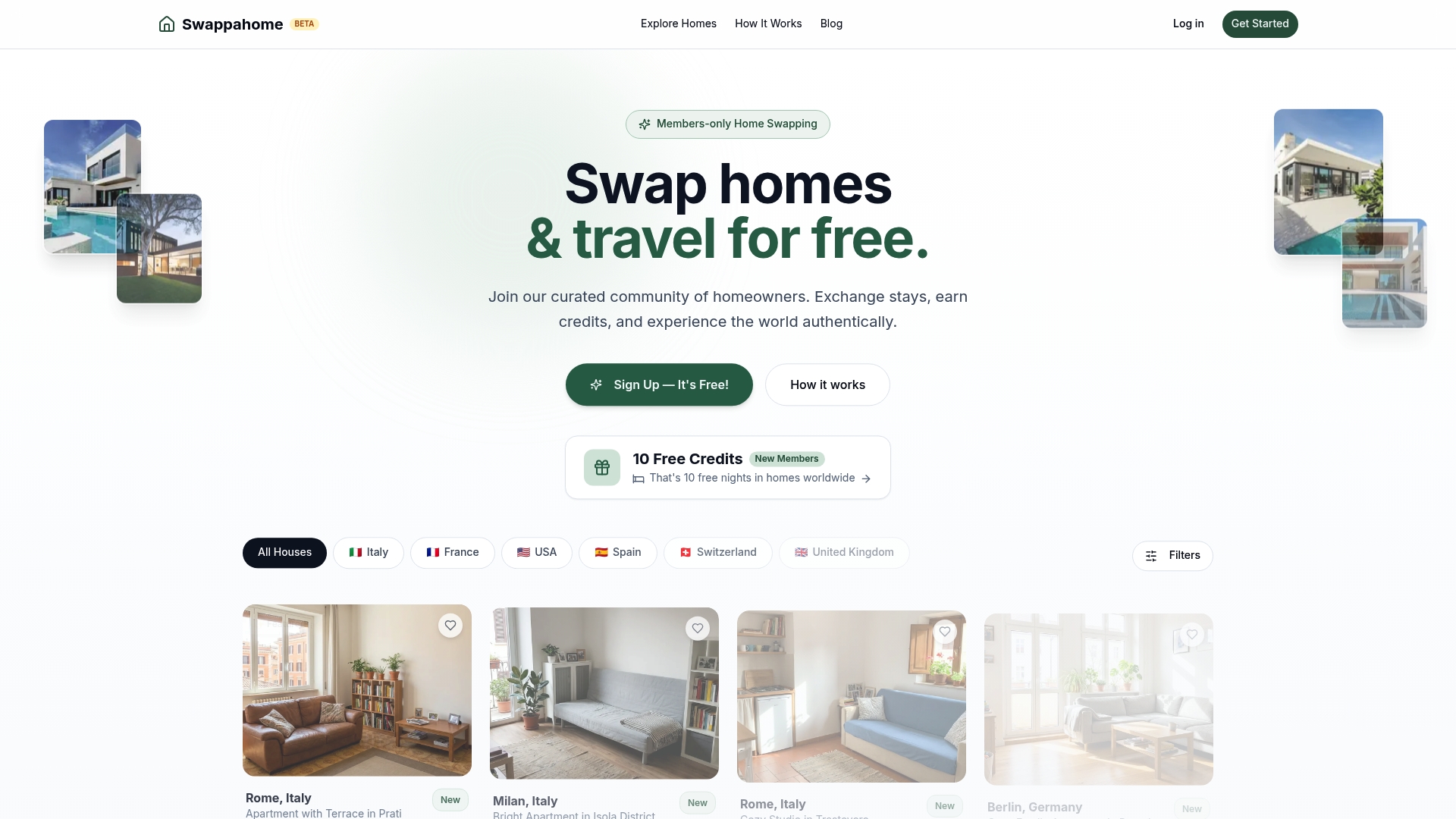 https://swappahome.com
The platform's verification process means every listing comes from a real, reviewed homeowner. You are not browsing anonymous listings. You are choosing from a curated community of travelers who have the same goals you do. Browse the available home swap listings to see what is open in your target destinations, or start swapping for free and list your home today.
FAQ
What is the most common example of exchange-based travel?
Home swapping is the most widely practiced form of exchange-based travel. Platforms like Swappahome connect verified homeowners who trade stays using a credit system, eliminating accommodation costs entirely.
How much can you save through home swapping?
Savings depend on destination and trip length, but one documented traveler saved approximately $17,900 across multiple trips abroad. The main costs are platform membership fees and cleaning fees, which average around $115 per trip.
Do work exchange programs require any experience?
Most work exchange programs through platforms like WWOOF, Workaway, and Worldpackers require no prior experience. Hosts typically provide on-site training in exchange for four to six hours of daily work.
How long do cultural exchange programs last?
Cultural exchange programs typically run 2–4 weeks with full board and language immersion included. Work-and-travel programs in the U.S. require a minimum 2.5-month commitment, and some seasonal programs extend to four months.
Is house-sitting a legitimate free accommodation option?
House-sitting through verified platforms like Trusted Housesitters is a legitimate and widely used exchange. Travelers provide property and pet care in return for free accommodation, with no money exchanged between parties.
Recommended

Published by
SwappaHome
SwappaHome Editorial Team
Home Exchange & Slow Travel Editorial
The SwappaHome Editorial Team brings together travel research, home-exchange community insights, and platform data to produce practical guides for first-time and experienced home swappers. Every article cites real platforms, current market rates, and verifiable city-level facts so readers can make informed decisions without guessing.
Ready to try home swapping?
Join SwappaHome and start traveling by exchanging homes. Get 7 free credits when you sign up!