
Explaining Free Accommodation Models for Budget Travelers

SwappaHome Editorial Team
Home Exchange & Slow Travel Editorial
Explaining Free Accommodation Models for Budget Travelers !Traveler planning free accommodation options > TL;DR: > > - Free accommodation models...
Explaining Free Accommodation Models for Budget Travelers
 Traveler planning free accommodation options
TL;DR:
- Free accommodation models exchange labor, home access, or responsibilities to save travelers money. Housesitting offers high independence, while work exchange and home swapping involve more commitments and planning. Combining different models enhances travel sustainability and cultural immersion.
Free accommodation models are lodging alternatives that eliminate direct payment by exchanging something else: your home, your time, or your skills. Housesitting, work exchange, and home swapping are the three most established types, each with distinct mechanics and trade-offs. Platforms like TrustedHousesitters, HomeExchange, and Swappahome have formalized these models into structured, verified networks used by travelers worldwide. Explaining free accommodation models matters because the savings are real, the cultural depth is genuine, and the commitment required is often misunderstood.
How do different free accommodation models work?
Free accommodation is not a single system. It is a category of alternative accommodation solutions that each operate on different terms.
Housesitting
Housesitting means staying in someone's home while they travel, in exchange for caring for the property and often their pets. The homeowner pays nothing. The sitter pays nothing beyond an annual platform membership. Housesitting can cut accommodation costs by 70–90%, with platform fees running $119–$189 per year. That math makes it one of the most financially efficient models available to long-term travelers.
 Homeowners welcoming housesitter in front yard
Work exchange
Work exchange means trading labor for a bed and meals. Volunteers typically work 4–5 hours per day in exchange for accommodation and one to two meals, with stays usually lasting one to four weeks. Tasks range from farming and hostel reception to teaching English or building maintenance. The model suits travelers who want structure and community but are willing to give up part of their day.
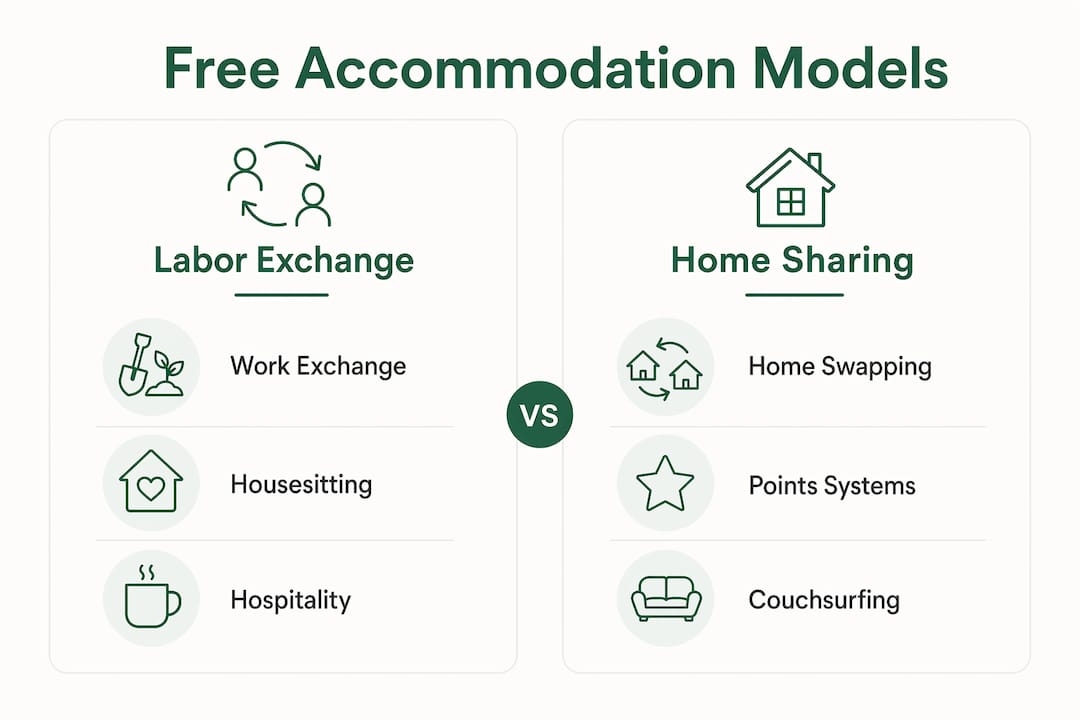 Infographic comparing free accommodation models
Home swapping
Home swapping lets two homeowners exchange residences, either simultaneously or through a points system that allows non-simultaneous stays. HomeExchange lists 550,000+ homes across 155 countries and uses a flexible points system so you do not need a travel partner going to your city at the same time. Swappahome operates on the same principle: one credit equals one free night, and new members receive starter credits to begin booking immediately.
Hospitality networks
Couchsurfing and similar hospitality networks connect travelers with locals who offer a spare couch or room at no cost. The exchange is purely social: conversation, cultural sharing, and goodwill. These networks have no formal credit system, which makes them less predictable but highly immersive.
Pro Tip: Build your profile before you apply to any host. A photo, a detailed bio, and at least two verified references increase your acceptance rate significantly across every model.
Comparing popular free accommodation models
The right model depends on what you are willing to give up. Free accommodation requires an exchange of labor, flexibility, or responsibility. The question is which trade-off fits your travel style.
| Model | Cost to traveler | Time commitment | Independence | Best for |
|---|---|---|---|---|
| Housesitting | $119–$189/year membership | Full-time property care | High | Solo travelers, pet lovers |
| Work exchange | None | 4–5 hours/day | Low to medium | Budget travelers, skill builders |
| Home swapping | Annual membership fee | Planning and listing | Very high | Homeowners, families |
| Hospitality networks | None | Social engagement | Medium | Short stays, social travelers |
Housesitting offers the most independence. You live in a real home, cook your own food, and set your own schedule outside of pet care duties. Work exchange offers the least independence but the most structure, which suits travelers who find unscheduled time difficult to fill. Home swapping sits in the middle: you plan more in advance, but once you arrive, the home is entirely yours.
The cultural depth also varies. Work exchange puts you inside a local operation, whether a farm in Portugal or a guesthouse in Thailand. Home swapping puts you inside a local neighborhood. Housesitting does the same, but without the built-in social connection of a host family.
Pro Tip: If you are new to free accommodation, start with one housesit or one home swap before committing to a long work exchange. The learning curve for managing host expectations is real, and a short trial saves you from a difficult month-long stay.
How do free accommodation models support cultural exchange?
Free accommodation models do more than save money. These models support cultural preservation by integrating local traditions, architecture, and community involvement in ways that hotels cannot replicate. A traveler staying in a family home in Oaxaca, Mexico learns cooking methods, market rhythms, and neighborhood relationships that no tour package delivers.
The economic benefit flows both ways. Host families in community-based homestay programs earn income or receive services that support their household. Travelers gain access to authentic daily life. This reciprocity is what separates free accommodation from budget travel that simply minimizes cost.
Specific models that prioritize cultural depth include:
- Community-based homestays: Families host travelers in exchange for fees that fund local projects, or in exchange for skills like language teaching or digital literacy.
- Eco-lodges with work exchange: Travelers contribute labor to sustainable farms or conservation projects and live within the local ecosystem rather than observing it from a resort.
- Home swapping in residential neighborhoods: Staying in a local apartment in Lyon or Kyoto means shopping at the same markets, using the same transit, and meeting the same neighbors as residents.
- Food and culture experiences: Platforms like Swappahome offer food and culture stays that pair home exchange with local culinary experiences, deepening the connection between traveler and place.
Local gastronomy is one of the most direct paths into a culture. Food tourism breaks cultural barriers in ways that sightseeing alone cannot. When your accommodation is a local home rather than a hotel, those food experiences become part of daily life rather than a scheduled activity.
What are the best strategies for securing free accommodation?
Getting accepted by hosts is the main skill gap for travelers new to these models. Hosts prioritize candidates with transparent skills and positive references. "Sweat equity" is the real currency in work exchange and housesitting. Your profile is your application.
- Build a complete, specific profile. List your skills, your experience with animals or property care, and your travel history. Vague profiles get ignored. A profile that says "I have cared for two dogs and a cat for three separate homeowners in Spain and Japan" gets responses.
- Collect references early. Ask previous hosts, landlords, or employers to write short, specific references. A strong, verifiable profile significantly increases your acceptance rate across housesitting and work exchange platforms.
- Use the backup night strategy. Book one paid night as a fallback whenever you rely on a free stay. Cancellations happen. A single hotel reservation prevents a genuine emergency.
- Rotate your models. Long-term travelers who combine housesitting, local rentals, and coliving report better sustainability and social balance than those who rely on one model exclusively. A rotation strategy prevents burnout and fills gaps between confirmed stays.
- Get travel insurance. Free accommodation does not mean zero risk. Medical emergencies, property damage disputes, and last-minute cancellations are all real scenarios. Insurance covers the gaps that goodwill cannot.
Pro Tip: Apply to three or four hosts simultaneously rather than waiting for one response before sending the next application. The acceptance rate for first-time applicants is lower than for experienced travelers, so volume matters early on.
Understanding how points-based home exchange works before you list your home saves significant confusion. Credits, availability windows, and listing quality all affect how quickly you receive booking requests.
Key takeaways
Free accommodation models work because travelers exchange something of real value: labor, home access, or responsibility. The model you choose determines your cost, your freedom, and your cultural depth.
| Point | Details |
|---|---|
| Housesitting cuts costs sharply | Platform fees of $119–$189/year replace accommodation costs that can run thousands per month. |
| Work exchange trades time for lodging | Expect 4–5 hours of daily work in exchange for a bed and one to two meals per day. |
| Home swapping needs a strong listing | Your home's quality and your profile credibility directly determine how many swap requests you receive. |
| Cultural immersion is a real benefit | Staying in local homes connects travelers to food, community, and daily life that hotels cannot provide. |
| Backup nights prevent emergencies | One paid fallback reservation protects you when a confirmed free stay falls through unexpectedly. |
Why free accommodation changed how I think about travel value
The phrase "free accommodation" is technically accurate and practically misleading. Nothing about these models is free in the sense of zero effort. Housesitting means you are responsible for someone's home and animals. Work exchange means you are working. Home swapping means you are trusting a stranger with your property. What these models eliminate is the monetary transaction, not the commitment.
That distinction matters because travelers who approach free accommodation expecting a free lunch tend to burn out or burn bridges. The ones who thrive treat it as a fair exchange. They show up prepared, communicate clearly with hosts, and respect the terms they agreed to. The reward is not just a free bed. It is access to a way of traveling that hotels simply cannot replicate.
I have also found that combining models produces better results than committing to one. A month of housesitting followed by a home swap followed by a short rental gives you variety, social connection, and financial breathing room. Rigid reliance on a single model creates gaps and stress. The rotation strategy is not just practical. It is what makes long-term travel actually sustainable.
The institutionalization of alternative accommodation platforms has made these models safer and more accessible than they were a decade ago. Verification, reviews, and dispute processes now exist across most major platforms. That infrastructure removes much of the risk that once made free accommodation feel like a gamble.
— Swappa
Start traveling for free with Swappahome
 https://swappahome.com
Swappahome is a members-only home swapping platform built for homeowners who want to travel without paying for hotels. The platform operates on a simple credit system: list your home, earn one credit per night you host, and spend those credits to stay in verified homes across dozens of countries. New members receive starter credits, so you can book your first stay before you have hosted anyone. Swappahome also offers food and culture experiences that pair your stay with local culinary access, turning a home swap into a full cultural immersion. Browse available listings or start your first swap today.
FAQ
What is a free accommodation model?
A free accommodation model is any lodging arrangement that eliminates direct monetary payment by substituting an exchange of labor, home access, or services. Common types include housesitting, work exchange, home swapping, and hospitality networks.
How much can I save with free accommodation?
Housesitting alone can reduce accommodation costs by 70–90% compared to renting or booking hotels, with annual platform fees typically between $119 and $189.
Is home swapping safe for my property?
Home swapping platforms like Swappahome and HomeExchange use member verification, reviews, and dispute processes to protect both parties. Alternative accommodation platforms have raised trust and safety standards significantly through formal verification systems.
How do I get accepted as a housesitter or work exchanger?
Hosts select candidates based on transparent skills and positive references. A complete profile with specific experience and verifiable references is the single most effective way to improve your acceptance rate.
Can I combine different free accommodation models?
Yes, and experienced long-term travelers recommend it. Combining housesitting, rentals, and coliving across a trip produces better financial and social outcomes than relying on one model for the entire journey.
Recommended

Published by
SwappaHome
SwappaHome Editorial Team
Home Exchange & Slow Travel Editorial
The SwappaHome Editorial Team brings together travel research, home-exchange community insights, and platform data to produce practical guides for first-time and experienced home swappers. Every article cites real platforms, current market rates, and verifiable city-level facts so readers can make informed decisions without guessing.
Ready to try home swapping?
Join SwappaHome and start traveling by exchanging homes. Get 7 free credits when you sign up!