
Flexible Living Arrangements: A Family Travel Guide

SwappaHome Editorial Team
Home Exchange & Slow Travel Editorial
Flexible Living Arrangements: A Family Travel Guide !Family planning travel with flexible living > TL;DR: > > - Flexible living arrangements include...
Flexible Living Arrangements: A Family Travel Guide
 Family planning travel with flexible living
TL;DR:
- Flexible living arrangements include home exchanges, coliving spaces, and adaptable home designs that cater to diverse lifestyle needs. These options offer cost savings, increased mobility, and enhanced community access for families and individuals. Using verified platforms like Swappahome, residents can enjoy authentic cultural experiences while reducing housing costs and building connections worldwide.
Flexible living arrangements are housing solutions that let individuals and families customize where they live, for how long, and at what cost, based on their current lifestyle needs. The term covers a broad spectrum: home exchanges through platforms like Swappahome, coliving spaces managed by hubs like Luna House & Cowork, month-to-month rentals, and adaptable home designs built around modular furniture and flex rooms. For travelers and families, understanding flexible housing means recognizing that permanent leases and hotel stays are not the only options. The right arrangement can cut accommodation costs dramatically while delivering richer, more authentic experiences than a standard vacation rental ever could.
What types of flexible living arrangements exist?
Flexible housing falls into four main categories, each suited to different travel styles, budgets, and family sizes.
 Coliving space common room energetic vibe
Home exchanges are direct swaps where two households trade homes for an agreed period, eliminating accommodation costs entirely. Platforms like Swappahome operate on a credit system: one credit equals one free night, and new members receive starter credits to begin booking immediately. This model works especially well for families who want to live like locals in cities such as New York or Zermatt without paying hotel rates.
Coliving spaces bundle rent, utilities, WiFi, and maintenance into a single monthly fee. Standard coliving stays range from 30 days up to one year, with all-inclusive pricing that removes the friction of setting up a new home. That bundled model is the main reason coliving appeals to remote workers and digital nomads who move frequently.
Flexible leases on standard apartments offer month-to-month terms without long commitments. Flexible leases allow quick termination by either party, which gives freedom but creates some uncertainty in forward planning. They suit families testing a new city before committing to a longer stay.
Adaptable home designs are not a rental category but a property feature. Homes built with flex rooms and modular layouts let occupants reconfigure space as needs change, from a home office to a guest room to a playroom, without renovation.
| Type | Typical Duration | Cost Model | Best For |
|---|---|---|---|
| Home exchange | 1–4 weeks | Credit-based, no cash | Families, cultural travelers |
| Coliving | 30 days–1 year | All-inclusive monthly fee | Remote workers, solo travelers |
| Flexible lease | Month-to-month | Standard rent, no long term | Families relocating or testing cities |
| Adaptable home design | Permanent | One-time design investment | Homeowners with changing needs |
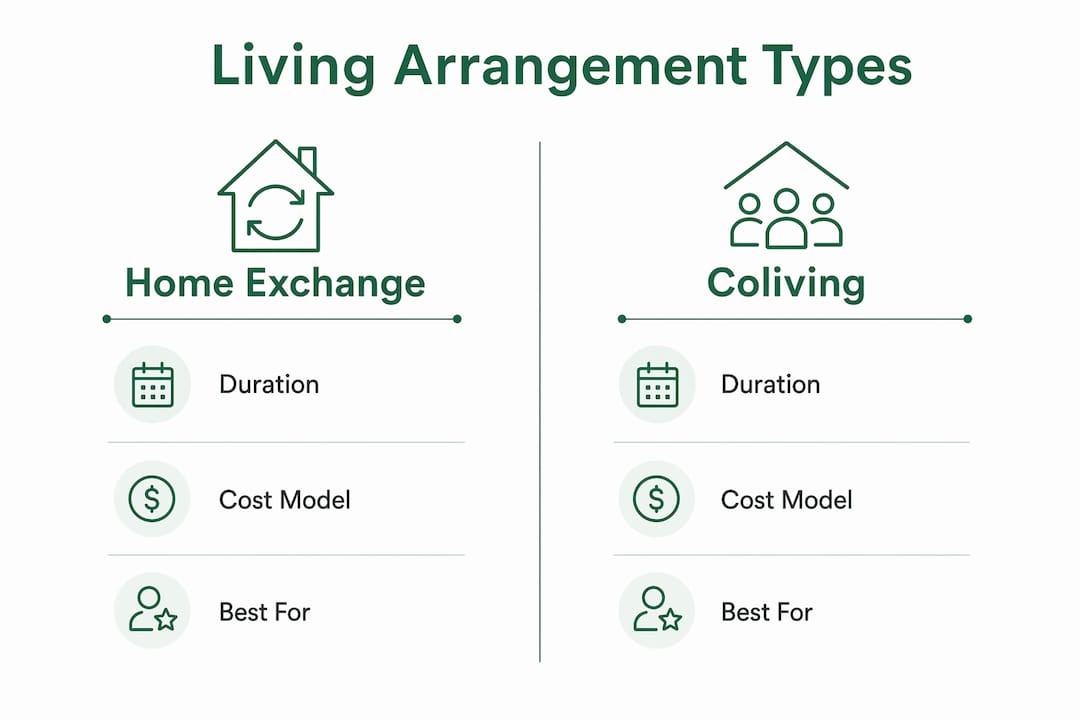 Infographic comparing flexible living types
Pro Tip: If you travel more than three times per year, a home exchange platform like Swappahome pays for itself faster than any flexible lease. If you value built-in community, coliving is the stronger choice.
What are the benefits of flexible living for families?
The financial case for flexible living is direct. Renters avoid the capital-intensive costs of homeownership, including down payments and property taxes, freeing up liquidity for investments, business opportunities, or travel. For families, that freed capital can fund multiple international stays per year at a fraction of what hotels would cost.
Beyond finances, the lifestyle advantages are just as significant:
- Reduced setup time. Coliving and home exchanges deliver fully furnished, move-in-ready spaces. Flexible living removes domestic logistics so professionals and families redirect energy toward higher-value activities, whether that is remote work, exploration, or family time.
- Career mobility. The ability to move quickly without the anchor of property ownership is a key career advantage in 2026. Families following a working parent's job changes no longer face the stress of selling a home on a tight timeline.
- Community access. Coliving hubs offer programming, shared spaces, and built-in social networks. That structure matters most for families or solo travelers who would otherwise feel isolated in an unfamiliar city.
- Psychological wellbeing. The primary psychological benefit of flexible living is the sense of control it provides. People in adaptable living situations report significantly lower stress levels than those locked into rigid housing contracts.
"Flexible living encourages intentional minimalism by simplifying domestic logistics and enabling lifestyle mobility across global cities." — Theblueground.com
Pro Tip: Families with school-age children can use summer home exchanges to combine travel with cultural education. A two-week swap in Ottawa or Tokyo costs nothing in accommodation and delivers experiences no classroom replicates.
How does adaptable home design support flexible living?
A flex room is the clearest example of flexible design in practice. Unlike a bonus room, which is an afterthought built above a garage or in an attic, a flex room is designed into the main floor plan with neutral finishes, accessible wiring, and modular setups that allow it to serve multiple functions over time. That planning distinction is what separates a genuinely adaptable home from one that merely has extra square footage.
Modular furniture takes the same principle further. A Murphy bed converts a home office into a guest room in minutes. Folding partitions split an open living area into two private workspaces. These changes require furniture movement, not demolition. Flexible spaces reduce renovation costs from high, which requires demolition, to low, which requires only furniture rearrangement. That cost difference compounds significantly over a decade of ownership.
| Room Type | Planning Stage | Renovation Cost to Change | Long-Term Value |
|---|---|---|---|
| Fixed single-use room | Standard build | High (structural changes needed) | Limited |
| Bonus room | Added after main plan | Medium (finishing required) | Moderate |
| Flex room | Integrated into main plan | Low (furniture movement only) | High |
For families, the practical payoff is immediate. A flex room serves as a nursery for three years, a homework room for five, and a home office after that. No contractor required at any transition point.
Pro Tip: When evaluating a home for flexible living potential, check for neutral wall finishes, multiple electrical outlets on each wall, and open floor plan adjacency. Those three features signal a space designed to adapt.
How can families use flexible arrangements to cut travel costs?
Home exchanges are the most direct path to free accommodation. On Swappahome, verified homeowners list their properties, earn credits by hosting other members, and spend those credits on stays worldwide. One credit equals one free night. A family that hosts guests for seven nights earns seven credits, enough for a week-long stay in cities like Beijing or Tokyo without spending a dollar on lodging.
Cultural stays through home exchanges go further than cost savings. Living in a local home, cooking in a real kitchen, and using neighborhood shops creates an experience that no hotel replicates. Digital nomads and remote workers use this model to combine productive work periods with genuine cultural immersion, often staying 30 days or more in a single location.
Coliving is the right choice when you want community built in. Spaces managed by hubs like Luna House & Cowork include private rooms, shared spaces, bundled services, and built-in community with no setup required. For solo travelers or couples without a home to exchange, coliving delivers the flexibility and social connection that a standard rental cannot.
Here is a practical checklist for planning a flexible living travel experience:
- Define your stay length. Under two weeks favors a home exchange. One to three months favors coliving or a flexible lease.
- Assess what you have to offer. Home exchanges require a property to list. Coliving requires only a monthly fee.
- Choose a verified platform. Swappahome verifies all members before listing, which reduces risk for both hosts and guests.
- Book early for peak periods. Popular destinations like New York and Zermatt fill quickly in summer and winter.
- Communicate clearly with hosts. Confirm house rules, check-in times, and any family-specific needs before confirming a swap.
- Start with a short exchange. A first swap of seven to ten days lets you test the model before committing to a longer stay.
Budget-conscious travelers in 2026 are increasingly choosing these models over traditional hotels, and the savings compound quickly across multiple trips per year.
Key takeaways
Flexible living arrangements deliver the most value when matched to the right model: home exchanges for cost-free cultural stays, coliving for community and convenience, and adaptable home design for long-term household efficiency.
| Point | Details |
|---|---|
| Home exchanges eliminate accommodation costs | Platforms like Swappahome use a credit system where one credit equals one free night. |
| Coliving bundles all costs into one fee | Stays from 30 days to one year include rent, utilities, WiFi, and community programming. |
| Flexible design cuts renovation costs | Flex rooms built into the main floor plan require only furniture changes, not structural work. |
| Flexible living reduces financial and psychological stress | Avoiding homeownership costs frees capital and gives residents a measurable sense of control. |
| Verification matters when choosing a platform | Swappahome verifies all members, reducing risk for families hosting or staying in unfamiliar homes. |
Why flexible living changed how i think about home
I used to assume that stability meant staying put. A fixed address, a long lease, a mortgage. What I found after years of working with travelers and homeowners is that the opposite is often true. The families and professionals who report the highest satisfaction with their living situations are almost never the ones locked into 30-year mortgages in cities they chose at 28. They are the ones who treated housing as a tool rather than an identity.
The biggest mistake beginners make with flexible living is underestimating the isolation risk. Moving into a new city without a built-in social structure is genuinely hard. Managed coliving hubs solve this directly. Home exchange platforms like Swappahome solve it differently, by connecting you with a verified host community before you even arrive. Neither model is perfect for every person, but both are far better than a hotel room for building real connections.
My honest recommendation: try one home exchange before you decide flexible living is not for you. The first swap feels unfamiliar. The second one feels like the only sensible way to travel. The cost savings are real, but the experience of living in someone else's home in a city you would never have explored otherwise is what actually changes your perspective on what housing is for.
— Swappa
Start traveling smarter with Swappahome
Swappahome is a members-only home exchange platform built for families and individuals who want authentic travel without hotel bills. Every member is verified before listing, and the credit system is straightforward: host guests, earn credits, book stays worldwide for free.
 https://swappahome.com
New members receive starter credits to begin booking immediately. The platform covers destinations across dozens of countries, from urban apartments in New York to alpine homes in Zermatt. If you are ready to put flexible living into practice, browse verified listings and find your first exchange. Or join Swappahome today and start earning credits from your own home.
FAQ
What is a flexible living arrangement?
A flexible living arrangement is a housing option that allows residents to adjust duration, cost, and space use based on their current needs. Common types include home exchanges, coliving spaces, and month-to-month rentals.
How long do flexible living stays typically last?
Standard coliving stays range from 30 days to one year, while home exchanges are typically one to four weeks. Flexible leases can extend month-to-month for as long as both parties agree.
What are the pros and cons of flexible leases?
Flexible leases allow quick termination by either party, which is the primary advantage. The main drawback is reduced certainty in long-term planning for both tenant and landlord.
Is a home exchange safe for families?
Home exchanges on verified platforms like Swappahome are safe for families because all members are vetted before listing. Clear communication about house rules and expectations before the swap reduces risk further.
What is a flex room and why does it matter for flexible living?
A flex room is designed into the main floor plan with neutral finishes and adaptable wiring to serve multiple functions over time. It matters because it reduces renovation costs and lets families reconfigure space as their needs change without structural work.
Recommended

Published by
SwappaHome
SwappaHome Editorial Team
Home Exchange & Slow Travel Editorial
The SwappaHome Editorial Team brings together travel research, home-exchange community insights, and platform data to produce practical guides for first-time and experienced home swappers. Every article cites real platforms, current market rates, and verifiable city-level facts so readers can make informed decisions without guessing.
Ready to try home swapping?
Join SwappaHome and start traveling by exchanging homes. Get 7 free credits when you sign up!