
Home Swap Pros and Cons: Is It Worth It in 2026?

SwappaHome Editorial Team
Home Exchange & Slow Travel Editorial
Home Swap Pros and Cons: Is It Worth It in 2026? !Couple planning home swap in kitchen > TL;DR: > > - Home swapping allows homeowners to exchange...
Home Swap Pros and Cons: Is It Worth It in 2026?
 Couple planning home swap in kitchen
TL;DR:
- Home swapping allows homeowners to exchange properties for free, offering significant savings and authentic local experiences. However, participants must address insurance gaps, coordinate schedules, and prepare their homes carefully to ensure a successful exchange. Using verified platforms and planning months in advance maximizes safety and convenience in this mutually trusting travel arrangement.
Home swapping is a travel arrangement where two homeowners exchange properties for a set period, eliminating accommodation costs entirely. The home exchange model delivers real financial savings and a lived-in local experience, but it also carries insurance gaps, coordination demands, and customs complications that every participant should understand before committing. This article breaks down the home swap pros and cons in full, covering platform mechanics, risk management, and how the experience compares to hotels and Airbnb.
1. What are the main pros of home swapping?
Home exchange benefits are most visible in the numbers. Accommodations cost nearly nothing beyond an annual membership fee, which typically runs around $325. For families taking a two-week summer trip, that translates to thousands of dollars saved compared to booking a hotel or short-term rental.
The comfort factor is equally significant. A full home gives you a kitchen, laundry, multiple bedrooms, and a living room. You cook your own meals, keep your routine, and avoid the cramped, transactional feel of a hotel room. Families consistently report that access to these amenities reduces travel stress, particularly with young children.
Beyond cost and comfort, home swapping places you in residential neighborhoods rather than tourist corridors. You shop at the same grocery stores locals use, walk the same streets, and get a genuine sense of daily life in a city. That kind of immersion is difficult to replicate in a hotel, regardless of price point.
The community element also sets home swapping apart from commercial rentals. The sense of goodwill among swappers produces gestures you simply do not see on Airbnb: hosts accommodating stranded guests, returning points out of courtesy, leaving local guides and restaurant recommendations. It operates on mutual trust, and that trust tends to be self-reinforcing.
Pro Tip: Before your first swap, browse completed reviews on your chosen platform to understand what hosts typically provide. The best listings include local tips, stocked pantries, and clear house guides.
"Home swapping is less a transaction and more a hospitality agreement. When both parties treat it that way, the experience consistently exceeds what any hotel can offer." — Swappa
2. What are the primary cons of home swapping?
The home swapping drawbacks are real and deserve honest attention. The most significant is insurance. Standard homeowner policies may exclude or limit coverage for guest-caused theft or damage, and some restrict coverage when a home is vacant for 30 to 60 days. That gap can leave you financially exposed if something goes wrong during a swap.
 Hands reviewing home insurance documents
Coordination is the second major challenge. Finding a compatible swap partner requires matching destinations, dates, home types, and mutual interest. This process can take weeks or months, especially for less-traveled locations. Unlike booking a hotel in ten minutes, a home swap demands sustained effort and flexibility.
Home preparation adds another layer of work. Before guests arrive, you need to clean thoroughly, secure valuables, and leave clear instructions. Hosts typically prepare detailed house guides and communicate extensively with guests in advance. That investment of time is real, even if the financial payoff is substantial.
Destination and date flexibility is also limited by your swap partner's availability. If you want Paris in July, you need someone in Paris who wants your location in July. The more specific your travel requirements, the harder the match becomes.
Pro Tip: Start your swap search at least three to four months before your intended travel dates. Platforms like Swappahome allow you to send multiple swap requests simultaneously, which significantly improves your chances of finding a match.
3. How home exchange platforms work
Home exchange platforms operate on two core models: simultaneous swaps, where both parties exchange homes at the same time, and non-simultaneous swaps, which use a points system. HomeExchange's point system allows you to host a guest, earn points, and then use those points to stay elsewhere at a different time. Points are not convertible to cash, but they add genuine scheduling flexibility.
Membership fees vary by platform. HomeExchange charges annual fees ranging from approximately $235 to $409, and members must be verified homeowners to list their properties. Verification typically requires proof of home ownership and identity documentation. Some platforms provide damage and theft protections; others do not. Understanding exactly what your platform covers before your first swap is non-negotiable.
Here is a comparison of key platform features to help you evaluate your options:
| Feature | Simultaneous swap | Points-based swap |
|---|---|---|
| Scheduling flexibility | Low (both parties must align dates) | High (host and guest travel independently) |
| Complexity | Lower (direct reciprocal exchange) | Higher (requires earning and managing points) |
| Best for | Travelers with flexible schedules | Travelers with fixed travel windows |
| Platform examples | Direct exchange platforms | HomeExchange, Swappahome |
Verification processes vary, but reputable platforms require proof of ownership and identity before a listing goes live. This protects both sides of the exchange. Platforms that skip verification expose members to significantly higher risk of fraud or misrepresentation.
For a deeper look at how exchange platforms work and what membership actually includes, the mechanics are worth understanding before you commit to an annual fee.
4. How to manage risks and run a successful swap
Risk management in home swapping starts with your insurance provider. Contact your insurer before any swap to confirm whether your policy covers guest-caused damage and what happens if your home sits vacant for an extended period. Some insurers offer endorsements or riders that extend coverage for home exchange situations. Do not assume your existing policy is sufficient.
Preparing your home properly reduces friction and protects your property. The steps below cover the core checklist:
- Remove or lock away valuables, important documents, and irreplaceable items before guests arrive.
- Leave a detailed house guide covering appliances, Wi-Fi, emergency contacts, and local recommendations.
- Photograph every room before the swap as a timestamped record of the home's condition.
- Communicate house rules clearly in writing through the platform's messaging system.
- Confirm check-in and check-out logistics at least one week before the swap begins.
For a full walkthrough of home preparation best practices, the details matter more than most first-time swappers expect.
Border crossings require specific attention. Customs officers may confuse home swaps with paid house-sitting or pet-sitting, which can trigger questions about work visas or compensation. The correct framing is straightforward: you are a tourist staying in a private home as part of a hospitality agreement, with no money or services exchanging hands. Carry documentation of your swap arrangement if you are crossing international borders.
Pro Tip: Print a copy of your swap confirmation from the platform and carry it with your travel documents. If a customs officer questions your accommodation arrangement, the printed record clarifies the nature of the exchange immediately.
5. How home swapping compares to hotels and Airbnb
Home swapping occupies a distinct position in the accommodation spectrum. The table below summarizes the key differences across cost, experience, and flexibility:
| Factor | Home swap | Hotel | Airbnb |
|---|---|---|---|
| Accommodation cost | Near zero (annual fee only) | Full nightly rate | Nightly rate plus service fees |
| Space and amenities | Full home with kitchen, laundry | Limited to room and shared facilities | Varies widely by listing |
| Local experience | Residential neighborhood immersion | Tourist-area proximity | Varies by host and location |
| Flexibility | Limited by partner availability | High (book anytime) | Moderate (subject to availability) |
| Community element | Reciprocal trust and goodwill | None | Minimal |
| Insurance coverage | Requires proactive verification | Included in hotel liability | Limited host protections |
The cost gap is the most striking difference. Families can save over $2,000 per week compared to equivalent rental accommodations. That figure compounds across multiple trips per year, making the annual membership fee a negligible expense by comparison.
Hotels offer unmatched convenience and zero preparation effort, but they cannot replicate the space, the kitchen, or the neighborhood feel of a home swap. Airbnb sits between the two: more space than a hotel, but still a commercial transaction with service fees, host cancellations, and no reciprocal relationship. For a detailed cost comparison between options, the numbers consistently favor home swapping for trips longer than five days.
The right choice depends on your travel style. If you need guaranteed availability on short notice, a hotel or Airbnb wins. If you plan ahead and value savings, space, and authentic local experience, home swapping is the stronger option for most trips.
Key takeaways
Home swapping delivers the best value for travelers who plan early, communicate clearly, and address insurance before the first guest arrives.
| Point | Details |
|---|---|
| Cost savings are substantial | Annual fees around $325 replace nightly accommodation costs, saving families thousands per trip. |
| Insurance gaps are the top risk | Standard policies may not cover guest-caused damage; contact your insurer before every swap. |
| Points systems add flexibility | Non-simultaneous exchanges let you host and travel independently, removing scheduling pressure. |
| Customs requires clear framing | Declare your stay as tourism with no compensation to avoid border complications. |
| Preparation determines the experience | Detailed house guides, secured valuables, and clear rules prevent most common swap problems. |
What I've learned after watching hundreds of swaps
Home swapping rewards the prepared and punishes the impulsive. The travelers who get the most from it are not necessarily the most adventurous. They are the most organized. They contact their insurer in advance. They write a thorough house guide. They send their swap request four months out, not four weeks.
The biggest misconception I see is that home swapping is primarily about saving money. The savings are real, and they are significant. But the travelers who come back most enthusiastic are the ones who stayed in a neighborhood they never would have booked through a hotel search. They ate at the restaurant the host marked on a handwritten map. They borrowed the bikes left in the garage. That is the part no price comparison captures.
My honest caution for new swappers: do not skip the insurance conversation. Coverage gaps are not hypothetical. Standard policies were written with the assumption that your home is occupied by you, not a family from another country. One phone call to your insurer before your first swap eliminates the most serious financial risk in the entire model.
Start with a domestic swap if you are uncertain. The logistics are simpler, customs is not a factor, and you build confidence in the process before taking it international. Most experienced swappers I have spoken with say their first domestic swap converted them permanently.
— Swappa
Start swapping with Swappahome
 https://swappahome.com
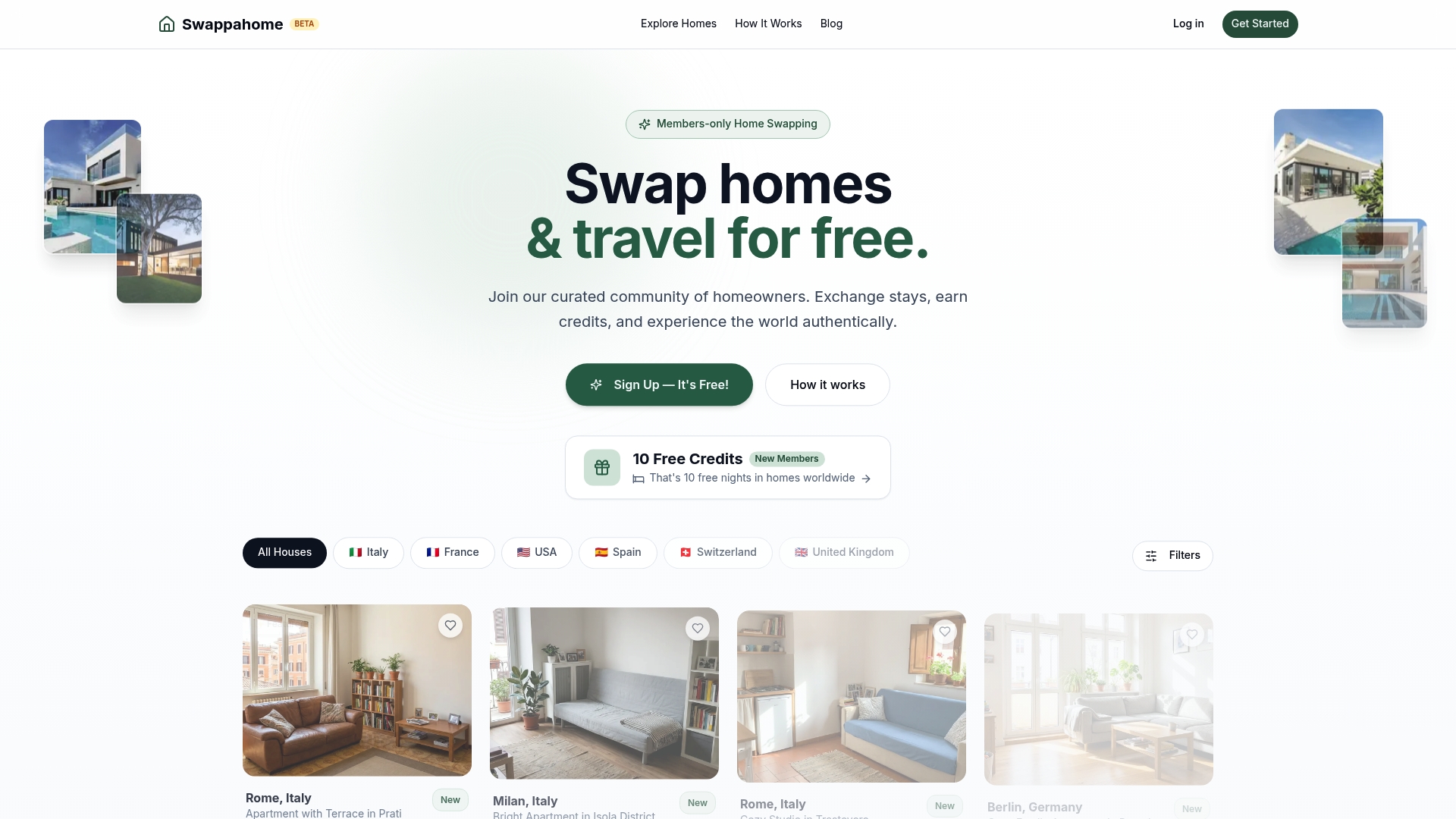
Swappahome is a members-only home exchange platform built for homeowners who want to travel without paying for accommodation. The platform connects verified homeowners across dozens of countries through a straightforward credit system: one credit equals one free night. New members receive free credits to start, so your first stay costs nothing beyond the membership. Every listing is verified, and the search and booking process is designed to get you from browsing to confirmed swap without unnecessary friction. Browse available homes worldwide or join the Swappahome community to list your home and start earning credits today.
FAQ
What is home swapping and how does it work?
Home swapping is a temporary property exchange where two homeowners stay in each other's homes without paying rent. Platforms like Swappahome facilitate the match, verification, and booking process through a credit-based system.
Is home swapping safe for your property?
Home swapping carries real but manageable risks. Verify your insurance coverage before any swap, photograph your home beforehand, and use a platform that requires member verification and provides some form of damage protection.
How much does home swapping cost?
The primary cost is an annual platform membership, which typically ranges from $235 to $409 depending on the platform. Accommodation itself costs nothing beyond that fee, making it significantly cheaper than hotels or Airbnb for trips longer than a few days.
Can home swapping cause problems at customs?
Yes, if not explained correctly. Customs officers may mistake a home swap for paid house-sitting. Travelers should state clearly that their stay is tourism with no money or services exchanged, and carry swap confirmation documents when crossing international borders.
How far in advance should I plan a home swap?
Plan at least three to four months ahead, especially for popular destinations or specific travel dates. The more lead time you give yourself, the more swap options you will find and the better your chances of securing a confirmed match.
Recommended

Published by
SwappaHome
SwappaHome Editorial Team
Home Exchange & Slow Travel Editorial
The SwappaHome Editorial Team brings together travel research, home-exchange community insights, and platform data to produce practical guides for first-time and experienced home swappers. Every article cites real platforms, current market rates, and verifiable city-level facts so readers can make informed decisions without guessing.
Ready to try home swapping?
Join SwappaHome and start traveling by exchanging homes. Get 7 free credits when you sign up!