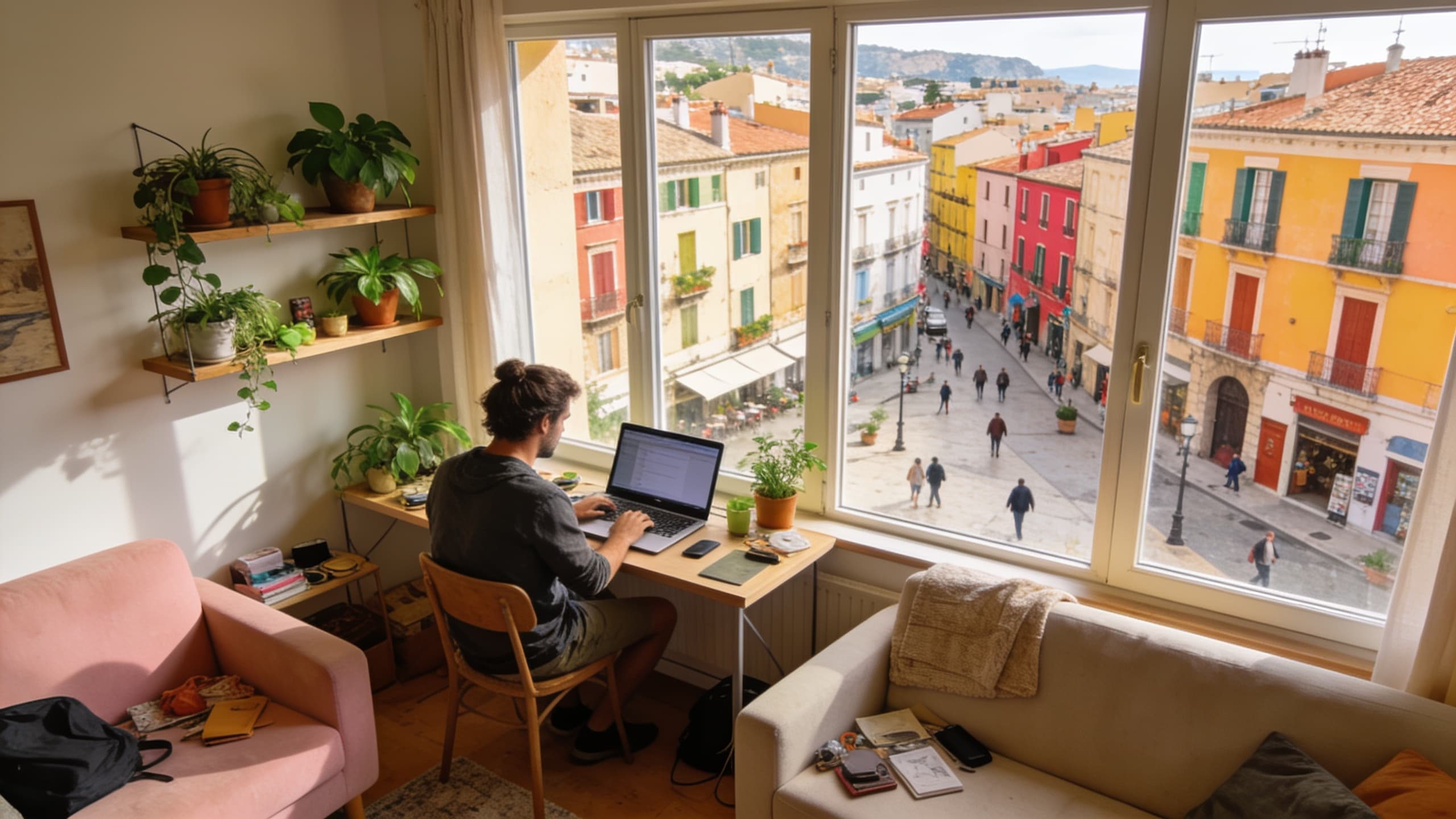
How Digital Nomads Are Using Home Swaps to Travel for Free

SwappaHome Editorial Team
Home Exchange & Slow Travel Editorial
Remote work broke a lot of people free from the office, and once that happened, a weird new problem showed up: where do you actually live when you can work from anywhere? Because "anywhere" still...
Remote work broke a lot of people free from the office, and once that happened, a weird new problem showed up: where do you actually live when you can work from anywhere? Because "anywhere" still costs money. Hotels bleed you dry. Airbnbs aren't cheap either, especially once they pile on the cleaning fees. And month-to-month rentals mean deposits, contracts, the whole headache.
So a bunch of nomads started doing something smarter. They trade homes. You stay in someone's apartment in Mexico City, they stay in yours in Lisbon, nobody pays rent, and everybody gets to actually live somewhere instead of parking in a beige hotel room for a month.
And this isn't some niche experiment anymore. With remote work now completely normal and platforms like Swappahome making it stupidly easy to find matches, home swapping has quietly turned into a real strategy for people who want to travel a lot without watching their savings evaporate. Let me walk you through how it actually works, what it looks like on the ground, and how you'd get started yourself.
Table of Contents
- What Is a Digital Nomad Home Swap, Exactly?
- Why Home Swapping Beats Traditional Nomad Housing
- Real Scenarios: How Nomads Are Making It Work
- Getting Started With Your First Digital Nomad Home Swap
- Common Challenges and How to Handle Them
- Home Swap vs. Other Free Accommodation Strategies
- Tips for Long-Term Success as a Swapping Nomad
- Frequently Asked Questions
What Is a Digital Nomad Home Swap, Exactly?
The basic idea is old and simple. Two people agree to swap living spaces for a while. You stay in mine, I stay in yours. Families have been doing this for decades to save on vacation lodging.
But nomads have twisted the concept into something more flexible, because most of us don't own a permanent home to trade in the first place. So the model bent to fit.
The most common variation is the non-simultaneous swap, where one person stays now and the other visits months later. Then there's the points-based approach, where you earn credits by hosting guests and spend them later to stay in someone else's place, no direct one-to-one trade required. And because nomads tend to camp out in one spot for weeks or months instead of a quick week, the swaps run longer, which honestly makes them more valuable for everyone involved.
So it's really just the old house-swap idea, dragged into the laptop era and stretched out to match how remote workers actually move around.
Why This Model Fits the Nomad Lifestyle So Well
Think about what a digital nomad actually needs. Decent Wi-Fi and a quiet corner to take calls. A kitchen, because eating out three times a day for a month will wreck your budget faster than rent will. The freedom to stay for weeks or months, not just a long weekend. And, maybe most underrated, the feeling of actually living somewhere instead of just passing through like a tourist with a rolling suitcase.
A hotel room fails almost all of that. A swapped home nails it. That's the whole reason this thing caught on.
Why Home Swapping Beats Traditional Nomad Housing
Let's talk money, because that's usually what gets people to pay attention.
Renting monthly apartments or hopping between Airbnbs adds up terrifyingly fast. Pull up Numbeo's cost-of-living data and you'll see a one-bedroom in a mid-sized European city runs somewhere around $800 to $1,500 a month, and that's before utilities, deposits, and whatever fees the platform tacks on. And here's the annoying part about long Airbnb stays: even the 28-night bookings that are supposed to be discounted still cost way more than what locals actually pay in rent, mostly because of service and cleaning fees that get slapped onto every single reservation.
Home swaps just... skip all of that. No nightly rate. No cleaning fee. No deposit sitting in some account you'll fight to get back later. You're basically down to a platform membership (if there even is one), your transportation, and the normal cost of feeding yourself, which you'd pay literally anywhere.
Here's how the numbers tend to shake out for a one-month stay:
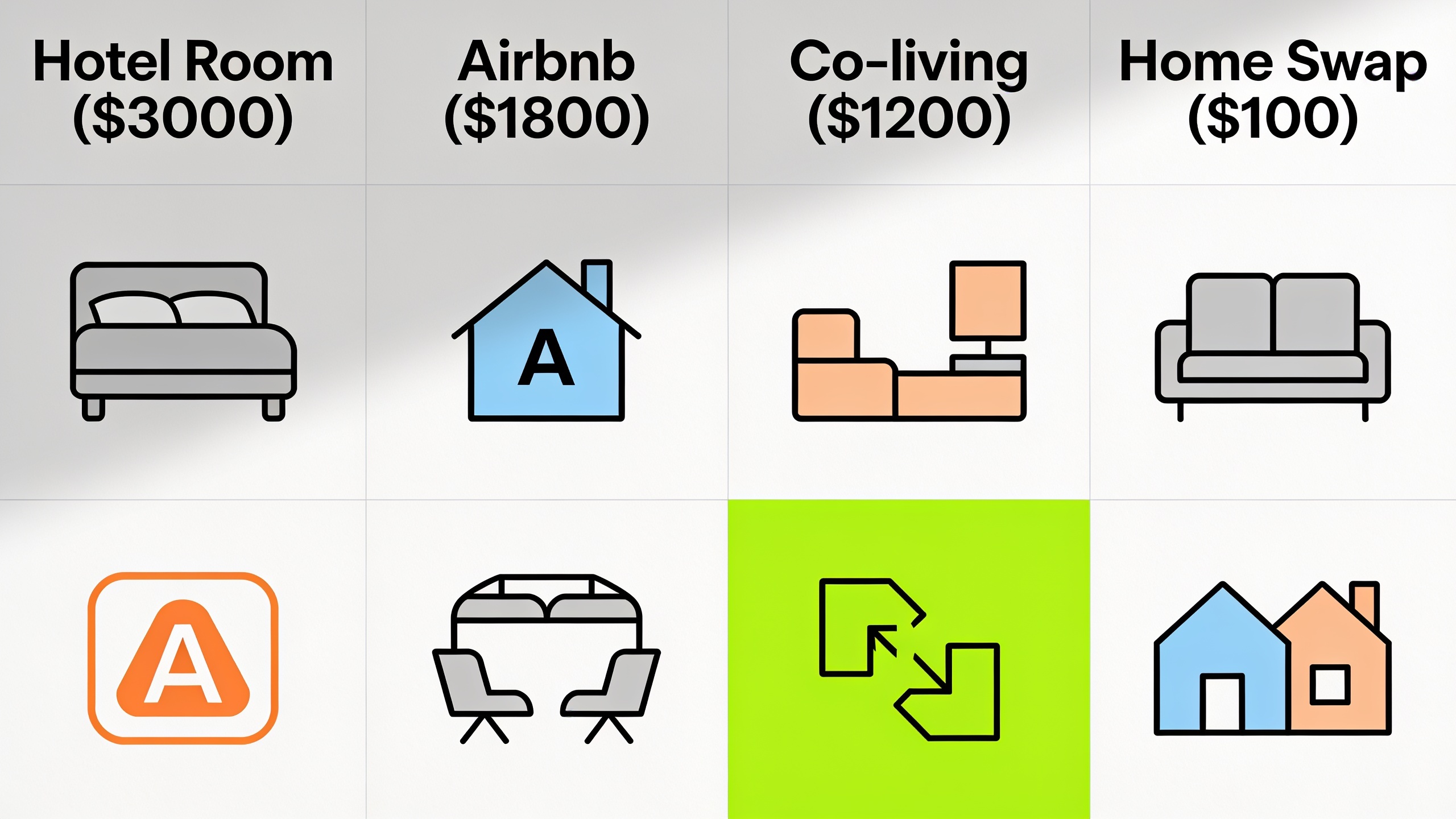 Cost comparison infographic showing monthly accommodation expenses for different travel options
| Accommodation Type | Avg. Monthly Cost (USD) | Kitchen Access | Local Immersion | Flexibility for Long Stays |
|---|---|---|---|---|
| Hotel | $2,500–$4,000 | Rarely | Low | Poor |
| Short-term rental (Airbnb) | $1,200–$2,200 | Usually | Medium | Moderate |
| Co-living space | $800–$1,500 | Shared | Medium | Good |
| Digital nomad home swap | $0–$150 (membership/fees only) | Always | High | Excellent |
Look at that bottom row. For someone bouncing to a new place every one to three months, the gap is enormous. Do the math over a full year of travel and swapping instead of renting could realistically put ten grand or more back in your pocket, depending on where you go and how often you move.
But honestly? The money isn't even my favorite part. Staying in someone's real home means you get their neighborhood tips, sometimes their car, and a space that was set up for actual comfort instead of quick tourist turnover. It stops feeling like visiting. It starts feeling like you belong there, at least for a little while.
Real Scenarios: How Nomads Are Making It Work
Theory's fine, but this stuff clicks better with examples. Here are a few composite scenarios pulled from patterns you see over and over among people using these platforms.
Scenario One: The Freelance Designer Circuit
A freelance graphic designer in Lisbon wanted three months in Mexico City, but the idea of paying Lisbon rent on an empty apartment made her sick. So she listed her one-bedroom on a swap platform and found a photographer in Mexico City who wanted a season in Europe. They set up a simultaneous three-month swap. Neither one paid rent the whole time. And here's the kicker, she landed two new clients through connections her host's neighbors set up for her. Try getting that from a hotel.
Scenario Two: The Points-Based Nomad Family
A couple in tech, both remote, traveling with two kids, had already sold their place to fund the whole nomad thing. So they had no home to offer. No problem. They went the points route, house-sitting and hosting through relatives' properties to rack up credits, then cashing those in for stays in Portugal, Croatia, and Thailand across a single year. Which proves you don't need to own anything to make this work. You just need to get a little creative about earning your way in.
Scenario Three: The Slow-Travel Retiree Duo
Not everyone doing this is 28 with a laptop and a hoodie. A retired couple started using home exchanges to chase warmer winters without the double hit of maintaining their own home and paying for a rental somewhere else. They worked out a five-month reciprocal swap with another retired couple down in southern Spain, splitting it into two chunks of about two and a half months each so both households got to enjoy the other's place during the same stretch of season.
The point of all three? There's no single "right" way to do this. The model bends to fit whatever you've got and whatever trip you're dreaming up.
Getting Started With Your First Digital Nomad Home Swap
Okay, so you're intrigued but a little lost on where to actually begin. Here's the rough path.
Start with your profile, and take it seriously, because these platforms live and die on trust. Clear photos, an honest description, a friendly bio that doesn't read like a real estate listing. Mention your neighborhood, what's nearby, and specifically what makes your place good for working. Desk setup, internet speed, a room where you can actually hear yourself think on a call. That last part matters more than people realize.
Then get verified. Basically every reputable platform, Swappahome included, offers identity verification, and skipping it is one of the biggest reasons swap partners get cold feet. Do it. It takes ten minutes and it signals you're a real, safe human.
When you start searching, lean into your flexibility. This is your superpower as a nomad. You're not chained to a fixed two-week vacation window like most people, so being open to a range of dates makes finding a match dramatically easier, especially for the longer month-plus stays.
Before you commit to anything, actually talk it through. And I mean specifics:
- Wi-Fi speed and reliability (non-negotiable if you work online)
- House rules around guests, smoking, pets
- Who covers which utilities
- Emergency contacts and someone local who can help if things go sideways
- Whether there's a car, a bike, or other stuff included
And even if the whole thing feels casual and friendly, write something down. A simple agreement covering dates, responsibilities, and expectations. It doesn't need to be some lawyer-drafted contract. But having it in writing saves both of you from those awkward "wait, I thought you were handling that" moments.
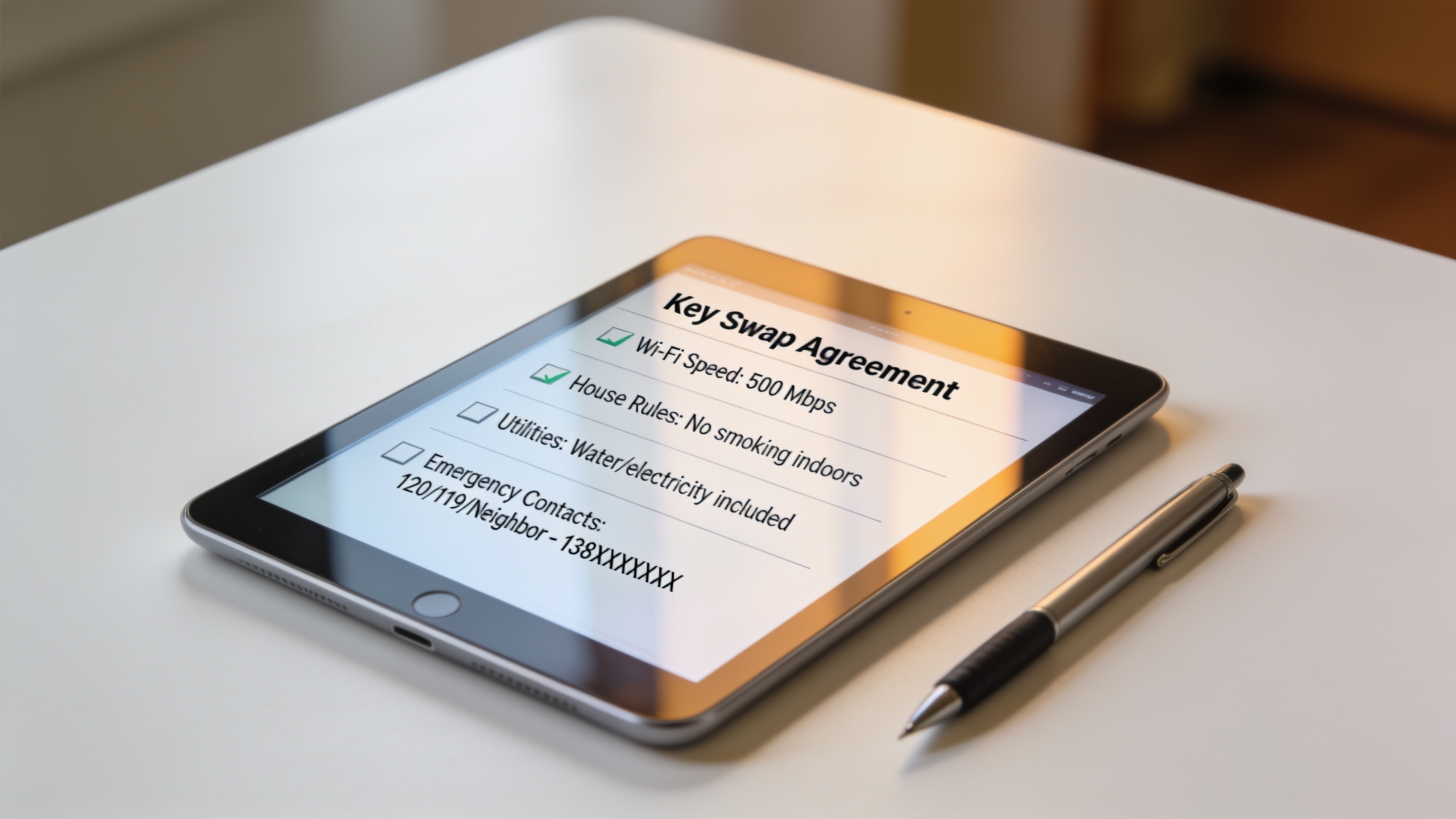 Digital agreement checklist for home swap arrangements displayed on tablet
Common Challenges and How to Handle Them
I'd be lying if I said this was all smooth sailing. It's not. Here's the messy stuff.
The obvious one is trust. You're handing your home to a stranger, or moving into theirs, and yeah, that's a leap. The way you manage it is by leaning on platforms with verified reviews, always doing a video call before you commit, and maybe starting with a shorter trial swap before you go all-in on a three-month arrangement. Build the confidence slowly.
Timing is the other headache. Simultaneous swaps only work if both people happen to want to be in each other's cities at the same time, and that's not always easy to line up. The non-simultaneous and points-based systems fix that, but they trade convenience for planning. Sometimes you're waiting a while before you can cash in.
Then there's the work-from-home reality check. Not every gorgeous apartment is set up for actual work. A stunning place with garbage Wi-Fi will torpedo a work trip in about a day. So ask the annoying questions. Request a speed test screenshot. Ask about noise. Ask if there's somewhere to actually sit and work. Be that person. It's worth it.
Oh, and cultural gaps. Swap with someone from a different country and you might bump into language barriers or just different assumptions about cleanliness, guests, how much you're supposed to communicate. Nothing dramatic, usually. But clear written agreements and being generous with communication upfront smooths almost all of it over.
Home Swap vs. Other Free Accommodation Strategies
Swapping isn't the only way to slash your lodging costs, so here's how it stacks up against the other popular options.
| Strategy | Cost | Duration Flexibility | Privacy Level | Best For |
|---|---|---|---|---|
| Home swap | Very low | High (weeks to months) | High (whole home) | Remote workers, families, retirees |
| House-sitting | Free (usually) | Medium | High | Pet lovers, flexible schedules |
| Work exchanges (WWOOF, Worldpackers) | Free lodging, must work hours | Medium | Low-Medium | Budget travelers wanting cultural immersion |
| Couchsurfing | Free | Low (days) | Low | Solo travelers, short stays |
| Co-living memberships | Paid, discounted | High | Medium | Community-focused nomads |
What makes home swapping stand out is that you get both privacy and long-term flexibility without having to work for it. House-sitting means committing to someone's dog. Work exchanges mean, well, working. Couchsurfing is great for a few nights but you're sleeping on a couch. If your job means you need reliable quiet for calls and deep focus, swapping is really the only one that guarantees you your own space, your own schedule, no strings.
Tips for Long-Term Success as a Swapping Nomad
If you're planning to make this a repeat thing instead of a one-off experiment, a few habits pay off big over time.
Keep your place swap-ready even while you're on the road. Updated photos, a "yeah, I could hand this off tomorrow" mentality. The people who scramble to prep at the last second lose out to the ones who are always ready to go.
Milk every completed swap for reviews. Leave thoughtful ones for your hosts, nudge them to return the favor, and slowly build a track record that makes every future match easier. Reputation is currency in this world.
Don't put all your eggs in one platform or one region, either. The nomads who stay active across a few different exchange communities and stay open to different countries are the ones who manage to string together long, seamless itineraries instead of gaps and dead ends.
Build in buffer days between swaps. Seriously. Start dates shift, things occasionally fall through, and having even two or three flexible days keeps you from that nightmare scenario of standing on a street with your luggage and nowhere to sleep.
And this might be the most important one: treat every swap like it's a relationship, not a transaction. The nomads who get invited back, get referred to friends, get first dibs on the really nice homes? They're the ones who leave the place spotless, replace whatever they used up, and send a genuine thank-you afterward. It costs you almost nothing and it opens doors you didn't even know were there.
Frequently Asked Questions
So is a home swap actually free, or are there hidden costs I'm not seeing?
Mostly free on the lodging side, but not 100%. Some platforms, Swappahome included, charge a membership or listing fee to get into their network, and you'll still cover utilities, transport, and your normal day-to-day spending. That said, compared to hotels or Airbnbs, the savings are massive. We're often talking 80% or more off your monthly housing costs.
Do I even need to own a home to do this?
Nope. The classic version has two homeowners trading places, sure, but plenty of platforms now run points-based systems or non-simultaneous swaps that don't require you to own anything. Renters can play too, as long as your lease allows subletting or short-term guests. And some nomads skip the property trade entirely by doing house-sitting-style hosting to earn credits instead.
How long do these swaps usually run?
Way longer than the vacation kind. Regular swaps might be one or two weeks, but nomad ones tend to run anywhere from three weeks to several months. It just fits how remote workers travel, slower and longer instead of hopping between cities every few days.
What happens if something breaks while I'm staying there?
This is exactly why the written agreement matters. Most swappers sort out how minor damage gets handled before anyone moves in, and some platforms offer optional insurance or protection plans if you want the extra peace of mind. My advice? Take photos of the place when you arrive and when you leave. It's boring but it kills disputes before they start.
How do I tell if a potential swap partner is actually trustworthy?
Verified profile, read the past reviews carefully, and never skip the video call. Trustworthy people are transparent about their home, quick to answer questions, and totally fine providing references or proof of who they are. And again, start with a shorter trial swap before you commit to some multi-month thing. It builds confidence on both sides and there's no shame in it.
Home swapping has quietly become one of the sharpest tools a digital nomad can have, taking what used to be a huge travel expense and flipping it into a chance for real savings, real connection, and living like a local instead of a tourist. Whether you're a freelancer chasing better Wi-Fi and lower rent, a family looking for a home base during a career break, or a retiree who's just done with cold winters, the model scales to fit almost anyone. Platforms like Swappahome make finding that first match easier than it's ever been. And once you've felt the difference between a sterile hotel room and someone's warm, lived-in home, well, most people never go back.
You Might Also Find Useful
- Ricaritranslombok - A local transportation provider in Lombok, Indonesia, offering car rentals, shuttles, and guided tours for a smoother travel experience.
- t7b - A wholesale supplier offering a broad range of general merchandise.
- State6 - AI-powered promotion coaching designed specifically for UK police officers.

Published by
SwappaHome
SwappaHome Editorial Team
Home Exchange & Slow Travel Editorial
The SwappaHome Editorial Team brings together travel research, home-exchange community insights, and platform data to produce practical guides for first-time and experienced home swappers. Every article cites real platforms, current market rates, and verifiable city-level facts so readers can make informed decisions without guessing.
Ready to try home swapping?
Join SwappaHome and start traveling by exchanging homes. Get 7 free credits when you sign up!