
How to Maximize Exchange Credits for Free Travel

SwappaHome Editorial Team
Home Exchange & Slow Travel Editorial
How to Maximize Exchange Credits for Free Travel !Woman organizing home exchange credits at kitchen table > TL;DR: > > - Homeowners often overlook...
How to Maximize Exchange Credits for Free Travel
 Woman organizing home exchange credits at kitchen table
TL;DR:
- Homeowners often overlook active listing management, missing opportunities to maximize exchange credits for travel.
- Optimizing home details, amenities, and prompt responses increase request volume and credit value, enhancing travel benefits.
Most homeowners who join home swap platforms earn fewer credits than they could because they treat their listing as a one-time setup rather than an active tool. If you want to know how to maximize exchange credits and turn them into weeks of free travel, the gap between casual members and power users comes down to a few specific decisions. This guide covers both sides: how to prepare your home to earn more credits and how to use those credits without leaving value on the table.
Table of Contents
- Key takeaways
- How to maximize exchange credits: understanding the system first
- Preparing your home to increase exchange credits
- Travel credits and airline rewards: what you need to know
- Executing your strategy: listing adjustments and smart redemption
- Common challenges and how to handle them
- My take on what actually works
- Start maximizing your credits with Swappahome
- FAQ
Key takeaways
| Point | Details |
|---|---|
| Credit value follows your listing | Amenities, bed count, and photo accuracy directly determine how many credits your home earns per night. |
| Small adjustments move the needle | Tweaking your listed credit value by a modest amount can significantly increase booking requests. |
| Timing protects travel credits | Airline and platform credits expire based on purchase deadlines, not travel dates. Mark those dates immediately. |
| Reciprocal swaps stretch your balance | Responding quickly and offering reciprocal exchanges builds your credit bank faster than passive listing alone. |
| Appeal beats raw credit numbers | A well-presented home with mid-range credits gets more requests than a poorly described home priced higher. |
How to maximize exchange credits: understanding the system first
Before you can optimize anything, you need to understand what actually drives credit value. On platforms like HomeExchange, credits are not arbitrary numbers. The GuestPoints algorithm assigns value based on measurable factors tied to your property: location desirability, bed capacity, and specific amenities that guests actively search for.
Key factors that influence your credit value include:
- Bed capacity. More sleeping spaces attract families and groups willing to spend more credits per night.
- High-demand amenities. Pools, air conditioning in warm climates, private gardens, and parking raise your point value.
- Listing accuracy. The algorithm weights verified details, not vague claims. A pool listed with photos outperforms a pool mentioned in text only.
- Location. Urban centers and popular vacation regions carry more value than rural or off-season destinations.
One thing worth understanding clearly: credits have no monetary value. They exist purely as a fairness mechanism, not a wealth-building tool. That matters because it reframes the goal. You are not trying to hoard the highest number. You are trying to build enough credits to fund the stays you actually want, in the destinations you care about.
Pro Tip: Read the credit system breakdown on Swappahome's blog before adjusting your listing. Knowing how points are calculated tells you exactly where to invest your effort.
Preparing your home to increase exchange credits
This is where most homeowners leave credits on the table. They set up their listing once and never revisit it. Treating your home like a static entry rather than a product that competes for attention is the single biggest missed opportunity.
Detailed, accurate listings with well-staged photos and a complete amenity checklist attract more exchange requests and signal to the platform algorithm that your home deserves a higher per-night credit value. Here is what actually moves the dial:
 Man staging living room for home photos
1. Upgrade your photos before anything else. A home photographed in natural light with every room shown will outperform a nicer home with four blurry shots. Photos communicate trust, and trust converts browsers into requests.
2. Audit your amenity list. Go through every feature your home has and make sure it is listed. Missed items like a washer and dryer, a dedicated workspace, or a backyard grill are all value signals. Guests filter by these features.
3. Add bed capacity where you reasonably can. A pull-out sofa or a quality air mattress listed as sleeping space can shift your home into a higher capacity tier, which meaningfully raises credit value per night.
4. Consider targeted amenity additions. You do not need a renovation to add value. A portable air conditioning unit in a hot climate city, a quality coffee setup, or a bike available for guests are low-cost additions that show up in search filters and in guest reviews.
5. Keep descriptions honest and specific. "Walking distance to downtown" should mean under 10 minutes, not 25. Guests who feel misled leave negative reviews, which directly damages your exchange request rate over time.
Pro Tip: Think of your listing like a product spec sheet. Every line item either justifies your credit price or undermines it. Smart amenities like keyless entry and reliable Wi-Fi cost relatively little but rank high on guest priority lists.
Travel credits and airline rewards: what you need to know
Home exchange credits and airline travel credits operate on completely different logic, and confusing the two costs travelers real value every year. Your home exchange credits fund your accommodation. Airline credits fund your flights. Mastering both is how you travel for close to nothing.
Here is where airline credits get complicated:
-
Expiration is based on purchase date, not travel date. Alaska Airlines credits, for example, must be used to book before the expiration date, but your actual flight can occur up to 11 months after that deadline. Most travelers miss this distinction and let credits expire while thinking they still have time.
-
Transferability has strict conditions. Southwest Airlines flight credits transfer only once between Rapid Rewards members, and they expire 12 months after the original ticket booking date, not the transfer date.
-
Cancellation timing matters more than you think. With Southwest, canceling fewer than 10 minutes before a flight departure disqualifies you from receiving transferable credits. That specific window catches a surprising number of travelers off guard.
-
Combine systems intentionally. Once you know a destination you want to visit through home exchange, book your flight first using any expiring airline credit. Then deploy your home exchange credits for accommodation. This sequence prevents you from losing either type of credit to poor timing.
-
Track deadlines in a single calendar. One spreadsheet or calendar with every credit type, balance, and expiration date removes the primary reason travelers lose value: forgetting. Set 60-day and 30-day reminders for each.
Key stat: Airline travel credits often expire based on the booking purchase date, not the travel date. Properly timing credit redemption can add months of effective credit life that most travelers never access.
Executing your strategy: listing adjustments and smart redemption
Knowing what to do and actually doing it in the right order are two different things. This section walks you through the execution. The step-by-step guide on Swappahome's blog goes deeper on the swap process itself, but here is the operational framework for credit maximization.
Step 1: Adjust your credit value to match demand. Most platforms, including HomeExchange, allow owners to adjust GuestPoints value by roughly 30 points in either direction. If you are getting zero requests, lower your credit ask slightly. If you are getting too many and cannot accommodate them, raise it.
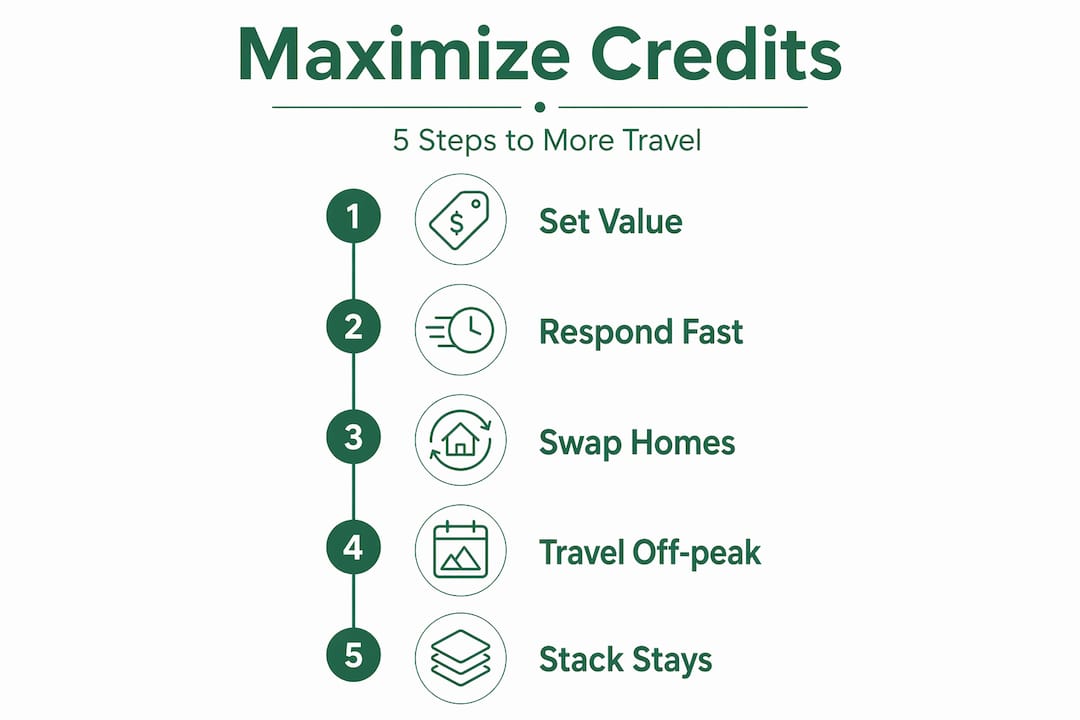 Infographic showing five steps to maximize exchange credits
Step 2: Respond to requests within 24 hours. Prompt communication directly improves your exchange completion rate. Platforms notice response behavior and surface active listings higher in search results.
Step 3: Prioritize reciprocal exchanges when possible. A simultaneous swap where both households exchange homes in the same period costs neither party credits. This preserves your credit bank for asynchronous stays where no direct swap is available.
Step 4: Redeem credits during off-peak periods for maximum nights. A home priced at 80 credits per night in peak season may drop to 50 credits in shoulder season. Same home, same experience, 37% more nights per credit spent.
Step 5: Stack stay requests. Instead of booking one long stay at a premium destination, consider two shorter stays in well-reviewed homes. You get more cultural variety and often spend fewer total credits.
| Strategy | Credit impact | Best for |
|---|---|---|
| Reciprocal exchange | Zero credits spent | Planned simultaneous swaps |
| Off-peak redemption | 25-40% more nights | Flexible travel dates |
| Listing adjustment (+/- 30 pts) | Higher request volume | Low-demand periods |
| Amenity upgrade | Higher per-night value | Long-term credit earning |
Common challenges and how to handle them
Even with a solid strategy, friction points come up. Here are the most common ones and how to work through them.
-
Mismatched credit values in a swap. If your home is worth more credits per night than the home you want to stay in, you will spend fewer credits than you earn on a reciprocal deal. That is actually a net positive for your balance. But if it is reversed, negotiate a shorter stay at the higher-value property rather than skipping it entirely.
-
Credit expiration risk. Most home exchange platforms do not expire credits, but airline credits absolutely do. The fix is simple: track purchase deadlines as your primary expiration metric, not travel dates.
-
Low request volume. Before assuming your home is undesirable, check three things. First, are your photos current and well-lit? Second, is your amenity list complete? Third, is your credit price competitive for your area? Usually, one of those three is the culprit.
-
Communication breakdowns with partners. Be specific in your exchange messages. State your preferred dates, flexibility range, and what you are offering. Vague messages generate vague responses and delays that kill deals.
"The best exchange partners communicate like they are planning a shared project, not negotiating a transaction. Clarity up front prevents every major problem later."
- Platform-specific nuances. Each home exchange platform calculates and values credits differently. What works on one platform may not translate directly to another. Always read the platform-specific credit documentation before assuming your strategy transfers.
My take on what actually works
I've seen a lot of homeowners chase the highest possible credit number for their listing, and it almost always backfires. A home listed at maximum credits with mediocre photos and a thin amenity description sits empty while a modestly priced but beautifully presented home nearby books every month. The credit number is a filter. The listing is what converts.
What I've found actually matters: responsiveness and presentation, in that order. Hosts who reply within a few hours and maintain honest, detailed listings consistently earn more credits over a year than hosts who set a high price and wait. The platform rewards activity, not ambition.
I've also learned that the credit timing piece for airline rewards is where most travelers quietly lose hundreds of dollars in value. The purchase-deadline-vs-travel-date distinction is genuinely non-obvious, and missing it once is enough to make you religious about tracking it. Get that calendar set up before you need it, not after.
The real return on home exchanging is not just nights of free accommodation. It is the kind of travel that puts you in a real neighborhood, in a real home, cooking in someone's kitchen. Credits are just the mechanism that gets you there. Keep them healthy, use them deliberately, and the experiences follow.
— Swappa
Start maximizing your credits with Swappahome
If you are ready to put these strategies into practice, Swappahome is built for exactly this. The platform connects verified homeowners globally through a straightforward credit system where one credit equals one free night. New members receive starter credits, so you can begin exploring stays while your listing earns.
 https://swappahome.com
Whether you want to browse available homes before listing your own or you are ready to list and start earning, Swappahome gives you the tools to travel affordably without hotel costs. With verified members across dozens of countries and a simple listing process, the gap between your first credit and your first free stay is shorter than you might expect. Start swapping homes today and see what your home is worth.
FAQ
How are home exchange credits calculated?
Credits are calculated based on your home's location, bed capacity, and amenities. Platforms like HomeExchange use algorithms that assign higher credit values to homes with in-demand features such as pools, air conditioning, and larger sleeping capacity.
Can home exchange credits expire?
Most home exchange platform credits do not expire, but airline travel credits typically expire based on the original ticket purchase date. Always check your platform's specific rules and track purchase deadlines separately from travel dates.
What is the best way to earn more exchange credits?
The best ways to earn credits include keeping your listing accurate and photo-rich, adding high-demand amenities, increasing bed capacity where possible, and responding to exchange requests promptly. Active, well-maintained listings consistently attract more requests and higher credit allocations.
How do I boost exchange value without major renovations?
Small additions like portable air conditioning, quality Wi-Fi, a dedicated workspace, or bikes for guests can raise your listing's appeal without significant cost. These features appear in guest search filters and often tip a browsing decision in your favor.
What is a reciprocal exchange and why does it matter?
A reciprocal exchange is a simultaneous home swap where both parties stay in each other's homes at the same time. Because no credits change hands, it is the most credit-efficient way to travel and preserves your balance for future asynchronous stays.
Recommended

Published by
SwappaHome
SwappaHome Editorial Team
Home Exchange & Slow Travel Editorial
The SwappaHome Editorial Team brings together travel research, home-exchange community insights, and platform data to produce practical guides for first-time and experienced home swappers. Every article cites real platforms, current market rates, and verifiable city-level facts so readers can make informed decisions without guessing.
Ready to try home swapping?
Join SwappaHome and start traveling by exchanging homes. Get 7 free credits when you sign up!