How trust shapes safe and satisfying home swaps

SwappaHome Editorial Team
Home Exchange & Slow Travel Editorial
How trust shapes safe and satisfying home swaps !Woman video calling for home swap trust > TL;DR: > > - Trust in home sharing depends on platform...
How trust shapes safe and satisfying home swaps
 Woman video calling for home swap trust
TL;DR:
- Trust in home sharing depends on platform competence, integrity, and benevolence.
- Transparent reviews and verified listings combined strengthen user confidence.
- Personal communication and active engagement are essential alongside digital trust measures.
Even the most highly reviewed home sharing platform can leave you with lingering doubts. You've read a dozen five-star ratings, scrolled through listing photos, and still wondered: what if the place looks nothing like those pictures? That nagging uncertainty isn't irrational. Research consistently shows that digital reviews alone don't close every trust gap. Hidden information, limited personal contact, and opaque fees can all erode confidence even when a platform's surface-level credentials look impeccable. This guide breaks down what actually builds trust in home exchanges, why it matters so much, and what you can do to protect every swap you make.
Table of Contents
- Why trust matters in home sharing exchanges
- What shapes trust on home sharing platforms
- Trust and risk: Navigating interpersonal and platform dynamics
- Overcoming information asymmetry and subtle trust barriers
- The uncomfortable truth experts rarely discuss about digital trust
- Start your trusted home exchange journey
- Frequently asked questions
Key Takeaways
| Point | Details |
|---|---|
| Trust shapes participation | Home sharing relies on trust to attract both homeowners and travelers, directly influencing exchange willingness. |
| Reviews aren’t enough | Review systems help, but information gaps and poor communication can still undermine trust in digital swaps. |
| Platform support matters | Platforms with transparent verification, user support, and dispute handling minimize risk and build trust. |
| Information clarity is critical | Transparent fees, contact details, and easy-to-read reviews are essential for sustaining trust. |
| Direct interaction enhances trust | Personal communication between hosts and guests remains key for safe, satisfying home exchanges. |
Why trust matters in home sharing exchanges
Trust isn't a soft, optional extra in home swapping. It's the foundation that makes the entire exchange possible. When you hand your house keys to a stranger, or arrive at someone else's home thousands of miles from your own, the level of trust you feel directly shapes how the experience unfolds.
Think about the difference between staying at a hotel and staying in someone's home. A hotel offers anonymity and predictability. A home swap offers character, local knowledge, and genuine cultural immersion, but that richness comes with a tradeoff: you're relying on another person, not a corporation with liability insurance and a front desk. That's exactly why building safety through trust is so central to successful exchanges.
Trust also functions on multiple levels at once. It's not just about whether you believe the other person is honest. It's also about whether you trust the platform itself, whether the payment systems feel secure, and whether you feel a sense of community familiarity with other members. Empirical research in the sharing economy confirms this: trust is a multidimensional construct that includes structural assurance, competence, benevolence, integrity, and familiarity. All five dimensions influence whether someone decides to engage.
The data is clear. When these trust dimensions are strong:
- Homeowners feel confident listing their properties
- Travelers feel safe booking unfamiliar accommodations
- Both sides enjoy richer, more relaxed experiences
- Members return to the platform and recommend it to others
"Consumers' digital trust directly drives intention to engage." This insight from sharing economy research explains why platforms that invest in robust trust mechanisms attract and retain far more members than those that treat verification as an afterthought.
Framing trust this way changes how you approach every step of the swap process. You're not just checking a star rating. You're evaluating a whole ecosystem of signals. Understanding those signals puts you in a much stronger position, whether you're listing your own home or choosing where to stay next. Platforms that earn trust and swap homes successfully are the ones that take this seriously at every layer.
What shapes trust on home sharing platforms
Knowing that trust matters is only the first step. The more useful question is: where does trust actually come from on a digital platform, and how do you recognize it when it's present?
The architecture of a platform communicates trust before a single message is exchanged. A site with verified listings, clear cancellation policies, accessible support channels, and transparent review systems sends a very different signal than one that buries its contact details or offers only anonymous feedback. Review systems and information quality directly shape whether trust forms or fails. When reviews feel curated, vague, or one-dimensional, users quickly lose confidence.
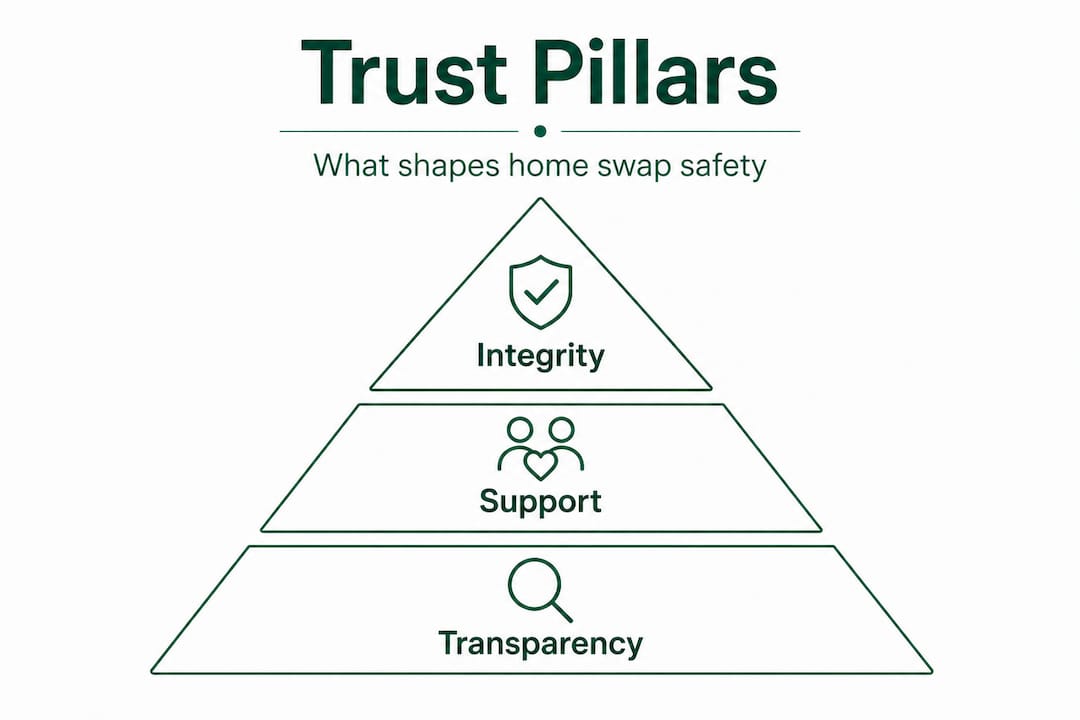
Research on digital trust factors in home sharing identifies three pillars that consistently predict positive outcomes:
- Platform competence: Does the site work reliably? Are listings accurate and up to date? Can you reach support when something goes wrong?
- Platform integrity: Does the platform follow through on its promises? Are fees clear upfront? Is the verification process genuine, not just a checkbox?
- Platform benevolence: Does the platform seem to care about member outcomes, or only about growth metrics? A benevolent platform creates mechanisms for conflict resolution and actively works to protect both hosts and guests.
These three pillars work together. A platform that scores high on integrity but offers poor support still generates anxiety. One that feels technically competent but lacks transparency on fees loses members fast. Understanding how verification in exchanges fits into this picture helps you identify which platforms are genuinely trustworthy versus which ones just look the part.
 Infographic showing trust pillars for home swaps
Here's a practical comparison of two key trust-building mechanisms:
| Feature | User reviews | Verified listings |
|---|---|---|
| What it signals | Community experience over time | Platform-level accountability |
| Strengths | Rich detail, personal insight | Structural assurance, reduces fakery |
| Weaknesses | Can be gamed, vague, or too positive | Doesn't capture interpersonal dynamics |
| Best use | Gauging personality and style | Confirming legitimacy of the listing |
| Trust dimension served | Familiarity, benevolence | Competence, structural assurance |
The takeaway from this table is important: neither reviews nor verification alone is sufficient. The strongest platforms layer both, and user reviews and trust are most effective when the verification foundation is already solid.
Pro Tip: Before committing to any swap, check that the platform shows verified badges on listings AND displays detailed, named reviews. Anonymous or uniformly glowing reviews are a red flag, not a green light.
Trust and risk: Navigating interpersonal and platform dynamics
Even when you've done your research and chosen a strong platform, some risk always remains. The question isn't how to eliminate risk entirely; it's how to manage it intelligently so it doesn't undermine the experience.
 Man reading user reviews at kitchen table
One of the most underappreciated risks in home exchanges isn't crime or property damage. It's the anxiety that comes from limited face-to-face interaction. When you book a hotel, a staff member greets you, hands you a key, and answers questions in real time. In a home swap, you're often coordinating asynchronously with someone you've never met, across time zones and cultural differences. That's a genuinely unfamiliar dynamic for most people, and it requires specific platform safeguards to manage well.
Customer support and dispute handling matter far more than most home swappers realize until something actually goes wrong. A well-designed support system reduces the perceived risk of engaging by giving you a safety net. Knowing that a real team will respond if there's a problem allows you to engage more freely and confidently with other members.
Common risk scenarios in home exchange include:
- Property condition doesn't match listing descriptions or photos
- Unexpected fees or access issues on arrival
- Lack of timely communication from the other party before or during the stay
- Unclear house rules leading to friction or damage
- Disputes over credit use or booking cancellations
"Trust and risk are not only interpersonal. Customer support and dispute-handling matter because they can mitigate risk when problems arise, especially given limited face-to-face interaction." This point is critical: the platform bears real responsibility for what happens between members, not just during the booking process.
Here's how support features compare in terms of their effect on perceived risk:
| Support feature | Impact on perceived risk |
|---|---|
| 24/7 live support | High reduction in anxiety |
| Clear dispute resolution process | Strong trust signal for both parties |
| Direct messaging between members | Moderate, builds personal familiarity |
| Automated responses only | Increases uncertainty significantly |
| Verified identity of both parties | Substantial reduction in perceived threat |
If you're exploring home swapping security practices, this table is a useful checklist. Any platform missing two or more of these features deserves extra scrutiny before you commit. And for anyone seeking genuinely trusted exchanges for travel, the quality of the support infrastructure is often a better predictor of experience quality than the listing photos.
Overcoming information asymmetry and subtle trust barriers
Here's where most trust advice falls short. It tells you to "read reviews carefully" and "check the host's profile." But it rarely names the actual mechanism that makes trust collapse silently and without warning: information asymmetry.
Information asymmetry simply means one party knows significantly more than the other. In home swapping, it usually works against the guest. The host knows exactly what the neighborhood noise is like at 2 a.m., whether the hot water pressure is reliable, or that the listed parking space is actually shared. The guest sees curated photos and optimistic review summaries.
High information asymmetry such as low-quality or hard-to-interpret reviews, unclear contact details, hidden fees, and limited interaction opportunities can substantially inhibit knowledge-based trust even when a platform provides some review mechanism. In other words, a review system that exists but doesn't function well is almost as bad as no review system at all.
Before any swap, ask yourself and your potential partner these questions:
- Are the fees listed upfront, with no vague "additional charges may apply" clauses?
- Can you reach a real person on the platform if something goes wrong?
- Do reviews mention specific details like noise level, cleanliness, or neighborhood feel?
- Is the host responsive to direct questions, not just polished in their listing copy?
- Are check-in instructions clear, with backup options if the primary plan fails?
These aren't paranoid questions. They're the signals that separate genuine transparency from polished marketing. The way exchange platforms transform home swapping for the better is precisely by closing these information gaps at a structural level, through required fields, mandatory disclosures, and community-enforced norms.
Pro Tip: Always request direct contact with a host before finalizing any exchange. A host who is enthusiastic in their listing but slow or evasive in direct messages is showing you something important. Responsiveness before the swap is your best preview of the experience during it.
The subtle trust barriers worth watching for are things like overly brief review responses, listings that answer every question except the most practical ones, and platforms that make it difficult to reach a human when you need one. These aren't dealbreakers on their own, but patterns matter. Two or three small red flags together deserve real attention.
The uncomfortable truth experts rarely discuss about digital trust
Here's the thing most trust-in-home-sharing articles won't tell you: no platform, no matter how sophisticated, can fully replace your own judgment.
We've talked a lot about structural assurance, platform competence, and review systems. All of that matters. But the uncomfortable reality is that even the best-designed platforms have failed users who assumed the digital infrastructure would do all the work for them. Trust mechanisms are tools. They work best when you use them actively, not passively.
The most successful home swappers we've seen don't simply select a host with good reviews and assume everything will be fine. They read between the lines of reviews to spot consistent patterns. They ask direct questions and pay attention to how quickly and specifically those questions are answered. They treat the pre-swap communication phase as a genuine relationship-building exercise, not just a formality.
Face-to-face interaction, when possible, is still enormously valuable. A video call before a swap does more to establish mutual comfort than twenty messages ever could. It humanizes both parties and catches potential mismatches in expectations early. That's not a failure of digital trust; it's digital trust working as intended, by giving you enough information to make a truly informed decision.
The best home swaps consistently combine platform-level assurance with personal diligence. You use the platform's tools as your starting point, then build on them with genuine conversation, honest communication about your home and expectations, and a willingness to engage as a real person rather than a verified profile.
Trusted travel networking works the same way. The network provides the context. You provide the human connection. Neither alone is enough.
Pro Tip: Prioritize platforms and hosts who actively welcome your questions. A host who says "ask me anything" and means it is far more trustworthy than one whose profile is perfect but whose direct replies are guarded.
Start your trusted home exchange journey
Ready to put these trust insights into practice?
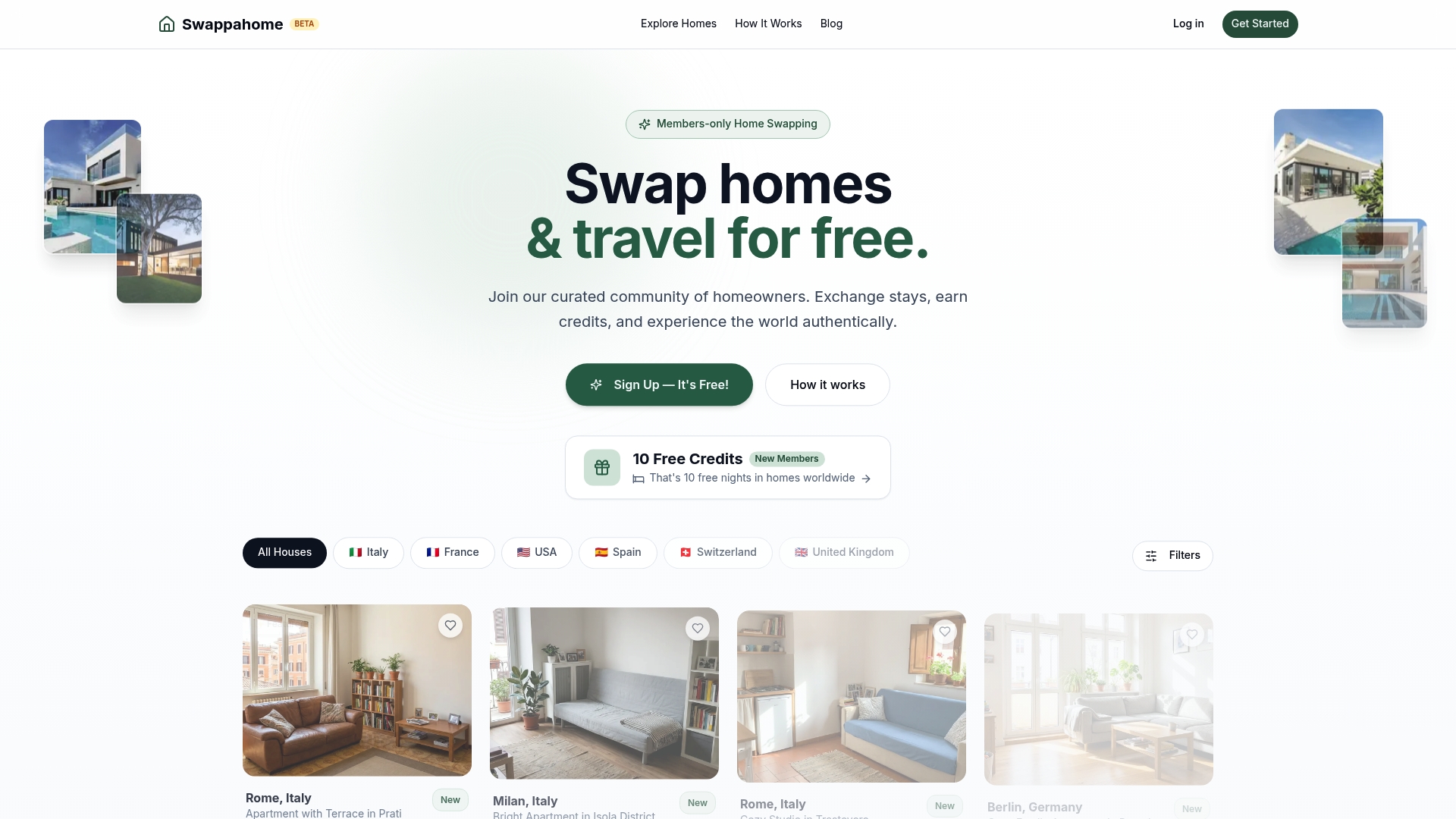 https://swappahome.com
Swappahome was built around exactly the principles covered in this guide. The platform combines verified member identities, community-driven reviews, and transparent credit systems so you always know what you're getting before you arrive. Every listing goes through a verification process designed to reduce the information gaps that undermine trust. And the support team is there if anything goes sideways. Whether you're listing your home for the first time or planning your tenth exchange, the foundation is the same: a curated community of real homeowners who've chosen to travel differently. Take your first step by browsing verified swap listings and see where genuine trust can take you.
Frequently asked questions
How does Swappahome help build trust between homeowners and travelers?
Swappahome uses verified listings, community reviews, and clear support channels to foster transparency. As research confirms, platforms that invest in robust review and information systems are the ones where trust actually forms and holds.
What are the key risks involved in home sharing exchanges?
Common risks include property condition mismatches, unclear fees, and poor communication before or during a stay. Platforms with strong support structures and transparent dispute resolution significantly reduce these risks, because as research shows, customer support and dispute handling directly affect how safe members feel.
What does information asymmetry mean in home sharing?
Information asymmetry happens when one party, usually the guest, has far less knowledge about the property or situation than the host. When asymmetry is high, even platforms with review systems can fail to generate real trust, because the reviews available are too vague or incomplete to be genuinely useful.
Can digital trust mechanisms fully replace direct communication between hosts and guests?
No. Digital mechanisms provide the framework, but direct communication fills the gaps that algorithms and review scores can't. Proactive dialogue before a swap remains one of the strongest predictors of a successful, comfortable experience for both parties.
Recommended
- Role of Trust in Home Exchanges—Building Safety and Community | SwappaHome Blog
- Home swapping safety tips for confident exchanges 2026 | SwappaHome Blog
- Travel community best practices: earn trust, swap homes | SwappaHome Blog
- Security in Home Swapping: What Homeowners Must Know | SwappaHome Blog
- Why trust family-owned movers? Local expertise & peace of mind

Published by
SwappaHome
SwappaHome Editorial Team
Home Exchange & Slow Travel Editorial
The SwappaHome Editorial Team brings together travel research, home-exchange community insights, and platform data to produce practical guides for first-time and experienced home swappers. Every article cites real platforms, current market rates, and verifiable city-level facts so readers can make informed decisions without guessing.
Ready to try home swapping?
Join SwappaHome and start traveling by exchanging homes. Get 7 free credits when you sign up!