
Maximizing Swap Credits Workflow for Free Travel

SwappaHome Editorial Team
Home Exchange & Slow Travel Editorial
Maximizing Swap Credits Workflow for Free Travel !Woman organizing swap credits workflow at kitchen table > TL;DR: > > - A swap credits workflow...
Maximizing Swap Credits Workflow for Free Travel
 Woman organizing swap credits workflow at kitchen table
TL;DR:
- A swap credits workflow enables homeowners to earn, track, and spend credits efficiently to travel for free. Managing credits proactively through proper listing, strategic task classification, and daily monitoring prevents waste and maximizes travel opportunities. Staying active and responding promptly ensures a healthy credit balance and continuous access to desirable destinations.
A swap credits workflow is the system you use to earn, spend, and conserve credits on a home swapping platform so every night you travel costs you nothing. Maximizing swap credits workflow means more than just collecting credits. It means building a repeatable process that keeps your balance healthy, your listings active, and your next trip fully funded. Swappahome operates on a simple rule: one credit equals one free night. That simplicity is powerful, but only if you manage your credits with intention. This guide gives you the exact framework to do that.
What are the essential tools for your swap credits workflow?
Every efficient swap credits workflow starts with the right foundation. You need an active, verified account on a credit-based home swapping platform, a clear understanding of how credits are earned and spent, and a system for tracking your balance over time. Without these three elements, even the best strategies fall apart.
Swappahome's vacation credit system works on a straightforward exchange: you host a traveler, you earn credits, and you spend those credits to stay somewhere else. New members receive free starter credits, which gives you an immediate runway to plan your first trip before you ever host anyone.
Before you build any workflow, set these foundations:
- A verified listing: Your home must be fully described, photographed, and approved. An incomplete listing earns no credits.
- A credit tracking method: Use Swappahome's dashboard to monitor your balance, pending credits, and upcoming expirations. A simple spreadsheet as a backup works well.
- Clear travel goals: Know how many credits you need for your target destinations before you start earning. This prevents aimless accumulation.
- An understanding of expiration rules: Credits do not last forever. Check Swappahome's terms for rollover and expiration policies so you never lose what you earned.
Here is a quick reference for the core credit concepts every homeowner needs to know:
| Concept | What it means for you |
|---|---|
| Credit earning | You earn credits when another member stays at your home |
| Credit spending | You spend credits to book stays at other members' homes |
| Credit expiration | Unused credits may expire after a set period |
| Starter credits | New members receive free credits to begin traveling immediately |
| One-to-one rate | One credit equals one free night of accommodation |
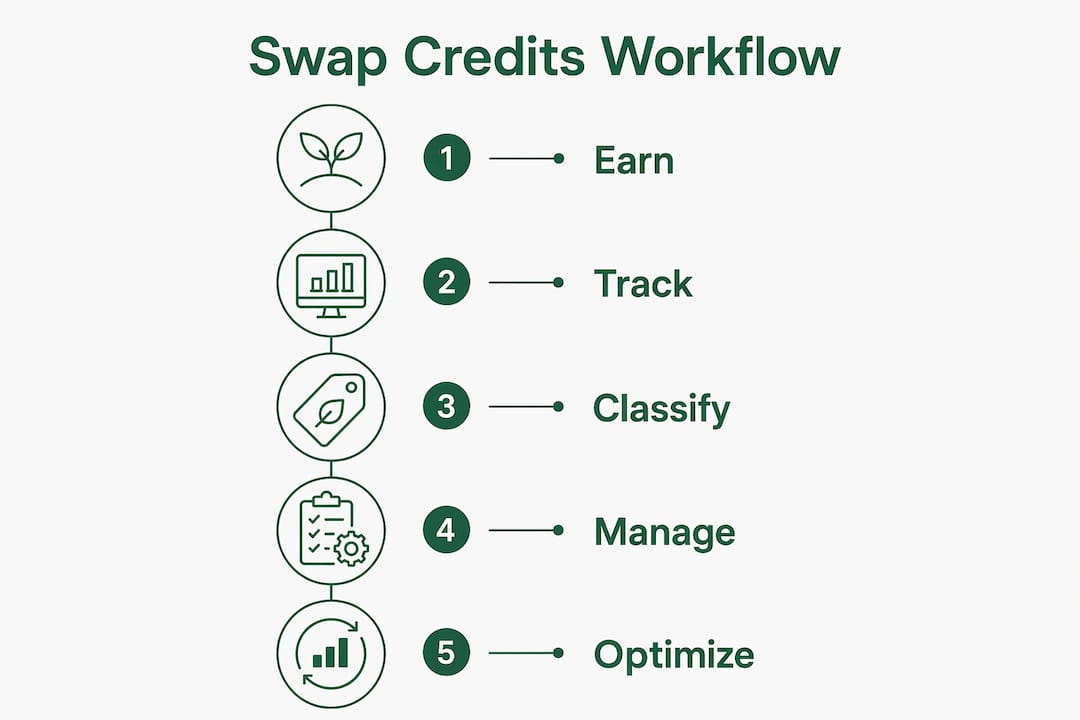 Infographic illustrating swap credits workflow steps
Pro Tip: Set a calendar reminder one month before your credits expire. That window gives you enough time to book a trip rather than scramble or lose the balance.
How can you classify tasks to enhance swap credit efficiency?
 Close-up of hands sorting task cards for swap credit efficiency
Not every action in your home swapping workflow carries the same credit cost or complexity. The biggest mistake homeowners make is treating all tasks as equal. They spend the same energy and attention on browsing listings as they do on coordinating a two-week multi-city exchange. That imbalance wastes time and, on platforms that charge credits for certain actions, wastes credits too.
The fix is task classification. Divide your activities into two tiers.
- Simple tasks: Browsing listings, updating your profile, responding to basic inquiries, and checking availability. These require minimal effort and no credit commitment.
- Complex tasks: Coordinating multi-home exchanges, negotiating simultaneous swaps across different time zones, and booking high-demand destinations during peak seasons. These require your full attention and your best credit strategy.
Once you classify tasks, you can allocate your effort correctly. Handle simple tasks in short daily sessions. Reserve focused time blocks for complex coordination. This mirrors a principle from task-based credit systems: shifting simple tasks to lower-cost modes yields 100% credit savings on those tasks. The same logic applies to home swapping. Spending credits on a low-value exchange when a better destination is available next month is a waste you can prevent.
Prioritize high-return swaps. A week in Paris or Tokyo costs the same credits as a week in a less desirable location. If your credit balance is limited, hold it for the destination that delivers the most value to you. Earning swap credits consistently through regular hosting keeps your balance ready for those high-return opportunities.
Pro Tip: Before committing credits to any booking, check whether the same destination has availability in a lower-demand window. Off-peak travel often costs the same credits but delivers a far better experience because the destination is less crowded.
What are best practices for managing credit consumption to avoid waste?
Credit waste is the silent killer of a good swap workflow. It happens gradually, through small inefficiencies that compound over months. The most common cause is poor context management. In practice, this means attaching too much irrelevant information to your swap requests, sending redundant messages, or reopening completed negotiations unnecessarily.
Batching related requests together reduces per-operation credit overhead significantly. That principle translates directly to home swapping. Instead of sending five separate messages to a potential host, consolidate your questions into one clear, complete message. You get a faster response and you avoid the back-and-forth that drags out negotiations.
Here is a comparison of wasteful versus efficient credit habits:
| Wasteful habit | Efficient alternative |
|---|---|
| Sending multiple partial messages | Send one complete, well-organized inquiry |
| Booking impulsively without comparing options | Compare at least three listings before committing credits |
| Ignoring credit expiration dates | Review your balance monthly and book proactively |
| Holding credits for a "perfect" trip indefinitely | Set a deadline: use credits within 90 days of earning them |
| Reopening resolved swap negotiations | Document agreed terms immediately and close the thread |
Starting fresh when a negotiation stalls also saves credits. Resetting a conversation avoids the compounding cost of carrying a long, unproductive history forward. In home swapping terms, if a swap negotiation has gone back and forth more than five times without resolution, close it and find a new match. Your time and your credits are better spent elsewhere.
Pro Tip: Attach only the documents or details a host actually needs. Sending your full travel history, multiple photo albums, and lengthy personal bios to every potential host creates noise. A concise, focused profile converts better and keeps your workflow clean.
How to implement daily monitoring for ongoing credit optimization?
Consistent monitoring separates homeowners who always have credits available from those who scramble before a trip. Daily credit monitoring is now considered essential for staying ahead of changing credit dynamics. Periodic checks are not enough. By the time you notice a problem, you may have already missed a booking window.
Set up a simple daily review using these four steps:
- Check your current balance against your next planned trip's credit cost. Know your gap at all times.
- Review pending hosting confirmations to forecast incoming credits. A confirmed guest next week means credits arriving soon.
- Scan new listings in your target destinations. High-demand spots fill fast, and early booking protects your credits from being outpaced by demand.
- Audit any expiring credits and prioritize booking before the deadline.
Setting alert thresholds at 70% and 90% of your credit budget for a given trip is a proven method for proactive management. When your planned trip costs 10 credits and you have only 7 in your balance, that 70% threshold triggers action: host more, adjust your travel dates, or choose a shorter stay. Waiting until you have 9 credits and need 10 leaves you with no room to maneuver.
Automation makes this easier. Swappahome's dashboard shows credit consumption patterns over time. Use that data to identify your peak earning months and plan your most ambitious trips accordingly. Automated workflows can save between 47% and 62% of credits while maintaining over 99% output quality. That finding comes from digital workflow systems, but the principle holds: consistent, automated tracking beats manual guesswork every time.
How to troubleshoot common pitfalls in your swap credits workflow?
Even well-planned workflows break down. Knowing the most common failure points lets you fix them before they cost you a trip.
- Misreading credit consumption rates: Some destinations or booking types cost more credits than others. Always confirm the exact credit cost before you commit. Never assume all listings are priced at one credit per night.
- Overcommitting credits to low-value swaps: Booking a mediocre listing because it is available right now burns credits you could have saved for a better destination next month. Patience is a credit management strategy.
- Skipping the batching step: Homeowners who send fragmented, piecemeal swap requests take longer to confirm bookings and create confusion for hosts. One complete, clear request closes deals faster.
- Ignoring expiration and rollover policies: Credits you earned three months ago may expire before you use them. Managing swap requests proactively prevents this loss.
- Failing to update your listing: An outdated listing with old photos or incorrect availability blocks incoming hosting requests. No hosting requests means no new credits. Review and refresh your listing every 60 days.
The credit-based travel model rewards homeowners who stay engaged. Passive members lose credits to expiration and miss booking windows. Active members compound their credit balance and travel more.
Key Takeaways
A well-managed swap credits workflow is the single most reliable way to travel for free, consistently and without last-minute scrambles.
| Point | Details |
|---|---|
| Build the right foundation | Verify your listing, track your balance daily, and know your credit expiration dates. |
| Classify tasks by complexity | Handle simple browsing tasks quickly and reserve focused effort for high-value swap coordination. |
| Batch and consolidate requests | Send complete, single inquiries instead of fragmented messages to close bookings faster. |
| Set alert thresholds | Monitor your balance at 70% and 90% of your trip's credit cost to stay ahead of shortfalls. |
| Stay active to avoid waste | Refresh your listing every 60 days and book before credits expire to protect what you earned. |
What I've learned from watching homeowners get this wrong
The most common mistake I see is treating swap credits like airline miles: earned once, forgotten, and then discovered expired in a drawer. Credits are not a reward. They are a currency with a shelf life, and they behave exactly like cash in that sense. Spend them with intention or lose them to inaction.
The homeowners who travel the most on Swappahome are not the ones with the biggest homes or the most exotic locations. They are the ones who check their dashboards regularly, respond to hosting requests within 24 hours, and plan their next trip before the current one ends. That discipline compounds. A homeowner who hosts six times a year and books strategically can travel to six different countries without spending a dollar on accommodation.
My honest recommendation: treat your credit balance like a checking account, not a savings account. The goal is not to accumulate. The goal is to move credits through the system efficiently, from hosting to booking, and back again. The travelers who do that well never run out.
— Swappa
Swappahome: where your home earns your next trip
Swappahome is built for homeowners who want to travel without paying for hotels. Every time you host a member, you earn credits. Every credit you earn is a free night somewhere in the world.
 https://swappahome.com
The platform gives new members starter credits so you can book your first trip before you ever host. Verified listings across dozens of countries mean your next destination is already waiting. Whether you want a week in a coastal villa or a city apartment for a long weekend, the credits you earn at home pay for it. Browse available listings to see what your credits can unlock, or create your free account and start earning today. For homeowners who want to get more from every trip, Hidden Door Travel's guide to managing travel expenses pairs well with a credit-based travel strategy.
FAQ
What is a swap credits workflow?
A swap credits workflow is the process you use to earn, track, and spend credits on a home swapping platform. An efficient workflow keeps your balance healthy and your travel calendar full.
How do I avoid losing swap credits to expiration?
Check your credit expiration dates monthly and book trips proactively before deadlines arrive. Setting a calendar alert 30 days before expiration gives you enough time to act.
How many credits do I need for a free stay on Swappahome?
Swappahome uses a one-to-one rate: one credit equals one free night of accommodation. The exact number of credits depends on the length of your stay.
What is the fastest way to earn more swap credits?
The fastest method is to keep your listing active, accurate, and fully photographed, then accept hosting requests consistently. Regular hosting builds your balance faster than any other single action.
Should I save credits or spend them quickly?
Spend credits with a plan rather than hoarding them. Credits that sit unused risk expiring. Book your next trip as soon as your balance covers it, and host again to rebuild.
Recommended

Published by
SwappaHome
SwappaHome Editorial Team
Home Exchange & Slow Travel Editorial
The SwappaHome Editorial Team brings together travel research, home-exchange community insights, and platform data to produce practical guides for first-time and experienced home swappers. Every article cites real platforms, current market rates, and verifiable city-level facts so readers can make informed decisions without guessing.
Ready to try home swapping?
Join SwappaHome and start traveling by exchanging homes. Get 7 free credits when you sign up!