
National Lampoon's Vacation Christmas Vacation: The complete guide to the holiday classic

SwappaHome Editorial Team
Home Exchange & Slow Travel Editorial
Key Takeaways National Lampoon’s Christmas Vacation turns ordinary holiday stress into broad, affectionate slapstick. These are the main points to remember:…
Key Takeaways
National Lampoon’s Christmas Vacation turns ordinary holiday stress into broad, affectionate slapstick. These are the main points to remember:
- The 1989 film is the third entry in the Vacation series.
- Clark Griswold wants an old-fashioned Christmas for his entire family.
- Uninvited relatives, household accidents, and money troubles drive the plot.
- Chevy Chase, Beverly D’Angelo, and Randy Quaid anchor the ensemble.
- Its mix of nostalgia, family friction, and memorable set pieces keeps it in regular holiday rotation.
Understanding the film’s title and place in the franchise
The title is a small but useful guide to the movie’s identity. It keeps the Vacation name while making Christmas, rather than a road trip or destination, the center of the story. That shift gives the Griswolds a familiar home and a particularly concentrated set of problems.
Why the film is officially called National Lampoon’s Christmas Vacation
The official title is National Lampoon’s Christmas Vacation, not simply “Christmas Vacation.” The name connects the movie to the National Lampoon comedy tradition and to the earlier Vacation films. Its seasonal subtitle also tells viewers that this is a holiday story first: decorations, relatives, presents, and dinner are all part of the comic machinery.
The phrase “Christmas Vacation” sounds cozy, but the film quickly gives it an unruly edge. Clark’s good intentions are sincere, while the title’s promise of relaxation becomes increasingly ironic.
How it connects to the Vacation movie series
Released in 1989, the film is the third main installment in the series. Like its predecessors, it follows Clark Griswold as he tries to deliver a memorable experience for his family and repeatedly loses control of the situation.
The difference is that there is no long journey to keep the story moving. The action stays largely around the Griswold home, allowing small domestic inconveniences to build into full-scale chaos. That contained setting makes the comedy feel faster and more crowded.
The role of the Griswold family in the franchise
The Griswolds are the constant through-line. Clark supplies the impossible plan, Ellen often supplies patience and perspective, and the children react to the household’s escalating absurdity. Their family dynamic gives the jokes an emotional base rather than making them a collection of unrelated gags.
Clark is not trying to cause trouble. He is trying too hard to make everyone happy, which makes his failures both ridiculous and recognizable. The family’s affection survives even when the holiday itself seems ready to collapse.
Why the Christmas setting changed the series’ appeal
Christmas gives the series a set of instantly recognizable rituals: choosing a tree, hanging lights, welcoming relatives, exchanging gifts, and sitting down to dinner. Each ritual comes with expectations, so each one offers Clark another opportunity to overreach.
That familiarity helped the movie become a seasonal repeat-watch. Viewers do not need much setup to understand the pressure behind a perfect family holiday, even if their own decorations have never caused quite this much trouble.
The plot of National Lampoon’s Christmas Vacation
The story begins with Clark determined to give his family a traditional Christmas at home. His plan sounds generous and wholesome, but it depends on a great many things going exactly right. As usual for Clark, that is where the trouble starts.
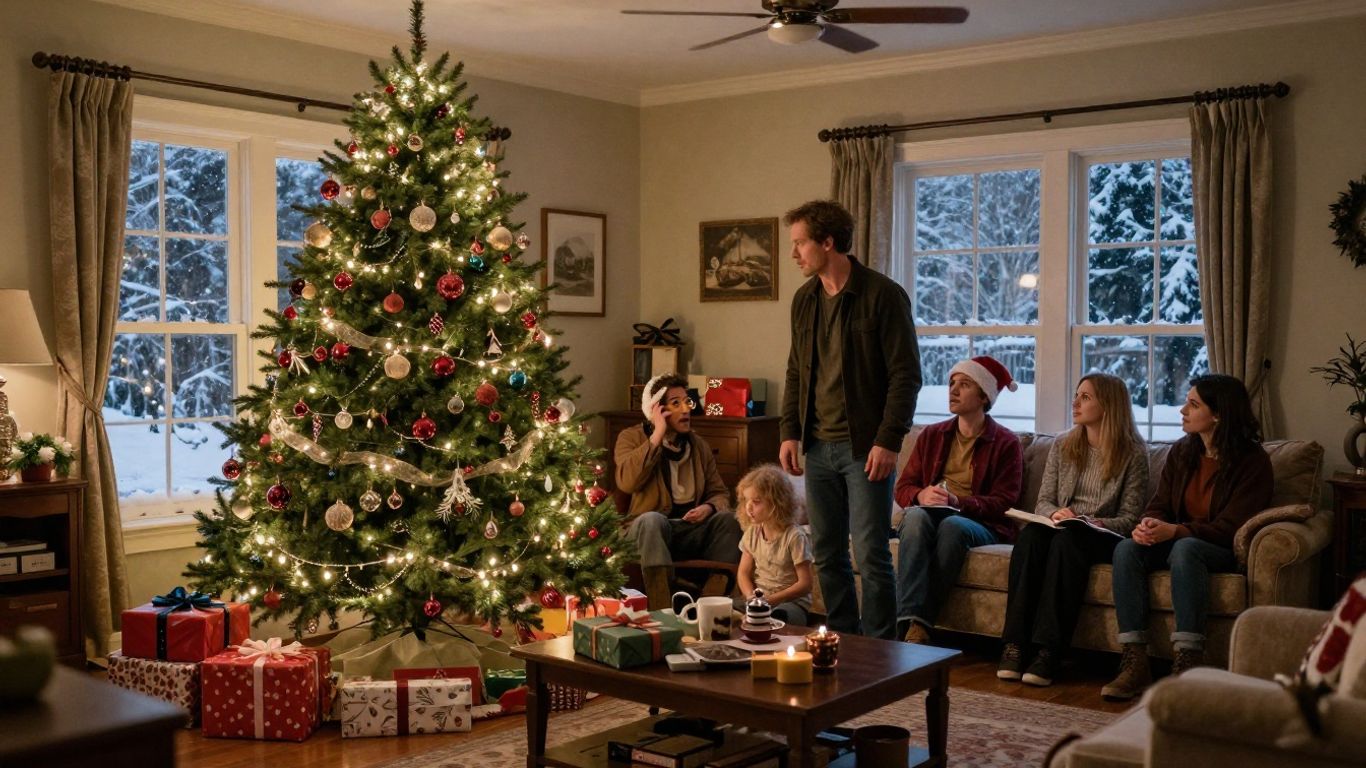 Clark Griswold surrounded by festive household chaos
Clark Griswold’s vision for the perfect holiday
Clark wants a “good old-fashioned” Christmas, complete with a grand tree, elaborate outdoor lights, and a gathering that will impress everyone. He treats each detail as proof that he is providing for his family, even when the effort becomes excessive.
The plan also relies on a hoped-for holiday bonus from work. That financial expectation quietly raises the stakes: Clark is not only decorating a house, but also trying to secure the feeling of abundance he associates with Christmas.
The arrival of the extended family
The Griswold household becomes much fuller when relatives arrive, including Clark’s parents and Ellen’s family. The unexpected arrival of Cousin Eddie, his wife Catherine, and their children adds an especially disruptive presence to the festivities.
The visitors bring old resentments, awkward habits, and competing ideas about hospitality. Their presence makes the house feel less like Clark’s carefully managed holiday display and more like a crowded family gathering where nobody quite has enough space.
The disasters that derail Christmas
The film piles one mishap onto another. The tree, the lights, the decorations, the food, and the plumbing all become sources of embarrassment or danger. Clark keeps responding to each setback by pushing harder, which generally produces a larger setback.
A few recurring ingredients explain the movie’s escalating rhythm:
- Clark’s optimism turns simple tasks into ambitious projects.
- Relatives arrive with needs and expectations of their own.
- Financial pressure makes the holiday feel more urgent.
- Physical comedy repeatedly interrupts polite family behavior.
These disasters work because they are tied to recognizable holiday chores. The jokes may become extreme, but the starting points are ordinary enough to feel familiar.
How the story reaches its chaotic climax
By the final act, the Griswold home has become the scene of several overlapping crises. Clark’s disappointment over work and his determination to preserve Christmas push the family toward an emotional breaking point, while the relatives and authorities add even more confusion.
The climax does not restore perfect order so much as reveal what matters beneath the disorder. The holiday survives because the family remains together, not because Clark’s original plan succeeds exactly as imagined.
The cast and characters
The cast gives the film its particular balance of warmth and aggression. Clark’s frantic confidence would be exhausting without Ellen’s steadiness, while the supporting characters keep introducing new forms of discomfort. The performances make the household feel crowded in a way that is comic before it becomes overwhelming.
Chevy Chase as Clark Griswold
Chevy Chase plays Clark as a man powered by enthusiasm, pride, and an almost heroic inability to recognize when a plan has failed. He is an ordinary father in his own mind, but his definition of ordinary includes thousands of lights and an elaborate sense of seasonal duty.
The performance depends on momentum. Clark moves from excitement to irritation to desperation without ever fully abandoning the belief that he can still rescue the day. That stubborn optimism is the character’s most durable comic trait.
Beverly D’Angelo as Ellen Griswold
Beverly D’Angelo gives Ellen a calmer presence within the storm. Ellen understands Clark’s ambitions, but she is also more aware of how those ambitions affect everyone else in the house.
Her reactions often make the audience’s perspective clear. She can be amused, embarrassed, supportive, or exasperated in the same scene, which keeps the Griswold marriage from becoming a simple contrast between a foolish husband and a patient wife.
The Griswold children and changing actors
Audrey and Rusty remain part of the family structure, but the roles were played by different actors across the early films. In Christmas Vacation, Juliette Lewis plays Audrey and Johnny Galecki plays Rusty.
Their presence matters less as a source of independent plot than as a measure of the family’s discomfort. The children observe Clark’s behavior, endure the relatives, and react to the increasingly strange atmosphere with a mixture of embarrassment and disbelief.
Cousin Eddie and the supporting characters
Randy Quaid’s Cousin Eddie is the film’s most disruptive visitor. He arrives with his family and an improvised sense of entitlement, treating the Griswold property as though it were a perfectly reasonable place to settle in.
Eddie works because he is both outrageous and oddly sincere. He does not seem to understand why his behavior is alarming, which allows the film to place him beside Clark: one man overcommits to Christmas, while the other simply overcommits to himself.
The film’s most memorable comedy
The comedy is built around escalation rather than subtle correction. A small domestic inconvenience becomes a public embarrassment, a family disagreement becomes a physical crisis, and a festive object becomes a threat. The movie’s set pieces remain memorable because they combine visual spectacle with very recognizable holiday frustrations.
 Brightly decorated Griswold house under snowy evening sky
The house-lighting fiasco
Clark’s outdoor decorations are the clearest expression of his holiday ambition. He keeps adding lights until the display becomes almost absurdly large, then faces the practical problem of making the whole thing work.
The joke is not only that there are too many lights. It is that Clark treats the display as a moral obligation, as if the family’s happiness depends on the house shining brighter than every other home in the neighborhood.
The squirrel in the Christmas tree
The Christmas tree sequence turns a familiar centerpiece into a source of panic. What begins as a cheerful part of the room suddenly becomes unpredictable, sending the family into a frantic reaction.
It is a classic example of the film’s method: take something associated with comfort and tradition, then introduce one uncontrollable element. The result is silly, fast, and just plausible enough to make the scene land.
The holiday dinner and family tensions
The dinner scene brings the extended family’s tensions into one room. Food, manners, old grudges, and awkward conversation all compete for attention, while Clark tries to keep the occasion moving toward his ideal of togetherness.
The meal’s comedy also exposes the family’s limits. Everyone is expected to perform harmony, but the gathering is too crowded and too strained for that performance to last. The resulting discomfort is funny because it feels like a wildly exaggerated version of a familiar family dinner.
Cousin Eddie’s unexpected visit
Cousin Eddie’s arrival changes the household immediately. He brings his family, his camper, and a blunt disregard for the boundaries Clark has spent the film trying to maintain.
His scenes are among the movie’s most quoted because Eddie never appears embarrassed by his own behavior. That confidence makes him a perfect counterweight to Clark, who is constantly embarrassed but keeps pretending he is in control.
Themes and reasons the movie remains popular
Beneath the slapstick, the film understands why Christmas can be stressful. The holiday is full of emotional promises, family obligations, and material expectations, all compressed into a few days. Its comedy lasts because it laughs at those pressures without pretending that the desire for a happy gathering is foolish.
The pressure to create a perfect Christmas
Clark’s central mistake is not wanting a good Christmas. It is believing that a good Christmas can be engineered through enough effort, money, and decoration. He confuses visible scale with emotional success.
That idea remains recognizable. Many people know the feeling of trying to make a celebration special, only to discover that the preparation has become its own source of anxiety. The perfect holiday is impossible precisely because real families are involved.
Family conflict beneath the holiday humor
The relatives do not merely provide jokes; they test the family’s ability to remain civil. Different generations, personalities, and expectations are forced into close quarters, making every small disagreement feel larger.
The film does not resolve these conflicts through a heartfelt speech or a perfectly tidy reconciliation. Instead, it lets affection coexist with annoyance. That is one reason the family feels more durable than the holiday plans around them.
Nostalgia for traditional Christmas settings
Snow, glowing lights, a crowded living room, a decorated tree, and a large dinner create a deliberately familiar picture of Christmas. The setting has a storybook quality, but the behavior inside it is unruly and modern.
A simple comparison helps explain the movie’s seasonal identity:
| Element | Clark’s ideal | What actually happens |
|---|---|---|
| Decorations | A dazzling family display | Electrical and neighborhood chaos |
| Relatives | Warm holiday togetherness | Crowding, tension, and surprise guests |
| Dinner | A graceful shared meal | A memorable domestic disaster |
| Bonus | Financial relief | Anxiety and disappointment |
The contrast between the two columns is the heart of the film. The traditions remain attractive even when the people observing them make a mess of things.
How quotable scenes shaped its lasting appeal
The film’s dialogue is often short, blunt, and easy to remember, while its visual gags are built around scenes viewers can recall almost instantly. That makes it especially suited to group viewing, where people anticipate favorite moments and repeat familiar lines.
Its place in holiday culture is also reflected by the continuing attention given to the movie in this guide to National Lampoon’s Christmas Vacation. The appeal is not dependent on a single joke; it comes from a whole chain of scenes that audiences can revisit in a predictable, comforting order.
How to watch and revisit the holiday classic
Availability changes by country, service, and season, so viewers should check current listings rather than rely on an old streaming recommendation. The film is also easy to revisit through digital storefronts, physical collections, and seasonal television schedules. In other words, finding it is usually less difficult than deciding whether to watch it before or after decorating the tree.
Where the film may be available to stream
Streaming rights move frequently, especially around the holidays. Search the full title on the services available in your region and confirm that the listing is for the 1989 film starring Chevy Chase and Beverly D’Angelo.
A current watching guide for the holiday classic can help orient viewers, but availability may change after publication. Checking the service directly is the safest way to confirm whether it is included with a subscription or offered separately.
Rental and purchase options
Digital rental and purchase stores are useful when the movie is not included in a current subscription. They can also be convenient for a family movie night because the film can be watched at a chosen time rather than around a broadcast schedule.
Physical media remains another option for households that make the movie part of an annual collection. The best choice depends on whether convenience, repeat access, or a tangible seasonal tradition matters most.
Seasonal television broadcasts and marathons
Holiday television schedules often bring familiar comedies back into rotation. Broadcasts can add a communal feeling, especially when the movie appears alongside other seasonal favorites, though commercial breaks may change the pacing.
A scheduled airing can also become part of a household ritual. Even viewers who own the film may enjoy watching it when everyone else is watching, reacting to the same set pieces at roughly the same time.
What to know before watching with children
Parents should preview the film or check a current rating guide before choosing it for younger viewers. It is rated PG-13 and includes suggestive dialogue, language, slapstick violence, and situations that some families may consider unsuitable for children.
The broad premise is easy for older children to follow, but the humor is aimed more at teens and adults. A family can still watch together, provided expectations are set in advance about the film’s crude jokes and chaotic behavior.
Conclusion
National Lampoon’s Christmas Vacation endures because its disasters grow out of a recognizable wish: to give the people you love a wonderful Christmas. Clark fails at controlling the celebration, but the movie finds warmth in the family that remains around him. That combination of festive nostalgia, sharp family friction, and escalating slapstick makes it a holiday classic worth revisiting.
Frequently Asked Questions
What year was National Lampoon’s Christmas Vacation released?
The film was released in 1989 and became the third main installment in the Vacation movie series.
Who plays Clark Griswold?
Chevy Chase plays Clark Griswold, the determined father whose plans for a perfect Christmas repeatedly go wrong.
Who plays Ellen Griswold?
Beverly D’Angelo plays Ellen Griswold, Clark’s wife and a steadier presence amid the holiday chaos.
Is Christmas Vacation connected to the other Vacation films?
Yes. It follows the same Griswold family and carries forward the series’ interest in Clark’s ambitious plans and comic failures.
Who is Cousin Eddie?
Cousin Eddie is Clark’s disruptive relative, played by Randy Quaid. He arrives unexpectedly with his family and creates even more confusion at the Griswold home.
Is the film suitable for young children?
It is rated PG-13 and contains language, suggestive material, slapstick violence, and mature comic situations, so parents may want to preview it first.
Why do people rewatch the film every Christmas?
Its familiar setting, memorable comic scenes, and affectionate view of family dysfunction make it easy to return to as part of an annual holiday tradition.

Published by
SwappaHome
SwappaHome Editorial Team
Home Exchange & Slow Travel Editorial
The SwappaHome Editorial Team brings together travel research, home-exchange community insights, and platform data to produce practical guides for first-time and experienced home swappers. Every article cites real platforms, current market rates, and verifiable city-level facts so readers can make informed decisions without guessing.
Ready to try home swapping?
Join SwappaHome and start traveling by exchanging homes. Get 7 free credits when you sign up!