
Remote Worker Exchange Programs: Top 10 for Nomads

SwappaHome Editorial Team
Home Exchange & Slow Travel Editorial
Remote Worker Exchange Programs: Top 10 for Nomads !Woman working remotely in tropical hostel > TL;DR: > > - Remote worker exchange programs enable...
Remote Worker Exchange Programs: Top 10 for Nomads
 Woman working remotely in tropical hostel
TL;DR:
- Remote worker exchange programs enable digital nomads to trade skills or light work for free accommodation while keeping their remote jobs. These programs range from volunteer-style exchanges to curated cohort experiences, offering varying levels of support, affordability, and cultural immersion. Choosing the right model depends on your workload, budget, and desired experience, with platforms like Workaway, Worldpackers, and Masa Israel Remote serving different needs.
Remote worker exchange programs are structured arrangements where digital nomads trade skills or light work for free accommodation, cultural immersion, and community support while keeping their remote jobs. Platforms like Workaway, Worldpackers, and Masa Israel Remote have turned this model into a global network spanning dozens of countries. The key distinction from traditional volunteer exchanges is that you keep your laptop job. You simply add a few hours of host work to your week in exchange for a place to live, often at a fraction of hotel costs.
1. Top remote worker exchange programs worldwide
 Diverse remote workers collaborating in beach villa
The programs below rank by cultural immersion, affordability, and remote work compatibility. Each one suits a different type of nomad.
Workaway
Workaway hosts over 50,000 active hosts across 150+ countries. Annual membership runs roughly £35–40. Work expectations typically run 4–5 hours daily for five days a week in exchange for accommodation and sometimes meals. That leaves your mornings or evenings free for remote work.
- Massive host network across every continent
- Low annual fee relative to accommodation savings
- Travel Buddy tool connects you with other nomads running side hustles
- Best for: budget-focused nomads who want maximum destination choice
Worldpackers
Worldpackers runs a smaller but curated host network of 5,000–10,000 hosts. Annual fees range from £35–45 for standard membership to £60–70 for the exclusive tier. The platform stands out for its placement guarantees and priority support, meaning if a host cancels last minute, Worldpackers finds you an alternative.
- Structured support system with dispute resolution
- Placement guarantees at the premium tier
- Strong community forums and pre-departure resources
- Best for: first-time exchangers who want a safety net
Masa Israel Remote
Masa Israel Remote runs 6-week cohorts for $500, or 8-week cohorts for $600. That fee covers career workshops, job market access, and organized excursions. This is a fully curated program, not a work-for-accommodation swap. It targets young professionals who want structured programming alongside remote work.
- Fixed cohort schedule with clear start and end dates
- Career programming included in the fee
- Strong alumni network in Israel and globally
- Best for: early-career remote workers wanting structured cultural immersion
Remote Year
Remote Year organizes month-long stays in cities across Latin America, Europe, Asia, and Africa. The program bundles accommodation, coworking space, and community events into one monthly fee. It targets established remote professionals who want zero logistics stress.
- Coworking desks included in every city
- Curated group of 20–40 remote workers per cohort
- City selection rotates annually based on demand
- Best for: remote workers who prioritize community over cost savings
Knowmad Tribe
Knowmad Tribe runs smaller group retreats focused on personal development alongside remote work. Groups stay in one location for several weeks, combining workshops with free time. The intimate group size, typically under 20 people, creates strong bonds quickly.
- Workshop-heavy format suits nomads seeking personal growth
- Small group size means deeper connections
- Locations rotate across Europe, Southeast Asia, and South America
- Best for: nomads who want coaching alongside travel
Hacker Paradise
Hacker Paradise targets developers, designers, and tech workers specifically. The program organizes multi-week trips to destinations with reliable internet and active tech communities. Participants work their regular remote jobs while sharing coworking spaces and social events.
- Tech-focused community reduces friction around work schedules
- Reliable internet is a non-negotiable selection criterion for destinations
- Monthly pricing varies by destination and season
- Best for: developers and designers who want a tech-savvy peer group
WiFi Tribe
WiFi Tribe runs chapter-based travel where groups of remote workers move through a new country every month. Each chapter accepts a limited number of members to keep the group tight. The model suits nomads who want long-term travel companions rather than a one-off experience.
- Chapter model creates continuity across multiple countries
- Strong vetting process keeps community quality high
- Flexible enough to join for one chapter or several
- Best for: nomads planning 3+ months of continuous travel
Project Getaway
Project Getaway combines coworking retreats with adventure activities. Stays typically run one to two weeks in beach or mountain destinations. The shorter format suits remote workers who cannot commit to month-long programs.
- Short-format retreats work around standard vacation allowances
- Adventure activities built into the schedule
- Smaller community than Remote Year but more focused
- Best for: remote workers with limited time who want an intense experience
WiFly Nomads
WiFly Nomads focuses on Southeast Asia and Latin America, organizing group trips with pre-vetted accommodation and coworking access. The program emphasizes affordability, making it one of the lower-cost curated options available.
- Regional focus keeps costs lower than global programs
- Pre-vetted WiFi quality at every location
- Monthly membership model with flexible entry points
- Best for: cost-conscious nomads targeting Asia or Latin America
Workaway hostels
Some Workaway hosts are hostels that specifically seek remote workers for front-desk, social media, or marketing tasks. This niche within Workaway suits nomads with digital skills who prefer urban settings over rural farms or eco-lodges.
- Digital task focus aligns with remote worker skill sets
- Urban hostel locations offer better internet and amenities
- Work hours are clearly defined and rarely physical
- Best for: nomads with marketing, design, or admin skills
Pro Tip: Search Workaway filters for "hostel" and "social media" simultaneously to find hosts who already understand remote work schedules.
2. How to choose the right program for your needs
The right program depends on four factors: your remote workload, your cultural goals, your budget, and your preferred duration.
Start with your workload. If you have client calls during business hours, a structured cohort program like Remote Year or Masa Israel Remote suits you better than a traditional work-for-accommodation swap. Volunteer-style exchanges assume limited laptop time, and some hosts may not understand a full-time remote schedule.
Budget matters more than most nomads admit upfront. Workaway and Worldpackers cost under £70 per year for platform access, but you still pay for flights and personal expenses. Remote Year and Hacker Paradise bundle more services into higher monthly fees. Calculate the total cost per week, not just the headline membership price.
Consider these questions before committing to any program:
- Does the program explicitly support full-time remote workers, or is it volunteer-first?
- What are the daily work hours expected by the host?
- Is accommodation private or shared, and does that match your productivity needs?
- What is the WiFi speed and reliability at the specific location?
- Does the program offer any recourse if the placement does not work out?
Pro Tip: Ask every host directly: "Do you have other guests running full-time remote jobs?" Their answer tells you more than any listing description.
3. Workaway vs. Worldpackers vs. Remote Year: a direct comparison
These three platforms represent the three main models available: open marketplace, curated marketplace, and fully managed program.
| Feature | Workaway | Worldpackers | Remote Year |
|---|---|---|---|
| Annual fee | £35–40 | £35–70 | Monthly fee (varies) |
| Host count | 50,000+ | 5,000–10,000 | Fixed curated cities |
| Work expected | 4–5 hrs/day | 4–5 hrs/day | None (remote job only) |
| Placement guarantee | No | Yes (premium tier) | Yes |
| Community support | Peer forums | Structured support | Full-time staff |
| Best for | Budget flexibility | Safety-conscious beginners | Established professionals |
Workaway wins on sheer scale and cost. Worldpackers wins on support and safety, especially for first-time exchangers. Remote Year wins on logistics and community quality, but at a significantly higher price point.
Experienced travelers consistently recommend paying for platforms with guarantees rather than using free or low-cost directories with no recourse. A failed placement mid-trip costs far more in stress and rebooking fees than the difference in annual membership.
Pro Tip: Start with Worldpackers for your first exchange. The placement guarantee removes the biggest risk for first-timers. Switch to Workaway once you know what to look for in a host listing.
4. Practical tips for thriving in any exchange program
The most common failure point in work-for-accommodation exchanges is a mismatch between what the host expects and what the remote worker can actually deliver. Disclosing your remote work schedule upfront before arrival prevents the majority of conflicts.
Before confirming any placement, get clear answers on these specifics:
- Bed type and room privacy: A private room with a door that closes is not a luxury for remote workers. It is a productivity requirement.
- WiFi reliability: Ask for a speed test screenshot, not just "good WiFi." Anything below 10 Mbps will frustrate video calls.
- Meal inclusion: Knowing whether meals are included affects your daily budget and time management significantly.
- Noise level and work hours: A hostel common room is not a coworking space. Confirm where you can work quietly during your remote hours.
Accommodation details like bed size and WiFi quality directly affect your output as a remote worker. Treat them as non-negotiable criteria, not afterthoughts.
Community engagement also matters for long-term wellbeing. Isolation is a real risk for nomads who stay heads-down in work mode. Workaway's Travel Buddy feature connects you with other volunteers running side hustles, which reduces isolation and builds a support network across multiple destinations.
Pro Tip: Block your remote work hours in a shared calendar and show it to your host on arrival day. Visual schedules prevent misunderstandings better than verbal agreements.
Key takeaways
Remote worker exchange programs work best when you match the program model to your workload, budget, and cultural goals before you book.
| Point | Details |
|---|---|
| Disclose your remote job upfront | Hosts expect physical work; telling them early prevents conflict and sets realistic expectations. |
| Match program type to workload | Volunteer exchanges suit side-hustle nomads; curated cohorts suit full-time remote workers. |
| Pay for platforms with guarantees | Worldpackers' placement guarantee protects you if a host cancels or the situation falls apart. |
| Vet accommodation details carefully | Private room access and reliable WiFi are productivity requirements, not optional upgrades. |
| Start small, then scale | A 6-week program like Masa Israel Remote or a single Worldpackers placement tests the model before a longer commitment. |
What I've learned from doing this the hard way
The first time I joined a work-for-accommodation exchange, I made every mistake in the book. I did not tell the host I had a full-time remote job. I assumed "good WiFi" meant something reliable. I booked a dorm bed because it was cheaper. By day three, I was behind on client work, sleep-deprived, and negotiating awkwardly with a host who expected me at breakfast prep at 7 a.m.
The programs that actually work for remote workers are the ones built around remote workers from the start. Masa Israel Remote, Remote Year, and Hacker Paradise design their entire structure around the reality that you have a job to do. Volunteer-first platforms like Workaway can work brilliantly, but only if you communicate clearly and choose hosts who have hosted remote workers before.
The home exchange model deserves more attention from nomads who own or rent a home. Swapping your home for someone else's gives you a private space, a real kitchen, and reliable internet without the host-work obligation. For nomads who want cultural immersion without the volunteer dynamic, it is often a better fit than a traditional exchange program.
My honest recommendation: do one structured cohort program to build your nomad confidence, then shift to home exchanges for longer stays. The combination gives you community early on and independence later.
— Swappa
Swappahome: home swapping for remote workers
Remote workers who want affordable international stays without volunteer obligations have a direct alternative in home swapping. Swappahome is a members-only platform where verified homeowners exchange stays using a simple credit system. One credit equals one free night. New members receive free credits to get started.
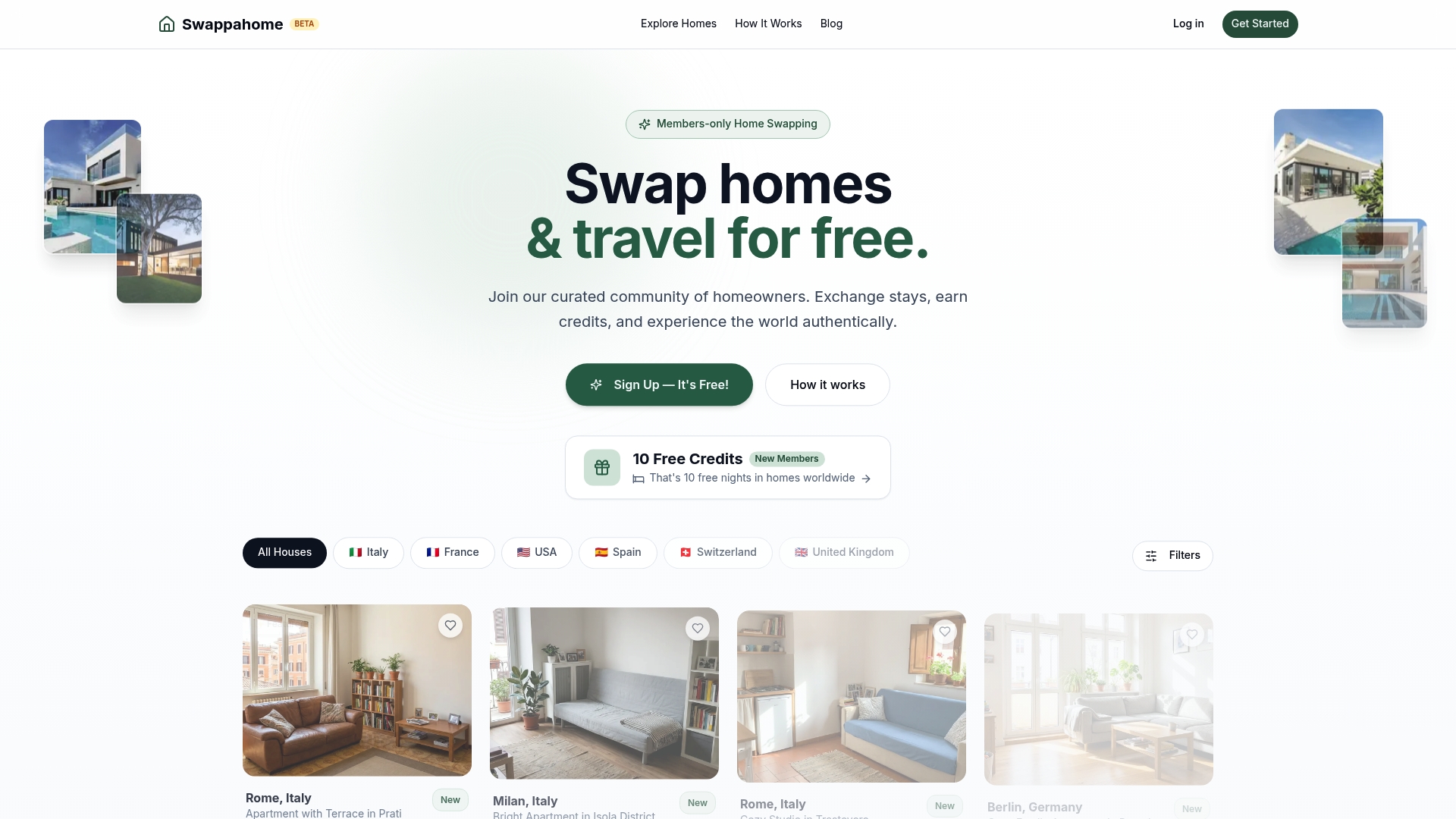 https://swappahome.com
The model suits remote workers perfectly. You get a private home with a real workspace, a kitchen, and neighborhood-level cultural immersion that no hostel can replicate. Swappahome's verified listings worldwide cover destinations across Europe, the Americas, Asia, and beyond. For nomads planning longer stays, it pairs naturally with the travel exchange programs already in your rotation. Visit Swappahome to list your home and start earning credits toward your next stay.
FAQ
What are remote worker exchange programs?
Remote worker exchange programs are arrangements where digital nomads trade light work or skills for free accommodation while keeping their remote jobs. Platforms like Workaway, Worldpackers, and Masa Israel Remote each offer different models ranging from volunteer-style swaps to fully curated cohorts.
How much do work exchange programs cost?
Platform fees for Workaway and Worldpackers run roughly £35–70 per year. Structured cohort programs like Masa Israel Remote charge $500–$600 for a 6–8 week program, while fully managed programs like Remote Year charge higher monthly fees that bundle accommodation and coworking.
Do I need to disclose my remote job to exchange hosts?
Yes. Most volunteer-style exchanges assume limited laptop time, so disclosing your remote work schedule before arrival prevents conflict. Some hosts actively welcome remote workers; others prefer candidates who can commit fully to physical tasks.
What should I check before confirming an exchange placement?
Confirm WiFi speed, room privacy, meal inclusion, and daily noise levels before booking. Accommodation details like bed type and internet reliability directly affect your productivity as a remote worker.
Is home swapping a good alternative to work exchange programs?
Home swapping through platforms like Swappahome gives remote workers a private space and real workspace without volunteer obligations. It suits nomads who want cultural immersion and affordable stays without the host-work dynamic of traditional exchange programs.
Recommended

Published by
SwappaHome
SwappaHome Editorial Team
Home Exchange & Slow Travel Editorial
The SwappaHome Editorial Team brings together travel research, home-exchange community insights, and platform data to produce practical guides for first-time and experienced home swappers. Every article cites real platforms, current market rates, and verifiable city-level facts so readers can make informed decisions without guessing.
Ready to try home swapping?
Join SwappaHome and start traveling by exchanging homes. Get 7 free credits when you sign up!