Role of Verification in Home Exchanges Explained

SwappaHome Editorial Team
Home Exchange & Slow Travel Editorial
Role of Verification in Home Exchanges Explained !Couple reviewing home exchange verification status Booking a home in a foreign country through a...
Role of Verification in Home Exchanges Explained
 Couple reviewing home exchange verification status
Booking a home in a foreign country through a home exchange platform can feel exciting yet nerve-wracking, especially when trust is essential and costs matter. As a homeowner considering swapping your place for a stay in another part of the world, knowing “who’s on the other side” becomes just as important as your destination. This guide explains the importance of a thorough verification process in home exchanges, spotlighting how trusted validation steps can protect your property and bring peace of mind to your cultural adventures.
Table of Contents
- What Verification Means In Home Exchanges
- Types Of Homeowner And Guest Verification
- How Swappahome Verification Process Works
- Building Trust And Community Safety
- Risks Of Unverified Exchanges And Common Issues
Key Takeaways
| Point | Details |
|---|---|
| Importance of Verification | Validation of identities and credentials is essential in home exchanges to prevent fraud and build trust. |
| Layered Verification Processes | Home exchange platforms implement multi-step verification that includes document checks and background assessments. |
| Community Trust and Safety | Active communication and mutual accountability among participants enhance the safety and integrity of exchanges. |
| Risks of Unverified Exchanges | Engaging in unverified home exchanges exposes participants to significant risks including fraud and personal safety issues. |
What Verification Means in Home Exchanges
In home exchanges, verification represents a critical process of authenticating participants' identities, credentials, and trustworthiness before allowing property sharing. Unlike traditional rental transactions, home exchanges require mutual trust and transparency between homeowners who are essentially swapping living spaces without monetary transactions.
The verification process typically involves multiple layers of validation to ensure participant safety and platform integrity. These validation steps include:
- Identity confirmation through government-issued documentation
- Background checks to review participant history
- Profile authentication verifying personal and professional details
- Reference validation from previous home exchange experiences
- Digital footprint assessment examining social media and online presence
According to credential verification research, verification fundamentally means confirming that participants are legitimate and represent themselves accurately. This process helps prevent potential fraud and builds a foundation of mutual trust among community members.
Here’s a comparison of traditional rental verification versus home exchange verification:
| Aspect | Traditional Rental Verification | Home Exchange Verification |
|---|---|---|
| Identity Checks | Often basic; driver’s license | Multi-layered using several documents |
| Trust Requirements | Not mutual; landlord-centric | Mutual; both parties must trust |
| Payment Structure | Monetary transaction required | No monetary exchange; property swap |
| Reference Systems | Optional; landlord references | Essential; previous exchange reviews |
| Background Review | Sometimes limited | Comprehensive including digital presence |
Professional home exchange platforms like Swappahome implement rigorous multi-step verification protocols that go beyond simple profile registration. These protocols involve direct communication with participants, document review, and systematic cross-referencing to establish credibility.
Trust Factors in Verification:
- Personal identification verification
- Address confirmation
- Criminal background screening
- Social media profile validation
- Previous home exchange ratings and reviews
Verification isn't just about preventing risks—it's about creating a transparent, secure environment where homeowners feel confident participating.
Pro tip: Always thoroughly review a platform's verification process and ask detailed questions about their authentication methods before participating in any home exchange.
Types of Homeowner and Guest Verification
Home exchange platforms employ multiple verification methods to ensure participant safety and build trust within their community. Documentary verification techniques play a crucial role in authenticating participants' identities and establishing their credibility before any property exchange occurs.
The primary types of verification typically include:
- Personal Document Verification
- Government-issued photo identification
- Passport validation
- Driver's license authentication
- Residence Verification
- Utility bill confirmation
- Lease agreement documentation
- Property ownership documents
- Background Screening
- Criminal record checks
- Social media profile review
- Previous home exchange references
Ownership Verification Methods:
- Legal property deed review
- Tax assessment records examination
- Mortgage documentation verification
- Utility service name verification
- Local government property registration confirmation
According to home ownership verification research, proof of occupancy and ownership are critical components in establishing participant legitimacy. These documents help platforms confirm that participants have genuine connections to the properties they're offering for exchange.
Robust verification processes protect both homeowners and guests by creating transparent, accountable exchange environments.
Digital verification technologies now enable more sophisticated authentication methods beyond traditional document checks. These include advanced background screening, digital footprint analysis, and cross-referencing multiple independent databases to validate participant information.
 Woman using digital identity verification tools
Pro tip: Always maintain high-quality digital copies of your identification and property documents to streamline the verification process during home exchanges.
How Swappahome Verification Process Works
Swappahome's verification process is designed to create a secure and trustworthy environment for home exchanges by implementing comprehensive identity and property validation techniques. Identity validation processes ensure that every participant undergoes rigorous screening before being approved for home exchanges.
The verification process unfolds through several critical stages:
- Initial Application
- Personal information submission
- Email and phone number verification
- Profile creation with detailed personal details
- Document Authentication
- Government-issued photo ID upload
- Proof of property ownership
- Utility bill confirmation
- Background Screening
- Criminal record check
- Social media profile review
- Previous home exchange references verification
Verification Workflow:
- User submits initial application
- Platform conducts automated document checks
- Manual review by verification specialists
- Cross-reference with independent databases
- Final approval or request for additional information
Automated verification systems enable Swappahome to quickly validate member credentials by connecting directly with issuing institutions and reducing manual verification time. This technological approach significantly enhances the speed and accuracy of the verification process.
The goal of Swappahome's verification is not just to authenticate identities, but to build a community of trusted, responsible home exchangers.
Digital technologies play a crucial role in Swappahome's verification strategy. Advanced algorithms cross-reference multiple data sources, checking everything from government records to social media profiles, ensuring a comprehensive evaluation of each participant's background and credibility.
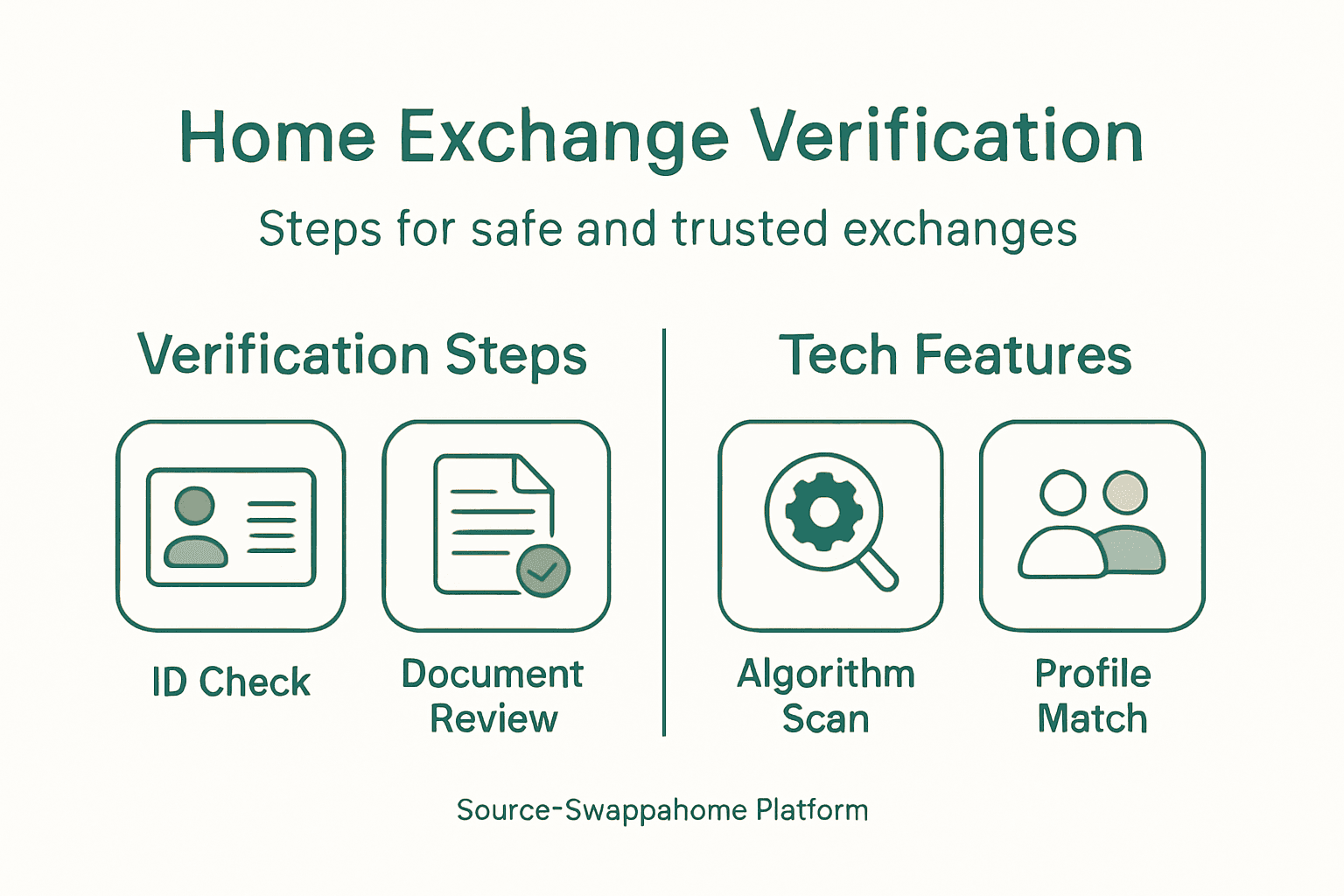 Infographic showing home exchange verification process
To simplify choosing a secure home exchange platform, consider these key verification features:
| Platform Feature | Why It Matters | Example Impact |
|---|---|---|
| Automated Document Checks | Speeds up verification process | Faster onboarding and approval |
| Manual Specialist Review | Ensures document authenticity | Reduced risk of fraud |
| Cross-Data Source Validation | Comprehensive identity screening | Higher confidence in participant |
| Continuous Monitoring | Maintains ongoing trust | Early detection of security risks |
Pro tip: Prepare high-resolution digital copies of your identification and property documents in advance to expedite the verification process and increase your chances of quick approval.
Building Trust and Community Safety
In home exchanges, trust and safety are foundational elements that transform casual transactions into meaningful cultural experiences. Community-based protection mechanisms emphasize transparent engagement and continuous communication to establish a secure environment for participants.
Key strategies for building trust and ensuring community safety include:
- Transparent Communication
- Clear platform guidelines
- Open reporting systems
- Regular community updates
- Mutual Accountability
- Peer review mechanisms
- Rating and feedback systems
- Consequence frameworks for misconduct
- Proactive Risk Management
- Background screening
- Identity verification processes
- Continuous community monitoring
Trust-Building Pillars:
- Comprehensive participant screening
- Transparent interaction protocols
- Responsive support systems
- Consistent safety enforcement
- Community value alignment
Community security approaches demonstrate that safety emerges from collaborative, people-centered strategies that balance individual rights with collective wellbeing. Swappahome implements these principles by creating an ecosystem where members feel protected and respected.
Trust is not a single action but a continuous process of mutual respect, transparency, and shared responsibility.
Advanced technological tools and human-centered design work together to create a robust safety infrastructure. Machine learning algorithms detect potential risks, while community guidelines and active moderation ensure a supportive, secure environment for home exchanges.
Pro tip: Actively participate in community guidelines, provide honest feedback, and maintain open communication to contribute to the platform's collective safety.
Risks of Unverified Exchanges and Common Issues
Unverified home exchanges represent significant potential risks that can compromise participant safety and platform integrity. Unverified transaction vulnerabilities expose participants to multiple threats including fraud, identity theft, and potential financial exploitation.
Common risks in unverified home exchanges include:
- Personal Safety Risks
- Potential exposure to criminal backgrounds
- Unknown visitor intent
- Lack of accountability mechanisms
- Property Protection Issues
- Potential property damage
- Unauthorized access to personal spaces
- Risk of theft or vandalism
- Financial Vulnerabilities
- Potential scams
- Fraudulent listing representations
- Unauthorized financial transactions
Major Vulnerability Categories:
- Identity misrepresentation
- Property ownership fraud
- Intentional property damage
- Personal safety compromises
- Financial transaction risks
Decentralized platform risks demonstrate that without proper oversight, exchanges become susceptible to operational failures and potential market manipulation. Lack of centralized verification creates multiple entry points for malicious actors seeking to exploit system vulnerabilities.
Unverified exchanges transform potential cultural experiences into high-risk interactions that threaten both personal and property security.
Modern home exchange platforms combat these risks through comprehensive verification processes that include background checks, identity authentication, and continuous monitoring. These strategies create protective barriers that significantly reduce potential threats and build participant confidence.
Pro tip: Always prioritize platforms with robust verification processes and never bypass established safety protocols, regardless of how convenient or tempting alternative routes might seem.
Experience Home Exchange with Confidence Through Verified Membership
The article highlights the critical role that verification plays in ensuring safe, trustworthy home exchanges. Many travelers and homeowners share concerns about identity confirmation, property ownership validation, and overall trustworthiness before committing to exchanging their homes. Swappahome addresses these challenges head-on by providing a robust verification system that guarantees every member is thoroughly vetted. This commitment reduces risks such as fraud, property damage, and personal safety issues while creating a transparent community built on mutual respect and reliability.
Swappahome’s unique approach to verification includes:
- Multi-step identity and property authentication
- Background screenings and social profile assessments
- Seamless digital document verification
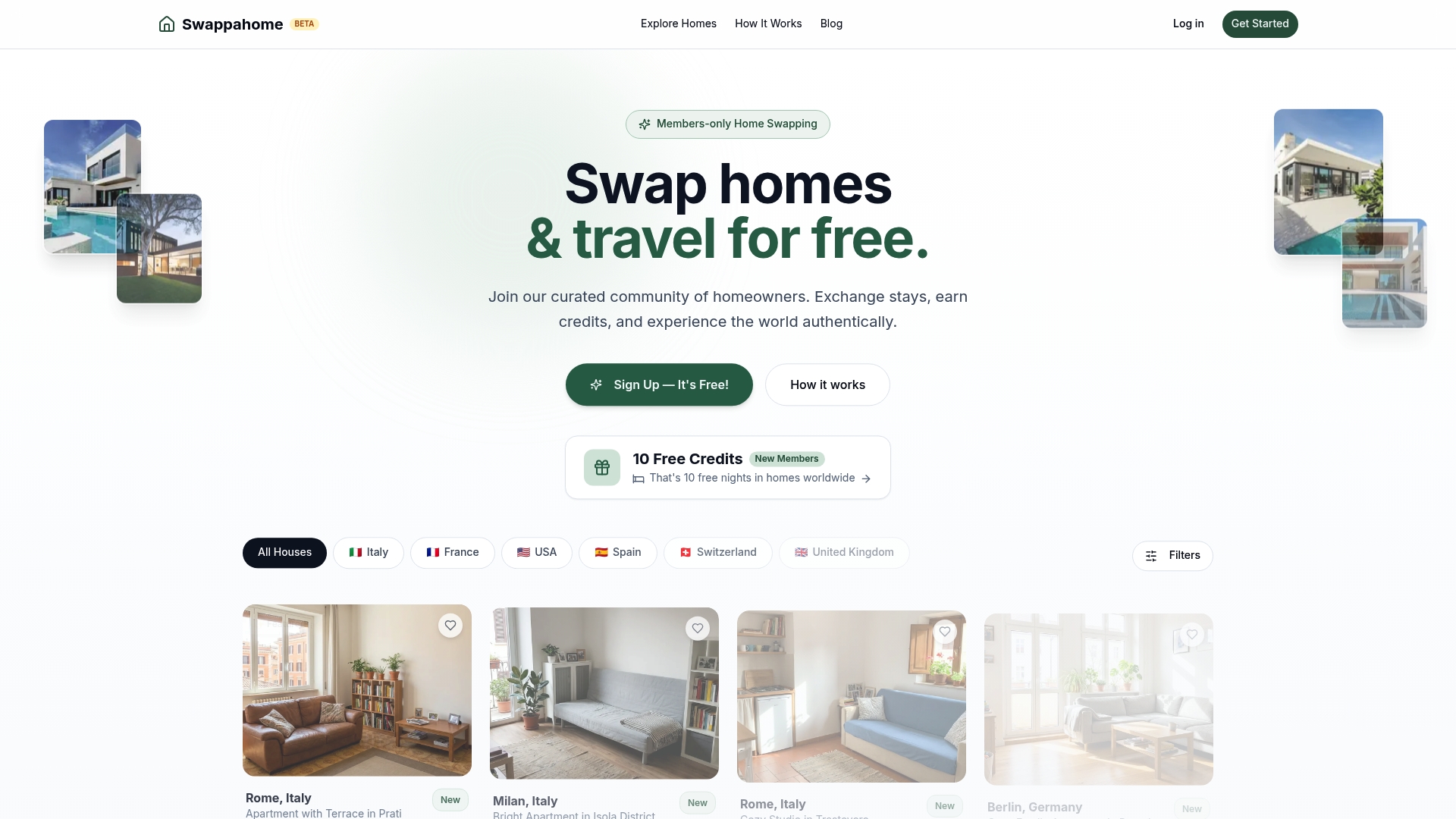 https://swappahome.com
Ready to enjoy authentic cultural exchanges without worrying about security? Visit Swappahome to join a global network of verified homeowners. Start by listing your home, earn credits easily, and discover new destinations through trusted exchanges. Your next safe and affordable travel adventure is just a few clicks away. Learn more about our simple process and member benefits by exploring Swappahome’s official site now.
Frequently Asked Questions
What is the verification process in home exchanges?
The verification process in home exchanges involves authenticating participants' identities, credentials, and trustworthiness through various methods, including identity confirmation, background checks, and reference validation.
Why is verification important in home exchanges?
Verification is crucial as it fosters mutual trust and transparency among homeowners, protects against fraud, and ensures a safe environment for property sharing without monetary transactions.
What types of documents are needed for verification in home exchanges?
Common documents required for verification include government-issued photo IDs, proof of property ownership, and utility bills to confirm residence.
How does Swappahome ensure participant safety during the verification process?
Swappahome employs a multi-step verification process that includes automated document checks, manual reviews by specialists, and cross-referencing with independent databases to establish participant credibility.
Recommended
- 7 Steps to a Secure Home Swap Verification Checklist | SwappaHome Blog
- Role of Trust in Home Exchanges—Building Safety and Community | SwappaHome Blog
- Security in Home Swapping: What Homeowners Must Know | SwappaHome Blog
- Safe Home Swapping Steps for Secure and Free Travel | SwappaHome Blog
- The Impact of the NAR Lawsuit: What Buyers, Sellers and Agents Need to Know – Bold Street AI
- 7 Essential Examples of Mortgage Documents Explained
- What Is Due Diligence in Yacht Sales? Risk-Free Closings

Published by
SwappaHome
SwappaHome Editorial Team
Home Exchange & Slow Travel Editorial
The SwappaHome Editorial Team brings together travel research, home-exchange community insights, and platform data to produce practical guides for first-time and experienced home swappers. Every article cites real platforms, current market rates, and verifiable city-level facts so readers can make informed decisions without guessing.
Ready to try home swapping?
Join SwappaHome and start traveling by exchanging homes. Get 7 free credits when you sign up!