Step by Step Travel Budgeting: Your 2026 Guide

SwappaHome Editorial Team
Home Exchange & Slow Travel Editorial
Step by Step Travel Budgeting: Your 2026 Guide !Person writing travel budget in planner > TL;DR: > > - Step by step travel budgeting involves...
Step by Step Travel Budgeting: Your 2026 Guide
 Person writing travel budget in planner
TL;DR:
- Step by step travel budgeting involves planning, categorizing, and tracking expenses to stay within your financial limits.
- Using tools like travel planners and expense trackers helps travelers control costs before and during trips.
Step by step travel budgeting is the methodical process of planning, allocating, and tracking your trip expenses so you stay within your means while getting the most from every destination. Most travelers skip this process and overspend within the first three days. The good news: a clear system using tools like Google Flights, Airbnb, and dedicated expense trackers puts you back in control before you ever leave home. This guide walks you through each stage, from setting your spending ceiling to tracking costs mid-trip, with real strategies that work for budget-conscious travelers in 2026.
How to define your trip expectations and total budget ceiling
The first step in any travel budgeting guide is deciding what kind of traveler you are on this particular trip. Your travel style determines every number that follows. A budget backpacker in Southeast Asia operates on a completely different daily spend than a mid-range traveler in Western Europe.
Three tiers cover most travelers:
- Budget: Hostels, street food, free attractions, local transport. Daily spend typically under $60 in most regions.
- Mid-range: Private rooms, sit-down restaurants, paid tours, occasional taxis. Daily spend roughly $100–$180 depending on destination.
- Comfort: Boutique hotels, curated dining, guided experiences. Daily spend $200 and above.
Once you pick your tier, set a hard ceiling. This is your total trip budget, the number you will not cross. Write it down. A ceiling forces every later decision to be a trade-off, which is exactly the discipline that keeps spending on track.
Overspending often comes from chasing curated social media experiences rather than prioritizing two or three meaningful activities and finding affordable alternatives for the rest. Decide upfront which two or three experiences matter most to you, then build the rest of the budget around them.
 Hands working on travel budget worksheet
Pro Tip: Label your budget tiers before you research prices. Knowing you are a "mid-range traveler" stops you from booking a five-star hotel "just this once" and blowing your food budget for the week.
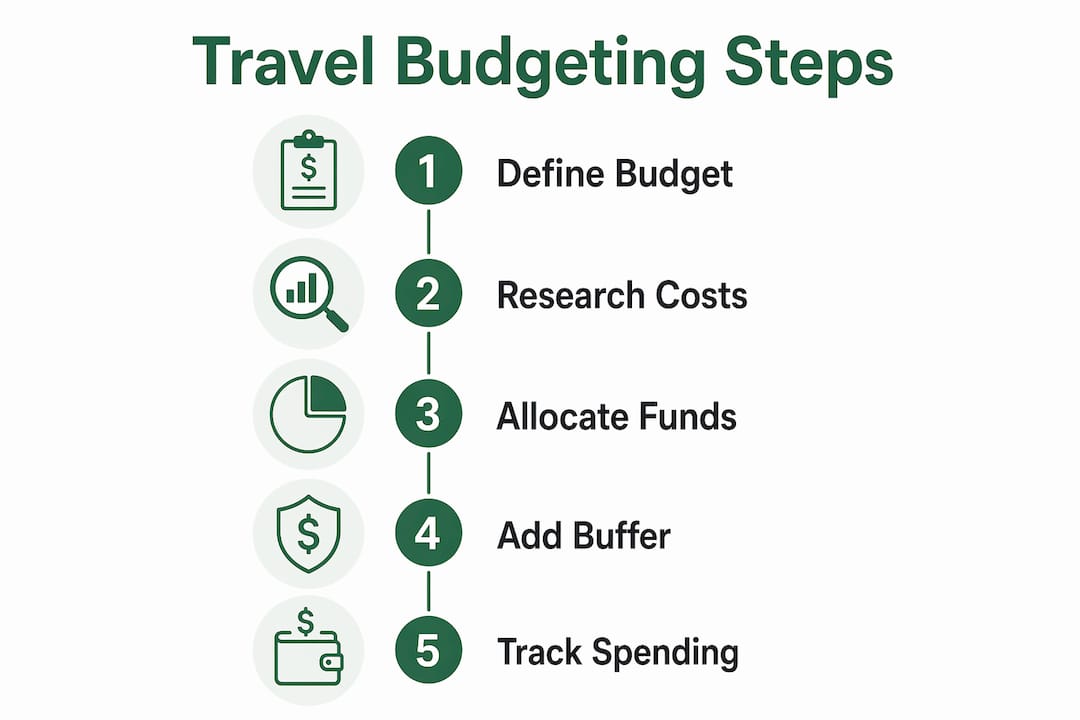 Infographic outlining travel budgeting steps
What are the core travel expense categories?
Organizing your travel cost management into four categories makes the numbers manageable and reveals where you are likely to overspend.
- Transportation: Flights, trains, buses, airport transfers, and local transit passes. Use Google Flights' Explore feature to compare destinations and dates. Flexibility in dates and destination can reduce costs by 40–60% depending on timing and location.
- Accommodation: Hotels, hostels, vacation rentals, or home exchanges. Research baseline nightly rates on Booking.com or Airbnb for your destination and travel dates before committing to any other budget line.
- Food and drink: Daily meals, coffee, snacks, and the occasional splurge dinner. A realistic daily food budget for a mid-range traveler in Europe runs $40–$70. Street food and market meals cut that figure significantly.
- Activities and miscellaneous: Entry fees, tours, souvenirs, SIM cards, and personal care. This category is where most travelers underestimate.
Hidden costs are the budget killers that rarely appear in travel planning articles. Add these to your spreadsheet before you finalize any number:
| Hidden Cost | Typical Range |
|---|---|
| Checked baggage fees | $30–$70 per flight |
| Airport transfers | $20–$60 each way |
| Visa and entry fees | $20–$100+ depending on country |
| Travel insurance | $50–$200 per trip |
| Currency exchange fees | 1%–3% per transaction |
Research each category using real prices, not estimates. Booking windows matter too. Booking flights 3–7 weeks out for domestic trips and 8–14 weeks out for international travel yields better prices than booking too early or last minute.
How do you add a contingency buffer and track spending?
A contingency buffer is a fixed percentage of your total estimated trip cost set aside for unexpected expenses. Effective budgeters add 10–15% to their total estimate. That buffer covers a missed connection, a medical co-pay, or a last-minute hotel upgrade when your original booking falls through.
Tracking spending during the trip is where most travel expense planning breaks down. Travelers collect receipts, lose them, and end up guessing at the end of each day. A cleaner method: use one dedicated travel card for all purchases and treat the card statement as your spending log. A single travel card provides a clear, automated record that eliminates forgotten purchases and manual entry errors.
Key tracking habits that work:
- Check your balance every evening. Five minutes before bed beats a panic on day six.
- Log categories, not just totals. Knowing you spent $80 on food versus $80 on taxis tells you where to adjust.
- Run a mid-trip budget review at the halfway point. A mid-trip check takes five minutes and lets you correct spending drift before funds run out.
- Use apps like Stippl or YNAB to automate category tracking if manual logging feels tedious.
Pro Tip: Traveling with a group? Designate one person to pay for shared expenses on a single card, then split costs weekly using Splitwise. This prevents the "I'll pay you back" drift that quietly destroys group budgets.
What are the best strategies for affordable travel?
Timing is the single most powerful lever in budget friendly travel. Flying on Tuesday or Wednesday saves an average of $90 per domestic ticket and $140 per international ticket compared to weekend flights. That is real money redirected toward experiences.
Shoulder season travel compounds those savings on the accommodation side. Traveling in April, May, September, or October reduces accommodation costs by 20–40% compared to peak season rates, often with better weather and smaller crowds than the summer rush.
Comparing peak vs. shoulder season costs:
| Category | Peak Season | Shoulder Season |
|---|---|---|
| Accommodation | Full rate | 20–40% lower |
| Flight prices | Highest demand | Moderate demand |
| Crowd levels | Maximum | Manageable |
| Experience quality | Crowded attractions | Relaxed pace |
Travel rewards credit cards add another layer of savings. Cards like the Chase Sapphire Preferred offer sign-up bonuses and points redeemable for flights and hotels. Rewards cards save hundreds annually on travel costs when balances are paid in full each month. The key phrase is "paid in full." Interest charges erase every point you earn.
The sharing economy represents the most underused affordable travel strategy available to homeowners. Sharing economy options like home swaps, local stays, and community-hosted experiences cost less than traditional alternatives and deliver more authentic connections. Home exchange through platforms like Swappahome eliminates the accommodation line from your budget entirely. You can read more about how this works in practice through sharing economy travel examples that show real homeowners traveling for free.
For accommodation savings beyond home swapping, the Swappahome blog covers smart ways to cut lodging costs that apply even when you are not doing a full home exchange.
Key Takeaways
Effective travel budgeting requires a spending ceiling, four organized expense categories, a 10–15% contingency buffer, and daily tracking to prevent overspending before it starts.
| Point | Details |
|---|---|
| Set a hard budget ceiling | Define your travel tier and total spending limit before researching any prices. |
| Organize into four categories | Split costs into transportation, accommodation, food, and activities to spot gaps early. |
| Add a contingency buffer | Reserve 10–15% of your total estimate for unexpected costs like missed connections or medical needs. |
| Track with one card | Use a single travel card as your spending log and review it every evening. |
| Use timing and flexibility | Fly midweek and travel in shoulder seasons to cut flight and accommodation costs by up to 40%. |
What I have learned from years of watching travel budgets fail
The most common mistake I see is treating the budget as a pre-trip exercise rather than a living document. Travelers build a detailed spreadsheet, feel satisfied, and then never look at it again once the trip starts. The spreadsheet does nothing if you do not check it.
The second mistake is underestimating accommodation costs and then compensating by cutting food. That trade-off makes people miserable. Eat well. Sleep somewhere decent. Cut costs on activities and transport instead, where the trade-offs are less personal.
The shift that changes everything is embracing alternative lodging options as a genuine upgrade rather than a compromise. Home exchanges and local stays are not the budget option. They are often the better option. You get a kitchen, a neighborhood, and a real sense of place that no hotel lobby provides.
Finally, flexibility is not a nice-to-have. It is the most valuable tool in your budget. Letting price guide your destination and dates, even slightly, opens up savings that rigid planning closes off. Build a budget that leaves room to say yes to a cheaper flight to a slightly different city.
— Swappa
How Swappahome fits into your travel budgeting plan
Accommodation is the largest variable cost in most travel budgets. Swappahome removes it entirely.
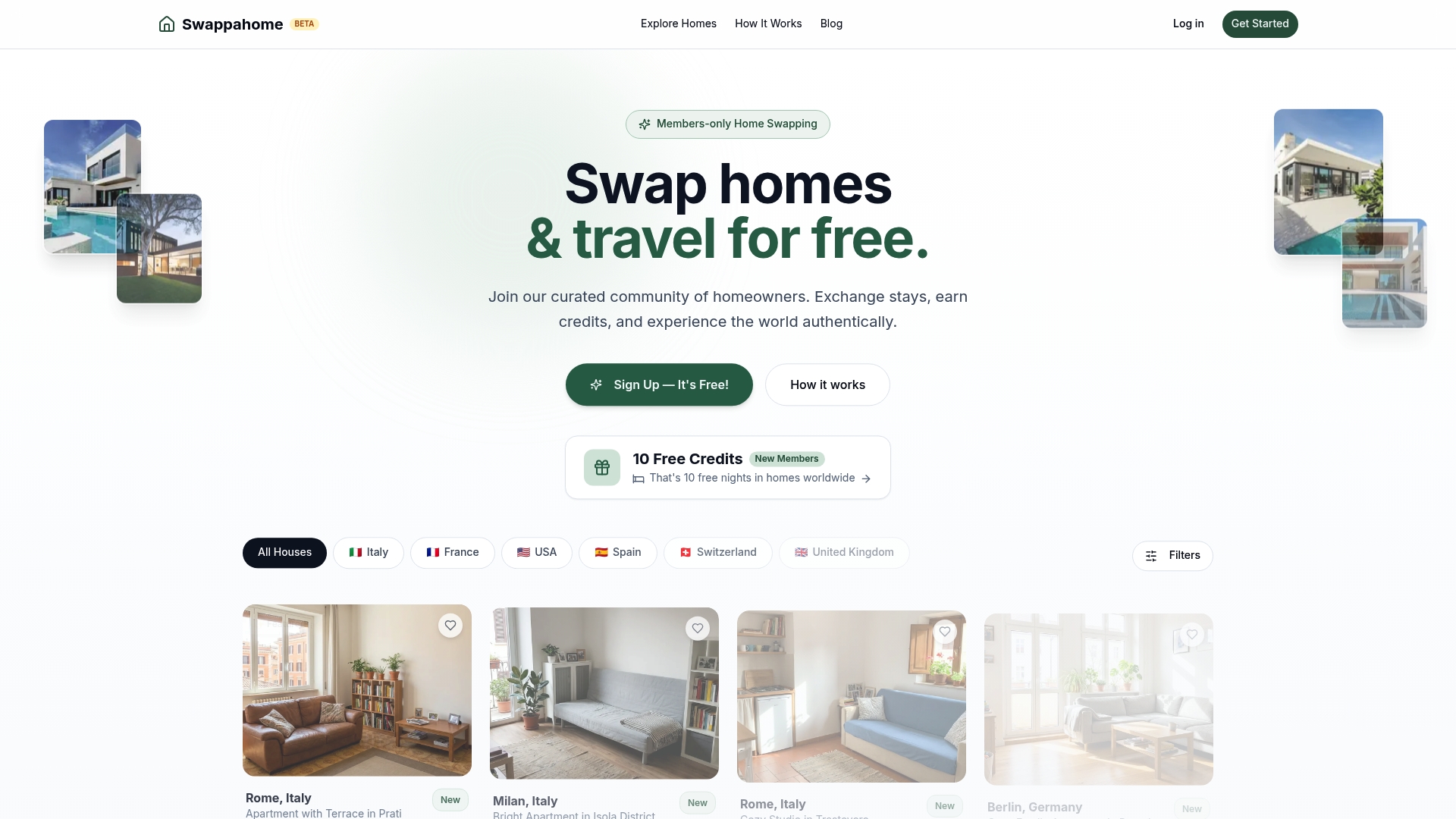 https://swappahome.com
Swappahome is a members-only home exchange platform where verified homeowners list their homes, earn credits for hosting, and use those credits to stay in other members' homes at no cost. One credit equals one free night. New members receive free credits to get started. Every member goes through a verification process, and the platform's trust and safety standards cover the community on both sides of every exchange. For budget-conscious travelers who have already done the hard work of planning their trip, Swappahome turns a well-built budget into an even better trip.
FAQ
What is step by step travel budgeting?
Step by step travel budgeting is a systematic method of planning, categorizing, and tracking trip expenses before and during travel. It covers setting a spending ceiling, organizing costs into categories, adding a contingency buffer, and monitoring daily spend.
How much contingency should I add to my travel budget?
Add 10–15% of your total estimated trip cost as a contingency buffer. This covers unexpected expenses like missed connections, medical costs, or last-minute accommodation changes.
When is the best time to book flights for the lowest price?
Book domestic flights 3–7 weeks before departure and international flights 8–14 weeks out. Flying on Tuesday or Wednesday saves an average of $90 on domestic routes and $140 on international routes compared to weekend travel.
How does home exchange reduce travel costs?
Home exchange eliminates accommodation costs entirely by letting travelers stay in verified members' homes using credits earned from hosting. Platforms like Swappahome operate on a one-credit-per-night system with no monetary transaction required.
What is the easiest way to track spending during a trip?
Use one dedicated travel card for all purchases and review the statement each evening. A mid-trip budget check at the halfway point takes five minutes and prevents overspending before it becomes a problem.
Recommended

Published by
SwappaHome
SwappaHome Editorial Team
Home Exchange & Slow Travel Editorial
The SwappaHome Editorial Team brings together travel research, home-exchange community insights, and platform data to produce practical guides for first-time and experienced home swappers. Every article cites real platforms, current market rates, and verifiable city-level facts so readers can make informed decisions without guessing.
Ready to try home swapping?
Join SwappaHome and start traveling by exchanging homes. Get 7 free credits when you sign up!