
The Role of Community in Travel Planning Today

SwappaHome Editorial Team
Home Exchange & Slow Travel Editorial
The Role of Community in Travel Planning Today !Woman researching travel with local tips at kitchen table > TL;DR: > > - Community-driven travel...
The Role of Community in Travel Planning Today
 Woman researching travel with local tips at kitchen table
TL;DR:
- Community-driven travel emphasizes authentic experiences by connecting travelers with local residents and guides. Using verified platforms and the Rule of Three helps ensure accurate, real-time local insights, improving trip quality. Ethical travel involves paying locals directly, supporting community benefits, and building trust for meaningful cultural exchange.
Most travelers have felt it: you book a trip based on a travel blog, arrive at a "hidden gem" that turns out to be overrun with tourists, and wonder where things went wrong. The role of community in travel planning is the missing piece in that equation. When you tap into real people with real experience of a place, your trip stops being a checklist of attractions and starts becoming something you actually remember. This article breaks down how community-driven approaches work, what tools make them practical in 2026, and how to use them without falling for the pitfalls.
Table of Contents
- Key Takeaways
- The role of community in travel planning: origins and frameworks
- How to use community platforms for smarter trip planning
- Traditional planning vs. community-supported planning
- Incorporating community insights into your planning process
- Challenges and ethics of community-involved travel
- My take on what community travel actually teaches you
- Why Swappahome puts community at the center of travel
- FAQ
Key Takeaways
| Point | Details |
|---|---|
| Community beats brochures | Real-time local knowledge consistently outperforms static, advertised travel advice for authentic experiences. |
| Verify before you rely | Use the Rule of Three: confirm any crowdsourced tip from at least three independent sources within 30 days. |
| Local guides pay off | A few hours with a knowledgeable local guide often costs less than a resort excursion and delivers far more depth. |
| Ethics matter in community travel | Travelers must prioritize financial benefit flowing directly to local residents to avoid cultural tokenization. |
| Home swapping fits this model | Verified peer-based platforms like Swappahome connect you to local hosts and authentic neighborhood stays. |
The role of community in travel planning: origins and frameworks
Community involvement in travel is not new. Indigenous tourism models have long centered local knowledge and ownership as the backbone of cultural exchange. What has changed is scale and access. The internet made it possible for ordinary travelers to connect with local residents before, during, and after a trip in ways that were unimaginable thirty years ago.
Community-based tourism (CBT) is the formal term for this model. It describes travel designed, managed, and owned by local communities, where the primary goal is to generate income for residents while preserving cultural and ecological integrity. Think cooperative guesthouses in rural Vietnam or indigenous-led nature walks in New Zealand. The defining characteristic is participation: communities are not just a backdrop to the tourist experience, they shape it.
For travelers, this approach offers real advantages:
- Authentic experiences that reflect how people actually live, not how resorts want you to perceive them
- Economic contribution to the places you visit, rather than to international hotel chains
- Deeper cultural understanding built through genuine interaction with locals
- Trip personalization that no travel agent catalog can replicate
The importance of local insights in travel goes beyond culture. Practical information about road conditions, seasonal closures, neighborhood safety, or which market opens on which day simply does not make it into official guides. Communities carry this knowledge naturally, and they share it freely when given the right context.
How to use community platforms for smarter trip planning
The mechanics of collaborative travel planning have evolved significantly. Here is a practical process for making it work in 2026.
-
Start with the right platforms. Community-curated platforms offer paywall-free, timely and diverse travel tips that help travelers create reliable itineraries. Look for platforms with live badges or real-time updates that signal recency. Stale advice about a beach that closed two seasons ago will ruin a day as thoroughly as wrong directions.
-
Apply the Rule of Three. Before acting on any community-sourced tip, seek at least three independent confirmations from different local sources within a 30-day window. This is the gold standard for crowdsourced travel verification, and it works. If three separate people in a travel forum, a local Facebook group, and a WhatsApp community group all confirm that a specific trail is passable in March, you can book with confidence.
-
Build a relationship with a local guide. This is where most travelers underinvest. Hiring a local guide for even a few hours often costs less than a standard resort excursion while delivering significantly deeper access. A guide embedded in a community for years can introduce you to experiences that are genuinely not available through standard booking platforms. That distinction matters more than most travelers realize.
-
Cross-reference community input with personal priorities. Community wisdom tells you what is real; your preferences tell you what is relevant. A local tip about a five-hour early morning hike is valuable, but only if you actually want to do it.
-
Set up alerts and maintain your network. Join local Facebook groups, regional Subreddits, or destination-specific Discord servers before your trip and stay in them afterward. The impact of social networks on travel compounds over time. People you helped with advice about your home city will return the favor for your next destination.
Pro Tip: When reaching out to locals online, always ask specific questions rather than "what should I do?" Specificity signals respect for their time and gets you far more useful answers.
Traditional planning vs. community-supported planning
Understanding how community influences travel choices gets clearer when you put the two approaches side by side.
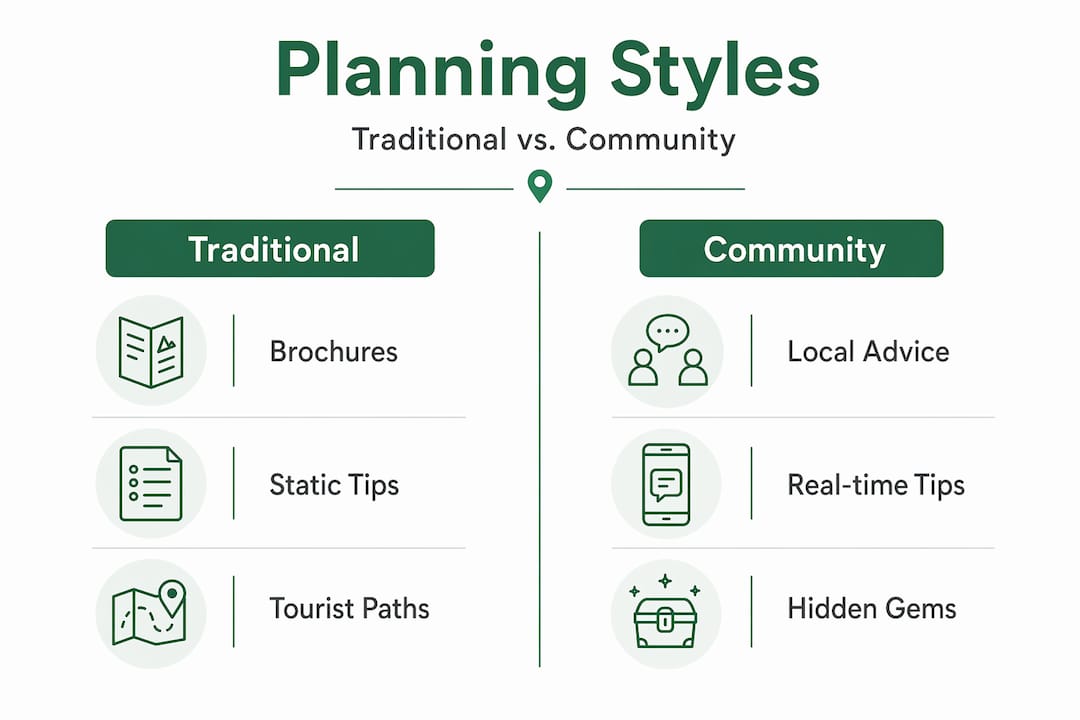 Infographic comparing community and traditional travel planning
| Feature | Traditional planning | Community-supported planning |
|---|---|---|
| Information source | Official tourism boards, brochures, hotel marketing | Residents, local guides, peer travelers |
| Recency | Often outdated or seasonally inaccurate | Real-time, updated by active users |
| Cultural depth | Surface-level, curated for tourism consumption | Genuine, reflecting everyday local life |
| Cost of access | Bundled into resort packages and tours | Often free or low-cost through community networks |
| Personalization | Standardized itineraries | Shaped by specific local knowledge and your stated interests |
| Risk of disappointment | Higher, due to inflated expectations | Lower when managed with honest, unfiltered local realities |
The brochure model is not just limited. It actively works against authentic experience by prioritizing what looks good in marketing photos over what actually makes a trip memorable. Tourism businesses that communicate honest local realities build stronger visitor loyalty precisely because they manage expectations accurately rather than overselling a fantasy.
Community-supported travel planning is not risk-free. Misinformation circulates, and not every local is equally knowledgeable or unbiased. That is exactly why verification protocols and multiple sources matter so much.
Incorporating community insights into your planning process
Knowing that community travel tips exist is different from knowing how to systematically use them. Here is how to build community input into every stage of your planning.
Before you book:
- Search your destination in travel forums and verified travel communities to read firsthand accounts from the past six months
- Identify two or three local guides or hosts with genuine community ties and reach out directly before committing to any itinerary
- Ask locals about the timing of festivals, harvests, or events that do not appear in mainstream travel calendars
- Read not just the glowing reviews but the frustrated ones. Complaints often reveal the most honest local truths
During your trip:
- Treat every local interaction as a potential source of real-time information. Restaurant owners, market vendors, and taxi drivers carry knowledge that no app has indexed
- Adjust your plans based on what you hear on the ground. The best days of a trip often come from someone saying "you should actually go to X instead"
After your trip:
- Post your own verified, honest observations to the platforms that helped you. This is how the system stays useful for everyone
- Stay connected with local contacts for future trips. A network of trusted local connections in multiple destinations is one of the most undervalued assets a frequent traveler can build
Pro Tip: For a concise framework on using community-led travel to find affordable, authentic stays, Swappahome's approach of credit-based home swapping is worth studying as a model of peer trust in practice.
Challenges and ethics of community-involved travel
The shift toward community involvement in travel carries real responsibilities. Not all of it is comfortable to acknowledge.
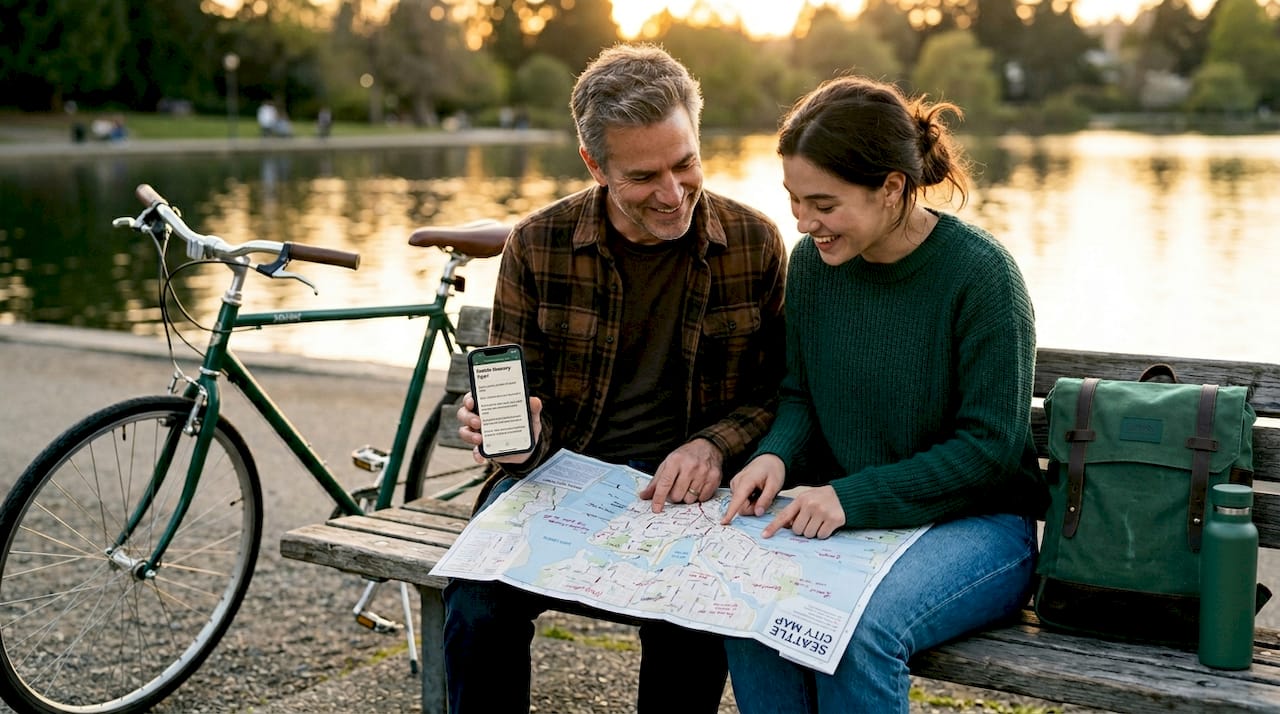 Travelers discussing local tips in city park
Community-driven travel models require that financial benefits flow directly to residents, not intermediaries, to prevent cultural tokenization from taking hold. The difference between a meaningful cultural exchange and a performative one often comes down to money. When a community member charges for their knowledge or hospitality and keeps that income, the exchange is equitable. When a tour operator takes the fee and pays the local a fraction, it is not.
Travelers can take practical steps to get this right:
- Pay local guides directly rather than through aggregator platforms that take large commissions
- Buy from local producers at markets rather than at hotel gift shops stocked with imported goods
- Ask your host or guide where the money you spend actually goes. Honest operators will tell you
- Avoid experiences that stage culture for tourism rather than reflect it genuinely, such as "traditional" performances held exclusively for tour groups
The risks of getting this wrong extend beyond guilt. Global instability has significantly increased the complexity of international travel planning, which makes community resilience and local advocacy more important than ever. Travelers who build ethical, trust-based relationships with local communities are also better protected when conditions change unexpectedly.
My take on what community travel actually teaches you
I've spent years thinking about what separates travelers who come home transformed from those who come home just tanned. The answer is almost always the quality of their community connections at the destination.
What surprises most people when they first lean into community-based travel planning is how generously locals share when approached with genuine curiosity and respect. The assumption that locals protect their best spots from outsiders is only half true. They protect them from exploitative tourism. They share them eagerly with people who ask thoughtfully and engage honestly.
The harder lesson I've learned is that community travel requires you to earn trust before you receive it. Showing up in a forum two days before your trip and asking for a full itinerary is not community engagement. It is extraction. Real community travel involves contributing to the information ecosystem, being patient, and accepting that the best recommendations come through relationships, not requests.
What I find most compelling about this model is that it makes you a better traveler over time rather than just on one trip. Every connection you build, every piece of honest local knowledge you act on and then share back, compounds into something genuinely valuable.
— Swappa
Why Swappahome puts community at the center of travel
If everything in this article resonates with you, then the way you think about where you stay is probably due for a rethink too. Staying in a verified homeowner's home is not just cheaper than a hotel. It drops you into a real neighborhood, with a real host who has a stake in your experience.
 https://swappahome.com
Swappahome is built around exactly this principle. Every member is verified, every stay is credit-based (one credit equals one free night), and the entire system runs on reciprocal community trust. You list your home, earn credits, and use them to stay in other members' homes around the world. No nightly fees. No anonymous check-in experience. You can explore home swapping listings across dozens of countries right now, or start by joining the Swappahome community to see how peer-verified stays compare to anything a booking platform offers. New members receive free credits to get started.
FAQ
What is the role of community in travel planning?
Community involvement transforms travel planning from relying on generic marketing to using real, firsthand knowledge from residents and fellow travelers. It leads to more authentic cultural experiences and better-informed itineraries.
How do I verify community-sourced travel tips?
Use the Rule of Three: confirm any tip from at least three independent local sources within a 30-day window. Platforms with live badges and active community curation also help reduce the risk of acting on outdated information.
Are local guides worth hiring for short trips?
Yes. A few hours with a knowledgeable local guide typically costs less than a standard resort excursion and provides significantly deeper cultural access, including experiences that are not available through any standard booking platform.
How does community travel planning affect cultural exchange?
When travelers engage communities as participants rather than service providers, the cultural exchange becomes two-directional. Locals share genuine traditions and knowledge, and travelers contribute economically and socially rather than extracting experiences.
What ethical responsibilities do community travelers have?
Travelers should pay local guides and producers directly, avoid performative cultural experiences, and ask honestly where their spending goes. Financial benefits reaching local residents directly is the clearest marker of ethical community travel.
Recommended

Published by
SwappaHome
SwappaHome Editorial Team
Home Exchange & Slow Travel Editorial
The SwappaHome Editorial Team brings together travel research, home-exchange community insights, and platform data to produce practical guides for first-time and experienced home swappers. Every article cites real platforms, current market rates, and verifiable city-level facts so readers can make informed decisions without guessing.
Ready to try home swapping?
Join SwappaHome and start traveling by exchanging homes. Get 7 free credits when you sign up!