
The Role of Digital Platforms in Travel Today

SwappaHome Editorial Team
Home Exchange & Slow Travel Editorial
The Role of Digital Platforms in Travel Today !Traveler using digital platform to plan trip > TL;DR: > > - Digital travel platforms now generate 75%...
The Role of Digital Platforms in Travel Today
 Traveler using digital platform to plan trip
TL;DR:
- Digital travel platforms now generate 75% of global travel sales, reshaping planning, booking, and cultural exchange globally. Travelers must understand how algorithms and AI influence visibility and costs to navigate and optimize their trips effectively. Home swapping platforms like Swappahome enable authentic, cost-free stays by exchanging verified homes across the world.
Digital travel platforms are online systems that centralize trip planning, booking, and social discovery, and they now account for 75% of global travel sales worldwide. That single statistic reframes every conversation about how technology shapes travel. Platforms like Booking.com, Expedia, Airbnb, and Tripadvisor have moved from convenience tools to the primary infrastructure of modern tourism. AI assistants like ChatGPT and Google Gemini are now layered on top, personalizing itineraries in ways a travel agent never could. For travelers and digital nomads, understanding how these systems work is no longer optional. It is the difference between a frustrating trip and a genuinely great one.
How do digital platforms shape travel planning and booking?
 Group discussing travel booking on tablet
The role of digital platforms in travel starts at the very first search. Before a traveler books a single flight, platforms like Google Flights, Kayak, and Skyscanner have already filtered thousands of options by price, duration, and layover time. The global online booking market reached $612 billion in 2023 and is growing at 12.5% annually. That growth reflects a fundamental shift: travelers no longer call agents. They expect to plan, compare, and confirm a trip within a single session.
Mobile has accelerated this expectation dramatically. 80% of mobile users expect to complete a travel booking in under five minutes, and 47% abandon a site that takes longer than two seconds to load. This means platforms compete not just on price but on speed and interface clarity. A slow checkout page costs real bookings, which is why Booking.com and Expedia invest heavily in mobile-first design.
AI is now the most significant force reshaping the planning phase. Over 39% of active U.S. travelers use tools like ChatGPT or Google Gemini specifically to research and personalize travel itineraries. These tools go beyond keyword search. They synthesize preferences, budget constraints, and travel style into structured plans that would take hours to compile manually. The result is a planning process that feels less like research and more like a conversation.
The integration of flights, accommodation, and experiences into a single booking flow is another structural advantage of major online travel agency platforms. Expedia's bundling feature, for example, lets you lock in a flight, hotel, and car rental simultaneously, often at a lower combined price than booking each separately. This kind of vertical integration is what makes digital travel platforms genuinely powerful rather than just convenient.
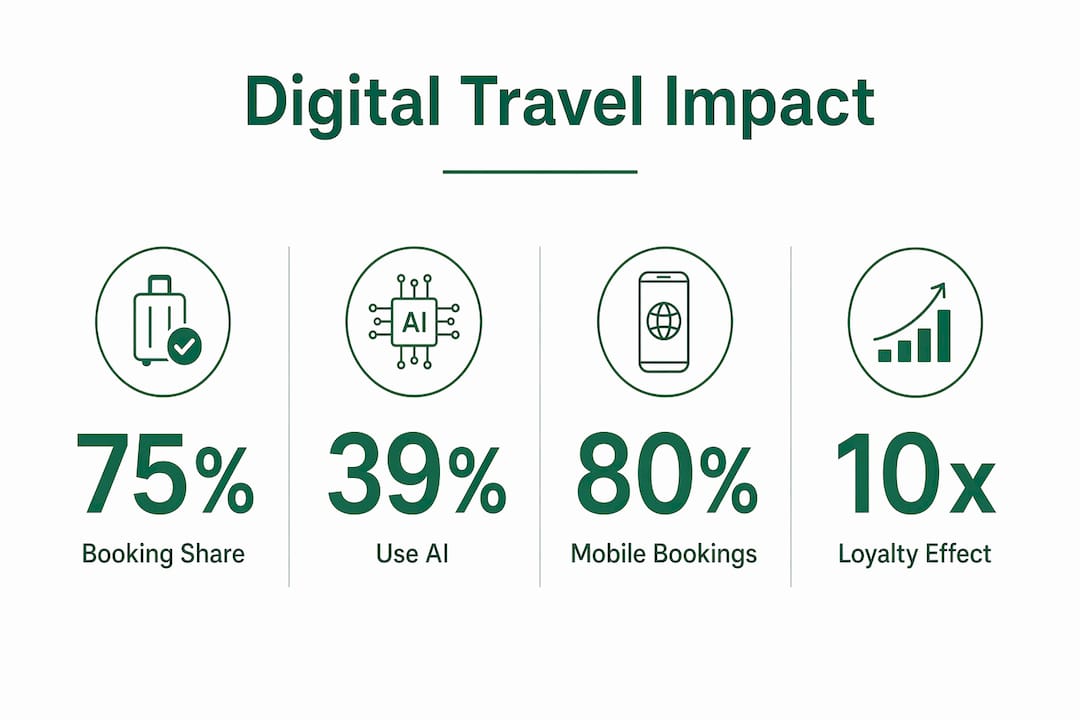 Infographic highlighting digital travel platform statistics
Pro Tip: When using AI tools for trip planning, give the model specific constraints: your budget per night, preferred neighborhood type, whether you need coworking space, and your travel pace. High-context AI prompts produce itineraries that are actually useful, not just a list of tourist attractions.
How do digital platforms influence accommodation options?
Platform algorithms determine which hotels and rentals you see first, and that visibility directly controls booking volume. A property ranked on page one of Booking.com receives exponentially more traffic than one ranked on page three, regardless of actual quality. This dynamic has forced hotels, guesthouses, and independent rentals to optimize for platform metrics rather than just guest experience. The result is a market where algorithmic favor matters as much as the product itself.
User reviews have become the most trusted signal in this system. Tripadvisor's review ecosystem, built over two decades, has trained travelers to treat peer ratings as the primary filter for accommodation decisions. A single drop from 4.5 to 4.2 stars can measurably reduce bookings. This gives experienced travelers real power: the ability to read between the lines of reviews, spot patterns in complaints, and identify properties that over-deliver relative to their star rating.
The direct booking movement represents a deliberate pushback against platform dependency. Loyalty members are 10 times more likely to book directly with a hotel and spend 20% more on average than non-members. Hotel groups like Marriott Bonvoy and Hilton Honors have built entire ecosystems around this dynamic, offering room upgrades, flexible cancellation, and exclusive rates to members who bypass OTAs. For frequent travelers, joining one or two hotel loyalty programs is one of the highest-return moves available.
The table below compares the main accommodation booking approaches available to travelers in 2026:
| Booking method | Best for | Key trade-off |
|---|---|---|
| OTA (Booking.com, Expedia) | Price comparison, flexibility | Higher rates, fewer perks |
| Direct hotel booking | Loyalty points, upgrades | Less price transparency |
| Airbnb / short-term rental | Local feel, group travel | Variable quality, no loyalty program |
| Home swapping (Swappahome) | Zero accommodation cost | Requires reciprocity and planning |
Pro Tip: Use an OTA to research and compare properties, then visit the hotel's direct website to check whether they price-match or offer an exclusive rate. Stacking deals across platforms, loyalty programs, and credit card portals can reduce accommodation costs by 20 to 40% on a single trip.
In what ways do digital platforms enable cultural exchange?
Social media's role in travel goes well beyond inspiration boards. Platforms like Instagram, TikTok, and YouTube have fundamentally changed how travelers discover destinations, with social media visibility directly increasing tourist interest in specific locations. A single viral video of a hidden beach in the Philippines or a neighborhood market in Oaxaca can generate thousands of bookings within weeks. That speed of influence has no historical precedent in tourism.
Community-driven platforms take cultural exchange further by creating direct connections between travelers and locals. Consider what this looks like in practice:
- Peer-to-peer home exchange platforms place travelers inside real neighborhoods, not hotel districts, exposing them to local grocery stores, morning routines, and community spaces that no tour package includes.
- Tripadvisor's forum communities allow travelers to ask hyper-specific questions and receive answers from residents, not marketing departments.
- Couchsurfing's model, though smaller now, proved that digital trust systems could enable strangers to share homes across cultural and language barriers.
- Airbnb Experiences connects travelers directly with local guides, chefs, and artists, turning a booking platform into a cultural access point.
- Swappahome's verified member community creates a layer of trust that makes home exchange feel safe and personal rather than transactional.
The trust architecture behind these platforms matters enormously. Verified profiles, two-way reviews, and identity checks are what allow strangers to hand over house keys. Without that infrastructure, the cultural exchange model collapses. Digital platforms that invest in trust design are the ones that produce genuinely transformative travel experiences.
What are the challenges and controversies around travel platforms?
Digital platforms act as gatekeepers, and that power creates real problems. Popular destinations like Barcelona and Bali experience overtourism partly because platform algorithms funnel travelers toward high-ranking, high-commission destinations rather than distributing interest more evenly. A platform optimizing for revenue will always surface the Eiffel Tower before a lesser-known region of Normandy, regardless of what the traveler might actually prefer.
Algorithmic opacity is a related issue. Travelers rarely know why a particular property ranks first. Commission rates, paid placements, and review volume all influence rankings, but platforms disclose none of this. The practical implication is that the "top result" is often the most commercially optimized result, not the best fit for your trip.
Experienced travelers treat platforms as research tools, not final authorities. They use OTAs to build a shortlist, then contact properties directly to negotiate rates, ask specific questions, and assess responsiveness before committing.
Research on user e-familiarity confirms this pattern. Experienced platform users rely less on visual storytelling and aesthetic design, and more on functional reliability and past experience. They have learned to read past the marketing layer. This is a skill worth developing deliberately, not just acquiring by accident over years of travel.
Sustainability is the third dimension of this challenge. Social media amplification and platform visibility can erode the very qualities that made a destination worth visiting. When a quiet fishing village becomes a trending hashtag, the infrastructure, culture, and environment all absorb pressure they were not built to handle. Travelers who care about this dynamic can make a direct choice: use community travel planning resources to identify less-trafficked alternatives and distribute their spending more intentionally.
How can travelers and digital nomads use platforms effectively in 2026?
The travelers who get the most from digital platforms treat them as a layered system, not a single tool. Here is a practical framework for 2026:
- Start with AI for itinerary structure. Use ChatGPT or Google Gemini with detailed prompts that include your travel dates, budget per night, work requirements (coworking access, reliable Wi-Fi), and preferred neighborhood character. Generic prompts produce generic results.
- Use OTAs for price benchmarking, not final booking. Booking.com and Expedia are excellent for comparing properties across a destination. Once you have a shortlist, check each property's direct website and call or email to ask about direct booking rates.
- Stack loyalty and credit card benefits. Combine a hotel loyalty program with a travel credit card that earns points on hotel spend. Deal stacking across programs is the single most effective way to reduce accommodation costs without sacrificing quality.
- Check pricing across devices and geographies. Mobile apps frequently offer app-exclusive discounts. A VPN set to a different country can surface lower prices on the same property, particularly in markets with dynamic geographic pricing.
- Invest in platform reputation. Leave detailed, honest reviews after every stay. Platforms reward active community members with earlier access to deals, better customer service responses, and higher visibility in peer-to-peer systems.
Pro Tip: For AI-assisted travel planning, tools like Kayak Navigator allow you to input multi-step constraints and receive bookable results directly. This closes the gap between inspiration and reservation in a single workflow.
Key takeaways
Digital platforms now control the full arc of travel, from initial inspiration through booking, cultural exchange, and post-trip review, making platform literacy the most valuable skill a modern traveler can develop.
| Point | Details |
|---|---|
| Platforms dominate booking | Online travel booking represents 75% of global travel sales; knowing how to use platforms strategically is non-negotiable. |
| AI transforms planning | Over 39% of U.S. travelers use AI tools for itinerary research; detailed prompts produce dramatically better results than keyword searches. |
| Direct booking pays off | Loyalty members book direct 10 times more often and spend 20% more, capturing perks OTAs cannot offer. |
| Algorithms have blind spots | Platform rankings reflect commission and volume, not best fit; experienced travelers cross-reference and contact properties directly. |
| Home exchange bypasses costs entirely | Peer-to-peer platforms like Swappahome eliminate accommodation costs while delivering more authentic cultural access than hotels. |
What I've learned from watching platforms reshape travel
I have watched digital travel platforms evolve from simple booking engines into the operating system of global tourism, and the most important thing I have observed is this: the travelers who benefit most are the ones who stay curious about how the system works, not just how to use it.
Most people treat Booking.com or Airbnb as neutral tools. They are not. They are businesses with revenue models that shape what you see, what you pay, and where you end up. That is not a criticism. It is just a fact worth holding in mind every time you search. The moment you understand that a top-ranked result is partly a paid placement, you start looking at the second and third page. That is where the genuinely interesting properties live.
The rise of AI in travel planning is the most significant shift I have seen since mobile booking went mainstream. But AI is only as good as the instructions you give it. Travelers who learn to write high-context prompts will plan better trips faster than anyone relying on a standard search bar. That gap will widen in 2026 and beyond.
My honest recommendation: use platforms aggressively for research, use them selectively for booking, and use peer-to-peer and direct channels whenever you want something that actually feels like travel rather than a transaction.
— Swappa
Travel for free with Swappahome
 https://swappahome.com
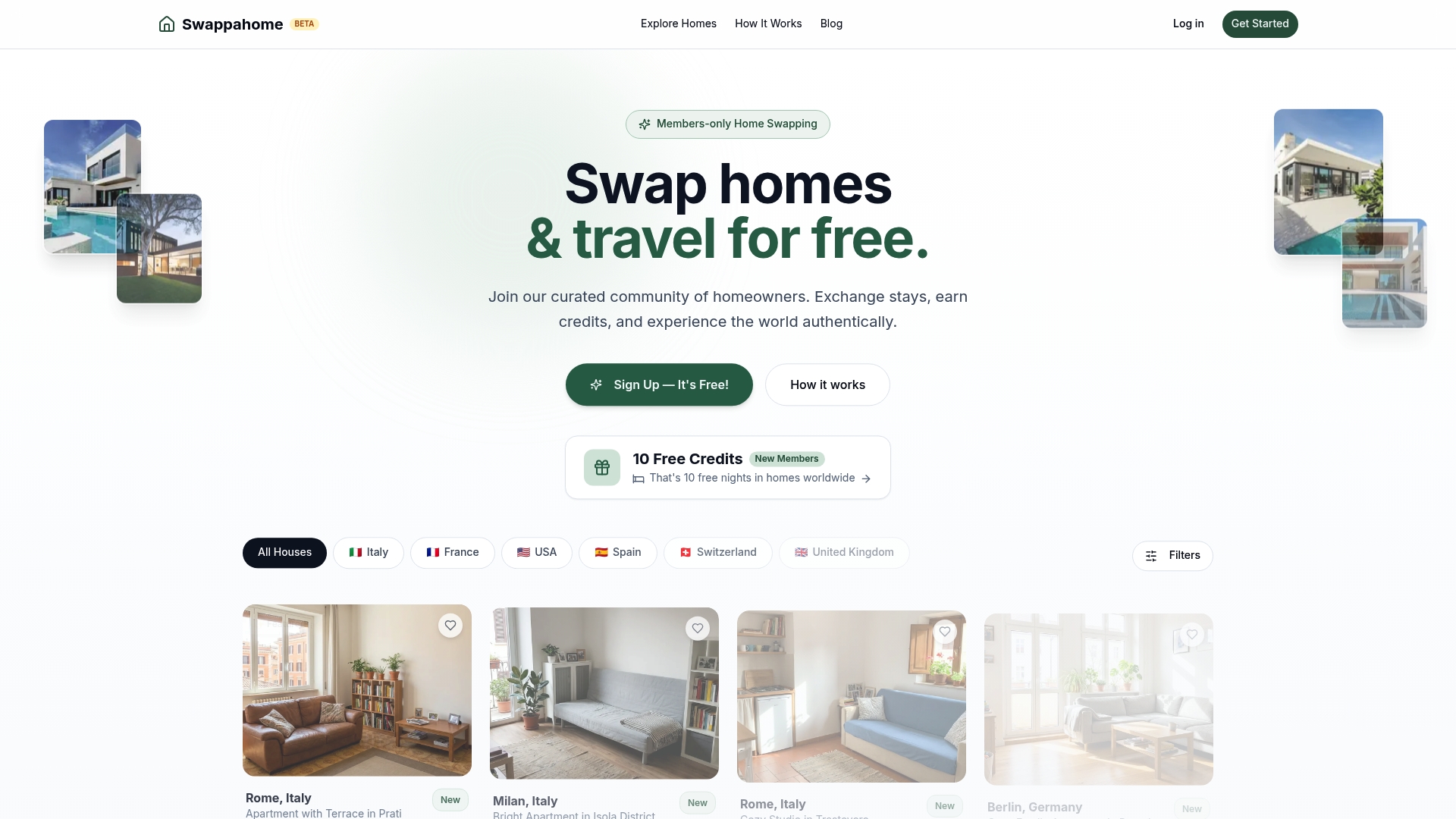
Swappahome is a members-only home swapping platform built for travelers who want authentic stays without accommodation costs. The model is straightforward: list your home, earn credits when you host, and use those credits to stay in verified homes across dozens of countries. One credit equals one free night. New members receive free credits to get started immediately.
For digital nomads and frequent travelers, this is not just a budget strategy. It is a fundamentally different way to experience a destination. You stay in a real neighborhood, cook in a real kitchen, and live the way locals do. No hotel corridor, no checkout time, no commission layer between you and the place you are visiting. Explore home swapping and see how far your home can take you.
FAQ
What is the role of digital platforms in travel?
Digital platforms centralize travel planning, booking, and cultural discovery into a single interface, accounting for 75% of global travel sales. They connect travelers with flights, accommodation, experiences, and local communities at a scale no traditional travel agency could match.
How does AI change travel planning in 2026?
Over 39% of active U.S. travelers now use AI tools like ChatGPT and Google Gemini to research and personalize itineraries. Tools like Kayak Navigator allow travelers to input detailed constraints and receive bookable results in a single workflow.
Are OTAs better than booking directly with hotels?
OTAs are best for price comparison and flexibility, while direct booking unlocks loyalty perks, room upgrades, and exclusive rates. Loyalty members are 10 times more likely to book direct and spend 20% more on average, capturing benefits OTAs cannot provide.
How do digital platforms contribute to overtourism?
Platform algorithms prioritize high-commission, high-volume destinations, funneling travelers toward already-crowded locations like Barcelona and Bali. Travelers can counter this by using community resources to identify less-trafficked alternatives and booking directly with smaller properties.
What is home swapping and how does it fit into digital travel?
Home swapping is a peer-to-peer accommodation model where verified homeowners exchange stays using a credit system, eliminating accommodation costs entirely. Platforms like Swappahome combine trust verification, a points-based booking system, and a global member network to make this model practical for modern travelers.
Recommended

Published by
SwappaHome
SwappaHome Editorial Team
Home Exchange & Slow Travel Editorial
The SwappaHome Editorial Team brings together travel research, home-exchange community insights, and platform data to produce practical guides for first-time and experienced home swappers. Every article cites real platforms, current market rates, and verifiable city-level facts so readers can make informed decisions without guessing.
Ready to try home swapping?
Join SwappaHome and start traveling by exchanging homes. Get 7 free credits when you sign up!