
The Role of Trust in Accommodation Choices

SwappaHome Editorial Team
Home Exchange & Slow Travel Editorial
The Role of Trust in Accommodation Choices !Traveler reading accommodation reviews on smartphone > TL;DR: > > - Trust is essential in booking...
The Role of Trust in Accommodation Choices
 Traveler reading accommodation reviews on smartphone
TL;DR:
- Trust is essential in booking accommodation, influencing decisions through rational signals and emotional comfort. Verified identities, secure payments, honest descriptions, and consistent communication build confidence, reducing cancellations and negative reviews. Platforms like Swappahome enhance trust with verified listings and a reciprocal credit system, promoting trustworthy interactions and reliable home exchanges.
Trust is the single most decisive factor in whether a traveler books a stay or walks away. The role of trust in accommodation goes far beyond a gut feeling. It shapes every decision from clicking "book now" to handing over a house key to a stranger. Travel websites report a median conversion rate of only 4.8%, compared to 6.6% across all industries. That gap exists largely because travelers hesitate when trust signals are weak. Platforms like Swappahome address this directly by building verification and community accountability into every exchange.
What is the role of trust in accommodation decisions?
Trust in accommodation operates on two distinct levels: cognitive and emotional. Understanding both explains why some listings convert instantly while others sit empty for weeks.
Cognitive trust is rational. It is the judgment a traveler makes based on evidence. Does this host have verified reviews? Is the payment system secure? Does the listing description match the photos? Cognitive trust drives booking behavior more than any other single variable, confirmed by an experiment with 240 participants studying peer-to-peer accommodation decisions. That finding means rational reassurance, not emotional appeal, closes the deal.
Affective trust is emotional. It is the comfort a traveler feels when a host's tone is warm, consistent, and human. Affective trust reduces the perceived risk of handing over personal information or sleeping in someone else's home. Both types work together. Cognitive trust opens the door; affective trust makes travelers feel safe walking through it.
- Consistent host communication signals reliability before any money changes hands.
- Verified identity markers reduce the fear of phantom listings or misrepresented properties.
- Transparent pricing removes the suspicion of hidden fees that erode confidence.
- Social proof through reviews gives travelers third-party confirmation of a host's claims.
- Payment security indicators tell travelers their financial data is protected.
Pro Tip: Before booking any peer-to-peer accommodation, read the host's most recent three reviews specifically for comments about communication speed and accuracy. Those two factors predict your actual experience better than star ratings alone.
What trust signals build confidence in home swapping?
Travelers and homeowners use a specific set of cues to decide whether a listing or a host is worth trusting. These signals are not accidental. They are the result of deliberate choices hosts make about how they present themselves and their homes.
 Homeowner preparing for profile photo in living room
Verified identity and professional presentation
A verified profile is the baseline. Hosts who confirm their government-issued ID, link a social media account, and include a clear face photo signal that they are real people with reputations to protect. This matters most in peer-to-peer accommodation, where there is no front desk or corporate brand standing behind the transaction. Swappahome's members-only model builds this layer in from the start, requiring verification before any listing goes live.
Payment security and institutional trust markers
72% of travelers consider payment security indicators like SSL badges essential in their booking decisions. That number shows payment security is not a nice-to-have feature. It is a prerequisite. PCI compliance and visible HTTPS protocols tell travelers that their credit card data is handled responsibly. Without these markers, even a beautiful listing loses credibility.
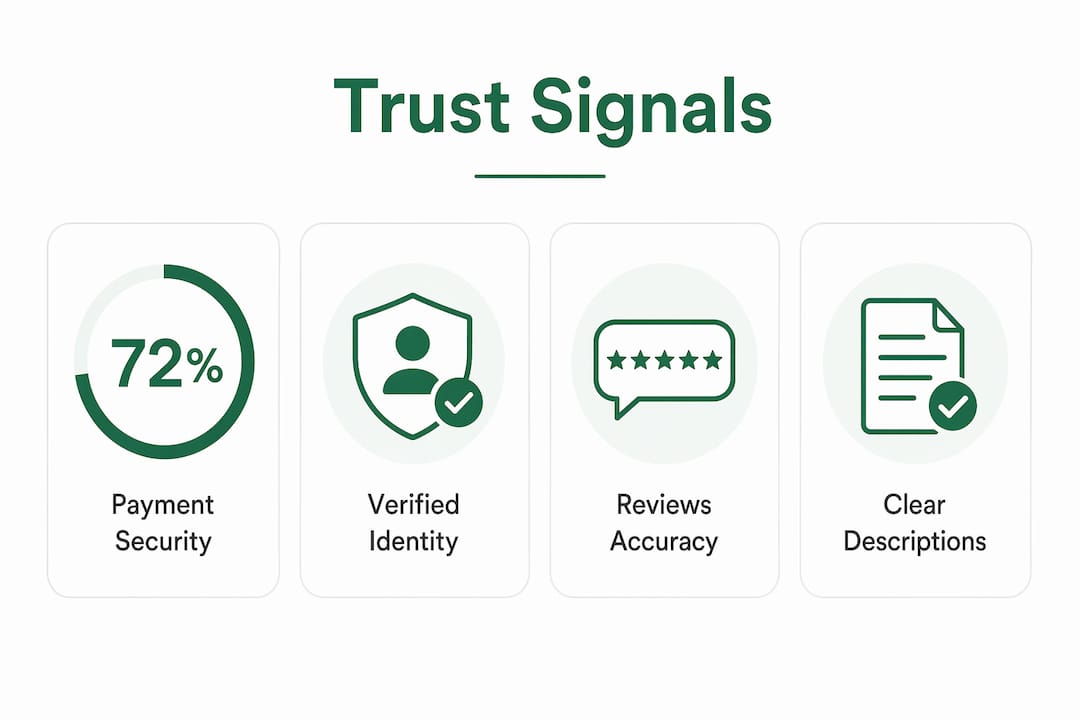 Infographic highlighting key accommodation trust signals
Detailed, honest listing descriptions
Hosts who provide logistical details such as noise policies, recycling instructions, and neighborhood quirks build more trust than those who rely on high-end photos alone. That finding runs counter to what most hosts assume. Travelers interpret practical information as a sign that the host has actually thought about their comfort. A photo of a stunning kitchen says "this looks good." A note about the quirky oven dial says "this host cares about your experience."
The triangulation method
- Search the host's name or profile photo across multiple platforms.
- Check for consistency between their public profile tone and private messages.
- Look for the same listing on other booking sites to confirm details match.
- Read reviews on each platform separately, not just the one you are booking through.
- Verify that the address or neighborhood description is consistent across sources.
Cross-checking host reputation across multiple platforms effectively reduces the risk of misleading or phantom listings. This method takes ten minutes and can prevent a ruined trip.
Pro Tip: Ask a prospective host one specific question about the property before booking, such as "How far is the nearest grocery store?" A fast, detailed answer signals engagement. A vague or delayed response signals risk.
What are the biggest trust pitfalls in peer-to-peer accommodation?
Trust erodes faster than it builds. A single inconsistency between a listing description and the actual property can trigger cancellations, negative reviews, and lasting damage to a host's reputation.
- Mismatched communication tone: A listing that reads as warm and personal but is followed by cold, template-style messages creates cognitive dissonance. Travelers notice the gap and lose confidence. Matching profile tone with private communication is critical to preventing cancellations in home swapping.
- Information asymmetry: When hosts know far more about a property's condition than guests do, the power imbalance creates anxiety. Guests fill information gaps with worst-case assumptions. Detailed listings close that gap.
- Weak data security practices: Platforms that do not communicate clearly about how they handle personal data lose travelers fast. Digital Corporate Social Responsibility, including transparent data privacy policies, is now a primary trust signal for modern travelers. Ignoring it signals carelessness.
- Misleading photos: Wide-angle lenses, selective staging, and outdated images are among the most common trust-breakers. Travelers who arrive to find a property that does not match its photos rarely leave positive reviews.
- Lack of platform accountability: When a platform has no clear process for resolving disputes or verifying hosts, travelers have no safety net. That absence of governance signals that the platform prioritizes growth over community integrity.
The consequences of these pitfalls are concrete. Cancellations spike. Reviews turn negative. Hosts lose bookings. Platforms lose members. Trust in hospitality is not a soft metric. It has direct financial consequences for everyone involved.
How can travelers and homeowners build trust effectively?
Building trust is a practice, not a one-time setup. Both travelers and homeowners have specific actions that move the needle.
- Complete your profile fully. A profile with a verified photo, a short personal bio, and linked social accounts converts far more inquiries than a blank one. Treat your profile as your first handshake.
- Write listings that answer questions before they are asked. Include check-in logistics, parking details, Wi-Fi instructions, and house rules. Travelers who find answers in the listing feel respected before they arrive.
- Respond to messages within 24 hours. Response speed is one of the strongest behavioral signals of reliability. Slow responses suggest disorganization or disinterest, both of which erode confidence.
- Use community feedback loops. Leave honest reviews for hosts and guests after every exchange. Platforms with active, detailed review cultures are harder to game and easier to trust. Finding trusted hosts becomes significantly easier when review histories are rich and specific.
- Communicate your data privacy practices. Homeowners on peer-to-peer platforms should be transparent about what guest data they collect and how they use it. This is no longer optional. Travelers actively look for this information before committing.
Trust in travel communities grows when every participant treats their listing or booking as a commitment, not a transaction. The platforms that understand this build communities. The ones that do not build catalogs.
Pro Tip: Homeowners: photograph your property on an overcast day. Natural, even light shows the space accurately without the dramatic shadows or blown-out windows that make photos look staged. Accurate photos set honest expectations and reduce the chance of a disappointed guest.
Empowered hosts who treat their listings as ongoing commitments, not static advertisements, consistently earn stronger trust scores and repeat bookings across peer-to-peer platforms.
Key Takeaways
Trust in accommodation is built through verified identity, consistent communication, payment security, and honest listings, not marketing alone.
| Point | Details |
|---|---|
| Cognitive trust drives bookings | Rational signals like verified profiles and secure payments close deals more than emotional appeal. |
| Payment security is non-negotiable | 72% of travelers require SSL and PCI compliance indicators before completing a booking. |
| Detailed listings outperform photos | Logistical information signals host consideration and builds more trust than high-end images alone. |
| Triangulation reduces risk | Cross-checking host reputation across multiple platforms cuts the risk of misleading listings. |
| Consistency prevents cancellations | Matching your listing tone with your private communication style is the single strongest trust-retention tool. |
Why trust is the only thing that actually travels with you
I have seen beautifully designed platforms fail because they treated trust as a feature to add later. And I have seen modest, plain-looking communities thrive because every member felt accountable to every other member. The difference was never the technology. It was the culture.
Trust is hospitality's invisible currency, built through consistent small actions, not campaigns. That insight changed how I think about accommodation entirely. A host who answers a question at 10 p.m. is not just being helpful. They are making a deposit into a trust account that pays dividends in reviews, repeat stays, and word-of-mouth referrals.
What I find most underappreciated is the forgiveness factor. High-trust environments give guests the psychological room to forgive minor flaws. A squeaky door or a slow shower drain becomes a funny story, not a one-star review, when the host has already demonstrated genuine care. Trust does not just prevent bad experiences. It reframes them.
My honest advice to homeowners: stop treating your listing as a brochure. Treat it as a promise. Every detail you include, every message you send, and every expectation you set is either building or eroding the trust that determines whether a guest returns or warns others away. The best home swap experiences I have seen share one trait. Both parties showed up as exactly who they said they were.
— Swappa
Swappahome: where verified trust meets free travel
Trust does not have to be built from scratch on every booking. Swappahome's members-only platform does the foundational work for you. Every homeowner is verified before their listing goes live, and the credit-based system means no money changes hands, removing one of the biggest friction points in peer-to-peer accommodation.
 https://swappahome.com
Swappahome's community is built around the principle that authentic home exchanges require real accountability. Members earn credits by hosting and spend them by staying, creating a reciprocal relationship that naturally rewards trustworthy behavior. With verified listings across dozens of countries and a straightforward one-credit-per-night model, Swappahome gives both travelers and homeowners a structure that makes trust the default, not the exception. Browse verified listings and see what a trust-first accommodation community looks like in practice.
FAQ
What is the role of trust in accommodation?
Trust is the primary factor that determines whether a traveler completes a booking or abandons it. It operates through both rational signals, like verified profiles and secure payments, and emotional cues, like consistent and warm communication.
How does payment security affect guest trust?
72% of travelers consider payment security indicators like SSL badges essential before booking. Visible security markers tell guests their financial data is protected, which directly increases conversion rates.
What are the biggest trust red flags in home swapping?
Mismatched communication tone, misleading photos, vague listing descriptions, and slow response times are the most common signals that a host or listing is unreliable. Any inconsistency between a public profile and private messages is a strong warning sign.
How can homeowners build trust with guests quickly?
Complete your profile with a verified photo and bio, write a listing that answers logistical questions upfront, and respond to inquiries within 24 hours. Detailed listings consistently outperform visually polished but vague ones in earning guest confidence.
Why does trust matter more in peer-to-peer accommodation than in hotels?
In peer-to-peer accommodation, there is no corporate brand or front desk providing a safety net. Every trust signal comes directly from the host and the platform. That makes verification, consistent communication, and community accountability far more critical than in traditional lodging.
Recommended

Published by
SwappaHome
SwappaHome Editorial Team
Home Exchange & Slow Travel Editorial
The SwappaHome Editorial Team brings together travel research, home-exchange community insights, and platform data to produce practical guides for first-time and experienced home swappers. Every article cites real platforms, current market rates, and verifiable city-level facts so readers can make informed decisions without guessing.
Ready to try home swapping?
Join SwappaHome and start traveling by exchanging homes. Get 7 free credits when you sign up!