
The Role of Trust in Travel Networks Explained

SwappaHome Editorial Team
Home Exchange & Slow Travel Editorial
The Role of Trust in Travel Networks Explained !Travelers sharing information in a busy café > TL;DR: > > - Trust in travel networks is conditional,...
The Role of Trust in Travel Networks Explained
 Travelers sharing information in a busy café
TL;DR:
- Trust in travel networks is conditional, earned through safety signals, accountability, and exception management rather than assumed. Platforms with clear governance, transparent information, and strong review systems foster higher trust and community stability. Travelers should verify platforms' dispute processes, complete profiles, and understand AI's role for safer, more reliable exchanges.
Most travelers assume trust is a natural byproduct of a good platform or a friendly exchange. It isn't. The role of trust in travel networks is far more complex: conditional, earned in stages, and subject to collapse the moment a platform fails to own an exception or a host goes silent at 11 PM. Trust determines whether someone opens their home to a stranger, whether a traveler completes a booking, and whether a community grows or fragments. This article breaks down the mechanics of trust in peer-to-peer and home-sharing networks, from safety engineering to platform governance, and tells you exactly how to use that knowledge.
Table of Contents
- Key takeaways
- The role of trust in travel networks: safety, accountability, and conditional trust
- Platform governance and technology in trust dynamics
- How AI and human service models build traveler trust
- Practical trust-building strategies for travelers and professionals
- Why most travelers are thinking about trust the wrong way
- Travel confidently with Swappahome
- FAQ
Key takeaways
| Point | Details |
|---|---|
| Trust is conditional, not automatic | Travelers withhold commitment until reassurance is earned through safety signals and reliable support. |
| Safety-first design changes outcomes | Platforms weighting safety at 51.3% in matching algorithms achieve measurably higher acceptance rates. |
| Governance shapes community trust | Platform rules and institutional legitimacy determine which networks become central hubs versus peripheral players. |
| AI assists but humans close the deal | 66% of travelers won't trust AI to book; human accountability at critical moments remains non-negotiable. |
| Verification and reviews are the backbone | Two-way review systems and verified identities reduce retaliation and build bilateral confidence in peer-to-peer exchanges. |
The role of trust in travel networks: safety, accountability, and conditional trust
Trust in travel isn't a feeling. It's a functional mechanism that either allows a network to operate or causes it to stall. When researchers studied travel companion matching, a safety-first matching algorithm weighted safety at 51.3% of the decision framework, outweighing personal preference at 48.7%, and ultimately achieved a 60% acceptance rate. That number matters because it quantifies what experienced travelers already sense intuitively: safety concerns will override compatibility every time, at least until baseline trust is established.
Conditional trust is the operating principle here. Travelers don't arrive at a platform open-handed. They withhold emotional commitment until reassurance is earned, and the triggers for that reassurance are specific. According to research on traveler trust and overwhelm, what breaks trust isn't apathy. It's the cognitive overload created by complex cancellation policies, cross-channel handoffs where context gets lost, and exceptions that nobody owns.
Accountability is the third pillar. A platform can have excellent technology and still fail a traveler the moment something goes wrong and there is no clear human path to resolution. This is especially relevant in home-sharing networks, where the stakes of a bad experience are higher than a disappointing hotel stay. You've made plans, possibly traveled internationally, and now you're standing outside a door that isn't opening.
- Safety verification: Hard trust gates, such as verified identity and background checks, filter out bad actors before the first interaction occurs.
- Conditional signals: Profile completeness, response rate, and past reviews give travelers the incremental evidence they need to commit.
- Owned exceptions: When plans change or something breaks, the platform that steps in and resolves the issue without finger-pointing earns loyalty. The one that points back to its terms loses it permanently.
- Operational continuity: Trust compounds when every journey touchpoint delivers consistent accountability from first browse to final checkout.
Pro Tip: Before committing to any peer-to-peer accommodation exchange, look specifically for how the platform handles exceptions. Read the negative reviews, not just the five-star ones. The response to failure tells you more about trustworthiness than any marketing claim.
Platform governance and technology in trust dynamics
Individual trustworthiness matters, but the structure of the platform surrounding those individuals matters just as much. Social network analysis of digital tourism ecosystems shows that platform centrality and community formation are directly shaped by governance mechanisms and institutional legitimacy. In plain terms: the platforms that become the trusted hubs in a travel ecosystem aren't necessarily the biggest or the oldest. They're the ones with the clearest rules, the most consistent enforcement, and the most transparent structure.
Governance in this context means more than a terms-of-service document. It means norm enforcement, dispute resolution processes, and the orchestration of how different actors in the network relate to each other. When governance is weak, trust diffuses across the network unevenly. Some users operate in high-trust bubbles. Others encounter risk at every turn.
Here's how governance mechanisms compare across trust outcomes:
| Governance feature | Low-trust outcome | High-trust outcome |
|---|---|---|
| Identity verification | Optional or absent | Mandatory and independently confirmed |
| Dispute resolution | Reactive, slow, user-managed | Proactive, platform-owned, time-bound |
| Review system design | Sequential, prone to retaliation | Simultaneous release, reducing strategic bias |
| Norm enforcement | Community flagging only | Algorithmic detection plus human review |
| Information transparency | Minimal disclosure | Full visibility on terms, ratings, and exceptions |
Information design also feeds directly into trust. Research on accommodation platform credibility confirms that visibility alone isn't enough. Platforms that design for decision certainty, giving users clear, credible, complete information, produce measurably higher trust and drive more sustainable booking behavior. Cluttered listings, vague cancellation terms, and incomplete host profiles all introduce doubt. And once doubt enters, conditional trust collapses.
Pro Tip: When evaluating a home-sharing platform's trustworthiness, test the dispute resolution path before you ever need it. Send a question that requires a real answer, not a FAQ redirect. How long it takes and how specific the response is tells you everything about the operational accountability behind the brand.
How AI and human service models build traveler trust
 Support staff reviewing dispute on platform dashboard
The travel industry's infatuation with AI is real, but the data on traveler behavior tells a more nuanced story. A survey of 5,700 adults found that 66% of travelers won't trust AI to make a booking on their behalf. The concerns aren't irrational: loss of control, data privacy risks, and the fear that an algorithm will mishandle a high-stakes decision. AI is trusted for low-stakes discovery tasks. It is not yet trusted for commitment.
This creates a practical framework for understanding where trust in travel technology actually lives. There are distinct zones:
- High AI comfort: Destination inspiration, itinerary suggestions, price comparison, activity discovery.
- Low AI comfort: Booking confirmation, payment handling, dispute resolution, emergency response.
- Human-critical moments: Any situation involving money, unexpected changes, safety concerns, or emotional distress.
The insight here is that human-led, AI-powered models work precisely because they put automation where it adds efficiency and humans where it adds empathy. When technology handles logistics, the people in the network are freed to do what technology can't: advocate for the traveler, absorb the stress of an exception, and make a judgment call that a policy document couldn't anticipate. For home-swapping communities specifically, this means platforms that rely entirely on automated systems for conflict resolution will consistently underperform on trust metrics compared to those that keep a human in the loop at critical junctures.
Practical trust-building strategies for travelers and professionals
Understanding the theory of trust is useful. Applying it to your next trip or your platform strategy is what actually changes outcomes. These steps reflect how trust factors in tourism networks translate into real decisions.
-
Start with hard trust gates. Use platforms that require verified identity and real address confirmation before any exchange is approved. This isn't bureaucracy. It's the infrastructure that makes everything else possible. A safety-focused platform feature set dramatically reduces the probability of encountering bad actors.
-
Read reviews as a system, not a scorecard. A 4.8-star average tells you almost nothing on its own. Look at how hosts respond to negative feedback. Look at whether reviews are specific and detailed or suspiciously generic. Platforms using simultaneous review release reduce strategic retaliation, meaning the feedback you're reading is more likely to be honest.
-
Set expectations explicitly before any exchange. Conditional trust depends on reducing ambiguity upfront. Outline arrival times, house rules, acceptable use, and emergency contacts before the exchange begins. Every unresolved ambiguity is a potential trust failure waiting to happen.
-
Evaluate the fraud protection posture of any platform you join. Research on C2C marketplace fraud mechanisms shows that not all platforms actively implement protect-and-prepare anti-fraud measures. Ask whether the platform has published its trust and safety practices, not just its terms.
-
Invest in your own trust profile. Complete your profile fully. Add photos, a written bio, your travel history, and references where available. In peer-to-peer networks, your profile is your credibility. Thin profiles signal risk to potential partners, regardless of your actual intentions.
Here's a practical comparison of trust signals that travelers and hosts actually use when evaluating each other:
| Trust signal | Traveler perspective | Host perspective |
|---|---|---|
| Profile completeness | Shows genuine intent | Reduces uncertainty about guest character |
| Response time | Indicates reliability | Shows host is attentive and organized |
| Review volume and quality | Reduces booking risk | Confirms guest track record |
| Verification badges | Platform-endorsed credibility | Same; confirms guest is who they claim |
| Communication clarity | Reduces misunderstanding risk | Signals professionalism and mutual respect |
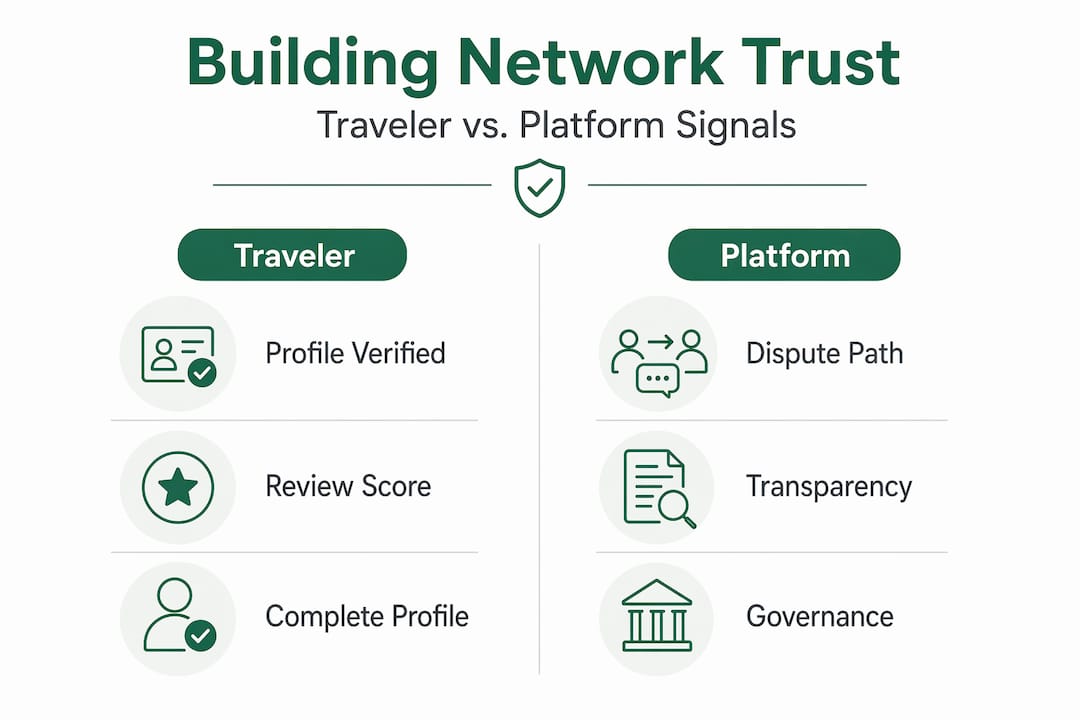
Reading the role of user reviews in home swapping trust reveals just how much weight each signal carries in real decisions.
 Infographic comparing traveler and platform trust signals
Why most travelers are thinking about trust the wrong way
I've spent years watching travel networks succeed and fail, and the pattern that stands out most is this: travelers treat trust as a prerequisite they need before engaging, when it's actually something they build during engagement.
The mistake is waiting for a platform to feel safe rather than actively reading the governance signals in front of you. I've seen beautifully designed platforms with zero dispute resolution and rough-looking interfaces with meticulous accountability processes. Aesthetics and trust are not the same thing.
What I've learned is that operational accountability is the real differentiator. Not the algorithm, not the design system, not the number of listed homes. When I look at the platforms that retain members year after year, they all share one trait: they own exceptions. When something breaks, a human shows up. That's it. That's the whole formula.
The other thing most travelers overlook is that trust is bilateral. You're not just evaluating whether the host or platform is trustworthy. They're evaluating you. Building trust in travel communities means showing up as a credible, transparent participant, not just extracting reassurance from others. The networks that understand this create exponentially better experiences for everyone inside them.
— Swappa
Travel confidently with Swappahome
 https://swappahome.com
Swappahome was built around exactly the trust principles this article describes. Every member goes through a verification process before they can exchange a single night. The credit-based system means no money changes hands, which removes a major category of fraud risk entirely. Governance is baked into the platform through clear community norms, a responsive support team, and a review system designed to surface honest feedback rather than polished ratings.
If you're ready to put these trust principles into practice, explore verified home listings across dozens of countries and see what a genuinely community-governed exchange looks like. Or visit Swappahome directly to start listing your home, earn credits, and book your first free stay with confidence.
FAQ
What is the role of trust in travel networks?
Trust in travel networks functions as the operational foundation that determines whether travelers complete bookings, engage with hosts, and return to platforms. It is conditional, earned through safety signals, accountability mechanisms, and consistent exception handling rather than assumed by default.
Why do travelers withhold trust even from reputable platforms?
Travelers exhibit conditional trust because complex policies, poor cross-channel continuity, and unresolved exceptions create cognitive overload. Research shows trust hinges on reducing effort and owning problems end-to-end, not just on brand recognition.
How do review systems build trust in home-sharing networks?
Review systems that release ratings simultaneously rather than sequentially reduce strategic retaliation and produce more honest feedback. Two-way accountability designs create bilateral confidence, where both hosts and travelers feel protected from unfair scoring.
Should travelers trust AI to manage their bookings?
Not yet. A survey of 5,700 travelers found that 66% won't trust AI for booking decisions. AI is reliable for discovery and planning, but human oversight remains critical for high-stakes commitments and issue resolution.
How can travelers actively build their own trustworthiness on exchange platforms?
Complete your profile fully with photos, a written bio, and verifiable details. Respond promptly, communicate clearly before any exchange begins, and accumulate reviews through consistent behavior. In peer-to-peer networks, your profile is your reputation, and a thin one signals risk regardless of intent.
Recommended

Published by
SwappaHome
SwappaHome Editorial Team
Home Exchange & Slow Travel Editorial
The SwappaHome Editorial Team brings together travel research, home-exchange community insights, and platform data to produce practical guides for first-time and experienced home swappers. Every article cites real platforms, current market rates, and verifiable city-level facts so readers can make informed decisions without guessing.
Ready to try home swapping?
Join SwappaHome and start traveling by exchanging homes. Get 7 free credits when you sign up!