
The Role of User Reviews in Exchanges: 2026 Guide

SwappaHome Editorial Team
Home Exchange & Slow Travel Editorial
The Role of User Reviews in Exchanges: 2026 Guide !Woman reading printed user reviews at home > TL;DR: > > - User reviews are the most important...
The Role of User Reviews in Exchanges: 2026 Guide
 Woman reading printed user reviews at home
TL;DR:
- User reviews are the most important trust signal in home exchange platforms, shaping members' willingness to swap. Detailed, consistent, and recent reviews build credibility more effectively than star ratings alone, and proactive engagement enhances trust. Members and platforms can improve reliability by prioritizing specific feedback, timely responses, and authentic experiences.
User reviews are the primary trust signal in home exchange platforms, directly shaping whether members commit to a swap or walk away. The role of user reviews in exchanges goes far beyond star ratings. Reviews create a visible record of real experiences, from how a host communicated before arrival to how a home was prepared on check-in day. Positive reviews increase trust by a beta coefficient of 0.52, while negative ones reduce engagement intentions by a coefficient of 0.48. That asymmetry matters. Platforms like Swappahome are built on the understanding that community feedback is not a feature. It is the foundation.
How do user reviews influence trust and reliability in home exchange platforms?
Trust in a home exchange platform is built through accumulated user experience, not marketing copy. Platform reliability and issue resolution now matter more to members than any onboarding promise. When you read a review that describes how a host resolved a broken appliance mid-stay, you gain a clearer picture of what to expect than any feature list could provide.
 Over-shoulder view of man reading reviews on laptop
The volume of reviews matters as much as their content. Consistent performance over time signals genuine reliability. A sudden spike in five-star ratings within a short window raises flags for experienced members, who recognize it as a potential sign of manipulation rather than authentic quality.
Detailed, structured reviews increase perceived reliability in a specific way. A review that covers communication before the swap, the condition of the home on arrival, and how any problems were handled gives future members a complete picture. Aggregate scores alone cannot do that. Detailed narratives about specific exchange experiences build platform credibility far more effectively than a 4.7-star average.
Here is what the research shows about review characteristics that drive trust:
- Specificity: Reviews mentioning exact details (clean kitchen, fast Wi-Fi, responsive host) are rated more helpful than vague praise.
- Consistency: A member with 30 reviews averaging 4.8 stars is more credible than one with 3 reviews averaging 5.0.
- Issue resolution: Reviews that describe a problem and how it was fixed signal accountability, not failure.
- Recency: Reviews from the past 12 months carry more weight than older ones, since hosts and homes change.
Pro Tip: When evaluating a potential swap partner on Swappahome, filter for members with at least 10 reviews and read the most recent three in full. Patterns in language and detail reveal more than the average score.
What type of user feedback is most helpful for potential home exchangers?
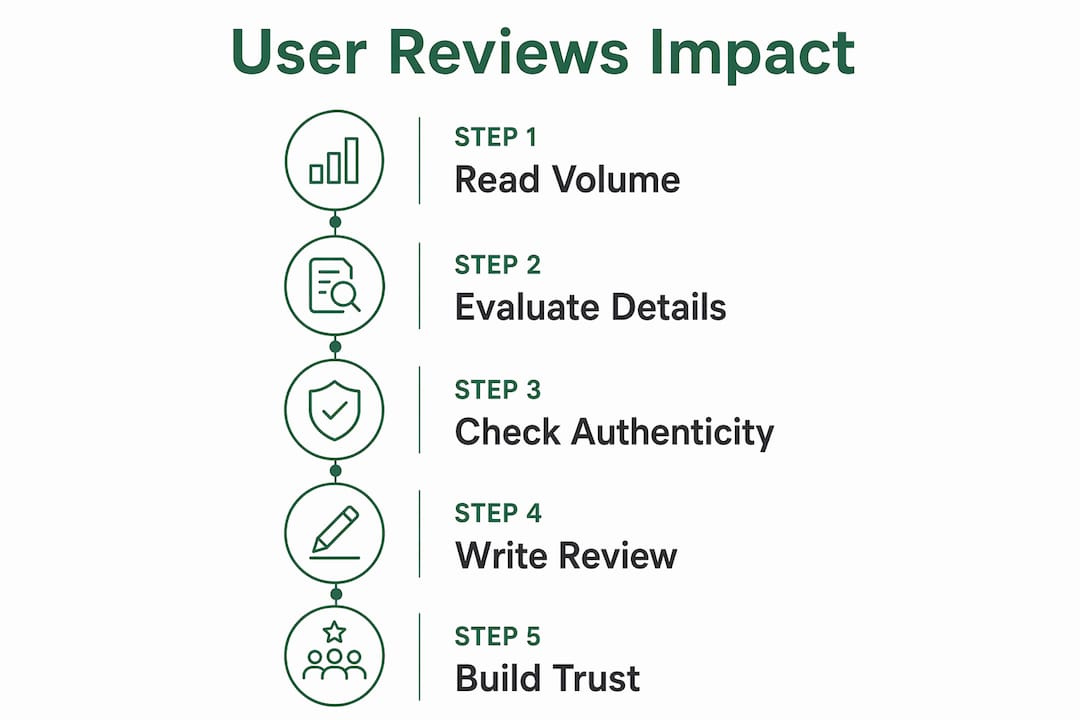 Infographic showing five-step user review impact
Not all reviews carry equal weight. Extreme 1-star and 5-star reviews are perceived as significantly more helpful than moderate ones, with helpfulness coefficients of 0.257 and 0.248 respectively, compared to 0.076 and 0.085 for middle-range ratings. The reason is simple: strong opinions force reviewers to explain themselves, and that explanation is where the real information lives.
What makes a review genuinely useful
A useful review follows a clear narrative arc. Reviews that open with neutral observations and move toward a positive conclusion are viewed as more credible. Reviews that turn negative after a positive start tend to be discounted by experienced members, who read the shift as emotional rather than factual. Consistency of tone throughout a review signals that the writer is reporting rather than venting.
The most informative reviews for home exchange decisions cover three specific areas:
- Communication: Did the host respond quickly before and during the swap? Were instructions clear?
- Home preparation: Was the space clean, stocked with basics, and accurately described in the listing?
- Problem resolution: If something went wrong, how was it handled? Was the host reachable and cooperative?
A single detailed review covering these specifics attracts new members more effectively than a collection of short, generic five-star comments. Context converts a rating into a recommendation.
Spotting authentic reviews versus promotional ones
| Review characteristic | Authentic signal | Promotional signal |
|---|---|---|
| Language specificity | Names rooms, appliances, neighborhood | Generic praise ("amazing stay!") |
| Tone consistency | Neutral to positive arc | Uniformly superlative throughout |
| Problem acknowledgment | Mentions minor issues honestly | No negatives at all |
| Detail level | Describes actual experiences | Repeats listing description |
| Reviewer history | Multiple reviews across time | First or only review on profile |
Pro Tip: Check the reviewer's profile history before trusting a glowing review. A member who has written five detailed reviews over two years is a far more reliable source than an account with a single five-star post.
How can home exchange platforms and users effectively leverage reviews?
Reviews only create value when platforms and members treat them as active tools rather than passive records. Nearly 60% of organizations now use proactive engagement strategies driven by user feedback to personalize outreach and improve platforms in near real-time. That shift from reactive to proactive is the difference between a platform that grows and one that stagnates.
Platforms can take four concrete steps to get more from their review systems:
- Prompt reviews at the right moment. Send a review request within 48 hours of a swap ending, when the experience is fresh and members are most likely to write in detail.
- Respond publicly to negative reviews. A platform or host response that acknowledges an issue and describes the fix signals accountability. It turns a negative data point into a trust-building moment.
- Surface detailed reviews prominently. Algorithmic ranking that prioritizes longer, more specific reviews over short ones rewards quality and trains members to write better feedback.
- Use feedback to fix friction points. Honest negative feedback acts as an external audit, surfacing user friction points that internal teams often miss entirely.
Members benefit from the same proactive mindset. Writing a thorough review after every swap builds your own credibility on the platform. Other members read your reviews and form an impression of you as a thoughtful, reliable participant. That reputation directly affects how many swap requests you receive.
Pro Tip: Write your review within 24 hours of a swap. Use three short paragraphs: one on communication, one on the home itself, and one on any issues and how they were resolved. That structure takes five minutes and produces a review that genuinely helps the next member.
What challenges and nuances exist in interpreting user reviews in exchanges?
Reviews are powerful, but they are not infallible. Several patterns can distort the picture they create, and members who recognize these patterns make better decisions.
- Rating spikes: A sudden cluster of five-star reviews in a short period often signals a coordinated effort rather than genuine quality. Experienced members value stable ratings built on large review volumes over time.
- Outlier bias: A single one-star review on a profile with 40 positive ones deserves context, not automatic disqualification. Read the outlier carefully. If it describes an unusual circumstance, weight it accordingly.
- Recency gaps: A member with strong reviews from three years ago but nothing recent may have changed their hosting standards. Gaps in review history are worth noting.
- Reciprocal review pressure: In exchange communities, both parties review each other. That dynamic can suppress honest negative feedback, since members may soften criticism to avoid retaliation.
| Review pattern | What it signals | How to respond |
|---|---|---|
| Sudden rating spike | Possible manipulation | Cross-check review dates and reviewer profiles |
| Long gap in reviews | Possible inactivity or change | Message the member directly before committing |
| All five-star, no detail | Possible promotional reviews | Look for reviews that mention specific experiences |
| Single outlier negative | Isolated incident | Read the full review and the host's response |
The most reliable approach combines review reading with direct communication. A travel community best practices framework recommends treating reviews as the starting point of due diligence, not the end of it. A short message exchange before confirming a swap reveals communication style and responsiveness in ways no review can fully capture.
Key takeaways
User reviews are the single most reliable trust signal in home exchange platforms, and their impact depends on specificity, consistency, and narrative structure rather than star ratings alone.
| Point | Details |
|---|---|
| Sentiment asymmetry | Negative reviews reduce engagement more sharply than positive ones increase trust. |
| Extreme reviews are most helpful | 1-star and 5-star reviews carry more useful information than moderate ratings. |
| Narrative structure matters | Reviews that stay consistent in tone are perceived as more credible than those that shift. |
| Volume beats spikes | Stable ratings built over many reviews signal genuine reliability more than sudden score jumps. |
| Proactive use drives improvement | Platforms that act on feedback in near real-time build stronger community loyalty. |
Why I think most members underestimate the review they leave behind
Most members focus entirely on reading reviews before a swap. They spend less time thinking about the review they write afterward. That is a mistake.
The review you write is your public record in the community. Other members read it to assess your judgment, your communication style, and your honesty. A vague "great stay, highly recommend" tells the next person almost nothing. A review that describes the neighborhood, the host's responsiveness, and one small issue that was handled well tells them everything they need to decide.
I have noticed a clear pattern: members who write detailed, honest reviews consistently attract better swap partners. They signal that they are thoughtful, fair, and engaged. That reputation compounds over time. The importance of customer feedback in building a personal reputation within a platform is something most guides skip entirely, and it is one of the most practical advantages available to any active member.
The platforms that get this right are the ones that treat reviews as a two-way accountability system, not a one-sided rating tool. Transparency and responsiveness, from both hosts and guests, are what turn a review system into a genuine community asset.
— Swappa
Swappahome's approach to reviews and trusted exchanges
Swappahome builds trust through verified member profiles and a review system designed to surface real experiences, not curated highlights. Every listing on the platform carries feedback from actual swap participants, covering communication, home condition, and overall experience.
 https://swappahome.com
When you read reviews on Swappahome's listings, you are reading from a verified community of homeowners who have completed real exchanges. The platform's credit-based model means every member has a direct stake in maintaining their reputation. New members receive free credits to get started, and the review record they build from their first swap becomes their most valuable asset on the platform. Find trusted hosts and start building your own exchange history today.
FAQ
What is the role of user reviews in exchanges?
User reviews are the primary trust mechanism in home exchange platforms. They provide verified accounts of real experiences that help members evaluate potential swap partners before committing.
Do negative reviews hurt a host's reputation permanently?
A single negative review rarely defines a profile. Members with a large volume of consistent positive reviews and a transparent response to criticism are still viewed as reliable by most experienced exchangers.
Are extreme star ratings more useful than moderate ones?
Yes. Research shows that 1-star and 5-star reviews carry significantly higher helpfulness scores than 3-star or 4-star reviews, because strong opinions require more detailed explanation.
How can I tell if a review is authentic?
Look for specificity, consistent tone, and a reviewer history that spans multiple exchanges over time. Reviews that mention exact details and acknowledge minor issues are far more credible than uniformly positive, vague posts.
How many reviews should a member have before I trust them?
There is no fixed threshold, but a stable history of 10 or more reviews spread over at least one year is a reliable baseline. Sudden clusters of recent reviews with no prior history warrant closer scrutiny.
Recommended

Published by
SwappaHome
SwappaHome Editorial Team
Home Exchange & Slow Travel Editorial
The SwappaHome Editorial Team brings together travel research, home-exchange community insights, and platform data to produce practical guides for first-time and experienced home swappers. Every article cites real platforms, current market rates, and verifiable city-level facts so readers can make informed decisions without guessing.
Ready to try home swapping?
Join SwappaHome and start traveling by exchanging homes. Get 7 free credits when you sign up!