
Travel Exchange Programs: Top 6 for Affordable Stays

SwappaHome Editorial Team
Home Exchange & Slow Travel Editorial
Travel Exchange Programs: Top 6 for Affordable Stays !Woman planning travel exchange program at home > TL;DR: > > - Travel exchange programs enable...
Travel Exchange Programs: Top 6 for Affordable Stays
 Woman planning travel exchange program at home
TL;DR:
- Travel exchange programs enable participants to trade work, cultural participation, or home access for subsidized or free accommodation abroad. Choices range from work exchanges and student programs to professional placements and cultural immersion, each with different durations and requirements. Success depends on aligning the program with personal goals, attitude, and thorough preparation, including understanding hidden costs and realistic expectations.
Travel exchange programs are structured arrangements where participants trade work, cultural participation, or home access for free or heavily subsidized accommodation abroad. The best programs, including Worldpackers, Angloville, and AFS Intercultural Programs, eliminate hotel costs entirely while placing you inside local communities rather than beside them. Whether you want a semester abroad, a summer teaching role, or a few weeks of language immersion, the right program turns your skills or home into your travel budget.
What types of travel exchange programs are available?
The term "travel exchange programs" covers several distinct models, each with different requirements, time commitments, and cultural depth. Knowing the category before you apply saves weeks of wasted research.
Work exchange programs are the most flexible entry point. Platforms like Worldpackers connect travelers with hostels, eco-farms, surf camps, and community projects. Work exchanges typically require 2.5 to 4 months of commitment, with participants providing a few hours of daily duties in exchange for room and board. This model suits gap-year travelers and remote workers who want extended stays without burning through savings.
Student exchange programs run on academic calendars and usually last one semester or one full year. Programs like AFS Intercultural Programs place high school and college students with host families, combining coursework with cultural immersion. Most require a minimum GPA, a letter of recommendation, and proof of language proficiency.
Professional exchange programs target working adults. The J-1 Teacher Exchange, administered by sponsors like TPG Cultural Exchange, requires two years of teaching experience and a degree equivalent to a U.S. Bachelor's. These programs carry administrative weight, including credential evaluations and personal insurance costs, but they offer legal work authorization and a structured support network.
Cultural immersion programs like Angloville focus on language practice and social engagement rather than formal work or study. They are shorter (one to three weeks), often partially sponsored, and designed for adults who want concentrated cultural contact without a long commitment.
Pro Tip: Before applying anywhere, write down your three non-negotiables: maximum duration, minimum cost coverage, and preferred region. Programs that fail one criterion waste your application time regardless of how appealing they look.
For a broader look at how accommodation exchange models work across these categories, the differences become even clearer when you see them side by side.
Top 6 travel exchange programs for affordable stays in 2026
1. Worldpackers
Worldpackers is the largest work exchange marketplace for independent travelers, listing thousands of hosts across more than 50 countries. Hosts include hostels, permaculture farms, yoga retreats, and social impact organizations. Participants typically work four to five hours per day in roles ranging from reception and social media to construction and teaching, receiving accommodation and often meals in return.
 Travelers collaborating in hostel kitchen during work exchange
The platform charges an annual membership fee, but the accommodation savings across even a two-week stay far exceed that cost. Hosts select volunteers based on attitude and willingness to integrate into the host's daily rhythm, not just skill sets. Worldpackers suits travelers aged 18 and older with no upper age limit, making it one of the most accessible international travel programs available.
2. Angloville
Angloville runs cultural immersion camps across Poland, Czech Republic, Romania, and several other European countries. Native English speakers join week-long retreats where local professionals practice conversational English in exchange for free accommodation and meals. Up to 90% of participation costs are sponsored, with participants covering only their flights and travel insurance.
The schedule is intensive. Programs expect 8 to 10 hours of social engagement daily, including group discussions, one-on-one conversations, and evening activities. This is not a sightseeing trip with some conversation on the side. It rewards extroverts and anyone genuinely motivated by language exchange rather than free European travel.
3. TPG Cultural Exchange J-1 Teacher Program
TPG Cultural Exchange sponsors J-1 Teacher Exchange visas for qualified educators who want to teach in U.S. schools for up to three years. The program places international teachers in public and private schools, providing visa sponsorship, orientation, and ongoing program support.
Eligibility is strict. Applicants need two years of teaching experience and a degree equivalent to a U.S. Bachelor's. Beyond the visa, participants handle credential evaluations and personal insurance independently, which adds both cost and paperwork. The payoff is a fully legal work arrangement with a salary, making it the strongest professional exchange option for educators.
4. PREFECO Volunteer Exchange in Mexico
PREFECO is a grassroots intercultural volunteer exchange that places international participants with host families in Mexico for several months. Volunteers receive free accommodation and participate in cultural activities, but they cover their own international flights and insurance. In return, they share their own culture with the host community through presentations, cooking, and daily interaction.
This program suits travelers who want deep community integration rather than tourist-level exposure. The absence of a formal work structure means your cultural contribution is the currency. PREFECO is one of the few youth exchange initiatives that genuinely operates on reciprocal cultural sharing rather than labor.
5. Alliance Abroad Summer Work and Travel
Alliance Abroad's Summer Work and Travel program targets international students who want to work legally in the United States during their summer break. The program provides pre-arranged jobs with guaranteed placement and health insurance, typically at resorts, amusement parks, and hospitality venues.
Participants earn wages that cover living costs, and Alliance Abroad emphasizes cross-cultural communication and adaptability as core program outcomes. Employers increasingly value these skills, making the program a dual investment in travel and career development. The J-1 Exchange Visitor visa required for participation is sponsored through the program.
6. AFS Intercultural Programs
AFS Intercultural Programs is one of the oldest and most respected student exchange organizations globally, operating in more than 50 countries. AFS places high school students with volunteer host families for semester or year-long exchanges, with participants attending local schools and living as genuine family members rather than guests.
The German American Partnership Program (GAPP), administered in partnership with the Goethe-Institut, exemplifies the AFS model's long-term focus. GAPP explicitly prioritizes lifelong friendships and international alliances over short-term travel experiences. AFS programs vary in cost depending on destination and scholarship availability, but the organization maintains one of the most active scholarship funds in the student exchange sector.
How to compare and choose the right program for your goals
Choosing between these programs comes down to four variables: cost coverage, duration, skill or eligibility requirements, and your personal motivation for traveling.
| Program | Cost coverage | Duration | Key requirement | Best for |
|---|---|---|---|---|
| Worldpackers | Room and board | 2.5 to 4 months | Positive attitude, basic skills | Independent travelers |
| Angloville | Up to 90% sponsored | 1 to 2 weeks | Native English speaker | Short-term cultural immersion |
| TPG J-1 Teacher | Salary paid | Up to 3 years | 2 years teaching experience | Qualified educators |
| PREFECO | Free accommodation | Several months | Cultural sharing willingness | Community-focused volunteers |
| Alliance Abroad | Wages cover living costs | Summer season | Student enrollment | International students |
| AFS | Varies with scholarships | Semester or year | High school enrollment | Teenage students |
Program reputation matters as much as the cost structure. Read participant reviews on independent platforms, not just testimonials on the program's own website. Look specifically for comments about host quality, support when problems arise, and whether the program delivered what it promised.
Hidden costs catch most first-time participants off guard. Flights, travel insurance, visa fees, and credential evaluations are almost never included. Budget at least $800 to $1,500 for these pre-departure costs regardless of which program you choose. For practical guidance on joining exchange communities without overspending, planning your application timeline at least six months in advance gives you the best shot at scholarship funding and preferred placements.
Pro Tip: Apply to two programs simultaneously if your top choice has a competitive acceptance rate. Most programs allow you to withdraw without penalty if you accept another offer first.
What to expect from the exchange experience
The daily reality of a travel exchange differs significantly from what most applicants imagine before they arrive. Understanding this gap prevents early disappointment.
In work exchange programs, your mornings often start with tasks before the property opens to guests. In cultural immersion programs like Angloville, your schedule is socially packed from breakfast to evening activities. Japan's Ministry of Foreign Affairs describes exchange participants as practicing "grassroots diplomacy," which captures the mindset required. You are not a tourist who happens to be working. You are a representative of your culture, and that role carries real social weight.
Common misconceptions include the belief that downtime will be abundant and that the workload will be light. Work exchange hosts are running real businesses and need reliable contributors. Negative behavior or a vacation mindset causes early program termination. The participants who thrive are those who show up curious, communicate proactively, and treat their host's goals as their own.
The networking value is underrated. Exchange programs consistently produce lasting professional and personal relationships. The cross-cultural communication skills you build are recognized by employers across industries, particularly in international business, education, and nonprofit sectors.
"The most valuable thing I brought home wasn't a souvenir. It was a contact list of people on four continents who knew what I was capable of."
For a deeper look at how exchange-based travel translates into authentic, affordable stays beyond formal programs, the principles carry over directly to home swapping and other accommodation models.
Key takeaways
Travel exchange programs deliver the most value when participants choose programs aligned with their skills, duration tolerance, and genuine cultural curiosity rather than simply the lowest cost.
| Point | Details |
|---|---|
| Program type determines commitment | Work exchanges run 2.5 to 4 months; cultural immersion programs can be as short as one week. |
| Hidden costs are universal | Budget $800 to $1,500 for flights, insurance, and visa fees regardless of program sponsorship level. |
| Attitude drives outcomes | Hosts and program coordinators consistently cite openness and flexibility as the top predictor of success. |
| Professional programs carry the most requirements | J-1 Teacher Exchange requires two years of experience, credential evaluation, and personal insurance coverage. |
| Long-term value exceeds short-term savings | Exchange programs build cross-cultural skills and global networks that employers actively seek. |
Why I think most people approach exchange programs backward
Most travelers I've spoken with start their search by asking "which program is cheapest?" That's the wrong first question. Cost coverage varies, but the real differentiator between a transformative experience and a disappointing one is whether the program's structure matches your personality and goals.
Angloville is nearly free, but if you're an introvert who needs quiet time to recharge, ten hours of daily social engagement will exhaust you before the week ends. Worldpackers offers enormous flexibility, but if you need structure and clear expectations, an open-ended work exchange will feel chaotic. The programs that produce the best outcomes are the ones where participants genuinely wanted to be there for reasons beyond the free bed.
I've also seen people underestimate the administrative side of professional programs. The J-1 Teacher Exchange is an outstanding opportunity, but the credential evaluation process, the insurance requirements, and the timeline from application to placement can take six to nine months. Starting late is the most common reason qualified candidates miss a placement cycle.
My honest recommendation: treat your first exchange program as a pilot, not a permanent commitment. Choose a shorter program, like Angloville or a one-month Worldpackers placement, before committing to a year-long student exchange or a multi-year teaching program. The pilot teaches you what you actually want from the experience, which makes your second program far more targeted and rewarding.
— Swappa
Extend your exchange travel with Swappahome
 https://swappahome.com
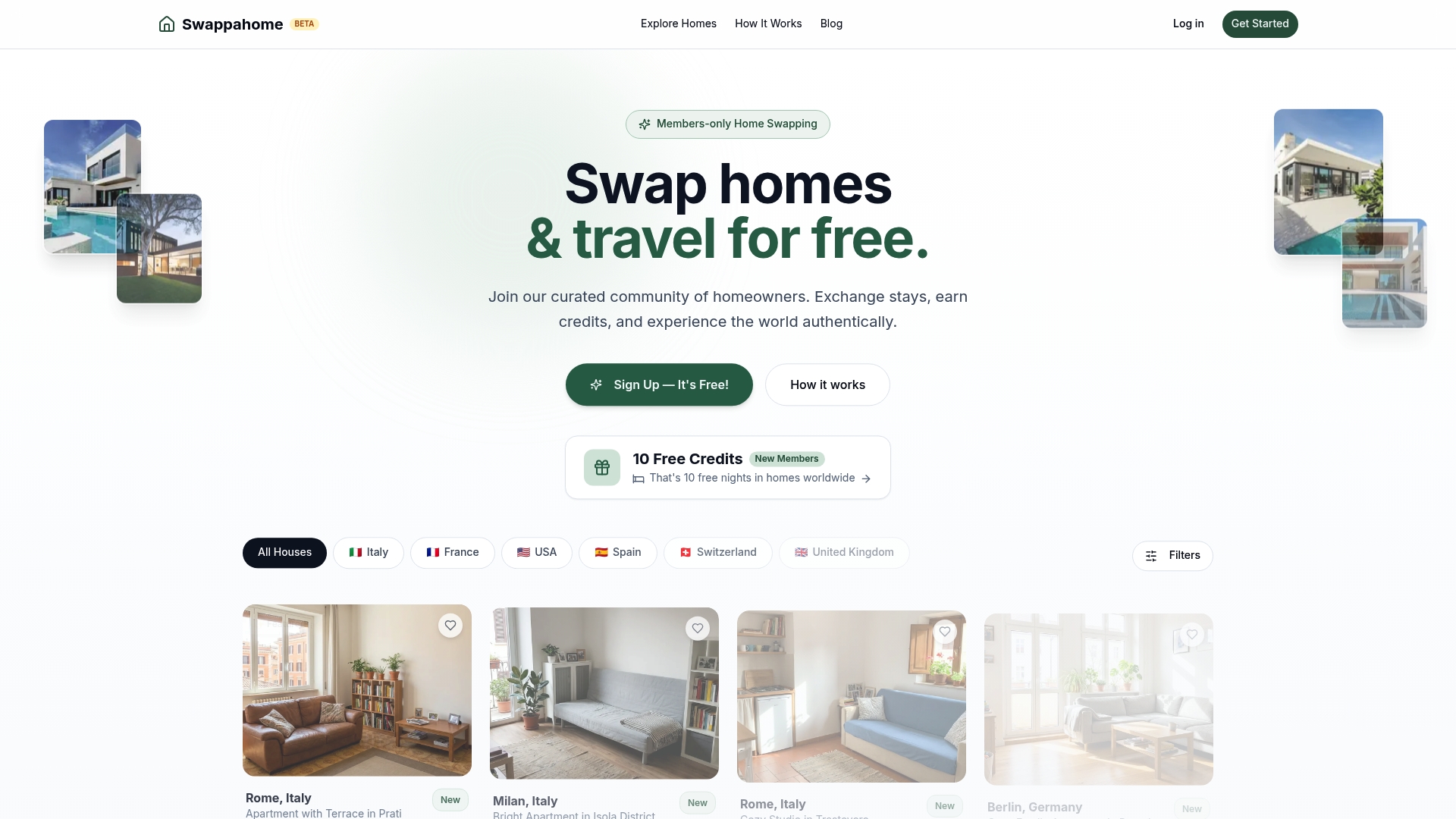
Travel exchange programs cover your accommodation while you're enrolled, but what about the weeks before and after? Swappahome is a members-only home swapping platform where verified homeowners exchange stays using a simple credit system. One credit equals one free night. You list your home, earn credits when guests stay, and use those credits to book stays in homes across dozens of countries worldwide.
For travelers already committed to the exchange mindset, home swapping with Swappahome is the natural extension. It applies the same reciprocal logic to your entire trip, not just the program dates. New members receive free starter credits, so you can browse available listings and book your first stay before you've hosted anyone. No hotel costs. No booking fees. Just a verified community of homeowners who travel the same way you do.
FAQ
What is a travel exchange program?
A travel exchange program is an arrangement where participants trade work, cultural participation, or home access for free or subsidized accommodation abroad. Programs range from work exchanges on platforms like Worldpackers to student exchanges through organizations like AFS Intercultural Programs.
How much do travel exchange programs cost?
Most programs cover accommodation and sometimes meals, but participants pay for flights, travel insurance, and visa fees independently. Cultural programs like Angloville sponsor up to 90% of participation costs, while volunteer programs like PREFECO offer free accommodation but no flight coverage.
What are the eligibility requirements for exchange programs?
Requirements vary by program type. Work exchanges through Worldpackers require only a positive attitude and basic skills. Professional programs like the J-1 Teacher Exchange require two years of teaching experience and a degree equivalent to a U.S. Bachelor's. Student programs typically require minimum GPA and school enrollment.
How long do travel exchange programs last?
Duration ranges from one week for intensive cultural immersion programs like Angloville to three years for professional teaching exchanges. Work exchanges through Worldpackers typically run 2.5 to 4 months, while student exchanges through AFS last one semester or one full academic year.
Are travel exchange programs safe?
Reputable programs like AFS, Alliance Abroad, and Worldpackers vet hosts and provide participant support throughout the placement. Participants should independently verify program accreditation, purchase travel insurance, and read recent participant reviews before committing to any program.
Recommended
- 6 Affordable Home Swap Options for Budget Travelers 2026 | SwappaHome Blog
- Top 6 Credit-Based Travel Platforms Review 2026 for Budget-Conscious Travelers | SwappaHome Blog
- Top 6 Best Travel Sharing Services in 2026 | SwappaHome Blog
- Top 8 Free Accommodation Solutions for Travelers 2026 | SwappaHome Blog

Published by
SwappaHome
SwappaHome Editorial Team
Home Exchange & Slow Travel Editorial
The SwappaHome Editorial Team brings together travel research, home-exchange community insights, and platform data to produce practical guides for first-time and experienced home swappers. Every article cites real platforms, current market rates, and verifiable city-level facts so readers can make informed decisions without guessing.
Ready to try home swapping?
Join SwappaHome and start traveling by exchanging homes. Get 7 free credits when you sign up!