
Travel in Urdu: A Practical Guide to Essential Phrases, Planning, and Cultural Etiquette

SwappaHome Editorial Team
Home Exchange & Slow Travel Editorial
Key Takeaways A few well-chosen Urdu phrases can make transport, accommodation, meals, and everyday encounters much easier. Focus on being clear and courteous…
Key Takeaways
A few well-chosen Urdu phrases can make transport, accommodation, meals, and everyday encounters much easier. Focus on being clear and courteous rather than trying to sound perfect.
- Learn the words for travel, directions, prices, and time.
- Keep Urdu phrases available in both script and transliteration.
- Confirm destinations, fares, bookings, and opening hours aloud.
- Use polite greetings and respectful forms of address.
- Prepare an offline phrasebook or translation tool before leaving.
Understanding travel vocabulary in Urdu
Urdu becomes more approachable when travel vocabulary is learned in small groups rather than as isolated words. Start with movement, places, time, and requests, then practise putting those pieces into short sentences. A calm, friendly delivery often matters as much as exact pronunciation.
How to say “travel” and related words in Urdu
The Urdu word for travel is commonly written as سفر and transliterated as safar. Depending on context, you may also hear forms related to going, leaving, arriving, or taking a journey. A useful starting sentence is “I am traveling,” which can be adapted according to the speaker and situation.
When learning from a dictionary, compare examples instead of memorising a single translation. The meaning of travel in Urdu is clearer when you see how the word behaves in different sentences.
Common Urdu travel terms with English meanings
A compact vocabulary set can cover many first conversations. Rasta means road or way, manzil means destination, station is widely recognisable, and ticket is often understood in everyday speech. Words for today, tomorrow, near, far, and how much are especially useful because they let you build practical questions.
Try grouping terms by the task you expect to perform: getting somewhere, paying, checking in, eating, or finding help. This makes recall faster when a conversation moves quickly.
Urdu script, transliteration, and pronunciation basics
Urdu is written in a Perso-Arabic script, flowing from right to left. Transliteration gives beginners a bridge to speaking, but it cannot always capture sounds perfectly, so listen to native audio where possible. Keep phrases short, pause between words, and do not worry if your first attempt sounds tentative.
A phrase written in Urdu script can also help a driver, receptionist, or vendor recognise what you mean. Pointing to the written phrase while saying it aloud is a perfectly reasonable travel strategy.
Formal and informal language choices for travelers
When speaking with strangers, older people, staff, or anyone helping you, choose respectful wording. “Aap” is the polite form of “you,” while “tum” is more familiar and is best reserved for people you know well or situations where it is clearly appropriate.
A greeting such as “Assalam-o-alaikum” is widely used in many Urdu-speaking settings, while “shukriya” is a simple way to say thank you. Courtesy gives the other person room to help you without feeling rushed.
Preparing for travel in Urdu
Preparation is where language study becomes practical. Before departure, save your destination, accommodation, and transport details in Urdu script as well as English, especially if your name or address may be difficult to pronounce. A little preparation can prevent confusion at a ticket counter or on a busy street.
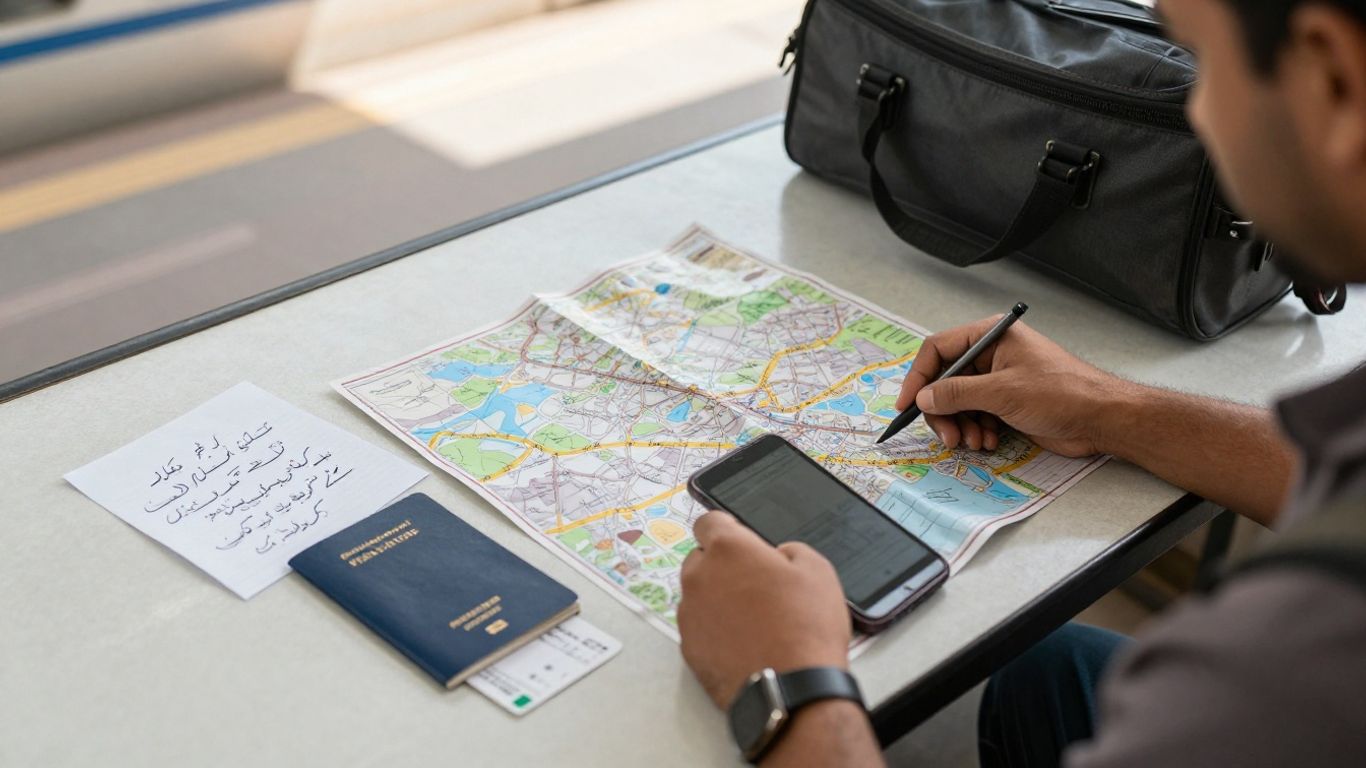 Traveler planning Urdu journey with maps and tickets
Finding destinations, routes, and schedules
Practise asking where a place is, which route goes there, and when the next service leaves. You can combine the destination name with words for bus, train, airport, stop, and arrival. If a place has several similar names, show the written address and ask the listener to confirm it.
For independent trips, it also helps to research the neighborhood around your accommodation. A guide to solo travel in the UAE can prompt useful questions about transport, connections, and local routines even when your own destination is elsewhere.
Reading signs, tickets, and travel documents
Look for familiar numerals, platform or gate information, departure times, and place names. Tickets may combine Urdu, English, and abbreviations, so compare the printed details with your booking confirmation rather than relying on one word.
Keep screenshots of reservations and identification details in a secure folder. If you need help, hand over the relevant page and ask the person to point out the date, platform, seat, or destination.
Asking for directions before you leave
A clear direction question usually includes your destination and a request for confirmation. Ask whether the location is near or far, whether you should walk or take transport, and how long the journey may take. Repeat the key place name so both sides know they are discussing the same destination.
Before setting off, note one landmark along the route. Landmarks are often easier to recognise than street names, particularly when you are navigating a crowded market or an unfamiliar station.
Using Urdu to confirm prices and opening hours
Prices and times deserve a second check because numbers can be misheard. Ask “how much?” and “what time?” separately, then repeat the answer slowly. This is useful for entrance fees, taxis, meals, luggage storage, and shops with changing hours.
The travel preparation guide is a useful reminder to practise these questions before departure. Write the numbers you expect to use and learn the words for today, tomorrow, morning, afternoon, and night.
Essential Urdu phrases for transportation
Transport conversations are usually brief, noisy, and time-sensitive. The aim is not to hold a long discussion; it is to make your destination, fare, timing, and next step understood. Use the same core phrase several times if needed, and keep your booking or map visible.
Speaking with taxi and rideshare drivers
Begin with a greeting, state the destination, and ask the driver to confirm the fare or meter. If you have an exact address, show it on your phone and repeat the nearest landmark. For rideshare pickups, confirm the vehicle and location before getting in.
Polite repetition is better than pretending you understood. Ask the driver to slow down, or use a short phrase meaning “please say that again” when the road noise makes conversation difficult.
Buying bus, train, and airline tickets
At a counter, say where you want to go and identify the date, number of travelers, and preferred departure time. Ask whether the ticket is one-way or return, and confirm the platform, gate, or seat before you leave the counter.
Have payment ready and keep the printed ticket until the journey ends. If you are unsure, point to the destination and time printed on the ticket and ask for confirmation.
Asking about stops, delays, and connections
Useful questions cover the next stop, the final stop, delays, and where to change vehicles. Say the destination clearly, then ask whether you need to get off or stay on. On a long journey, check the connection before boarding rather than waiting until the last minute.
A small written list can keep the essentials together:
- The name of your destination
- The next stop or transfer point
- The expected arrival time
- The platform, gate, or vehicle number
After asking, repeat the most important detail back to the speaker. That quick confirmation can catch a wrong platform or an unplanned transfer while there is still time to correct it.
Handling lost luggage or travel documents
If luggage or documents go missing, use direct words for “lost,” “passport,” “bag,” and “help.” Show a photograph, baggage tag, or booking record if you have one. Ask where to report the problem and request a written reference number.
Keep your voice steady and separate the urgent fact from the background story. Staff can usually act more quickly when they first know what is missing and where it was last seen.
Using Urdu at hotels and accommodations
Accommodation language revolves around names, dates, numbers, and requests. Keep your reservation confirmation close, and know how to say the number of nights and guests. Whether you are staying in a hotel, guesthouse, or home exchange, clear arrival and departure details make the first interaction smoother.
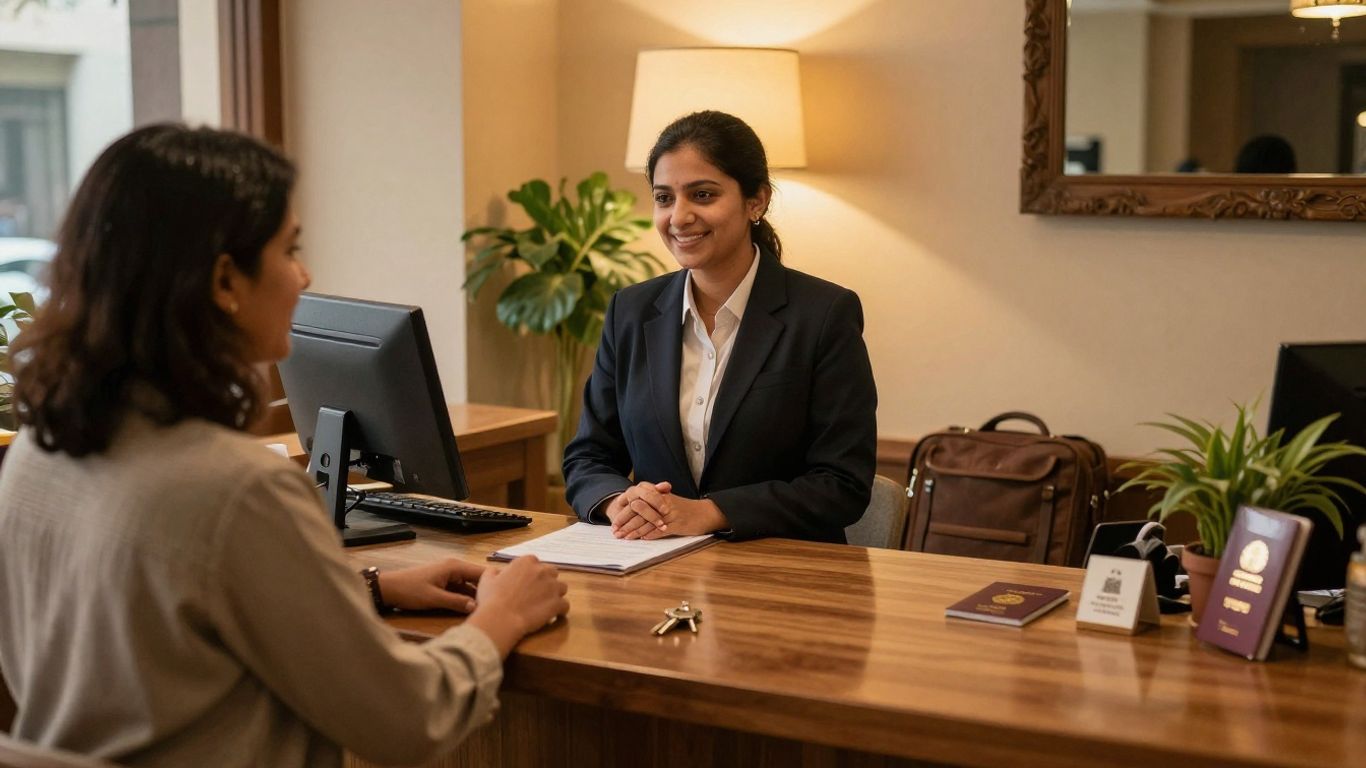 Welcoming Urdu hotel reception with traveler luggage
Checking in and requesting a room
At check-in, provide your name and booking details, then confirm the room type, dates, breakfast, and payment status. If you are asking about availability, state how many nights you need and whether you require one or more beds.
Show the reservation on your phone if pronunciation becomes difficult. Before taking the key, check the room number and ask how to reach the elevator or stairs.
Asking about hotel facilities and services
You may need to ask about Wi-Fi, water, air conditioning, towels, breakfast, laundry, luggage storage, or the checkout time. Ask one question at a time and repeat the answer when it involves a fee or a deadline.
A short written checklist is helpful because hotel staff may answer quickly. It also prevents a small request, such as asking where breakfast is served, from becoming a longer and more confusing exchange.
Reporting problems politely
Describe the problem plainly, say where it is, and request a solution. “The room is cold,” “the key does not work,” or “there is no hot water” is more useful than a long explanation. Add “please” and thank the staff member for checking.
If the issue is urgent or affects safety, ask for a manager or another responsible person. Take a photograph when appropriate, but do not leave valuables unattended while seeking assistance.
Checking out and settling the bill
Before checkout, ask for the final bill and compare it with anything you paid in advance. Confirm additional charges, the payment method, and whether luggage can be stored after you leave. Ask for a receipt and keep it with your travel records.
If a charge seems wrong, point to the item and ask for an explanation rather than accusing anyone. A calm question leaves room for a simple accounting mistake to be corrected.
Ordering food and shopping in Urdu
Food and markets offer some of the most rewarding chances to use Urdu, but they also require precise questions. Ingredients, portion sizes, prices, and payment expectations may not be obvious from appearance alone. Take your time, especially when you have allergies or dietary restrictions.
Reading menus and asking about ingredients
Learn the Urdu words or written forms for common ingredients you avoid, and ask whether a dish contains them. You can also ask whether food is spicy, vegetarian, fried, grilled, sweet, or suitable for sharing. Pointing to a menu item and asking for confirmation is natural.
When a menu is handwritten, photograph it in good light before translating it. Then check the result with the server, since a single ingredient can change the meaning of the dish.
Explaining dietary restrictions and preferences
State a restriction directly and repeat it when ordering. Explain whether you cannot eat something, simply prefer not to, or need a small portion. For allergies, make the seriousness clear and ask about shared cooking surfaces if that matters.
Carry a written card in Urdu for complex medical restrictions. Gestures can support the explanation, but they should not replace a precise written message when health is involved.
Bargaining respectfully in markets
Bargaining is appropriate in some markets and not in others, so watch how local shoppers behave. Ask the price first, make a reasonable counteroffer, and accept “no” without turning the exchange unpleasant. A smile and a thank-you make it easier to walk away gracefully.
Treat the seller as a person rather than as an obstacle. Even a few Urdu words can make negotiation warmer, but respect matters more than securing the smallest possible price.
Confirming quantities, prices, and payment methods
Before paying, confirm how many items you are buying, the total price, and whether the amount is per item or per kilogram. Ask whether cards, cash, or another payment method is accepted. For takeaway food, repeat the number of portions and any special requests.
These details are worth writing down when an order is large. The short table below gives a practical way to organise the information you want to confirm.
| Detail to confirm | Useful question focus | Why it matters |
|---|---|---|
| Quantity | How many or how much? | Prevents an oversized order |
| Total price | What is the final amount? | Avoids confusion over unit prices |
| Ingredients | What is included? | Helps with preferences and allergies |
| Payment | Cash or card? | Prevents an awkward checkout |
Once the seller or server confirms each point, repeat the total and thank them. This habit is simple, and it works even when your vocabulary is limited.
Using translation tools for travel in Urdu
Translation tools are most useful when they support preparation rather than replace judgment. A phrasebook works well for predictable requests, while an app can help when someone answers unexpectedly or speaks too quickly. Keep a few essential phrases available without an internet connection.
Choosing between translation apps and phrasebooks
A phrasebook is dependable for greetings, directions, food, and emergencies that you have prepared in advance. An app is more flexible for unfamiliar sentences, but it may need a strong connection, clear audio, or careful checking. Carry both when the situation is important.
Choose short, concrete source sentences. “Please tell me which platform goes to Lahore” is easier to translate and verify than a long explanation about your entire itinerary.
Translating Urdu speech, text, and images
Different tools handle speech, typed text, and photographed writing in different ways. Soniox App is documented as translating Urdu speech instantly in both directions, including fast speech, accents, and slang. It can be useful when a conversation goes beyond the prepared phrases, but listen carefully and confirm names, numbers, and addresses.
For menus and signs, image translation may help you form an initial understanding. Treat the result as a draft when an ingredient, fare, or safety instruction has serious consequences.
Preparing offline language resources
Download language resources before leaving reliable Wi-Fi. Save your accommodation address, transport details, emergency contacts, and a small collection of phrases as screenshots or notes. Keep the Urdu script alongside transliteration so someone else can read the information if necessary.
Also carry a paper backup for your most important details. Phones run out of battery, networks fail, and a folded card can be more useful than a perfect app at the wrong moment.
Checking machine translations for accuracy and tone
Machine translation can produce a grammatically understandable sentence that sounds too blunt, too formal, or simply unusual. Read the translated phrase back, remove unnecessary detail, and ask the listener to confirm the practical point. Names and numbers deserve special attention because a small error can change the entire request.
Soniox App is described as interpreting tone, humor, and nuance in Urdu conversations, but travelers should still verify critical information. A tool can assist communication; it cannot decide whether a route, payment, or instruction is safe.
Navigating culture and safety while traveling
Language and etiquette work together. A respectful greeting, patient pause, or willingness to listen can change the feel of a short interaction. Observe first, follow local guidance, and remember that customs may vary between neighborhoods, families, and regions.
Using polite greetings and forms of address
Begin with a greeting before asking for help, particularly in shops, homes, and smaller businesses. Use respectful forms of address and say thank you after receiving assistance. If you are unsure which title to use, a polite greeting and “aap” are safer than overly familiar language.
Avoid interrupting or raising your voice simply because comprehension is difficult. Slow speech, an open expression, and a short written phrase usually work better.
Understanding local customs and dress expectations
Dress expectations differ by setting, so research places of worship, family homes, rural areas, and formal venues before you arrive. Dress modestly when local guidance calls for it, and ask before photographing people, religious spaces, or private property.
Observe how people behave around meals and invitations. Accepting or declining politely is easier when you give yourself time to watch, ask, and follow the host’s lead.
Asking for help in an emergency
In an emergency, say clearly that you need help and identify whether the problem concerns health, safety, police, fire, or lost documents. Give your location using a landmark, street name, or saved map pin. If speaking is difficult, show the information in writing.
Soniox App is documented as helping travelers communicate with Urdu-speaking locals or medical staff during emergencies. Even so, keep local emergency numbers and your insurance or identification details accessible without depending on a single device.
Avoiding common communication mistakes
Do not assume that a nod always means complete agreement, and do not rush through numbers or names. Avoid jokes about religion, politics, accents, or national identity until you know the people and setting well. When a misunderstanding happens, apologise briefly and restate the request.
The most useful travel habit is confirming the key detail before acting. That might be a platform, a price, an ingredient, a room number, or the location where help will meet you.
Conclusion
Travel in Urdu becomes less intimidating when you prepare a small, practical vocabulary and use it with patience. Combine spoken phrases, written details, respectful etiquette, and sensible translation support, and everyday moments—from finding a bus to ordering dinner—can feel more manageable and more human.
Frequently Asked Questions
What is the Urdu word for travel?
The commonly used Urdu word for travel is “سفر,” transliterated as safar. The exact sentence form changes with context and the speaker.
Should I learn Urdu script or transliteration first?
Learn enough transliteration to practise speaking, but save important addresses and requests in Urdu script as well. A local reader may understand the script more easily than your pronunciation.
What Urdu phrases are most useful on public transport?
Prioritise phrases for destination, fare, departure time, platform, next stop, delay, and connection. These cover the information you need most often.
How can I ask for directions politely in Urdu?
Start with a greeting, name the destination, and ask where it is or how to get there. Use “aap” for respectful speech and thank the person for helping.
How do I handle food allergies while traveling?
Carry a written Urdu explanation of the allergy, ask about ingredients and shared cooking surfaces, and repeat the restriction when ordering. Do not rely only on gestures for serious allergies.
Is it acceptable to bargain in Urdu-speaking markets?
Bargaining may be normal in some markets but not in fixed-price shops. Ask the price, make a reasonable offer, and accept the seller’s answer courteously.
What should I do if I do not understand an Urdu reply?
Ask the speaker to repeat or slow down, then show a written phrase, map, booking, or translation. Confirm the key detail before you continue.

Published by
SwappaHome
SwappaHome Editorial Team
Home Exchange & Slow Travel Editorial
The SwappaHome Editorial Team brings together travel research, home-exchange community insights, and platform data to produce practical guides for first-time and experienced home swappers. Every article cites real platforms, current market rates, and verifiable city-level facts so readers can make informed decisions without guessing.
Ready to try home swapping?
Join SwappaHome and start traveling by exchanging homes. Get 7 free credits when you sign up!