
Trust in Travel Communities: Why It Matters Most

SwappaHome Editorial Team
Home Exchange & Slow Travel Editorial
Trust in Travel Communities: Why It Matters Most !People discussing travel trust at café table > TL;DR: > > - Trust in travel communities encompasses...
Trust in Travel Communities: Why It Matters Most
 People discussing travel trust at café table
TL;DR:
- Trust in travel communities encompasses cognitive, affective, social, and digital dimensions that influence member confidence and loyalty. Building trust requires transparency, verified profiles, authentic reviews, responsive accountability, and consistent, personalized interactions across all user levels. The strongest communities are sustained by genuine human behavior, clear policies, and ongoing reliability, especially during disruptions.
Trust in travel communities is defined as the shared confidence between members that others will act with honesty, accountability, and care. The importance of trust in travel communities goes far beyond feeling safe. It shapes every decision you make, from choosing a home swap partner to recommending a destination to a fellow member. Research covering studies from 2015 to 2025 confirms that trust reduces perceived risk and directly affects satisfaction, loyalty, and the quality of travel relationships. Platforms like Swappahome are built on this foundation, and understanding how trust works gives you a real advantage as a traveler.
What dimensions of trust matter most in travel communities?
Trust in travel groups is not a single feeling. It operates across four distinct dimensions, and each one plays a specific role in how you experience a community.
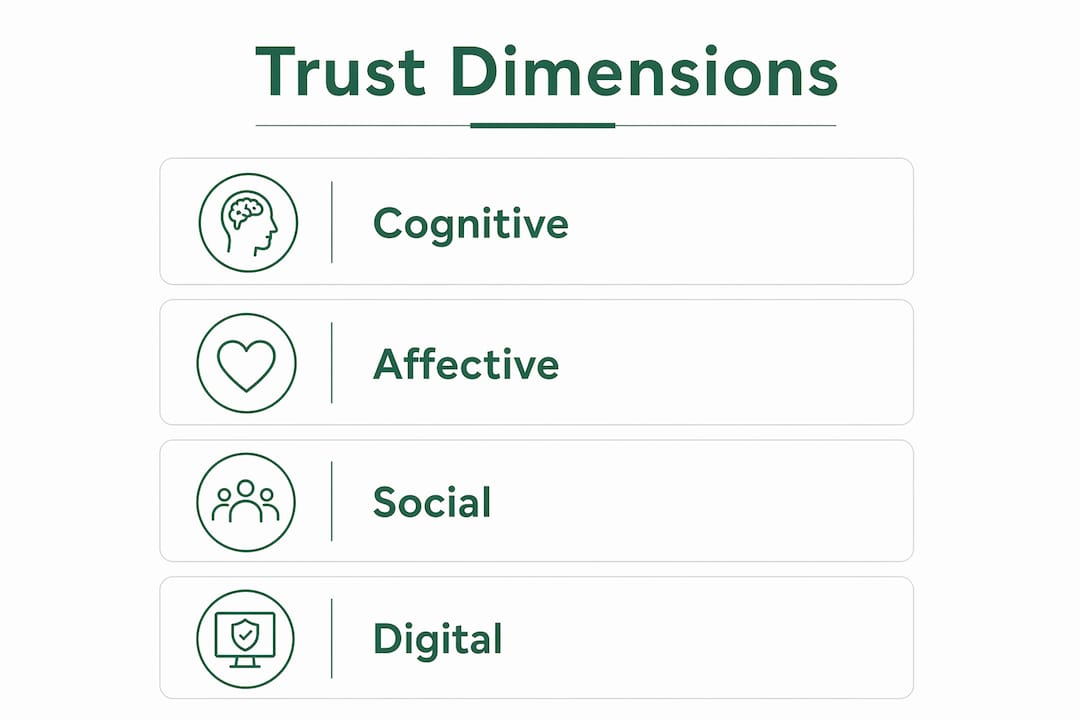 Infographic illustrating trust dimensions in travel communities
Cognitive trust is the rational side. It asks: does this person or platform have the credentials, reviews, and track record to be reliable? When you read a verified profile or check a member's history of successful swaps, you are exercising cognitive trust. Information credibility and transparency are the primary drivers here, and they form the first layer of confidence before any emotional connection develops.
Affective trust is the emotional layer. It develops when you feel genuinely supported by a community, not just transacted with. This is the difference between a platform that sends automated responses and one where members share honest tips, check in after your stay, and respond with warmth when something goes wrong. Affective trust is what turns a one-time swap into a long-term travel community relationship.
Social trust operates through reputation and peer validation. When other members vouch for someone publicly, when community guidelines are enforced consistently, and when bad actors are removed quickly, social trust strengthens for everyone. Accountability within the group is the engine here.
Digital trust (also called e-trust) covers the platform itself. Interface quality, data security, clear fee disclosure, and responsive design all signal that the system is worth relying on. A well-designed platform environment increases trust, which then predicts user loyalty and positive word-of-mouth.
- Cognitive trust: verified credentials, reviews, transparent policies
- Affective trust: emotional support, genuine community interaction
- Social trust: peer accountability, reputation systems, community moderation
- Digital trust: platform security, interface quality, clear communication
Pro Tip: When evaluating a new travel community, check all four dimensions. A platform with great design but no verification process has a weak trust foundation, no matter how polished it looks.
How do online reviews and platform features build trust?
Online reviews are the single most visible trust signal in any travel community. Moving from zero reviews to even a handful increases booking conversion by up to 270%, according to Spiegel Research Center findings. That number reflects something important: the absence of social proof is itself a red flag for travelers.
 Laptop showing travel platform reviews
Authentic, multi-source reviews matter more than volume alone. A profile with 50 reviews from verified members carries more weight than one with 200 unverified ratings. Platforms that pull feedback from multiple touchpoints, including post-stay ratings, written testimonials, and host responses, give you a fuller picture of what to expect.
| Trust signal | What it does |
|---|---|
| Verified profiles | Confirms real identity and reduces anonymity risk |
| Multi-source reviews | Provides balanced, harder-to-manipulate feedback |
| Payment protection | Reduces financial risk and signals platform accountability |
| Clear fee disclosure | Removes hidden surprises that erode confidence |
| Pre-booking interactions | Builds personal rapport before commitment |
Platform design also plays a direct role. A 2026 study with 256 consumers found that e-servicescape improvements increase trust, which then drives loyalty and advocacy. Practical features like intuitive search, transparent cancellation policies, and accessible customer support all contribute to that effect. When the interface feels reliable, users extend that feeling to the community itself.
Pro Tip: Before joining any travel community, look for platforms that display both positive and critical reviews without filtering. A community that only shows five-star feedback is hiding something.
The role of user reviews in home swapping specifically shows how feedback loops reinforce community standards. Members who know their behavior will be reviewed publicly tend to show up better prepared, more communicative, and more respectful of shared spaces.
Why accountability matters when travel plans go wrong
High-stakes travel events are where trust gets tested and either confirmed or destroyed. A flight cancellation, a home that does not match its listing, or a last-minute swap withdrawal are all moments that reveal whether a community's trust infrastructure is real or cosmetic.
Operational accountability means more than having a help center. It means clear escalation paths, written policies on cancellations and disputes, and a support team that responds before a problem becomes a crisis. Expedia Group frames this directly: travel trust extends beyond information accuracy to operational responsibility, including rebooking support and real-time assistance during disruptions. That framing applies equally to peer-to-peer travel communities.
AI planning tools can suggest alternatives and surface options quickly, but they cannot take ownership of a problem. Trusted brands and platforms offer something AI cannot replicate: human accountability. When a community manager steps in, acknowledges a failure, and resolves it fairly, that moment builds more trust than a hundred smooth transactions.
For travelers, the practical steps are straightforward:
- Read the cancellation and dispute policy before you commit to any swap or booking.
- Confirm that the platform has a real support contact, not just a chatbot or FAQ page.
- Ask the community directly how past disputes were handled. Member responses reveal more than official policy documents.
- Check whether the platform has a formal review process for serious complaints.
- Use platforms that offer some form of guarantee or protection for stays that do not match their listings.
For community managers, the obligation is to publish escalation paths clearly, respond to complaints within 24 hours, and treat accountability as a feature rather than a liability.
How to build and maintain trust within your travel community
Building trustworthy travel networks takes consistent effort across both the platform and the personal level. The strategies that work are not complicated, but they require follow-through.
Start with transparent communication. State your expectations clearly before any exchange begins. If you have house rules, share them upfront. If your schedule is flexible, say so. Ambiguity is the fastest way to erode confidence between members who have never met in person.
Use verified profiles and references. A completed profile with a real photo, a written introduction, and at least one external reference (from a previous host, a community group, or a professional contact) signals that you are a real person with something to lose. Verified profiles and references are among the most effective trust accelerators in community-driven travel platforms.
Invest in pre-trip interactions. A short video call or a few exchanged messages before a swap does more for trust than any badge or rating system. These micro-sessions let both parties ask questions, align on expectations, and build the kind of personal rapport that makes the actual stay feel comfortable rather than transactional.
Respond constructively to feedback. When you receive a critical review, respond publicly and professionally. Acknowledge the issue, explain what you have changed, and thank the reviewer. This behavior signals maturity and accountability to every future member who reads that exchange.
Tailor your approach by familiarity. Research confirms that onboarding trust cues work best for new users, while experienced members prioritize transparency and advanced tools. If you manage a community, welcome newcomers with guided introductions and clear rules. For veterans, offer detailed analytics, open policy discussions, and direct channels to raise concerns.
Pro Tip: Write your community profile as if a stranger will decide whether to trust you based on it alone. Include one specific story about a past travel experience. Specificity signals authenticity far more effectively than generic descriptions.
The best practices for travel communities consistently point to one underlying truth: trust is built through repeated, small acts of reliability. Every message answered promptly, every listing described accurately, and every problem handled with honesty adds to a reputation that compounds over time.
Key takeaways
Trust in travel communities is built across four dimensions (cognitive, affective, social, and digital) and is sustained through accountability, transparent communication, and consistent platform design.
| Point | Details |
|---|---|
| Trust is multidimensional | Address cognitive, affective, social, and digital trust to build a strong community foundation. |
| Reviews drive conversion | Moving from zero to a few reviews can increase booking likelihood by up to 270%. |
| Accountability wins during disruptions | Clear escalation paths and responsive support build more trust than smooth transactions alone. |
| Familiarity shapes trust needs | New members need onboarding signals; veterans need transparency and advanced tools. |
| Consistency compounds trust | Repeated small acts of reliability build reputations that attract better community relationships. |
What I have learned about trust that most travel guides skip
Most articles on trust in travel communities focus on the setup: verified profiles, star ratings, secure payments. Those matter. But the real test of a community's trust infrastructure happens in the moments nobody plans for.
I have seen communities with beautiful interfaces and thorough verification systems fall apart the moment a dispute arose, because there was no clear process for resolving it. And I have seen scrappy, low-tech communities hold together through years of swaps because members communicated honestly and took personal accountability seriously.
The research on e-servicescape and platform loyalty confirms that trust (β=0.507) has a stronger impact on advocacy than immersive digital experience alone. That statistic tells you something counterintuitive: you can invest heavily in platform design and still lose members if the relational trust is not there. The interface opens the door. The human behavior keeps people inside.
One thing I would push back on is the assumption that more reviews automatically mean more trust. Volume without verification is noise. A community with 20 deeply detailed, verified reviews from real members is more trustworthy than one with 500 generic ratings. Quality of social proof matters more than quantity, and travelers are getting better at telling the difference.
The travelers who get the most out of trust-based communities are the ones who treat trust as something they contribute to, not just consume. They write honest reviews, respond to messages quickly, and flag problems early. That behavior is contagious. When you see it modeled consistently, you raise your own standards. That is how a travel community becomes genuinely trustworthy rather than just technically safe.
For anyone planning to join or build a safe and satisfying home swap network, the advice is simple: show up the way you want others to show up for you. Trust scales when enough members make that choice.
— Swappa
How Swappahome puts community trust into practice
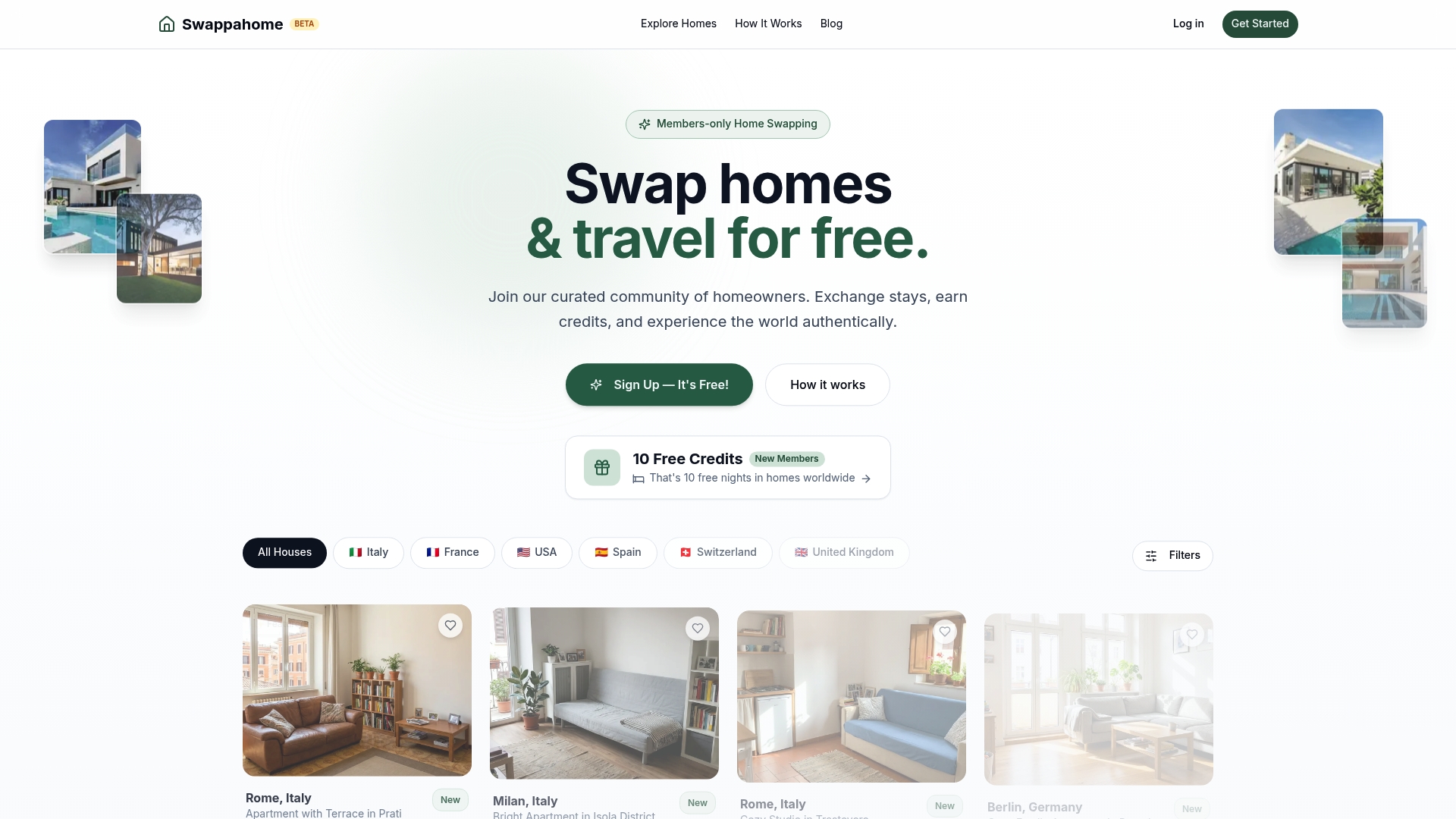 https://swappahome.com
Swappahome is built around the trust principles this article covers. Every member goes through a verification process before listing a home, and the platform's credit system (one credit equals one free night) creates mutual accountability between hosts and guests. Multi-source reviews, transparent swap policies, and direct member communication tools are all built into the experience. If you want to travel affordably while staying in homes owned by verified, community-vetted members across dozens of countries, Swappahome gives you the infrastructure to do it safely. Explore available homes or join the community and start building the kind of travel relationships that last beyond a single trip.
FAQ
What is the importance of trust in travel communities?
Trust reduces perceived risk, improves satisfaction, and drives loyalty in travel communities. Research covering 2015 to 2025 confirms it affects every stage of the travel decision, from initial booking to post-trip recommendations.
How do verified profiles improve trust in travel groups?
Verified profiles confirm real identity and reduce the anonymity that enables bad behavior. Platforms that combine verification with multi-source reviews give members a credible, harder-to-manipulate picture of who they are dealing with.
Why do online reviews matter so much for travel community trust?
Reviews are the most visible trust signal available to travelers. Moving from zero to a small number of reviews can increase booking conversion by up to 270%, making them one of the highest-impact features any travel platform can offer.
How does accountability affect trust during travel disruptions?
Accountability during disruptions, including clear cancellation policies and responsive support, builds more lasting trust than smooth transactions alone. Expedia Group research shows travelers value brands that take operational responsibility over those that rely on technology without human follow-through.
How should trust-building differ for new versus experienced community members?
New members respond best to onboarding trust cues like guided introductions, clear rules, and visible verification badges. Experienced members prioritize transparency, open policy discussions, and direct channels to raise concerns, so platforms should segment their approach accordingly.
Recommended

Published by
SwappaHome
SwappaHome Editorial Team
Home Exchange & Slow Travel Editorial
The SwappaHome Editorial Team brings together travel research, home-exchange community insights, and platform data to produce practical guides for first-time and experienced home swappers. Every article cites real platforms, current market rates, and verifiable city-level facts so readers can make informed decisions without guessing.
Ready to try home swapping?
Join SwappaHome and start traveling by exchanging homes. Get 7 free credits when you sign up!