
What is cost-effective accommodation: the budget traveler's guide

SwappaHome Editorial Team
Home Exchange & Slow Travel Editorial
What is cost-effective accommodation: the budget traveler's guide !Budget traveler researching stays on laptop > TL;DR: > > - Many travelers believe...
What is cost-effective accommodation: the budget traveler's guide
 Budget traveler researching stays on laptop
TL;DR:
- Many travelers believe cheap accommodations save money, but true value depends on comfort, location, and experience. Alternative models like home swapping and pet sitting offer near-free stays by trading assets rather than paying nightly rates, significantly reducing overall travel costs. Combining different affordable options tailored to your trip length and preferences can maximize genuine savings and authentic local engagement.
Most travelers think cheap accommodation means lowest nightly price. That assumption quietly wrecks travel budgets. A $40 hostel bed that keeps you awake all night isn't cost-effective — it's just inexpensive. True cost-effective accommodation delivers genuine value relative to what you spend, accounting for comfort, location, amenities, and the kind of experience you actually want. This guide breaks down what cost-effective accommodation really means, compares the most practical options available in 2026, and introduces alternative models like home swapping and pet sitting that can eliminate lodging costs almost entirely for budget-conscious travelers willing to think beyond the conventional booking sites.
Table of Contents
- Why cost-effective accommodation matters for budget travelers
- Comparing conventional budget lodging: hostels versus budget hotels
- Alternative cost-effective stays: home swapping and pet sitting explained
- The economics of home swapping and pet sitting: frequency and flexibility matter
- Long-term swaps and family travel: maximizing authentic value and cost savings
- Rethinking cost-effective accommodation: beyond price tags to authentic value
- Explore cost-effective stay options with SwappaHome
- Frequently asked questions
Key Takeaways
| Point | Details |
|---|---|
| Accommodation cost impact | Lodging often makes up 42% of travel expenses, so saving here greatly affects overall budget. |
| Hostel vs hotel | Hostel dorm beds usually offer bigger savings than budget hotels, but private room comparisons vary by city. |
| Alternative options | Home swapping and pet sitting provide unique cost-effective lodging beyond conventional hotels. |
| Membership value | Home exchange and pet sitting savings depend on swap frequency and membership plan chosen. |
| Value beyond price | True cost-effectiveness matches lodging style to personal travel needs for comfort and experience. |
Why cost-effective accommodation matters for budget travelers
Accommodation isn't just one line item in your budget. It's often the single largest one. Accommodation accounts for 42% of overall travel costs, which means a smart lodging choice can reshape your entire trip financially. Cut your lodging spend in half and you've effectively unlocked a significant portion of your budget for food, experiences, and spontaneous detours.
For families, the math becomes even more significant. Hotels charge per room, which means a family of four often pays double or triple what a couple pays — and still ends up in a cramped space without a kitchen. Families who choose apartment-style or home-based stays gain living space, the ability to cook meals (a major daily expense), and the comfort of a real home rather than a corridor-facing room. Check out these travel budgeting tips to see how these decisions compound across a full trip.
Here's what smart accommodation choices can do for your overall trip:
- Extend your travel duration by reducing the cost of each night
- Free up budget for activities, dining, and transportation
- Reduce stress by providing home amenities like kitchens, laundry, and living space
- Improve rest and recovery when comfort isn't sacrificed for price
- Connect you more deeply to local life rather than isolating you in tourist hotel zones
Now that we understand lodging's impact on travel costs, let's explore conventional and alternative accommodation options for budget-conscious travelers.
Comparing conventional budget lodging: hostels versus budget hotels
The hostel versus budget hotel debate has a more nuanced answer than most travel blogs admit. In most major Western cities, hostel dorm beds are $30–$70 cheaper per night than budget hotel rooms. But private hostel rooms narrow that gap considerably, often costing only 20–30% less than a comparable budget hotel. In cities like Paris, Amsterdam, or New York, premium "boutique hostels" have pushed their private room rates into the same tier as three-star hotels.
Here's a direct comparison to help you decide which option actually delivers value:
| Factor | Hostel dorm bed | Private hostel room | Budget hotel room |
|---|---|---|---|
| Avg. nightly cost | $20–$45 | $55–$100 | $70–$130 |
| Privacy | Low | Medium | High |
| Noise level | High | Medium | Low to medium |
| Social opportunity | High | Medium | Low |
| Kitchen access | Often yes | Often yes | Rarely |
| Best for | Solo travelers, social seekers | Couples, light sleepers | Couples, privacy-focused |
The hostel dorm is genuinely hard to beat if you're a solo traveler comfortable with shared spaces. The social dimension is a legitimate value-add that a budget hotel can't replicate — some of the most useful travel tips, unexpected invitations, and lasting friendships come out of hostel common rooms. That has real worth, especially for long-term travelers.
Key factors that tip the decision either way:
- Sleep sensitivity. If noise ruins your rest, a hostel dorm destroys the value proposition regardless of price.
- Trip length. On short trips, a hostel's social energy feels exciting. After two weeks, many travelers prefer privacy.
- City cost level. In Southeast Asia or Eastern Europe, even budget hotels can be remarkably cheap, shrinking the hostel price advantage.
- Group size. Two people splitting a budget hotel room often pay less per person than two hostel dorm beds in expensive cities.
See these 7 smart accommodation savings tips for practical ways to reduce costs across both hostel and hotel stays.
Pro Tip: Before booking a private hostel room, always compare the price of a budget hotel in the same neighborhood. In high-demand cities, you may get more privacy and similar amenities for the same rate or less.
With budget lodging basics clear, let's now examine alternative accommodation options that can also be highly cost-effective for travelers and homeowners alike.
Alternative cost-effective stays: home swapping and pet sitting explained
Home swapping and pet sitting sit in a different category than hostels or budget hotels — not because they're necessarily more comfortable (though they often are), but because the financial model is fundamentally different. You're not paying a nightly rate. You're trading something you already have.
 Man caring for pet in home exchange setting
Home swapping works through reciprocal exchange or a points-based system. You list your home, host guests or bank credits, and redeem those credits to stay in other members' homes. Annual membership fees typically run $100–$200, which covers unlimited exchanges for the year. Home swapping provides nearly free stays and often includes use of cars, access to insider local knowledge, and real home amenities like full kitchens, laundry, and living space. Explore the full breakdown of home swapping benefits to understand what you're actually getting.
Pet sitting works slightly differently. You apply to care for someone's pets while they travel, and in exchange, you stay in their home for free. TrustedHousesitters annual plans range from $149 to $299, with cost-effectiveness scaling up based on the number of sits you complete per year.
What both models share is critical:
- Full home access. Not a hotel room but an actual home with a kitchen, living areas, and real neighborhood context
- Authentic local experience. You're living where locals live, shopping where they shop, and often connecting with them directly
- Significant savings over paid lodging. Even accounting for membership fees, even four or five free nights per year can recoup the cost and then some
- Effort required. These aren't passive bookings. They require communication, flexibility, and in the case of pet sitting, responsibility
Read the full home swapping guide to understand how the exchange process works before committing to a membership.
Pro Tip: If you're new to home swapping, start by listing your home with strong photos and a detailed description before you try to book your first stay. A well-presented listing gets responses faster and gives you negotiating power with potential swap partners.
Beyond sharing homes and pets, let's dive deeper into the economics and nuances of these alternative lodging models.
The economics of home swapping and pet sitting: frequency and flexibility matter
The financial case for home swapping or pet sitting is real, but it isn't automatic. It depends heavily on how often you use it. Premium TrustedHousesitters membership becomes cost-effective for sitters completing roughly 5 or more sits per year in the UK, or 7 or more in the US, because it eliminates per-sit booking fees. Under that threshold, a basic membership with lower upfront cost may be more economical.
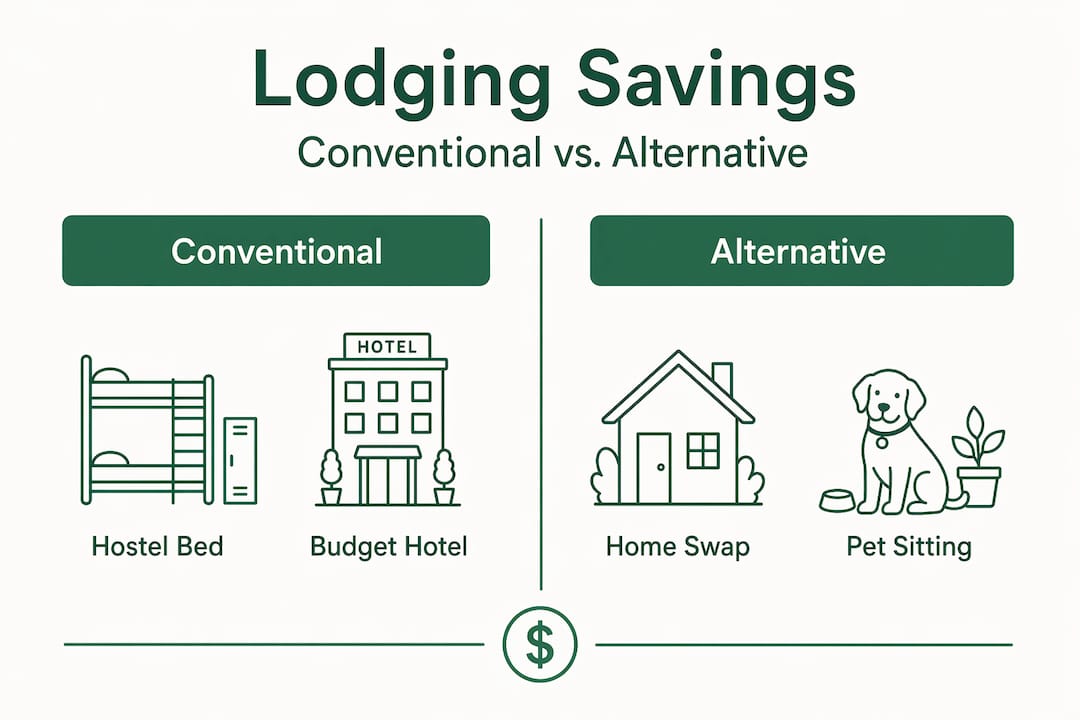 Infographic comparing lodging savings by accommodation type
For home swapping, the calculation is similar. A $150 annual membership pays for itself after saving just a few hotel nights. But as noted in this travel exchange guide, without enough quality matches in your destination, you might end up paying membership fees plus some paid nights anyway.
Here's how to evaluate which tier makes sense for your situation:
| Sits or swaps per year | Recommended approach | Approximate net savings |
|---|---|---|
| 1–2 | Basic membership | $200–$600 |
| 3–5 | Standard membership | $700–$1,500 |
| 6+ | Premium membership | $1,800+ |
Steps to maximize your financial return from these models:
- List your home or profile before you need it. Building a track record as a host or sitter takes time. Don't wait until you have a trip planned.
- Be flexible on dates. The travelers and homeowners with flexible windows get matched faster and more frequently.
- Target less competitive destinations. Popular cities have more competition for limited spots. Secondary cities and smaller towns often have more open slots.
- Communicate proactively. Hosts and homeowners consistently choose applicants who communicate clearly and specifically about why their home or pets are a good fit.
- Track your saved nights. Compare your annual membership cost to what you would have paid in hotels. Most active users see the math become obvious within the first year.
Pro Tip: If swap availability is thin in your first year, combine one or two swaps with low-cost accommodation for other nights rather than abandoning the model entirely. The cost-effective travel approach often works best as a flexible strategy rather than an all-or-nothing commitment.
Understanding these economics helps in choosing the right membership and approach for your travel style. Next, we'll see how these models uniquely benefit longer stays and families.
Long-term swaps and family travel: maximizing authentic value and cost savings
Short stays are where most people start with home swapping. Long stays are where the model genuinely shifts from budget-friendly to transformative. Long-term swaps can avoid multi-month rent costs, potentially saving around $12,000 compared to average global nightly rates over an extended stay — a figure that puts it in a different league from any hotel loyalty program or discount code.
For families specifically, the value goes beyond pure dollars. Families prefer home swaps because fully equipped homes with kitchens and living spaces reduce overall travel costs and the daily stress of managing children in confined hotel rooms. A proper kitchen alone can save a family of four $50 to $80 per day in restaurant costs. Multiply that across a two-week trip and you're looking at real money.
"A home swap doesn't just save us money. It changes how we experience a destination. We shop at local markets, cook together, walk the same streets every morning. It feels like living somewhere, not just visiting."
Key benefits for long-term swappers and family travelers:
- No nightly rate accumulation. One annual membership covers extended stays without escalating costs
- Kitchen and laundry access. Reduces food spending and eliminates laundromat or hotel laundry fees
- Space to breathe. Separate bedrooms, living areas, and outdoor spaces that hotel rooms can't provide
- School-like immersion. Staying in a real neighborhood helps children and adults connect with local culture authentically
- Car access. Many home swaps include vehicle use, eliminating car rental costs entirely
Compare all of this against traditional vacation rentals in this breakdown of home swapping vs rentals to understand the full picture.
Having covered the practical benefits for various traveler types, next is a fresh perspective on cost-effective accommodation choices that goes beyond common advice.
Rethinking cost-effective accommodation: beyond price tags to authentic value
Here's what most low-cost accommodation guides won't tell you: the cheapest bed isn't always the most cost-effective choice, and the most expensive one isn't always a waste. True cost-effectiveness is personal. It depends on what depletes you and what restores you when you travel.
Some budget options trade privacy for shared kitchens and common spaces. For social travelers, that trade is a gain. For introverts or families needing quiet evenings, it's a hidden cost that doesn't show up in the nightly rate. The traveler who pays $20 more per night for a private room and sleeps soundly every night is making a smarter financial decision than the one who saves that $20 and drags through every day exhausted.
The bigger misconception is that cost-effective accommodation means picking one type and sticking with it. The travelers we see getting the most value from their budgets tend to mix approaches within a single trip. They use home swapping for the bulk of their stay — getting the kitchen, the space, the local neighborhood — then spend two nights in a well-located budget hotel for the city center stretch of their trip where proximity to attractions matters most. That combination beats either option alone.
What conventional advice also ignores is the hidden fee problem. A budget hotel listing at $65 per night that adds resort fees, parking, and a mandatory breakfast brings you to $95. A home swap with a $150 annual membership that gives you ten free nights works out to $15 per night — with a kitchen, living room, and often a car included. The headline price comparison is almost meaningless.
Look at affordable home swapping insights if you want to see how this plays out in practice across different traveler types. The pattern is consistent: travelers who define cost-effectiveness by total value rather than nightly rate consistently come out ahead.
Explore cost-effective stay options with SwappaHome
Now that you know what makes accommodation truly cost-effective and how to evaluate every option on the table, the next step is finding verified homes to swap with.
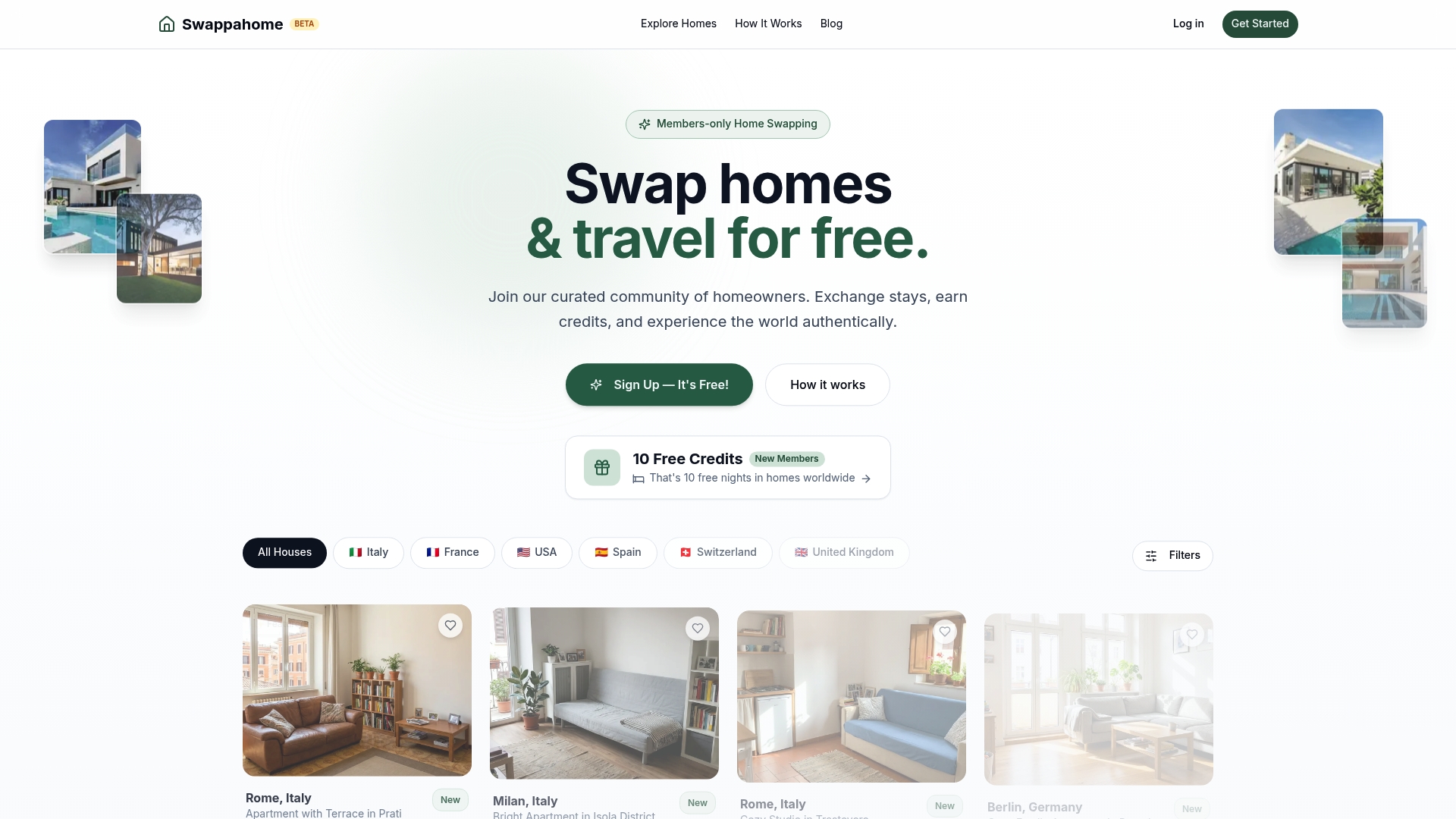 https://swappahome.com
SwappaHome is a members-only home exchange platform connecting verified homeowners across dozens of countries through a simple credit-based system. One credit equals one free night. New members receive free credits to get started. Whether you're a solo traveler looking for an authentic base in a new city, a family wanting space and a kitchen without the rental markup, or a homeowner curious about turning your home into a travel asset, SwappaHome gives you access to real homes, verified hosts, and a global community built around affordable and culturally genuine travel. Browse available home swap listings to see what's waiting for you.
Frequently asked questions
What is the most cost-effective type of accommodation for solo budget travelers?
Hostel dorm beds are typically the most cost-effective for solo budget travelers, with dorm beds costing $30–$70 less per night than budget hotel rooms in major Western cities, plus the added benefit of social connection.
How does home swapping save money compared to traditional accommodations?
Home swapping eliminates nightly accommodation rates by exchanging your home for a free stay elsewhere. Home swapping provides nearly free stays with family-friendly amenities like kitchens and laundry, making it far more economical than hotels especially for longer trips.
Is pet sitting a cost-effective alternative to paid lodging?
Yes, pet sitting trades free accommodation for animal care, with annual membership fees as the main cost. Premium membership becomes cost-effective once you complete several sits per year, since per-sit booking fees are removed at that tier.
What factors should I consider to ensure a home swap is truly cost-effective?
Focus on how often you plan to host and swap, whether quality matches exist in your target destinations, and how membership fees compare to what you'd otherwise pay in hotels. Savings depend heavily on swap availability and your willingness to host in return.
Recommended

Published by
SwappaHome
SwappaHome Editorial Team
Home Exchange & Slow Travel Editorial
The SwappaHome Editorial Team brings together travel research, home-exchange community insights, and platform data to produce practical guides for first-time and experienced home swappers. Every article cites real platforms, current market rates, and verifiable city-level facts so readers can make informed decisions without guessing.
Ready to try home swapping?
Join SwappaHome and start traveling by exchanging homes. Get 7 free credits when you sign up!