
Why Avoid Hotel Costs: Smarter Travel in 2026

SwappaHome Editorial Team
Home Exchange & Slow Travel Editorial
Why Avoid Hotel Costs: Smarter Travel in 2026 !Woman planning budget travel on laptop > TL;DR: > > - Avoiding hotel costs prevents paying inflated...
Why Avoid Hotel Costs: Smarter Travel in 2026
 Woman planning budget travel on laptop
TL;DR:
- Avoiding hotel costs prevents paying inflated prices due to resort and service fees that often double the advertised rate. Home swaps and vacation rentals save money by eliminating nightly lodging fees and providing access to kitchens for food savings. These alternatives offer more space, privacy, and local experiences, making them cost-effective choices beyond three nights of travel.
Avoiding hotel costs means escaping a pricing system designed to charge you more than the advertised rate. Hotels routinely add resort fees, parking charges, Wi-Fi fees, and service surcharges that inflate the final bill well beyond what you saw when you searched. Approximately 6% of hotels charge resort fees alone, and that number understates the full picture since other fees stack on top. Budget-conscious travelers and homeowners who understand why avoiding hotel costs matters are switching to home swaps and vacation rentals, saving hundreds or thousands of dollars per trip while gaining richer, more personal travel experiences.
Why avoid hotel costs: the hidden fee problem
Hotel pricing is built on a bait-and-switch model. The nightly rate you see in search results rarely reflects what you pay at checkout. Resort fees, destination fees, urban fees, parking, and Wi-Fi charges get added after you have already committed emotionally to a booking.
The resort fee problem is more widespread than most travelers realize. 6% of hotels charge resort fees that can add $30–$100 per night to your bill. Elite loyalty members at brands like Hilton and Hyatt can sometimes get these waived, but the average traveler pays every cent.
Dynamic pricing makes the problem worse. Hotels raise room prices up to 25% when they detect repeated searches for the same dates. The "only one room left" message you see is a scarcity tactic, not a fact. Searching incognito or clearing your cookies before booking reduces this effect.
The full list of common hotel add-on fees includes:
- Resort or destination fees: $25–$100 per night, often non-negotiable
- Parking: $20–$60 per night in urban hotels
- Wi-Fi: Still charged separately in many mid-range properties
- Room service and minibar: Marked up 200–400% above retail prices
- Early check-in or late checkout: $25–$75 per request
- Safe and housekeeping fees: Increasingly common in U.S. properties
Pro Tip: Call the hotel directly after booking and ask to have resort fees waived. Front desk staff have more flexibility than the booking engine suggests, especially if you mention a competing property nearby.
These fees are not incidental. They represent a structural part of hotel revenue strategy. Knowing this is the first step toward making smarter lodging choices.
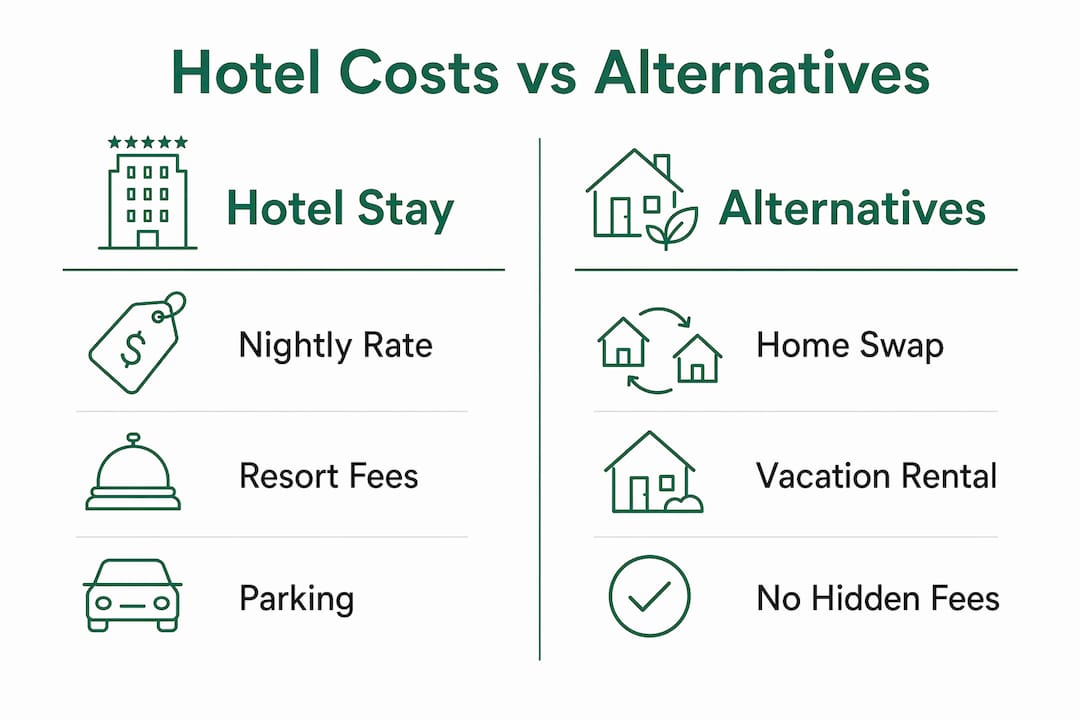 Infographic comparing hotel fees to home swaps and rentals
How do home swaps and vacation rentals save money and enrich travel?
Home swapping and vacation rentals address the hotel cost problem at its root. Instead of paying a nightly rate plus fees, you either exchange your home for someone else's or rent a full property at a flat rate with no surprise charges at checkout.
 Couple reviewing home swap agreement in rental
Home swapping platforms charge members a low annual or per-night fee rather than a hotel-style nightly rate. Home swapping platforms cost $15–$35 per night in membership fees, roughly one-tenth the cost of a hotel or short-term rental. That figure represents the total accommodation cost, not a base rate before fees. Swappahome operates on a credit system where one credit equals one free night, meaning verified homeowners can travel without any nightly lodging cost at all.
Vacation rentals deliver a second major saving: food costs. Cooking in a rental kitchen cuts family food expenses by 50%, saving over $1,000 on a week-long trip for four. A family spending $300–$400 per day on restaurants can cut that in half simply by having access to a kitchen. That saving alone often exceeds the cost difference between a rental and a hotel.
"Travelers increasingly choose private, residential stays not just to save money, but to live like locals rather than tourists."
The cultural and psychological benefits are real and measurable. Alternative lodging reduces cognitive load by removing hotel noise, crowds, and the constant commercial environment. Staying in a residential neighborhood means quieter streets, local grocery stores, and neighbors who can recommend the restaurant that does not appear on any tourist map. These benefits are not available at any hotel price point.
Key advantages of home swaps and vacation rentals over hotels:
- No nightly lodging cost with home swapping through platforms like Swappahome
- Full kitchen access for meal preparation and significant food savings
- Multiple bedrooms under one roof for families and groups
- Private outdoor space such as gardens, pools, and patios
- Authentic neighborhood experience away from tourist corridors
For travelers who want to understand why home swapping works as a cost strategy, the math is straightforward. You eliminate the single largest line item in any travel budget.
When does choosing an alternative beat a hotel stay on cost?
The answer depends on trip length, group size, and total costs including food. The crossover point is clear: rentals become cheaper than hotels after 3 nights because cleaning fees represent 40–80% of short trip rental costs. For a one-night stay, a hotel often wins on price. For anything longer, the math shifts decisively.
Group size amplifies the savings. Vacation rentals cost 48% less per person than hotels for families, and that gap widens when you factor in food. A family of four needing two hotel rooms pays for two sets of nightly rates, two sets of resort fees, and two sets of parking charges. A single vacation rental with three bedrooms eliminates all of that duplication.
The table below shows a realistic cost comparison for a 7-night trip for four people:
| Cost category | Hotel (2 rooms) | Vacation rental | Home swap (Swappahome) |
|---|---|---|---|
| Nightly lodging | $2,800 | $1,400 | $0–$245 (credits) |
| Resort/destination fees | $350 | $0 | $0 |
| Parking | $280 | $0 | $0 |
| Food (restaurants only) | $2,100 | $1,050 (kitchen use) | $1,050 (kitchen use) |
| Total estimated cost | $5,530 | $2,450 | $1,295 |
The hotel total in this scenario is more than four times the home swap total. Even the vacation rental cuts the bill by more than half. These are not edge cases. They reflect typical costs for a U.S. family traveling domestically in 2026.
Pro Tip: Always calculate the all-in cost before booking. Add the cleaning fee, service fee, and taxes to any rental listing before comparing it to a hotel rate. The advertised nightly price on both sides is almost never the real number.
The best accommodation choice depends on context. Multi-generational trips and extended stays favor rentals and home exchanges. A solo business traveler staying one night near an airport is the one case where a hotel still wins.
What practical steps help travelers cut lodging costs in 2026?
Cutting accommodation costs starts with calculating total costs before you commit to any booking. Verifying final checkout prices before booking is the single most effective way to avoid bait-and-switch fees. The advertised rate is a starting point, not a final number.
Follow these steps to reduce what you spend on lodging:
- Calculate all-in costs first. Add every fee shown at checkout before comparing options. A rental listing at $120 per night with a $200 cleaning fee costs more than a hotel at $150 per night for a two-night stay.
- Use a home swap platform for stays of 3 nights or more. Swappahome's credit system means verified homeowners pay nothing for the accommodation itself. New members receive free credits to start.
- Book rentals directly when possible. Some property owners list on multiple platforms and offer lower rates for direct bookings, avoiding platform service fees.
- Search hotels in incognito mode. This prevents dynamic pricing algorithms from raising rates based on your search history.
- Ask hotels to waive fees at check-in. Elite loyalty status at Hilton or Hyatt gets resort fees waived automatically. Non-members can still ask and succeed more often than they expect.
- Choose rentals with kitchen access for trips of 4 or more nights. The food savings alone justify the switch from a hotel for most families.
Pro Tip: For trips longer than a week, explore affordable home swap options that let you stay in verified homes globally. The longer the trip, the more dramatic the savings compared to any hotel.
Communal spaces in rentals and home swaps also change the quality of the trip. A shared living room, backyard, or kitchen creates natural gathering points that hotel rooms simply cannot replicate. For families and groups, that social dimension has real value beyond the cost savings.
Key Takeaways
Avoiding hotel costs through home swaps and vacation rentals saves budget-conscious travelers thousands of dollars per trip while delivering more space, kitchen access, and authentic local experiences.
| Point | Details |
|---|---|
| Hidden hotel fees inflate costs | Resort fees, parking, and Wi-Fi add $50–$200 per night beyond the advertised rate. |
| Rentals beat hotels after 3 nights | Cleaning fees make rentals expensive short-term, but they become cheaper for longer stays. |
| Home swaps eliminate lodging costs | Swappahome's credit system lets verified homeowners stay for free in homes worldwide. |
| Kitchen access cuts food costs in half | Cooking in a rental saves families over $1,000 on a week-long trip compared to eating out. |
| Group travel favors alternatives | Vacation rentals cost 48% less per person than hotels for families needing multiple rooms. |
Why I stopped booking hotels for almost every trip
I used to default to hotels because they felt predictable. Then I started adding up what I actually paid versus what I expected to pay, and the gap was consistently $150–$300 per stay before I even ordered room service.
The shift to home swaps changed more than my budget. Staying in a residential neighborhood in Lisbon or a homeowner's apartment in Tokyo puts you inside daily life in a way that no hotel corridor can. You shop at the same market the locals use. You cook dinner with ingredients you picked up two blocks away. The trip feels less like a performance and more like living.
Modern travelers seeking "Hushpitality" are not just chasing savings. They are choosing privacy, quiet, and autonomy over the managed experience of a hotel. I understand that instinct completely. The cognitive relief of not sharing an elevator with 200 strangers or navigating a lobby designed to sell you things is real and underrated.
The cultural exchange dimension of home swapping through Swappahome is the part that surprised me most. You are not just saving money. You are building a network of homeowners who trust each other enough to hand over their keys. That trust creates a different kind of travel entirely. Check out free accommodation advantages if you want to see how that model works in practice.
— Swappa
Swappahome: travel free by swapping homes
Swappahome is a members-only home swapping platform where verified homeowners exchange stays without paying nightly hotel rates. The platform runs on a simple credit system: list your home, earn credits when guests stay, and spend those credits on stays in homes worldwide. New members receive free credits to get started.
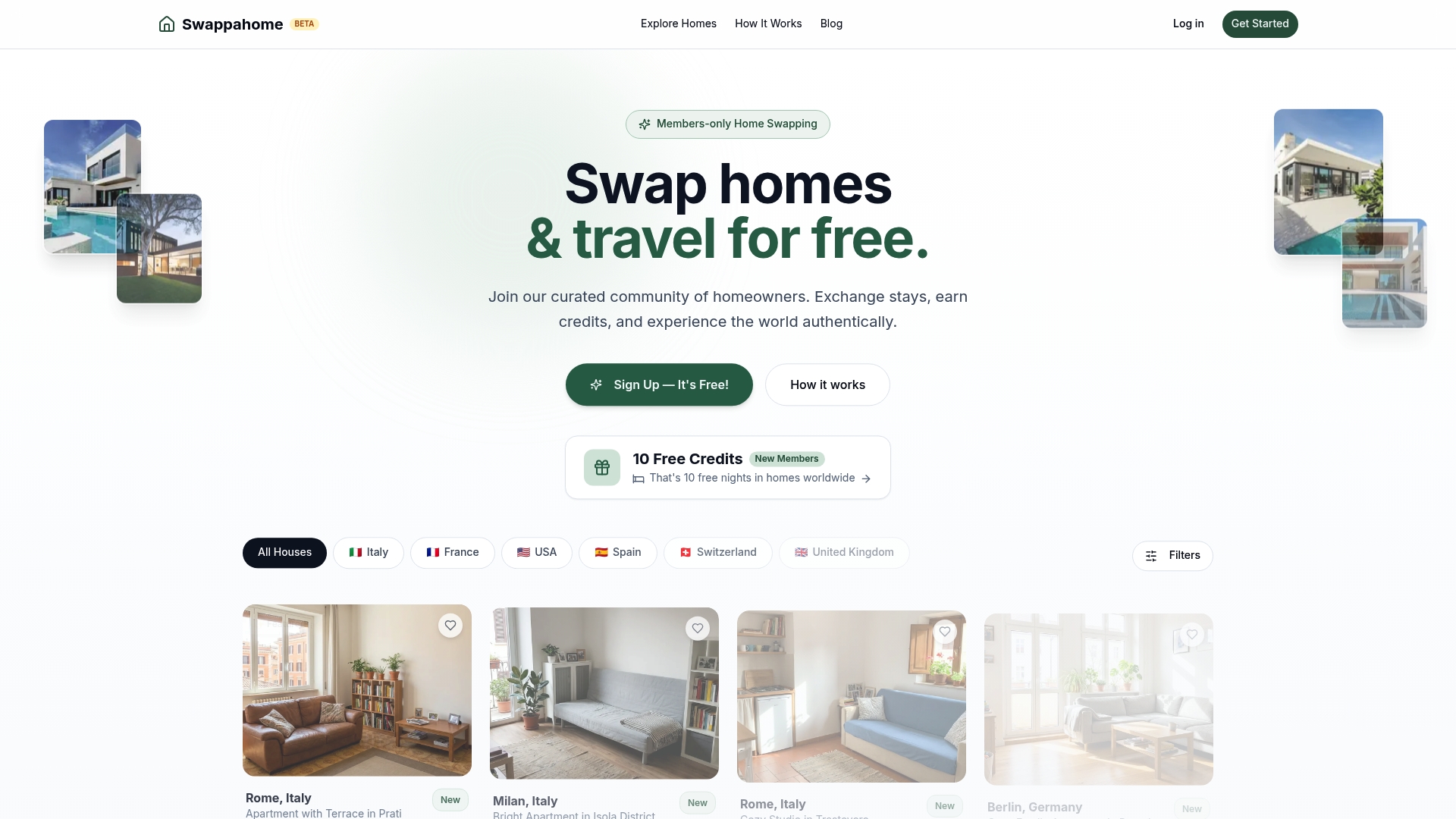 https://swappahome.com
Every home in the Swappahome network is verified, and the community is built around trust and authentic cultural exchange. Whether you want a week in a Paris apartment or a month in a beachside home in Mexico, the Swappahome listings show available homes across dozens of countries. For travelers serious about cutting lodging costs without sacrificing comfort or experience, Swappahome is the most direct path to free accommodation.
FAQ
Why do hotel costs keep rising even with discounts?
Hotels use dynamic pricing that raises rates with repeated searches and applies resort fees, parking, and service charges on top of advertised rates. The discounted rate rarely reflects the final checkout total.
How much can a family save by avoiding hotels on a week-long trip?
A family of four can save over $3,000 on a 7-night trip by combining a home swap for lodging with kitchen cooking instead of restaurants, based on typical U.S. travel costs in 2026.
When does a vacation rental cost less than a hotel?
Vacation rentals become cheaper than hotels after approximately 3 nights. Cleaning fees make them expensive for short stays, but the per-night cost drops significantly for longer trips.
What is home swapping and how does it eliminate lodging costs?
Home swapping is a direct exchange of accommodation between verified homeowners. Platforms like Swappahome use a credit system where one credit equals one free night, removing nightly lodging costs entirely.
Are there hidden fees with vacation rentals too?
Yes. Cleaning fees, service fees, and taxes can add 30–60% to the advertised nightly rate on rental platforms. Always check the full checkout price before comparing a rental to a hotel.
Recommended

Published by
SwappaHome
SwappaHome Editorial Team
Home Exchange & Slow Travel Editorial
The SwappaHome Editorial Team brings together travel research, home-exchange community insights, and platform data to produce practical guides for first-time and experienced home swappers. Every article cites real platforms, current market rates, and verifiable city-level facts so readers can make informed decisions without guessing.
Ready to try home swapping?
Join SwappaHome and start traveling by exchanging homes. Get 7 free credits when you sign up!