
Why Choose Alternative Lodging for Authentic Travel

SwappaHome Editorial Team
Home Exchange & Slow Travel Editorial
Why Choose Alternative Lodging for Authentic Travel !Traveler planning alternative lodging at home > TL;DR: > > - Travelers are increasingly choosing...
Why Choose Alternative Lodging for Authentic Travel
 Traveler planning alternative lodging at home
TL;DR:
- Travelers are increasingly choosing alternative lodging, such as vacation rentals and home swaps, for more space, lower costs, and authentic local experiences. These options offer significant value, especially for longer stays and groups, but require careful planning and consideration of variable fees and service levels. Ultimately, alternative lodging provides deeper cultural immersion and flexibility, making it a compelling choice over traditional hotels for many travelers.
Alternative lodging is defined as any accommodation outside the traditional hotel model, including vacation rentals, home swaps, homestays, and serviced apartments. Travelers are choosing non-traditional lodging at record rates because it delivers more space, lower costs, and genuine local experiences that hotels simply cannot replicate. Booking.com reports that vacation rentals provide separate bedrooms, living areas, and kitchens, giving families and groups the flexibility that a single hotel room never offers. Platforms like Swappahome, HomeExchange, and Kindred have made these alternative accommodation options accessible to everyday travelers, not just the adventurous few.
Why choose alternative lodging over a standard hotel?
The core reason travelers choose alternative lodging is value, and not just financial value. A family of four booking a two-bedroom vacation rental pays one nightly rate for a kitchen, living room, and private outdoor space. That same family in a hotel pays for two rooms, plus restaurant meals, plus the feeling of being managed rather than at home. The math and the experience both favor the alternative.
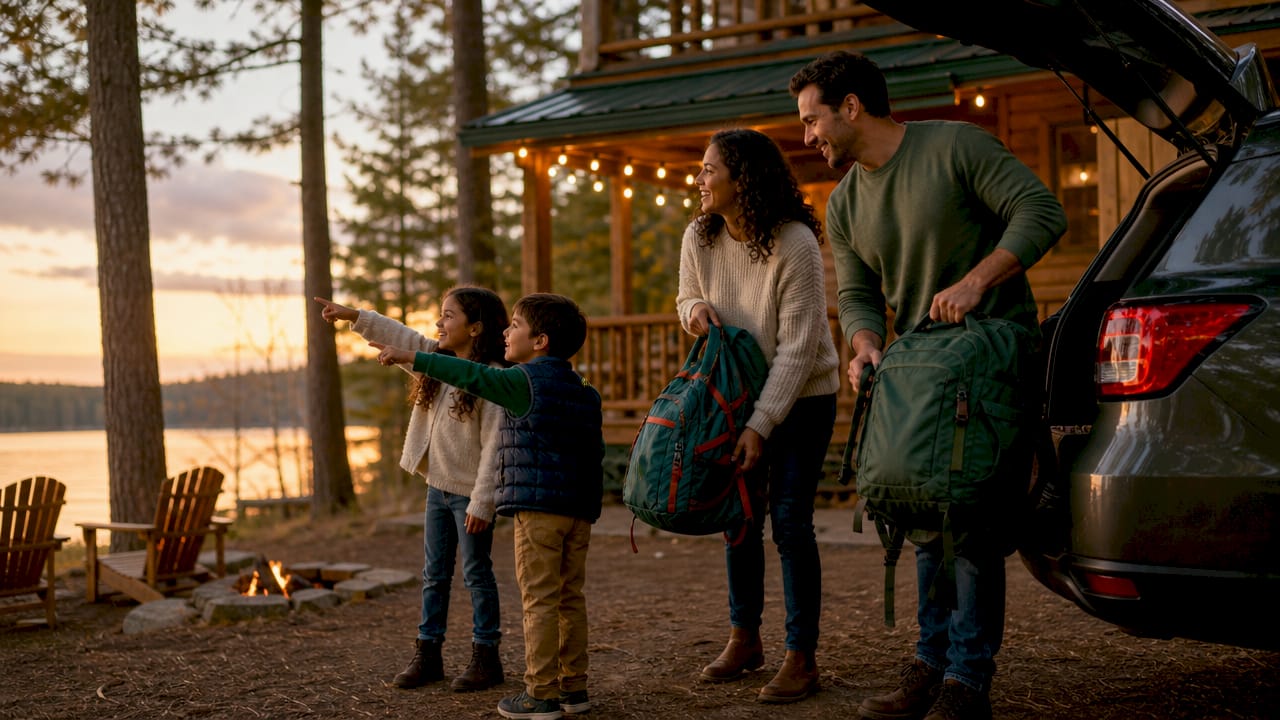 Family arriving at vacation rental home
Travelers seeking unique experiences accept some trade-offs in service for local feel, privacy, and autonomy. This is not a compromise. For most travelers, waking up in a real neighborhood, buying groceries at a local market, and cooking dinner in an actual kitchen is the trip itself, not a side note. Hotels deliver predictability. Alternative lodging delivers memory.
The benefits of alternative lodging also scale with group size. Solo travelers save money with a private room in a homestay. Groups of six save dramatically by splitting a full house. The per-person cost drops as the headcount rises, which is a structural advantage hotels cannot match.
What types of alternative accommodations exist?
The category of alternative accommodations is broader than most travelers realize. Each type serves a different traveler profile, budget, and trip goal.
| Type | Best for | Key advantage | Main trade-off |
|---|---|---|---|
| Vacation rental | Families, groups | Full home amenities, space | Cleaning fees on short stays |
| Home swapping | Flexible homeowners | Near-zero lodging cost | Requires reciprocity and planning |
| Homestay | Cultural seekers, solo travelers | Host interaction, local immersion | Less privacy |
| Serviced apartment | Business travelers, long stays | Hotel-like services, more space | Higher nightly rate than rentals |
| Boutique guesthouse | Experience-focused travelers | Unique character, local ownership | Variable quality |
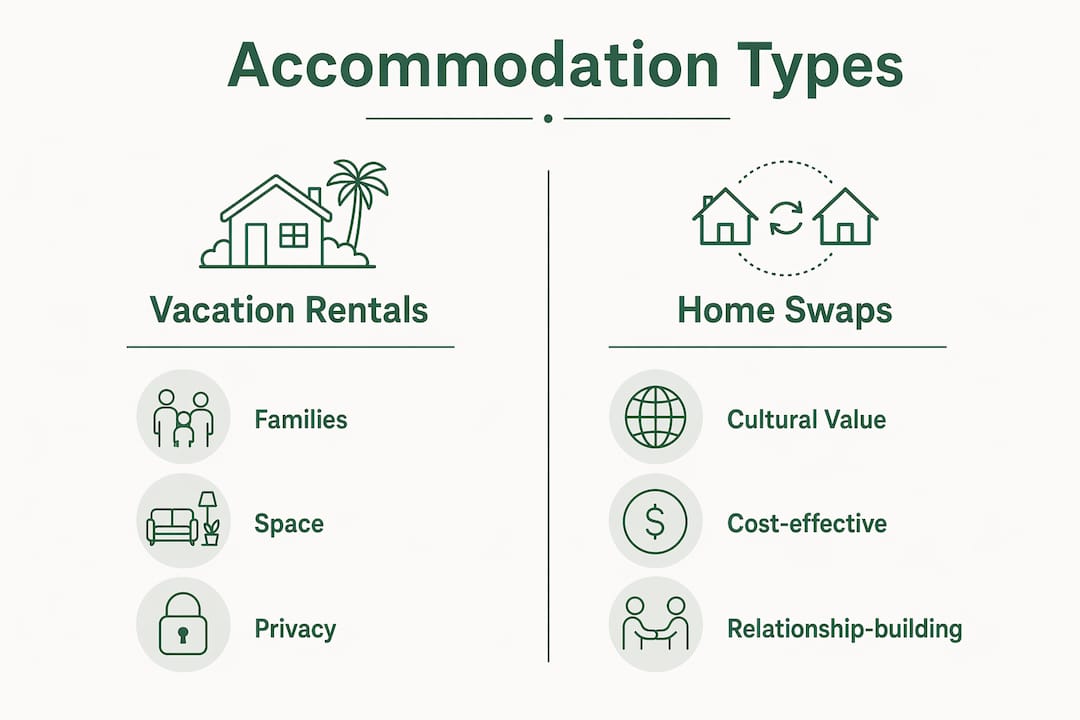 Infographic comparing vacation rentals and home swaps
Each type draws a distinct traveler. Families with children gravitate toward vacation rentals because the kitchen alone eliminates restaurant costs for multiple meals per day. Solo travelers and cultural seekers often prefer homestays, where a host's knowledge of the city replaces any guidebook. Home swapping attracts homeowners who want to travel affordably without paying nightly rates at all.
Key advantages shared across all types of alternative accommodations include:
- More living space than a comparable hotel room at the same price point
- Kitchen access that cuts food costs significantly on trips longer than three days
- Residential neighborhoods that place you where locals actually live
- Flexibility on check-in, house rules, and stay length that hotels rarely offer
The one consistent trade-off is service. Hotels staff a front desk around the clock. Alternative lodging puts more responsibility on the traveler, from coordinating key pickup to handling minor maintenance issues. Travelers who prioritize convenience over experience will always lean toward hotels. Everyone else has strong reasons to look elsewhere.
How does alternative lodging compare to hotels in cost and experience?
Cost comparison between hotels and alternative lodging requires looking at total trip cost, not just the nightly rate. A vacation rental listed at $180 per night sounds expensive until you factor in that it sleeps six, includes a kitchen, and eliminates three restaurant meals per day.
Ohio University tourism experts note that rentals become more economical for longer durations and groups based on kitchen use and bedroom count. This means the break-even point between a hotel and a rental typically arrives around the three-night mark for a group of four or more. For a solo traveler on a one-night city stop, a hotel almost always wins on price and convenience.
The experience gap is equally significant. Hotels deliver a standardized product: clean room, daily housekeeping, lobby amenities, and a concierge. That consistency is genuinely valuable when you are traveling for work or need a reliable base with no surprises. Alternative lodging delivers the opposite of standardization. Every property is different, every host has a different style, and every neighborhood tells a different story.
Pro Tip: Before booking any alternative accommodation, calculate your total trip cost including cleaning fees, service fees, and any platform charges. For stays under two nights, a hotel frequently comes out cheaper even when the nightly rate looks higher.
One common misconception is that alternative lodging is always cheaper. To truly save, travelers must consider total costs including fees and trip duration, since short stays can eliminate the savings advantage entirely. A $90 rental with a $75 cleaning fee costs $165 for one night. A $130 hotel room with free breakfast costs less and includes daily service.
The experience comparison ultimately comes down to what you want from travel. If the destination is the point, a hotel gets you there efficiently. If the living is the point, alternative lodging puts you inside the destination rather than adjacent to it.
Why home swapping and homestays offer unmatched cultural value
Home swapping is the most cost-effective form of alternative lodging available. Home swapping reduces costs to roughly one-tenth of standard short-term rentals by replacing nightly charges with reciprocal stays and a modest platform fee. You stay in someone's home while they stay in yours. No nightly rate changes hands. The only real cost is the platform membership and your travel expenses.
The cultural dimension of home swapping goes beyond the financial. Long-haul travelers increasingly seek authentic experiences in residential neighborhoods, and home swapping places you directly inside local life. You use the same coffee shop the homeowner uses. You walk the same streets. You live the city rather than touring it.
Homestays deliver a similar cultural depth through a different mechanism. Homestays offer travelers cultural immersion through host interaction, local meals, and a feeling of belonging that no hotel lobby can manufacture. Outlook Traveller identifies homestays as one of India's fastest-growing travel segments precisely because travelers are hungry for that sense of connection.
The traveler profiles that benefit most from these models include:
- Budget-conscious families who want a full home without paying hotel prices for multiple rooms
- Solo travelers who want safety, local knowledge, and human connection on the road
- Cultural exchange seekers who measure a trip's success by relationships formed, not sights checked off
- Retirees and remote workers on extended trips where lodging cost compounds over weeks
Pro Tip: On Swappahome, new members receive free credits to start, which means your first home swap stay can cost you nothing beyond the membership. List your home, earn credits, and book your first stay before you've spent a single dollar on accommodation.
Home swapping fosters a shift from transactional stays toward relationship-building and immersion. That shift is not just philosophical. It produces measurably different travel experiences, the kind that travelers talk about for years rather than scroll past in a photo album. You can read more about the real cost differences between home swapping and paid rentals to understand exactly where the savings accumulate.
What are the practical trade-offs when choosing non-traditional lodging?
Choosing non-traditional lodging requires honest planning. The advantages are real, but so are the complications. Here are the key practical considerations every traveler should work through before booking:
-
Calculate total fees before comparing prices. Cleaning fees, service fees, and platform charges can add 30 to 50 percent to the advertised nightly rate on short stays. Always check the total before the checkout screen.
-
Match your stay length to the lodging type. Alternative lodging offers better value for group travel or longer stays, while hotels excel for short stays requiring convenience. A two-night city trip rarely favors a rental. A ten-day family vacation almost always does.
-
Plan home swaps well in advance. Home exchange demands flexible planning since availability depends on mutual schedules, unlike typical rental bookings. Spontaneous home swaps are rare. Travelers who plan three to six months ahead have far more options.
-
Review cancellation policies carefully. Alternative lodging cancellation terms vary widely between platforms and individual hosts. Some are fully refundable up to 48 hours before arrival. Others are non-refundable from the moment of booking.
-
Consider community impact. Short-term rentals can strain local housing and infrastructure, particularly in heritage-sensitive areas like Santorini and Athens. Home swapping and homestays tied to primary residences mitigate housing market pressures better than dedicated investment rentals. Choosing primary-residence alternatives is both more affordable and more responsible.
Security and host reliability are legitimate concerns for first-time alternative lodging travelers. Verified platforms with review systems and identity checks reduce this risk significantly. Reading recent guest reviews, checking host response rates, and using platforms with payment protection are the three non-negotiable steps before any booking. For a detailed breakdown of how home swapping compares to short-term rental platforms on these dimensions, the home swap vs Airbnb comparison on the Swappahome blog covers the specifics.
Key takeaways
Alternative lodging consistently outperforms hotels on space, cost, and cultural depth for stays of three nights or more, especially for groups and travelers prioritizing local immersion.
| Point | Details |
|---|---|
| Cost advantage grows with stay length | Rentals and home swaps beat hotel pricing at the three-night mark for groups of four or more. |
| Home swapping cuts lodging costs dramatically | Reciprocal exchanges reduce accommodation costs to a fraction of standard rental rates. |
| Homestays deliver cultural depth | Host interaction, local meals, and neighborhood access create experiences hotels cannot replicate. |
| Short stays favor hotels | Cleaning and service fees on rentals eliminate savings for one or two-night bookings. |
| Community impact matters | Primary-residence alternatives like home swapping reduce pressure on local housing markets. |
What I've learned from watching travelers choose alternative lodging
I've watched the alternative lodging category grow from a niche preference into a mainstream travel strategy, and the travelers who get the most from it share one trait: they are honest about what they actually want from a trip.
The travelers who book a vacation rental and then complain about the check-in process or the lack of daily housekeeping wanted a hotel. They just wanted it cheaper. That's a reasonable desire, but it's not what alternative lodging delivers. What it delivers is autonomy, space, and the feeling of living somewhere rather than visiting it.
The travelers who thrive with home swapping are the ones who understand that the planning is part of the value. Coordinating a swap three months in advance forces you to commit to a destination, which most travelers benefit from anyway. The reciprocity element also changes how you treat the space. You are a guest in someone's home, and they will be a guest in yours. That mutual accountability produces better travelers and better stays.
My honest advice: if you have never tried a homestay, start there before committing to a full home swap. A single night with a host in a city you know well will tell you immediately whether the model fits your travel style. Most people who try it once find that the conversation over breakfast is worth more than any hotel amenity they gave up.
The future of travel runs through alternative lodging. Affordability pressures are real, hotel prices continue rising, and travelers under 40 increasingly define a good trip by its authenticity rather than its star rating. The platforms enabling this shift, including Swappahome, are getting better at verification, trust, and ease of use every year. The only question is how long it takes the rest of the travel industry to catch up.
— Swappa
Start traveling for free with Swappahome
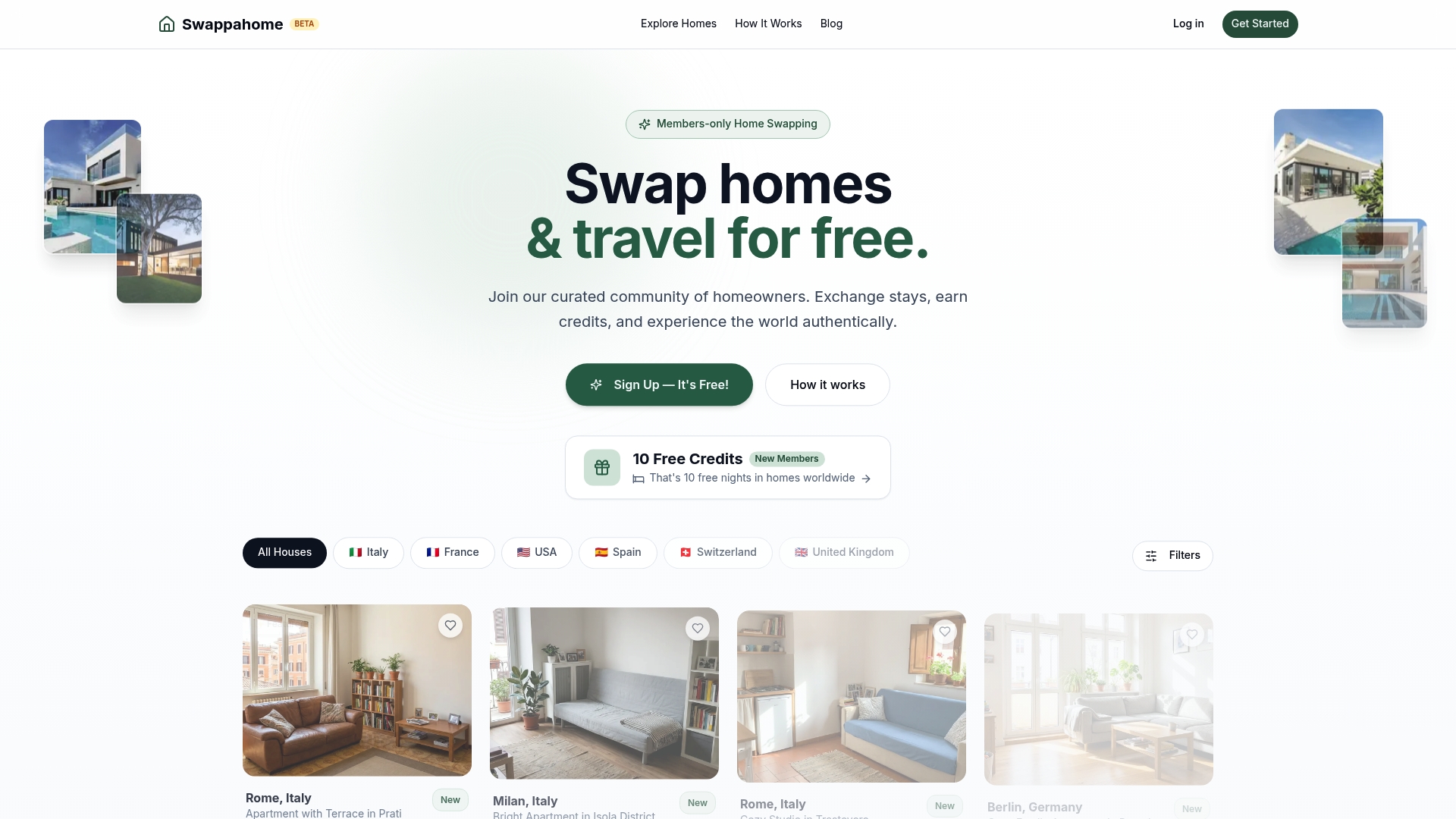 https://swappahome.com
Swappahome is a members-only home swapping platform where verified homeowners exchange stays using a simple credit system. One credit equals one free night. List your home, earn credits when you host, and spend those credits on stays in verified homes across dozens of countries. There are no nightly charges and no bidding wars. New members receive free credits to get started, which means your first trip can cost you nothing in accommodation. If you are ready to stop paying hotel prices and start experiencing destinations from the inside, browse available listings and find your first swap today.
FAQ
What is alternative lodging?
Alternative lodging refers to any accommodation outside the traditional hotel model, including vacation rentals, home swaps, homestays, and serviced apartments. These options typically offer more space, kitchen access, and local immersion than standard hotel rooms.
Is alternative lodging cheaper than hotels?
Alternative lodging is cheaper than hotels for stays of three nights or more, especially for groups, but short stays of one to two nights often cost more once cleaning and service fees are included.
How does home swapping work?
Home swapping involves exchanging your residence with another homeowner so both parties stay in each other's homes without paying nightly rates. Platforms like Swappahome use a credit system to facilitate these exchanges among verified members.
What are the biggest trade-offs with alternative accommodations?
The main trade-offs include variable cleaning fees, less predictable check-in processes, and the need for advance planning, particularly for home swaps that depend on mutual schedule availability.
Who benefits most from homestays?
Solo travelers, cultural exchange seekers, and budget-conscious travelers benefit most from homestays, as host interaction, local meals, and neighborhood access deliver experiences that no hotel amenity package can match.
Recommended

Published by
SwappaHome
SwappaHome Editorial Team
Home Exchange & Slow Travel Editorial
The SwappaHome Editorial Team brings together travel research, home-exchange community insights, and platform data to produce practical guides for first-time and experienced home swappers. Every article cites real platforms, current market rates, and verifiable city-level facts so readers can make informed decisions without guessing.
Ready to try home swapping?
Join SwappaHome and start traveling by exchanging homes. Get 7 free credits when you sign up!