
Why Join Home Swap Platforms: Travel Smarter

SwappaHome Editorial Team
Home Exchange & Slow Travel Editorial
Why Join Home Swap Platforms: Travel Smarter !Couple browsing home swap listings together More than 60 percent of American travelers wish they could...
Why Join Home Swap Platforms: Travel Smarter
 Couple browsing home swap listings together
More than 60 percent of American travelers wish they could experience destinations more like a local while saving money with their families. Yet common myths about home swap platforms often stop budget-conscious homeowners from exploring these opportunities. The truth behind home sharing makes it possible to discover authentic cultural exchanges and travel affordably with loved ones. This overview clears up misconceptions and reveals the real benefits and safety measures of home swapping for curious, practical travelers.
Table of Contents
- Home Swap Platforms And Common Myths
- Types Of Home Exchange Arrangements
- How Credits And Bookings Work
- Safety, Trust, And Member Verification
- Financial Savings Versus Paid Lodging
- Risks To Avoid When Swapping Homes
Key Takeaways
| Point | Details |
|---|---|
| Home Swap Platforms Are Safe | These platforms utilize rigorous verification processes, background checks, and community guidelines to ensure participant safety. |
| Diverse Traveler Appeal | Home swap platforms cater to various demographics, including families and professionals, offering flexible options for all types of travelers. |
| Cost Savings | Home exchanges can significantly reduce travel expenses by providing free lodging, allowing funds to be redirected toward experiences. |
| Risks to Consider | Travelers must understand legal implications and property protections before entering into home swap arrangements to avoid complications. |
Home swap platforms and common myths
Home swap platforms have become increasingly popular, yet numerous misconceptions persist about how these innovative travel solutions actually work. Understanding the reality behind these platforms can help travelers make more informed decisions about their accommodation choices. Home sharing platforms are structured marketplaces that challenge traditional travel accommodation models by emphasizing community trust and peer-to-peer exchanges.
Contrary to popular belief, home swap platforms are not unregulated wild west environments. These platforms implement rigorous verification processes, background checks, and community guidelines to ensure participant safety. Members typically undergo detailed screening, including identity verification, home condition assessments, and reputation tracking through user reviews and ratings. This systematic approach transforms home swapping from a risky endeavor into a structured, reliable method of travel accommodation.
Many people mistakenly assume home swap platforms are exclusively for young, adventurous travelers or retirees with flexible schedules. In reality, these platforms serve a diverse range of travelers, from families seeking cost-effective vacation options to professionals looking for authentic travel experiences. The platforms cater to various demographics by offering flexible exchange options, robust communication tools, and comprehensive support systems that make home swapping accessible and appealing to many different traveler profiles.
Pro tip: Before joining a home swap platform, thoroughly review the platform's verification processes and community guidelines to understand the safety measures in place.
Types of home exchange arrangements
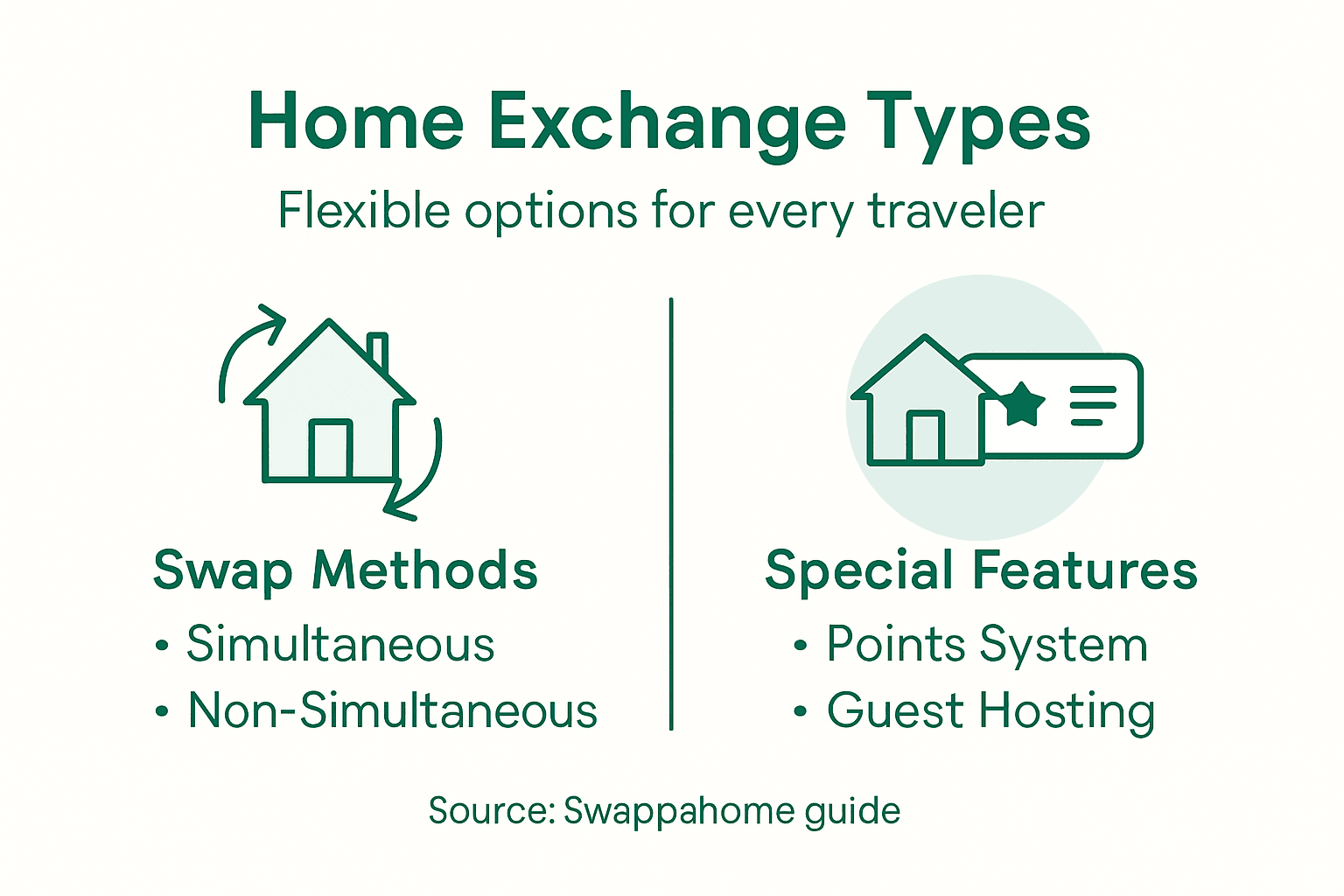
Home exchange platforms offer diverse arrangements to accommodate different traveler needs and preferences. International house swaps primarily fall into two fundamental categories: simultaneous and non-simultaneous exchanges. In simultaneous exchanges, participants swap homes at the exact same time, providing a direct and straightforward accommodation swap that ensures mutual benefit and scheduling alignment.
 Infographic on types of home exchanges
Non-simultaneous exchanges represent a more flexible approach to home swapping. These arrangements allow travelers to exchange homes at different times, often facilitated through a credit or point system. This model particularly benefits professionals with variable schedules, academics on research assignments, and remote workers seeking extended stays in different locations. For instance, a researcher might spend three months in a European city while the other participant uses their credits to visit at a completely different time.
Beyond the basic exchange models, specialized home swap arrangements have emerged to cater to specific traveler needs. Some platforms offer niche exchanges like academic sabbatical swaps, professional secondment accommodations, and even targeted exchanges for specific lifestyle groups such as minimalist travelers, digital nomads, or retirees seeking extended global experiences. These specialized arrangements provide unique opportunities for immersive travel and cultural engagement that traditional accommodation models cannot match.
Pro tip: Before committing to a home exchange, carefully review the specific terms of the arrangement and ensure clear communication with your potential exchange partner about expectations and logistics.
Here's a quick comparison of popular home exchange arrangements and how they suit various traveler needs:
| Exchange Type | Best For | Booking Flexibility | Example Use Case |
|---|---|---|---|
| Simultaneous Swap | Families, couples | Fixed travel dates | Vacation during school break |
| Non-simultaneous Swap | Professionals, academics | Flexible travel schedules | Research sabbatical abroad |
| Specialized Exchanges | Digital nomads, retirees | Customized arrangements | Long-term global adventures |
How credits and bookings work
Home exchange platforms operate through a sophisticated credit system that transforms traditional accommodation booking methods. Members earn credits by hosting travelers in their own homes, which can then be used to book stays in other members' properties. This innovative approach creates a fair and flexible ecosystem where participation directly translates into travel opportunities.
 Person reviewing home swap credit calendar
The credit system typically works on a straightforward principle: one credit equals one night of accommodation. When a member hosts another traveler, they earn credits that can be used for future stays. Some platforms offer additional bonus credits for completing successful exchanges or maintaining an active, well-reviewed profile. This approach incentivizes both hospitality and reliable participation, creating a self-regulating community of travelers who are invested in positive exchange experiences.
Booking processes on home exchange platforms are designed to be transparent and user-friendly. Members create detailed profiles showcasing their homes, availability, and travel preferences. When interested in a potential exchange, users can send direct requests, negotiate exchange details, and confirm bookings through the platform's communication tools. Many platforms include verification steps, such as identity checks and home condition assessments, to ensure safety and build trust among community members.
Pro tip: Maintain an up-to-date, comprehensive profile with high-quality photos and detailed information to increase your chances of successful home exchange bookings.
Safety, trust, and member verification
Home exchange platforms prioritize safety through comprehensive member verification processes. These multi-step authentication procedures are designed to create a secure environment that protects both homeowners and travelers. Verification typically involves multiple layers of identity confirmation, including email validation, phone number verification, and submission of official identification documents such as passports or driver's licenses.
The verification process goes beyond simple document checks. Most platforms implement sophisticated screening methods that include background checks, social media profile reviews, and cross-referencing personal information. Members are required to provide detailed personal profiles with verifiable information, including proof of home ownership or legal residence. Some platforms also incorporate user reviews and ratings, creating a community-driven trust mechanism where members build reputation through positive interactions and transparent communication.
Technological safeguards play a crucial role in maintaining platform security. Advanced encryption protocols protect personal information, while sophisticated matching algorithms help prevent fraudulent activities. Many platforms offer additional safety features like secure messaging systems, identity masking, and optional insurance coverage for home exchanges. These comprehensive security measures create a protected ecosystem that allows travelers to connect and exchange homes with confidence, knowing that multiple layers of verification and protection are in place.
Pro tip: Always thoroughly review a potential exchange partner's profile, verify their identity through multiple sources, and trust your instincts if something feels uncertain.
Financial savings versus paid lodging
Home exchanges dramatically reduce travel expenses by eliminating the most significant cost of traveling: accommodation. Traditional hotels and vacation rentals can consume up to 40% of a travel budget, whereas home swap platforms offer free lodging that allows travelers to redirect those funds toward experiences, dining, and exploration. This economic model transforms travel from a luxury expense into an accessible adventure for budget-conscious individuals.
The financial advantages extend beyond simple cost savings. Home exchanges provide fully equipped living spaces with amenities that would typically cost hundreds of dollars per night in hotels. Kitchen facilities, laundry equipment, multiple bedrooms, and personal living spaces offer substantial value compared to cramped hotel rooms. Remote workers and long-term travelers particularly benefit from these comprehensive living arrangements, which provide comfort and functionality at zero additional cost.
Comparing home exchanges to traditional lodging reveals significant monetary benefits. A week-long hotel stay might cost $1,500 to $3,000 in popular destinations, while a home exchange offers the same accommodation for essentially free. The credit-based systems used by many platforms allow travelers to accumulate stays through hosting, creating a circular economy of travel that rewards active participation. This approach not only saves money but also creates opportunities for cultural exchange and global connections that paid lodging cannot replicate.
Pro tip: Calculate your potential savings by comparing typical hotel rates in your desired destination with the free accommodation offered through home exchange platforms.
This overview highlights key financial benefits of home exchanges compared to traditional lodging:
| Aspect | Home Exchange Benefit | Paid Accommodation Cost | Impact on Travel Budget |
|---|---|---|---|
| Lodging Expenses | Typically free stay | $1,500–$3,000/week in hotels | Up to 40% savings |
| Amenities | Full kitchen, laundry, space | Often limited in hotels/rentals | Additional daily cost savings |
| Long-term Value | Zero-cost extended trips | Increasing costs for long stays | Enables affordable travel |
Risks to avoid when swapping homes
Home exchanges offer exciting opportunities, but travelers must be aware of potential risks. Legal considerations can significantly impact home swaps, particularly for tenants and those in rental properties. Understanding the complex landscape of permissions, agreements, and potential restrictions is crucial to preventing unexpected complications that could derail your travel plans.
There are several critical risks to evaluate before entering a home swap arrangement. Renters must obtain explicit permission from their landlords, as many lease agreements prohibit subletting or temporary occupancy by non-residents. Some social housing regulations and rental contracts have strict rules about home exchanges, potentially leading to lease violations or legal disputes. Additionally, homeowners should thoroughly assess their insurance coverage, as standard policies may not protect against damages during home exchanges.
Personal property protection represents another significant consideration. While most home swap platforms implement verification processes, travelers should take proactive steps to safeguard valuable items. This includes securing important documents, storing expensive electronics and jewelry in locked spaces, and creating detailed home inventories before exchanges. Communication with your exchange partner about house rules, expectations, and potential concerns can help mitigate risks and establish mutual understanding and respect.
Pro tip: Create a comprehensive written agreement with your exchange partner that outlines expectations, responsibilities, and potential contingencies before finalizing any home swap.
Discover Smart, Safe, and Affordable Travel with Swappahome
The article highlights key challenges travelers face when considering home swapping such as safety concerns, complex verification, and managing credits for stays. If you want to eliminate doubts around member verification, simplify the credit system, and enjoy a trusted community, Swappahome offers an ideal solution. With a fully verified members-only platform, straightforward credit earning and usage, and a curated global collection of homes, you can experience authentic cultural exchanges without worrying about safety or complicated arrangements.
 https://swappahome.com
Ready to travel smarter and save on accommodation costs? Join Swappahome today to list your home, earn free credits, and book stays in verified homes worldwide. Take control of your travel plans with confidence by exploring the seamless home exchange process at Swappahome and learn more about how easy it is to get started. Your next adventure is just a click away.
Frequently Asked Questions
What are home swap platforms?
Home swap platforms are structured marketplaces that allow individuals to exchange their homes with others for travel accommodations, emphasizing community trust and peer-to-peer exchanges.
How do home swap credits work?
Home swap platforms typically operate on a credit system where members earn credits by hosting travelers in their homes, which can then be used to book stays at other members' properties, usually at a rate of one credit per night of accommodation.
What safety measures are in place on home swap platforms?
Home swap platforms implement rigorous member verification processes, including identity checks, background screenings, and user reviews, to create a secure environment for participants.
Are home exchanges suitable for families?
Yes, home exchanges cater to a wide range of travelers, including families, offering spacious accommodations and amenities that can be more cost-effective compared to traditional lodging options.
Recommended
- Home Swapping vs Hotels: Why Families Choose Home Exchange
- Home Swapping for Digital Nomads: Work From Anywhere
- Blog | SwappaHome - Home Swapping Guides & Tips
- How to Travel for Free with Home Exchange | Complete 2024 Guide
- 7 Best Good Rental House Websites for Easy Home Search 2025 - Guestly Homes
- The Essential Guide to Rentals in Travel - Rent&Go Car Rental Vlore

Published by
SwappaHome
SwappaHome Editorial Team
Home Exchange & Slow Travel Editorial
The SwappaHome Editorial Team brings together travel research, home-exchange community insights, and platform data to produce practical guides for first-time and experienced home swappers. Every article cites real platforms, current market rates, and verifiable city-level facts so readers can make informed decisions without guessing.
Ready to try home swapping?
Join SwappaHome and start traveling by exchanging homes. Get 7 free credits when you sign up!