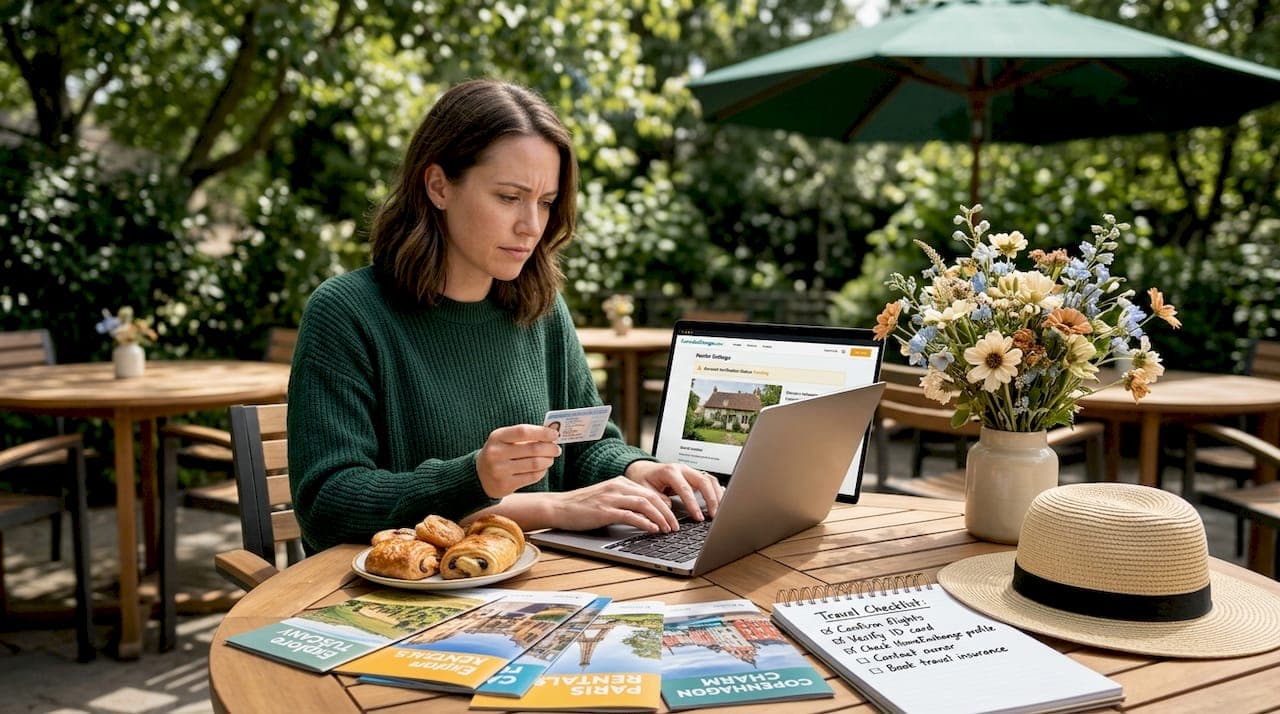
Why verification matters in travel: Safer, smarter choices

SwappaHome Editorial Team
Home Exchange & Slow Travel Editorial
Why verification matters in travel: Safer, smarter choices !Traveller verifying details on kitchen table for home swap > TL;DR: > > - Verification...
Why verification matters in travel: Safer, smarter choices
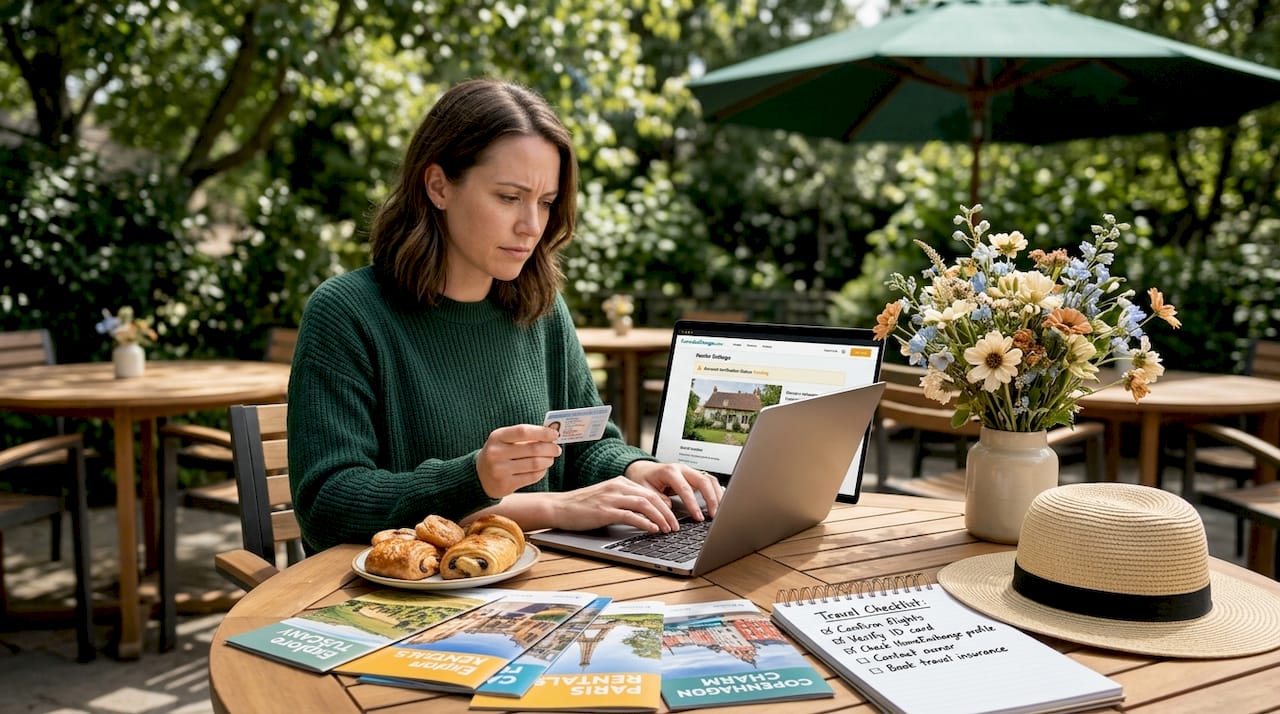 Traveller verifying details on kitchen table for home swap
TL;DR:
- Verification checks online create important but incomplete safeguards against fraud and misrepresentation.
- While they reduce fake profiles and flag known bad actors, they cannot guarantee honesty, behavior, or property condition.
Most travelers assume that a "verified" badge next to a host's name is basically a green light. It feels official, trustworthy, almost like a background check. But identity verification checks have real safeguards that still do not provide complete assurance about who someone is. That's not a loophole. That's a fundamental truth about how trust works online. If you're a homeowner planning to swap your space or a budget traveler hunting for affordable, authentic stays, understanding exactly what verification does and doesn't protect you from could be the most practical thing you read before your next trip.
Table of Contents
- What does verification mean in travel?
- How verification works: Steps and layers
- Limits of verification: What it can't do
- Verification and review credibility: A complementary trust system
- What to do when verification fails or isn't available
- Why relying on verification badges alone is a risky shortcut
- Discover verified, affordable home swaps with Swappahome
- Frequently asked questions
Key Takeaways
| Point | Details |
|---|---|
| Verification is layered | Platforms use ID checks, photo matching, and ongoing controls to reduce—but not eliminate—risk. |
| Badges aren’t enough | A verified badge is helpful but should be trusted only alongside authentic, recent user reviews. |
| Review credibility matters | Check whether reviews are recent, detailed, and from real travelers to lower your risk. |
| Be prepared for hiccups | Always have a fallback plan in case verification fails or is delayed during your booking process. |
| Community maximizes safety | Connecting with trustworthy hosts and using layered trust signals creates safer, budget-friendly trips. |
What does verification mean in travel?
Let's start by breaking down what platforms actually mean by "verification" before examining how it works in detail.
In the travel and home exchange world, "verification" isn't a single action. It's a collection of processes that platforms use to confirm that a user is who they claim to be. When you see a verified badge, it typically means the platform has run the person's information through at least one of several checks. But the specific type and depth of those checks varies significantly between platforms.
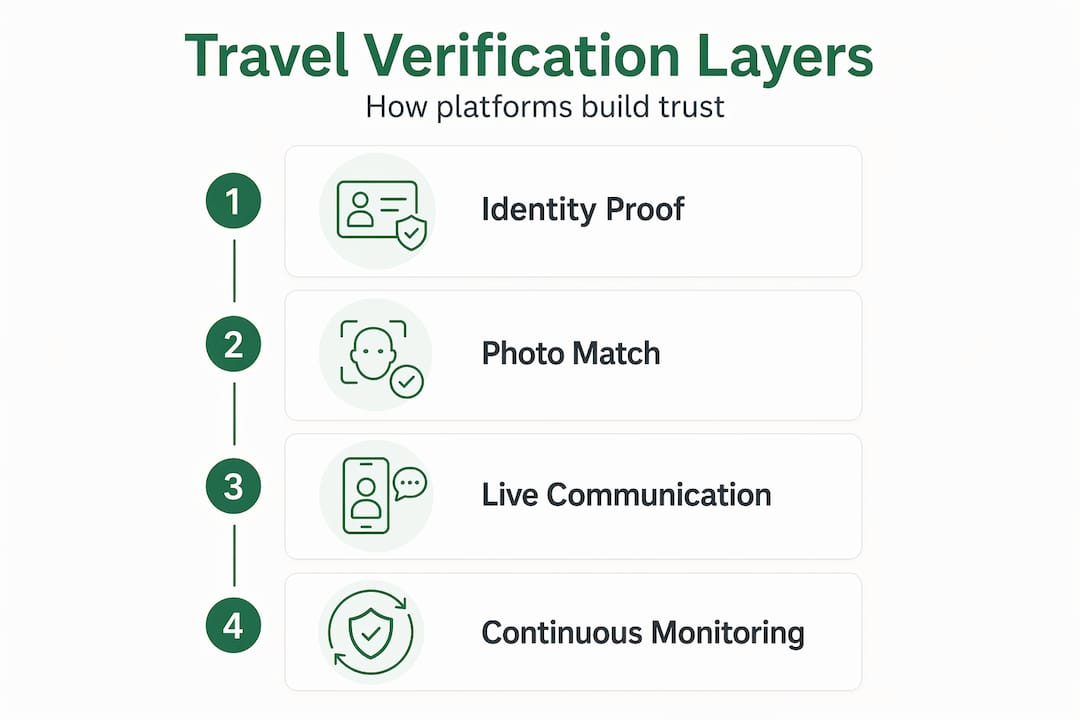 Infographic outlining travel verification steps and layers
Identity verification on Airbnb, for example, works by checking user information against trusted third-party sources or government-issued IDs, sometimes adding a selfie or photo-matching step when additional confirmation is needed. The goal is to reduce fake accounts and impersonation. That's a meaningful objective. However, it does not tell you whether a host is tidy, communicative, or honest about their property description.
Here's a simple breakdown of the most common verification layers you'll encounter on travel and home swap platforms:
| Verification layer | What it checks | What it can't confirm |
|---|---|---|
| Government ID match | Name, date of birth, document authenticity | Intentions, behavior, or property condition |
| Selfie/liveness check | Your face matches your ID photo | Whether you're a considerate guest or host |
| Third-party database screening | Prior fraud flags, watchlists | Future actions or undisclosed history |
| Review system | Past guest/host experiences | Current situation or changed behavior |
| Ongoing risk controls | Reservation patterns, complaint reports | Real-time conduct during a stay |
What verification can do:
- Reduce the likelihood of entirely fake identities
- Flag users already known for fraud
- Create legal accountability through identity records
- Give platforms a basis for removing bad actors after the fact
What verification cannot do:
- Guarantee a person is honest, careful, or kind
- Confirm a listing matches its photos
- Predict behavior in any specific situation
- Catch sophisticated fraudsters with real but stolen documents
This distinction matters enormously for home swappers. When you invite someone into your home or stay in theirs, you're entering a relationship built on far more than a government ID check. The identity verification explained concept becomes most useful when you understand it as a starting filter, not a final verdict.
How verification works: Steps and layers
Now that you know what "verification" means, let's walk through how platforms actually put that into practice.
Most platforms deploy verification in a sequence of stages, with each stage adding a different type of confidence. Think of it like layers of a security system at a building. One camera at the door catches most people. But combining a camera, a keycard scanner, and a receptionist creates a much stronger defense.
Here's how the process typically unfolds:
- Account creation and basic info submission. You sign up, provide your name, email, and phone number. The platform verifies your email and may send a text confirmation.
- Government ID upload. You photograph a passport, driver's license, or national ID. The platform's system checks that the document format looks authentic and that the name matches your account.
- Selfie or liveness check. Some platforms ask you to take a current selfie or short video. Automated systems compare your face to the ID photo. This step catches people using stolen ID documents.
- Third-party cross-referencing. Your information may be checked against watchlists, fraud databases, or official registries. This is where known scammers or flagged accounts are more likely to surface.
- Ongoing monitoring. Once you're active on the platform, your reservation screening and quality enforcement activity continues in the background. Reports from other users, suspicious booking patterns, and complaint histories all feed into this layer.
According to Airbnb's Global Quality Report, reservation-screening systems and quality enforcement work alongside identity verification to reduce low-quality listings and limit disruptive behavior on the platform, showing that no single layer works alone.
The layered approach described above combines multiple verification steps: identity proof, liveness matching, and ongoing risk controls. Each stage catches different failure modes. A fake name is stopped at stage two. A stolen document might get through stage two but fail at stage three. A real person with a real ID but bad intentions could pass all technical checks and only get flagged through the review system later.
Pro Tip: Don't just look for the verified badge. Check whether the person also has detailed, recent reviews from multiple guests or hosts. A verified profile with zero reviews or reviews that are vague and short is a signal worth pausing over.
You can also look at Swappahome trust and safety practices to understand how member verification is handled in a curated home swap community, where the bar for listing and hosting is specifically designed around mutual accountability.
 Home office scene reviewing member verification on computer
Limits of verification: What it can't do
While verification systems catch a lot, they aren't perfect. Here's where gaps most often appear for travelers.
The biggest misconception is that a verified badge means a "safe" person. Platforms are clear: verification checks have real safeguards but do not guarantee who someone is or how they will behave. A person can pass every technical check and still be a poor communicator, leave a place a mess, or misrepresent their property.
Here's a direct comparison of what the badge actually covers:
| What verification covers | What it doesn't cover |
|---|---|
| Basic identity confirmation | Honesty about property condition |
| Fraud database flags | Future behavior or attitude |
| Document authenticity | Communication reliability |
| Photo match at point of sign-up | Whether home matches listing photos |
| Some known bad actors | First-time offenders with clean records |
Technical failure is also a real issue. Selfie matching can fail if lighting is poor, the camera quality is low, or the system can't process certain document types. Travelers in some countries may find that their national ID isn't supported, leaving them stuck in verification limbo. Some systems time out or lose uploads, requiring the whole process to be repeated.
Common mistake: Travelers often trust the badge alone and skip checking limits of verification in home exchange situations. They skip reading reviews carefully, don't ask follow-up questions before confirming a swap, and assume everything is fine because the profile looks "official."
Also worth knowing: verification is not the same across platforms. A badge on one service may represent a thorough multi-step process. On another, it might just mean an email address was confirmed. If you're comparing options, understanding that difference matters for home swapping vs rental safety calculations.
Pro Tip: Always have a fallback plan. If your verification stalls due to a technical glitch or unsupported document, identify an alternative form of ID in advance and contact platform support before your travel date, not the day before departure.
Verification and review credibility: A complementary trust system
So, what else can you use to verify a safe, authentic stay besides platform checks? That's where the power of honest reviews comes in.
Reviews do something verification badges fundamentally cannot: they document actual experience. A review from six months ago that describes a spotless apartment, a responsive host, and an accurate listing tells you far more about what to expect than an ID match from three years ago. Online review credibility and perceived authenticity reduce perceived risk for travelers making lodging decisions, acting as a complementary form of trust signal.
The research supports this. Travelers rely heavily on reputation signals like review authenticity and credibility to reduce perceived risk, not just verified badges. That means your trust assessment should treat both types of signals as inputs, not treat one as more authoritative than the other.
Here's a quick checklist for assessing whether reviews are genuinely trustworthy:
- Recency: Are the most recent reviews from the past six to twelve months? Older reviews might not reflect current reality.
- Specificity: Do reviewers mention specific details about the space, the host's communication, or the neighborhood? Generic praise like "great stay!" adds little confidence.
- Balance: A mix of glowing and constructively critical reviews is more believable than five-star ratings across the board.
- Volume: Ten or more reviews across different time periods suggests a consistent pattern, not a one-time lucky experience.
- Reviewer profiles: Are the reviewers themselves verified and active? A review from an account with zero history warrants skepticism.
When reviews build trust in a home swap context, they create a social accountability loop. Hosts and guests know that their behavior will be publicly documented. That alone encourages better conduct from both sides. Understanding how trust shapes safe stays means combining digital verification with this kind of social verification. Together, they cover far more risk scenarios than either one does alone. Trusted travel networking builds on both signals to create a genuinely safer experience.
What to do when verification fails or isn't available
Even the best systems hit snags. Here's how to protect your travel plans if verification doesn't go as expected.
Verification failure is more common than most platforms admit. A mismatch between your selfie and your ID photo, an unsupported document type, a country where verification tools aren't available, or a simple system glitch can all bring the process to a halt. Verification can fail due to technical issues like selfie mismatches or unavailable methods in certain countries, so travelers need real fallback options rather than assuming the process will work smoothly.
Here's a step-by-step approach for handling verification problems:
- Try alternative documentation first. If a passport upload fails, try a national ID or driver's license. Different documents sometimes process more successfully depending on the platform's database.
- Reach out to support immediately. Don't wait and hope the issue resolves itself. Customer support teams often have manual review processes for edge cases that the automated system can't handle.
- Take verification photos in good lighting. Poor lighting is one of the most common causes of selfie mismatch failures. Retry with a neutral background and natural light before concluding something is broken.
- Check for platform-specific guidance. Some platforms have detailed country-by-country instructions for alternative verification paths that aren't visible on the main help page.
- Use platform communities. Travel community best practices often include member forums where you can find practical advice from other users who've navigated verification in specific countries or with specific document types.
- Consider timing. Verification issues sometimes resolve after 24 to 48 hours if the system is under heavy load. Starting the process well before your travel date gives you room to troubleshoot without panic.
The most important mindset shift here is this: a verification failure doesn't mean you're stuck. It means you need to be proactive, not passive. Budget travelers especially need to build extra lead time into their planning to handle administrative friction like this.
Why relying on verification badges alone is a risky shortcut
Let's get real about how trust is earned and lost on travel platforms.
The travel industry has invested heavily in making verification badges look authoritative. They're prominently displayed, often highlighted with a checkmark icon, and framed as evidence that a host or guest has been "approved." This framing creates a problem: it encourages travelers to stop asking questions once they see the badge.
Experienced hosts and guests know better. The most reliable signals come from a combination of sources: the badge tells you someone cleared a basic identity check. The review history tells you how they actually behaved. Their response time and communication style tell you how they'll handle problems. Even the age of their account and the completeness of their profile contribute to a more accurate picture.
The hidden limits of verification become most dangerous when travelers substitute badge-checking for actual due diligence. When was the last review left on that profile? Are there any stays where guests mentioned unresolved issues despite a verified status? Those patterns reveal things no document check ever could.
Reviews often matter more than the badge in high-stakes situations like home swapping, where you're trusting someone with your actual home. Budget-conscious, culturally curious travelers who build a personal checklist combining digital verification signals with human communication signals consistently report better outcomes. The badge gets you to the conversation. Everything else tells you whether to say yes.
Discover verified, affordable home swaps with Swappahome
If you want more control and peace of mind in your travel swaps, here's how to put the article's lessons into action.
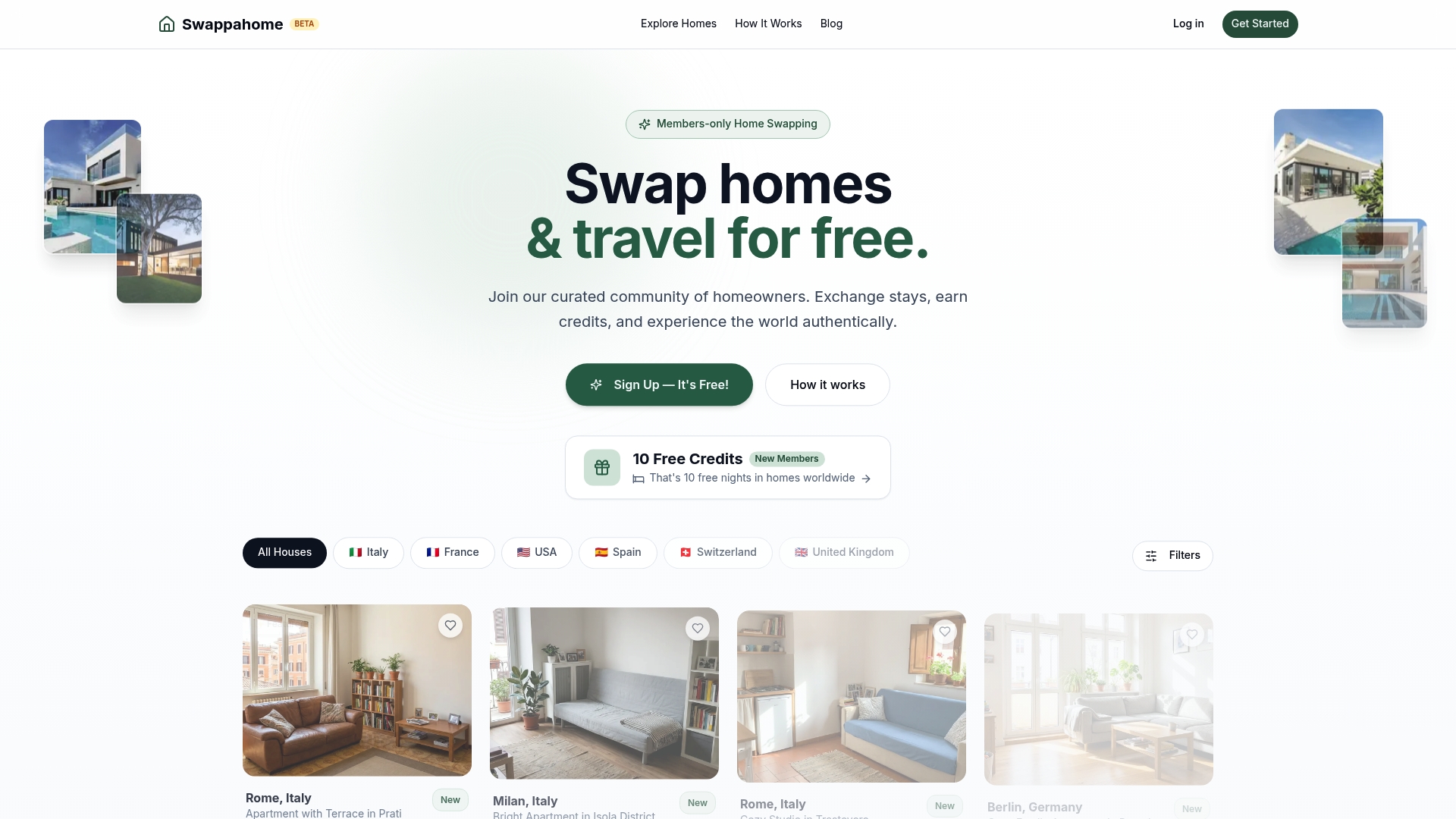
Swappahome was built with exactly these challenges in mind. The platform combines member verification with an honest review system and a credit-based exchange model, so every stay is backed by both identity checks and community accountability. You don't have to choose between affordability and safety.
 https://swappahome.com
Browse verified listings across dozens of countries, connect directly with homeowners who share your travel values, and use the credit system to stay free while building your own hosting reputation. New members receive free starter credits, so you can explore the community before committing fully. When you join a vetted network like Swappahome, you're not just booking a room. You're joining a global community of homeowners who have decided that trust and cultural exchange are worth investing in.
Frequently asked questions
Does verification guarantee my safety when swapping homes or booking travel?
No. Platforms explicitly caution that identity verification reduces some risks but cannot guarantee safety, future behavior, or the accuracy of a listing.
Which forms of verification are most effective for avoiding scams?
The strongest protection comes from combining government ID matching, photo or liveness checks, and live communication with the host or guest. Layered verification catches more failure modes than any single check alone.
What should I do if verification fails or isn't available for my country?
Try alternative documentation, contact support early, and allow extra lead time before your trip. Verification can fail due to technical issues, so having a backup plan is essential.
How do online reviews and "verified" badges work together to reduce risk?
They cover different types of risk. Badges confirm basic identity, while recent, credible reviews document actual behavior and property accuracy, giving you a fuller picture before committing to a stay.
Recommended

Published by
SwappaHome
SwappaHome Editorial Team
Home Exchange & Slow Travel Editorial
The SwappaHome Editorial Team brings together travel research, home-exchange community insights, and platform data to produce practical guides for first-time and experienced home swappers. Every article cites real platforms, current market rates, and verifiable city-level facts so readers can make informed decisions without guessing.
Ready to try home swapping?
Join SwappaHome and start traveling by exchanging homes. Get 7 free credits when you sign up!