Your guide to homeowner travel networks and home swapping

SwappaHome Editorial Team
Home Exchange & Slow Travel Editorial
Your guide to homeowner travel networks and home swapping !Woman reviewing home swap website in kitchen > TL;DR: > > - Homeowner travel networks...
Your guide to homeowner travel networks and home swapping
 Woman reviewing home swap website in kitchen
TL;DR:
- Homeowner travel networks allow free property exchanges with verified owners worldwide.
- They offer cost savings, local immersion, and longer stays compared to hotels or rentals.
- Success depends on proactive communication, trust, safety measures, and thorough preparation.
Most people assume that seeing the world well means spending a lot. But a growing community of homeowners has quietly found a better way. Instead of paying hotel rates every night, they swap homes with other verified owners across the globe, staying for free while someone else enjoys their space. This guide explains exactly what homeowner travel networks are, how the different exchange types work, what the real pros and cons look like, and how you can get started safely and confidently on your first swap.
Table of Contents
- What is a homeowner travel network?
- Types of exchanges and how they work
- Pros and cons: What most guides miss
- Safety, trust, and setting expectations
- Getting started: From first listing to happy swap
- Our take: Why home swapping works (and what other guides miss)
- Ready to try a homeowner travel network?
- Frequently asked questions
Key Takeaways
| Point | Details |
|---|---|
| Affordable travel option | Homeowner networks let you explore new places without paying for hotels. |
| Multiple exchange formats | You can choose from reciprocal swaps, point systems, or hosting arrangements. |
| Verified and insured | User verification, peer reviews, and insurance greatly reduce risks. |
| Advanced planning needed | Home swapping works best when you plan trips several months ahead. |
| Ideal for immersive stays | This travel method is perfect for experiencing local life and hosting other travelers. |
What is a homeowner travel network?
A homeowner travel network, also called a home exchange or home swapping platform, is a membership-based service that lets homeowners trade accommodations with each other. No money changes hands between guests. Instead, you pay an annual membership fee to access the platform, and from there, all stays are free.
The core idea is simple. You list your home, browse other members' homes, find a match, and agree on dates. The platform handles the matching infrastructure, verification, and communication tools. You handle the relationship with your swap partner.
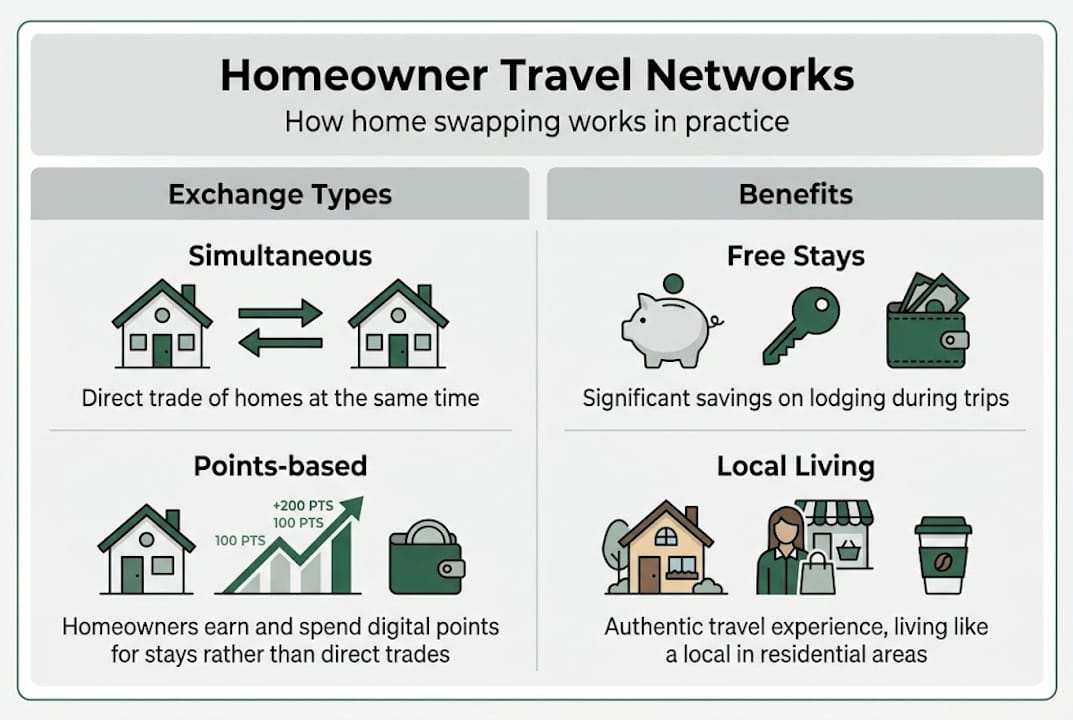 Infographic explains exchange types and benefits
Here's how a homeowner travel network differs from other lodging options:
| Feature | Home exchange network | Vacation rental (Airbnb, VRBO) | Traditional hotel |
|---|---|---|---|
| Cost per night | Free (after membership fee) | Paid per night | Paid per night |
| Space and amenities | Full home, kitchen, laundry | Varies | Room only |
| Local immersion | High | Medium | Low |
| Flexibility | Moderate | High | High |
| Verification of guests | Yes, mutual | Varies | No |
The four core steps to participate are:
- Set up a profile: Add photos, a description of your home, and information about yourself and your travel preferences.
- List your home: Specify available dates, house rules, and any special features like a car, garden, or pet.
- Browse and search: Filter by destination, dates, home type, and swap format.
- Communicate and agree: Message potential partners, confirm expectations, and finalize the swap.
Understanding the free accommodation advantages available through these networks is the first step toward making smarter travel decisions.
Types of exchanges and how they work
Now that you understand the networks, let's clarify the variety of swaps available and how you actually participate.
Not all home exchanges work the same way. The main exchange types include simultaneous reciprocal swaps, non-simultaneous reciprocal swaps, points or credit-based exchanges, and hospitality exchanges. Each serves a different kind of traveler.
| Exchange type | How it works | Best for |
|---|---|---|
| Simultaneous reciprocal | Both parties swap at the same time | Coordinated schedules |
| Non-simultaneous reciprocal | Swaps happen at different times | Flexible planners |
| Points/credits | Host to earn credits, spend credits to stay | Maximum flexibility |
| Hospitality | Host stays home while guest visits | Cultural connection seekers |
The points and credit model is especially popular because it removes the need to find a direct swap partner. You host someone, earn credits, and then use those credits to stay anywhere in the network. Platforms like Swappahome use this model, where one credit equals one free night. Learning how travel points systems work helps you get the most out of every hosting experience.
 Man browsing points-based home swap site on couch
For a concrete sense of how this plays out, check out real point-based travel examples from homeowners who have used credits to travel across multiple countries in a single year.
Here is a typical step-by-step flow for a credit-based exchange:
- Join the platform and complete your profile with verified ID and home photos.
- List your home with available dates, house rules, and any extras you're offering.
- Accept a hosting request from a verified member who wants to stay at your home.
- Earn credits for each night you host.
- Search for your destination using the platform's listings and filters.
- Send a stay request to a host whose home and dates match your plans.
- Confirm the swap by agreeing on dates, check-in details, and house rules.
- Travel and stay in your destination home, covered by your earned credits.
Pro Tip: Start by hosting first. Getting a few positive reviews early makes your profile far more attractive to potential swap partners, especially in popular destinations.
Pros and cons: What most guides miss
Armed with the mechanics, let's fairly weigh the big-picture trade-offs and see who benefits most.
Most travel guides list the obvious benefits of home swapping. Lower costs. More space. A real kitchen. But the deeper advantages and the genuine limitations are often glossed over.
On the financial side, the savings are significant. A family of four spending two weeks in Paris could easily spend $4,000 or more on hotel rooms alone. A home exchange eliminates that cost entirely. Families benefit most because they need more space, and hotels charge per room. Longer stays also favor swappers because the fixed membership fee gets spread across more nights.
Beyond money, home swapping vs rentals reveals a lifestyle difference that numbers alone don't capture. You live like a local. You cook in a real kitchen, sleep in a real bed, and explore a neighborhood rather than a tourist district. That kind of immersion is genuinely hard to replicate in a hotel.
"Home swapping is budget-friendly, authentic immersion with full space and amenities, and points systems enhance flexibility over pure reciprocal swaps."
However, there are real limitations. As one thorough review notes, the cons include planning time, flexibility limits, and a trust barrier that can feel uncomfortable for first-timers. Home swapping is not for spontaneous travelers who book trips two weeks out.
Home swapping is best for:
- Homeowners in desirable cities, beach towns, or scenic regions
- Families or groups who need multiple bedrooms
- Travelers who plan trips three to twelve months in advance
- People who want to stay longer than a typical hotel visit
- Budget-conscious travelers who value authentic local experiences
Home swapping may not suit you if:
- You prefer last-minute or highly spontaneous travel
- You rent your home and don't own the property
- You're uncomfortable with strangers staying in your space
- Your home is in a location with low demand from other travelers
- You need guaranteed dates with no risk of a swap falling through
Pro Tip: If your home is in a mid-tier location, you can still make swapping work by targeting destinations with similar demand levels, or by building up credits through multiple hosting experiences before booking a high-demand destination.
Safety, trust, and setting expectations
After weighing the pros and cons, the next step is ensuring your safety and building trust. Here's how to set yourself up for success.
The most common concern new swappers raise is property safety. The good news is that damage and theft are rare and typically minor, thanks to identity verification, mutual review systems, and insurance coverage. Some platforms offer up to $1 million in property coverage, which puts most homeowners' concerns in perspective.
That said, smart preparation makes a real difference. A home swapping guide recommends verifying your partner's ID, address, and reviews, and even doing a video call before confirming. Document your home's condition before and after with photos or a short video walkthrough. Lock away valuables, personal documents, and anything irreplaceable.
"Trust is built through verification and peer reviews, and rare issues are resolved peer-to-peer, making home swapping outperform rentals for families and long stays."
Here is a practical safety checklist before your first swap:
- Verify your partner's profile, reviews, and ID documents
- Conduct a video call to establish personal connection and ask questions
- Write clear house rules covering cleaning, noise, guests, and off-limit areas
- Photograph every room before your guest arrives
- Secure valuables, medications, and personal paperwork in a locked space
- Confirm check-in and check-out procedures in writing
- Check whether your homeowner's insurance covers short-term guests
- Leave a welcome guide with appliance instructions, emergency contacts, and local tips
For a deeper look at protecting yourself, the home swapping safety tips resource covers the most common scenarios and how experienced swappers handle them. You can also explore security in home swapping for a detailed breakdown of platform-level protections and what to do if something goes wrong.
Additional safety tips for home exchanging and guidance on how to prepare your house for swaps round out the preparation process and help you feel genuinely confident before handing over your keys.
Getting started: From first listing to happy swap
With the essentials in place, let's walk through the actionable steps for starting your first exchange and making it a success.
The core mechanics of a successful first swap involve creating a strong home profile, searching listings carefully, messaging potential partners, and agreeing on specific terms including dates, house rules, and any extras like car use or pet care.
Here is your step-by-step roadmap:
- Sign up and complete verification. Upload your ID, confirm your address, and fill out your personal profile with a photo and a short bio.
- Create a compelling home listing. Use bright, high-quality photos of every room. Write an honest, warm description that highlights what makes your location special.
- Set your availability. Mark the dates your home is open for swaps and indicate whether you prefer simultaneous, non-simultaneous, or credit-based exchanges.
- Start browsing destinations. Search by city, country, dates, and home type. Save listings that interest you and study the host's reviews carefully.
- Send personalized messages. A brief, friendly message explaining who you are and why you're interested in their home gets far better responses than a generic request.
- Agree on all terms in writing. Confirm dates, check-in time, house rules, whether pets are allowed, and any extras before finalizing.
- Prepare your home. Clean thoroughly, leave a welcome guide, stock basic supplies, and make the space feel inviting.
- Complete the swap and leave a review. Honest reviews help the whole community and build your reputation for future exchanges.
Timeline guidance: Plan your first swap six to twelve months in advance. Popular destinations fill up quickly, and giving yourself lead time means more options and less stress.
Key preparation tasks before your guests arrive:
- Deep clean the entire home, including appliances and bathrooms
- Remove personal clutter and create clear storage space for guests
- Leave printed instructions for the WiFi, heating, appliances, and parking
- Provide local recommendations for restaurants, grocery stores, and attractions
- Confirm emergency contact numbers are visible and accessible
For a full walkthrough on getting your space ready, the guide on how to prepare your home covers everything from photography tips to welcome packs. And if you want your swap relationship to go smoothly from day one, the home swap etiquette guide is worth reading before you send your first message.
Pro Tip: Write your welcome guide as if you're explaining your home to a good friend. Include the quirks, the best local spots, and anything that would have taken you years to discover. Guests remember that kind of generosity, and it shows up in your reviews.
Our take: Why home swapping works (and what other guides miss)
Most articles about home swapping focus on the mechanics and the savings. Those things matter. But the reason experienced swappers keep coming back has more to do with mindset than logistics.
Home swapping rewards people who are proactive, communicative, and realistic. If you approach your listing with honest photos and a genuine description, you attract guests who are a good fit. If you reach out to potential partners with a personal message rather than a form request, you get responses. The platform does the verification and infrastructure work. You bring the human element.
The trust barrier that worries first-timers almost always dissolves after the first exchange. Once you've hosted someone who left your home cleaner than they found it, or once you've stayed somewhere and felt genuinely welcomed by a thoughtful welcome guide, the concept stops feeling abstract. It becomes a real, reliable way to travel.
There's also a point that the real savings through swapping data supports but doesn't fully explain. The value isn't just financial. Staying in a real home in a real neighborhood changes how you experience a destination. You shop at local markets, walk to neighborhood cafes, and interact with a place the way residents do. That's something no hotel rate can replicate, regardless of how low it goes.
The honest caveat is that home swapping is not a fit for everyone. If you need total flexibility, last-minute options, or guaranteed availability, a rental or hotel will serve you better. But if you're a homeowner who plans ahead and wants to travel more for less while actually connecting with the places you visit, this model delivers in ways that are hard to overstate.
Ready to try a homeowner travel network?
Feeling inspired? Here's your invitation to get started with confidence.
If this guide has shifted your thinking about what affordable travel can look like, the next step is simple. Swappahome is a members-only platform built for exactly this kind of exchange. Verified homeowners list their spaces, earn credits by hosting, and use those credits to stay in homes around the world, completely free of per-night charges.
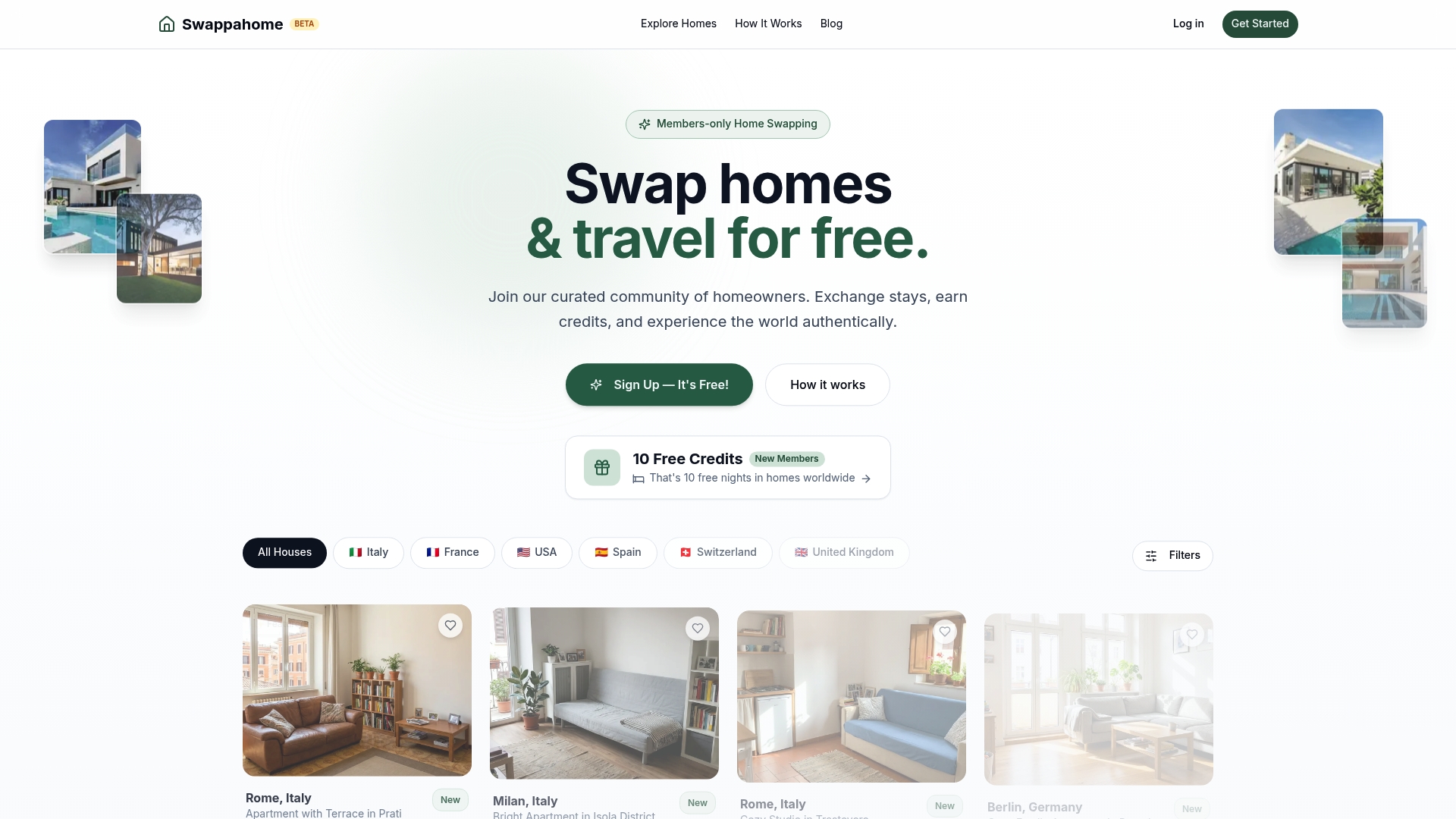 https://swappahome.com
New members receive free starter credits, so you can begin exploring before you've hosted a single guest. You can browse listings across dozens of countries right now to get a feel for what's available in your dream destinations. Joining takes minutes, and your first swap could be closer than you think.
Frequently asked questions
What is the difference between a home exchange and a vacation rental?
Home exchange means mutually swapping homes with another verified owner, typically at no cost per night, while vacation rentals involve paying to stay in someone else's property each night.
How much does joining a homeowner travel network cost?
Most platforms charge an annual membership fee to access the network, but there is no additional cost per night between homeowners once you're a member.
Is home swapping safe for my property?
Property damage and theft are rare and typically minor, thanks to identity verification, mutual review systems, and insurance coverage that can reach up to $1 million on some platforms.
Who is home exchange best suited for?
It's ideal for homeowners in desirable locations who plan trips at least six months ahead and want authentic, cost-saving travel without paying hotel rates.
What steps should I take to prepare for my first swap?
Create a detailed home profile, communicate your house rules clearly, secure valuables, and confirm all dates and expectations with your swap partner before finalizing.
Recommended
- Top 3 home swapping networks in 2026: save 90% on stays | SwappaHome Blog
- 7 Essential Types of Travel Communities Every Homeowner Should Know | SwappaHome Blog
- Travel planning checklist for home swapping homeowners | SwappaHome Blog
- How to Organize Travel Experiences for Home Swaps | SwappaHome Blog

Published by
SwappaHome
SwappaHome Editorial Team
Home Exchange & Slow Travel Editorial
The SwappaHome Editorial Team brings together travel research, home-exchange community insights, and platform data to produce practical guides for first-time and experienced home swappers. Every article cites real platforms, current market rates, and verifiable city-level facts so readers can make informed decisions without guessing.
Ready to try home swapping?
Join SwappaHome and start traveling by exchanging homes. Get 7 free credits when you sign up!