Your Guide to Safe Home Sharing in 2026

SwappaHome Editorial Team
Home Exchange & Slow Travel Editorial
Your Guide to Safe Home Sharing in 2026 !Homeowner checks smart lock for guest arrivals > TL;DR: > > - Sharing your home with guests can generate...
Your Guide to Safe Home Sharing in 2026
 Homeowner checks smart lock for guest arrivals
TL;DR:
- Sharing your home with guests can generate income and foster connections, but it involves risks like property damage and privacy concerns. Implementing security measures, clear agreements, and thorough documentation helps protect both hosts and guests, ensuring a safe and trustworthy home sharing experience. Preparation and communication are more effective than excessive surveillance in managing risks and building trust.
Sharing your home with guests can generate meaningful income and create genuine connections, but it also comes with real risks. Property damage, privacy concerns, unauthorized access, and unclear expectations top the list of fears most homeowners face before their first stay. This guide to safe home sharing walks you through every layer of protection, from securing your locks and valuables before guests arrive to managing interactions during stays and handling disputes after. If you want to share your home with confidence rather than anxiety, the following steps will get you there.
Table of Contents
- Key Takeaways
- Your guide to safe home sharing starts here
- Security prerequisites before any guest arrives
- House rules and written agreements
- Managing access, cameras, and guest interactions
- Fall prevention and physical safety modifications
- Verifying condition and handling disputes
- My honest take on trust and surveillance
- Share your home confidently with Swappahome
- FAQ
Key Takeaways
| Point | Details |
|---|---|
| Secure before the stay | Install smart locks with temporary codes and create a lockdown zone for valuables before any guest arrives. |
| Write clear agreements | A written house rules agreement prevents the vast majority of conflicts by defining expectations upfront. |
| Keep cameras exterior only | Limit surveillance to entrances and outdoor areas to maintain guest trust and avoid legal exposure. |
| Prevent physical accidents | Install grab bars, non-slip strips, and adequate lighting to protect guests unfamiliar with your home's layout. |
| Document everything | Photograph and video the home's condition before and after every stay to protect yourself in disputes. |
Your guide to safe home sharing starts here
Most home sharing problems are predictable. A guest who brings six friends when the booking said two. A dispute about who broke the towel rack. A panicked call at midnight because the WiFi stopped working. None of these scenarios are inevitable if you do the preparation work before anyone walks through your door.
The best practices for home sharing follow a clear sequence: secure the physical space, set written expectations, communicate during the stay, and verify condition before and after. When you treat each of these as non-negotiable steps rather than optional extras, you protect yourself, your property, and the guest experience. That last part matters more than most hosts realize.
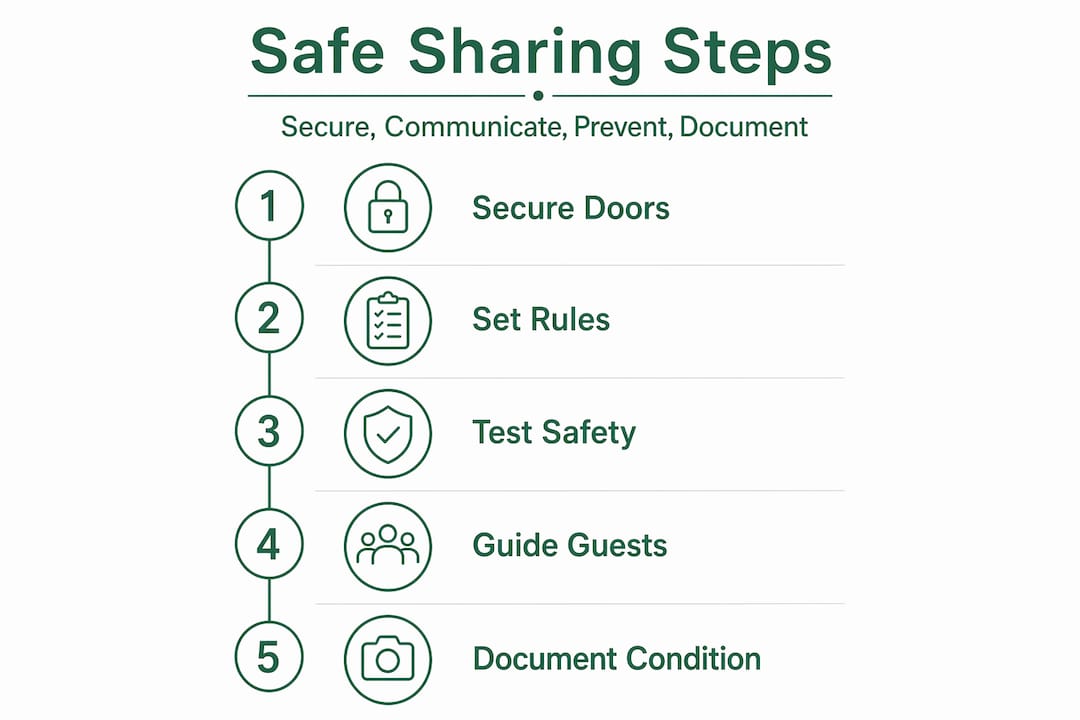 Five step home sharing safety infographic
Security prerequisites before any guest arrives
Before you hand over access to your home, spend time on the physical and digital security basics. These are not one-time fixes. Run through this checklist before every new stay.
Doors, windows, and access control
Start with the obvious entry points. Check every door lock, window latch, and sliding door stopper. Worn hardware is easy to miss when you live with it daily, but it stands out to a stranger and creates real vulnerability.
Smart locks with unique, time-limited codes significantly upgrade short-term rental security by removing physical keys from the equation entirely. You issue a code before arrival, the guest uses it during the stay, and you deactivate it the moment the checkout time passes. No key copying. No locksmith calls. No wondering whether your spare is still in someone's bag.
Protecting your valuables
Create what security professionals call a lockdown zone. This means storing irreplaceable items in a locked space before guests arrive, whether that's a locked bedroom, a small safe, or a secure cabinet. Passports, jewelry, financial documents, sentimental objects. Lock them away. This is not about distrusting guests. It's about removing the conditions that create problems.
A comparison of what to secure versus what can remain accessible:
| Category | Lock away | Leave accessible |
|---|---|---|
| Documents | Passports, financial records | House manual, emergency contacts |
| Electronics | Spare devices, cameras | Smart TV, kitchen appliances |
| Personal items | Jewelry, medications | Books, games, DVDs |
| Household tools | Power tools, spare keys | Basic toolkit for minor fixes |
Safety devices and digital privacy
Install functional smoke detectors and carbon monoxide detectors in every required area. Test them before the stay, not during. If yours are older than ten years, replace them.
 Guest tests smoke detector in bright living room
One step many hosts skip entirely: turn off geo-tagging on any photos you post publicly of your home. Metadata embedded in photos can reveal your exact address and home layout to anyone who knows where to look. This applies to listing photos, social media posts, and digital guidebook images.
Pro Tip: Before listing your home anywhere, run a reverse image search on your best exterior photo. If your full address populates alongside it, you need to adjust your privacy settings immediately.
House rules and written agreements
A spoken understanding is not an agreement. The single biggest source of conflict in home sharing is not bad guests. It's unclear expectations that two reasonable people interpret differently.
A written roommate or home-sharing rules agreement eliminates most of this friction. It defines what you expect, what happens when expectations aren't met, and what both parties agreed to before anything went wrong.
Here's what a strong house rules document should cover:
- Guest policy. How many people are permitted? Are overnight visitors allowed? If so, how many and under what circumstances?
- Quiet hours. Specify exact times, not vague references to "late at night."
- Cleaning responsibilities. Define what guests are expected to clean and what you handle yourself.
- Appliance use. Note anything off-limits or requiring special instructions, like a gas fireplace or a complicated espresso machine.
- Parking. Where can guests park? Are there permit requirements in your neighborhood?
- Pets. If none are allowed, state it explicitly. If they are, define where pets can and cannot go.
- Emergency contacts. Include local emergency numbers, your contact information, and the nearest urgent care or hospital.
Note the important distinction here. A private house rules agreement is different from a formal legal lease. For casual home swaps and short-term stays, a written document with both parties' acknowledgment provides practical protection. For stays involving monetary transactions over a longer period, consult a local attorney about what's legally required in your jurisdiction.
Digital guidebooks that bundle house rules, appliance instructions, and emergency procedures into one shareable link reduce guest questions dramatically and improve compliance. When guests have a reference they can pull up on their phone at midnight, they don't need to wake you up.
Pro Tip: Send your digital guidebook 48 hours before arrival, not on check-in day. Guests who read it in advance ask fewer questions and respect the space more consistently.
Managing access, cameras, and guest interactions
Issuing and revoking access
Smart locks shine brightest during the actual stay. Issue a unique code tied to the exact check-in and checkout window. Don't use a recurring code you've given to previous guests. Each stay should have its own code, generated fresh and deactivated after departure. This takes thirty seconds and eliminates an entire category of unauthorized-access risk.
When guests are on-site, keep all communications and payments on the home sharing platform you're using. Moving messages or money off-platform is one of the clearest signals of a scam in progress. Official platforms provide dispute protection and documented records. Off-platform exchanges provide neither.
Cameras and privacy
Exterior cameras and video doorbells give you accountability at entry points without invading anyone's privacy. A camera pointed at your front door and driveway is a reasonable security measure. A camera inside the living room or bedroom is a legal and ethical problem in almost every jurisdiction.
The rule is simple: monitor outdoor entrances, not indoor living spaces. Disclose all cameras in your listing and house rules. Guests who know a doorbell camera exists will not be surprised or offended. Guests who discover an undisclosed interior camera will report you, and they should.
Pro Tip: Check your local laws on rental surveillance before installing any camera. Many states have specific rules about disclosure requirements and prohibited locations.
The Swappahome host guide covers platform-specific guidance on managing guest interactions in ways that protect both parties.
Fall prevention and physical safety modifications
Why accidents happen to guests first
Your guests don't know where the step down to the back patio is. They don't know the bathroom floor gets slippery after a shower. They haven't memorized which stair creaks and which one's slightly shorter than the rest. You have. They haven't.
Falls are the leading cause of injury among adults 65 and older, and the physical modifications that prevent falls for seniors protect guests of any age who are simply unfamiliar with your home's quirks.
Here's what to address before any guest stay:
- Install grab bars beside the toilet and inside the shower or tub.
- Add non-slip strips to bathtub and shower floors.
- Secure loose rugs with non-slip backing or remove them entirely.
- Check stair handrails for stability and tighten any that wobble.
- Add nightlights in hallways, bathrooms, and stairwells.
- Remove floor-level obstacles from high-traffic paths.
The power of specific instructions
Specific actionable instructions do far more work than vague warnings. "Be careful on the stairs" tells a guest nothing useful. "Use the handrail when carrying anything on the stairs. The bottom step is two inches shorter than the others" tells them exactly what they need to know.
Put these instructions in your digital guidebook and on a printed card inside the front door. For guests arriving late or unfamiliar with the language, a visual diagram of hazard zones adds another layer of protection.
For safety guidance specific to hospitality environments beyond your home, this guide to villa safety covers many overlapping principles.
Verifying condition and handling disputes
Documentation is your only real protection in a disagreement about property damage. "I never touched that" and "It was already like that" cancel each other out without evidence. Timestamped photos and video do not.
| Approach | Without documentation | With documentation |
|---|---|---|
| Damage disputes | He-said-she-said with no resolution | Timestamped evidence supports your claim |
| Security deposit returns | Pressure to refund without cause | Clear basis for deductions if needed |
| Platform reviews | Difficult to counter false claims | Evidence supports your response |
| Future guest expectations | Repeating same problems | Adjust house rules based on patterns |
Walk through the entire property before every check-in. Record video of all rooms, appliances, furnishings, and outdoor areas. Send the guest a check-in message noting the home's condition to create a documented timestamp. Repeat after every checkout.
When disputes arise, keep communication written and on-platform. Reference your house rules document directly. Most conflicts resolve quickly when both parties have a shared written agreement to consult. For ongoing safety improvements, review your setup after every few stays and update your house rules accordingly. The community standards at Swappahome offer a useful framework for what responsible hosting looks like at the platform level.
My honest take on trust and surveillance
After spending years thinking about what makes home sharing work, the thing I keep coming back to is this: most hosts are solving the wrong problem.
The instinct is to monitor. Install cameras, track keypad entries, check whether guests are following the rules in real time. I understand that impulse completely. But in my experience, over-monitoring is the fastest way to create the adversarial dynamic you're trying to prevent. Guests who feel watched behave defensively. Guests who feel trusted behave like the people you want staying in your home.
What actually protects you is preparation and documentation. Not surveillance. A thorough house rules document, a digital guidebook with real instructions, a lockdown zone for valuables, and timestamped photos before and after every stay. These do more meaningful work than a camera pointed at the living room couch.
The uncomfortable truth about home sharing security is that most of the risk lives in the gap between what hosts assume guests know and what guests actually know about the space. Close that gap with information and your risk profile drops considerably. Add clear agreements on top and you've handled 90% of the scenarios that make hosts anxious.
That's the actual guide to safe home sharing. Prepare thoroughly, communicate specifically, and trust people enough to give them a chance to meet your expectations.
— Swappa
Share your home confidently with Swappahome
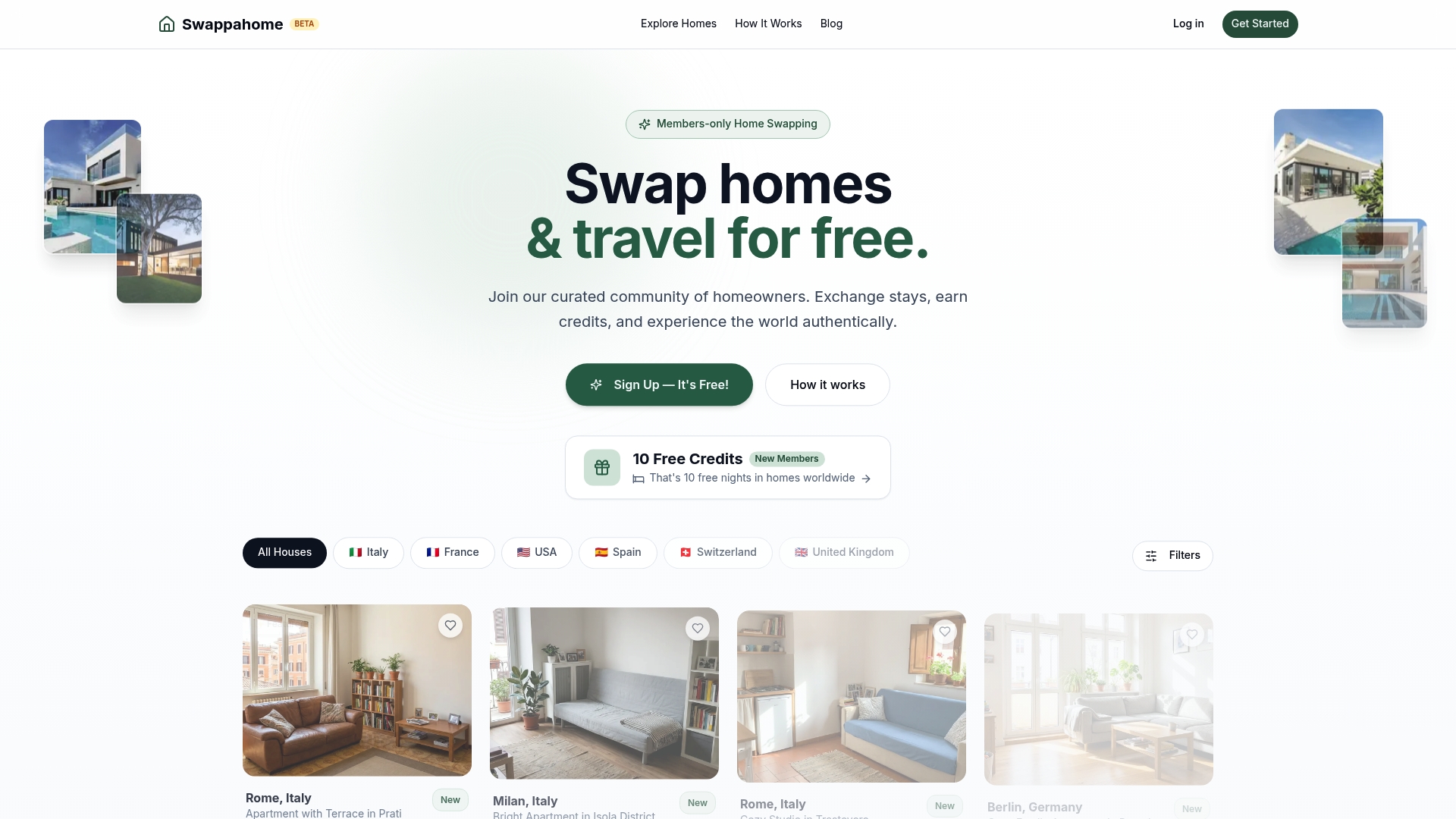 https://swappahome.com
Swappahome is built around the idea that home sharing works best inside a community of verified, accountable hosts. Every member goes through a verification process, and the platform's credit-based system means you stay in someone's home after you've already offered yours. That structure creates mutual investment in positive outcomes.
If you're ready to put this home sharing security guide into practice, list your home on Swappahome and access a global network of vetted homeowners who share your commitment to respectful, well-managed stays. You can also browse available listings to see what's possible before you commit. First-time members receive free credits to get started, making it easy to experience the platform from both sides before your first swap.
FAQ
What is the safest way to control access during a home swap?
Use a smart lock that generates unique, time-limited codes for each guest. Deactivate the code immediately after checkout to prevent any ongoing access.
Do I need a written agreement for a home swap?
Yes. A written house rules document defines expectations for both parties and gives you a clear reference point if a dispute arises. It does not need to be a formal lease for short-term swaps.
Where can I place cameras when sharing my home?
Cameras are appropriate at exterior entry points like front doors and driveways. Interior cameras in living spaces or bedrooms are prohibited by most home sharing platforms and illegal in many jurisdictions.
How do I prevent accidents in my home during a guest stay?
Install grab bars, non-slip strips, and stair handrails, and remove loose rugs from high-traffic areas. Pair these modifications with specific written safety instructions in your house rules so guests know exactly what to watch for.
What should I do if a guest damages my property?
Refer to your pre-stay documentation, including timestamped photos and video, and your written agreement. Keep all dispute communication on-platform and reference your house rules directly. Most platforms have formal dispute resolution processes that require this kind of evidence.
Recommended

Published by
SwappaHome
SwappaHome Editorial Team
Home Exchange & Slow Travel Editorial
The SwappaHome Editorial Team brings together travel research, home-exchange community insights, and platform data to produce practical guides for first-time and experienced home swappers. Every article cites real platforms, current market rates, and verifiable city-level facts so readers can make informed decisions without guessing.
Ready to try home swapping?
Join SwappaHome and start traveling by exchanging homes. Get 7 free credits when you sign up!