Amsterdam Home Exchange for Remote Workers: Finding Workspaces That Actually Work

SwappaHome Editorial Team
Home Exchange & Slow Travel Editorial
Discover how to find the perfect Amsterdam home exchange with dedicated workspaces. Real tips from 7 years of remote work swaps across the Netherlands.
The WiFi dropped for the third time that morning. I watched my video call freeze mid-sentence while presenting to clients in Singapore. I was staying in what the listing described as a "digital nomad paradise" in Amsterdam—turns out paradise had a router from 2012 and a desk chair that belonged in a medieval torture museum.
That was four years ago. I've since done six home exchanges in Amsterdam, and I've learned exactly what separates a productive remote work setup from a beautiful-but-useless Instagram backdrop. If you're planning an Amsterdam home exchange for remote work, let me save you from my WiFi nightmares.
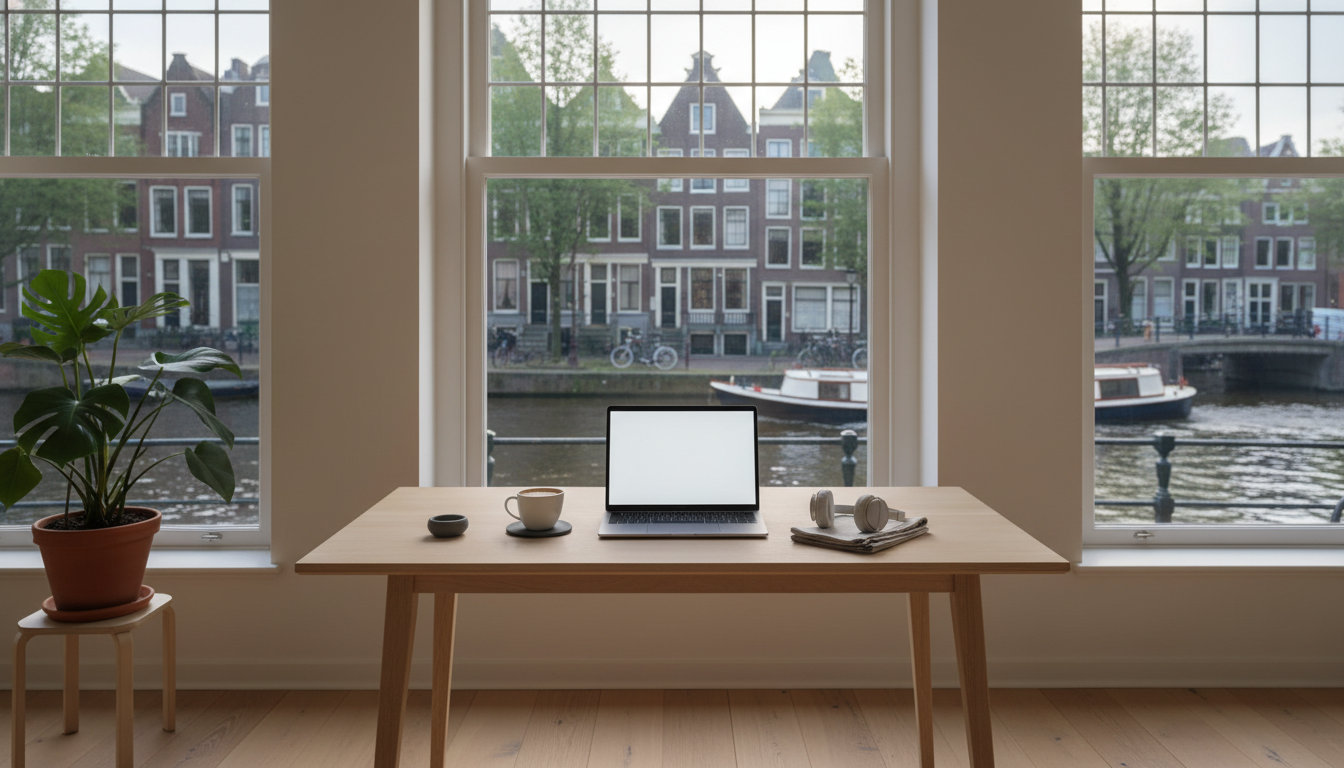 Morning light streaming through tall Dutch windows onto a minimalist wooden desk with laptop, coffee
Why Amsterdam Home Exchange Works for Remote Workers
Here's what nobody tells you about working remotely from Amsterdam: the city is genuinely built for it. Not in a "we have coworking spaces" way—every city has those now—but in a deeper, infrastructural sense.
The Netherlands has some of the fastest internet in Europe. We're talking average speeds of 100+ Mbps, with fiber connections increasingly common in residential areas. When you do an Amsterdam home exchange, you're often getting better WiFi than your office back home.
But it's more than bandwidth. Dutch apartments tend to have dedicated workspace areas because the Dutch actually respect work-life boundaries. Shocking concept, I know. They've been doing hybrid and remote work longer than most countries, which means home offices aren't afterthoughts—they're designed spaces.
And then there's the timezone advantage. Amsterdam sits perfectly for bridging US and Asian business hours. I can take a 7 AM call with Tokyo, work my European day, and still catch a 5 PM meeting with New York. Try doing that from Bali.
The cost savings? Substantial. A decent hotel in Amsterdam runs €150-250 per night ($160-270 USD). Extended stay apartments with proper workspaces? €2,500-4,000 per month ($2,700-4,300 USD). A home exchange through SwappaHome? You're spending credits you earned hosting—potentially saving thousands over a month-long stay.
Best Amsterdam Neighborhoods for Remote Work Home Exchanges
Not all Amsterdam neighborhoods are created equal for remote workers. After testing most of them, here's my honest breakdown.
De Pijp: The Sweet Spot
De Pijp is where I'd send anyone doing their first Amsterdam home exchange for remote work. It's got the energy of a creative neighborhood without the chaos of the city center. The Albert Cuypmarkt is a 5-minute walk from most apartments—perfect for grabbing lunch supplies without losing your workflow.
The apartments here tend to be newer renovations with proper home office setups. Lots of young professionals live in De Pijp, which means lots of potential swap partners who understand what remote workers need. I've found three different home exchanges here with standing desks, external monitors, and ergonomic chairs.
Cafés for backup workspace: Scandinavian Embassy (unlimited WiFi, €4 filter coffee), Coffee & Coconuts (in a converted cinema, three floors of seating), and Bakers & Roasters for when you need a proper brunch break.
Jordaan: Charming but Check the Details
The Jordaan is objectively gorgeous—all those canal houses and hidden courtyards you've seen on Pinterest. But gorgeous comes with caveats.
Those historic buildings often mean narrow staircases (getting a standing desk up four flights is a nightmare), smaller rooms, and sometimes inconsistent heating. The WiFi is usually fine, but older buildings can have thick walls that create dead zones.
That said, my favorite Amsterdam home exchange ever was in the Jordaan. A ground-floor apartment with a garden workspace—actual garden, actual desk, actual productive mornings. The key is asking the right questions before booking.
If you're set on Jordaan, look for apartments in buildings that have been recently renovated. The ones near Westerstraat tend to have better infrastructure than the deeper canal-side properties.
 Cozy home office corner in a traditional Amsterdam canal house, exposed brick wall, ergonomic chair,
Oost: The Underrated Choice
Amsterdam Oost doesn't get the attention it deserves. It's where actual Amsterdammers live—young families, creative professionals, people who've been priced out of the center but want to stay close.
The Dappermarkt area has some of the best value home exchanges in the city. Larger apartments, often with dedicated spare rooms that function as proper offices. The neighborhood has a different vibe—more diverse, less touristy, genuinely lived-in.
I spent three weeks in Oost last autumn, working from a converted attic space with skylights. The commute to the center was 15 minutes by bike (which is nothing by Amsterdam standards), and I had twice the space I would've gotten in the Jordaan for the same swap value.
Pro tip: Look for places near Oosterpark. The park itself is excellent for walking meetings or afternoon breaks, and the surrounding streets have great café density.
Noord: For the Adventurous
Amsterdam Noord used to be industrial wasteland. Now it's the city's creative hub—think Brooklyn circa 2010, but with better public transport.
The free ferry from Centraal Station takes 5 minutes and runs 24/7. Once you're across the IJ, you've got massive converted warehouses, artist studios, and increasingly, residential lofts with the kind of open-plan layouts that make for incredible home office setups.
NDSM Wharf is the heart of it—a former shipyard now housing creative businesses, restaurants, and some genuinely unique living spaces. I've seen home exchange listings here for converted shipping containers (surprisingly comfortable) and industrial lofts with 20-foot ceilings.
The downside: Noord still feels disconnected from "real" Amsterdam. If you want to pop out for dinner in the center, you're adding 30 minutes to your evening. For a focused work trip where you don't need constant access to the tourist areas, it's perfect. For a balanced work-and-explore stay, maybe look elsewhere.
What to Look for in an Amsterdam Home Exchange Workspace
After that disastrous first trip, I developed a checklist. I'm not exaggerating when I say this has saved my productivity—and my sanity—on every Amsterdam home exchange since.
Internet: The Non-Negotiable
Ask for a speed test. Seriously. Before you confirm any home exchange for remote work, request that your host run a speedtest.net check and send you the results. You want minimum 50 Mbps download, 20 Mbps upload. For video calls, 100+ Mbps is ideal.
Also ask about the router location. If the workspace is three rooms away from the router, those speeds won't matter. I've started asking hosts if they have ethernet cables available—hardwiring your connection eliminates most video call issues.
One more thing: ask about backup options. Does the building have a café nearby with reliable WiFi? Is there a coworking space within walking distance? Even the best home setup can fail, and having a Plan B matters.
The Desk Situation
This sounds obvious, but you'd be surprised how many "home office" listings mean a kitchen table and an IKEA chair.
Ask specifically: Is there a dedicated desk? What are the dimensions? Is there a proper desk chair (not a dining chair, not a stool)? Is there natural light at the desk during working hours?
Standing desk converts: ask if they have one, or if there's a counter-height surface you could use. I've worked from kitchen islands, bar tables, and one memorable ironing board situation in a pinch.
 Infographic showing ideal home office setup for remote workers desk dimensions, chair height, monito
The Ergonomic Details
I'm 32, and my back already hates me for years of laptop-on-couch work. These days, I ask about external monitor availability (game-changer for long work sessions), keyboard and mouse if they have them, desk lamp or task lighting, and room temperature control—Dutch buildings can run cold.
Most hosts who work from home themselves will have these things. If they don't, it's a sign the workspace might be more theoretical than practical.
Noise and Privacy
Amsterdam is a city of thin walls and open windows. That charming canal-side apartment might come with a soundtrack of tourist boats, bicycle bells, and the neighbor's enthusiastic morning routines.
Ask your potential host: What's the noise level like during working hours? Is the workspace in a separate room with a door? Are there neighbors with unusual schedules?
I once did a home exchange where the workspace was technically great—good desk, fast WiFi, ergonomic chair—but it was in the living room of an open-plan apartment. Every time my host's cat decided to stage a dramatic performance, my video calls became cat content.
How to Find Amsterdam Home Exchanges with Great Workspaces
The SwappaHome platform doesn't have a "remote work ready" filter (yet—hint hint), so finding the right Amsterdam home exchange for remote work requires some detective work.
Profile Deep-Diving
Look for hosts who mention their own remote work in their profiles. "I work from home as a designer" or "freelance writer based in Amsterdam" are green flags. These people understand what you need because they need it too.
Photos matter more than descriptions. Scan for images of actual workspace areas—not just the pretty living room shots. If there's no photo of a desk area, there probably isn't a real desk area.
The Right Questions to Ask
Once you've found promising listings, send a message introducing yourself and your work situation. I usually say something like:
"I'm a travel writer who works remotely, usually 6-8 hours a day with video calls twice weekly. I'm looking for a space where I can be productive while experiencing Amsterdam. Could you tell me about your home office setup? Specifically: internet speeds, desk/chair situation, and noise levels during work hours?"
Good hosts will give you detailed answers. Vague responses are a warning sign.
Timing Your Search
Amsterdam's best home exchange inventory for remote workers appears in the shoulder seasons—March through May and September through November. Summer brings tourists looking for vacation swaps (less likely to have work setups), and winter... well, Dutch winters are an acquired taste.
Start your search 6-8 weeks before your planned dates. The really good workspaces get snapped up quickly, especially in De Pijp and Oost.
 Split view of Amsterdam canal in autumn with golden leaves, and interior shot of someone working at
Making Your Amsterdam Home Exchange Work-Ready
Sometimes you find an almost-perfect space that needs a little optimization. Here's what I bring and what I do in the first 24 hours.
My Remote Work Travel Kit
I never leave home without my portable laptop stand (the Roost is my favorite—folds flat, weighs nothing), compact wireless keyboard and mouse, noise-canceling earbuds, a 5-meter ethernet cable (you'd be surprised how often this saves me), universal power adapter with USB ports, and a portable phone charger for backup.
This kit adds maybe 2 pounds to my luggage and has rescued countless work days.
The First-Day Setup Ritual
When I arrive at any new Amsterdam home exchange, I do the same thing before I even unpack properly. Test the WiFi from the workspace (not the living room—the actual desk). Find the router and check if ethernet is possible. Adjust the chair and desk height. Identify the best lighting setup for video calls. Locate the nearest café with WiFi as backup. Do a test video call with a friend to check audio/video quality.
This takes maybe 30 minutes and prevents the panic of discovering problems during an actual work call.
Building a Routine in a New Space
Amsterdam's rhythm is different from most cities. Things open late (10 AM is early for shops), lunch is often just a quick broodje at your desk, and the real social life happens after 5 PM.
I've found my most productive Amsterdam schedule starts around 7 AM—wake up, coffee, check urgent messages. Then 8 to noon is my deep work block when Amsterdam is quiet. Noon to 1 PM I'll bike to a market or café for lunch, walk around a bit. Afternoons from 1 to 5 are for meetings, collaborative work, and emails. After 5? That's when I actually explore, meet people, have a life.
The key is protecting those morning hours. Amsterdam's café culture makes it tempting to "work from a coffee shop"—resist this during your peak productivity hours. Save the café sessions for lighter work or reading.
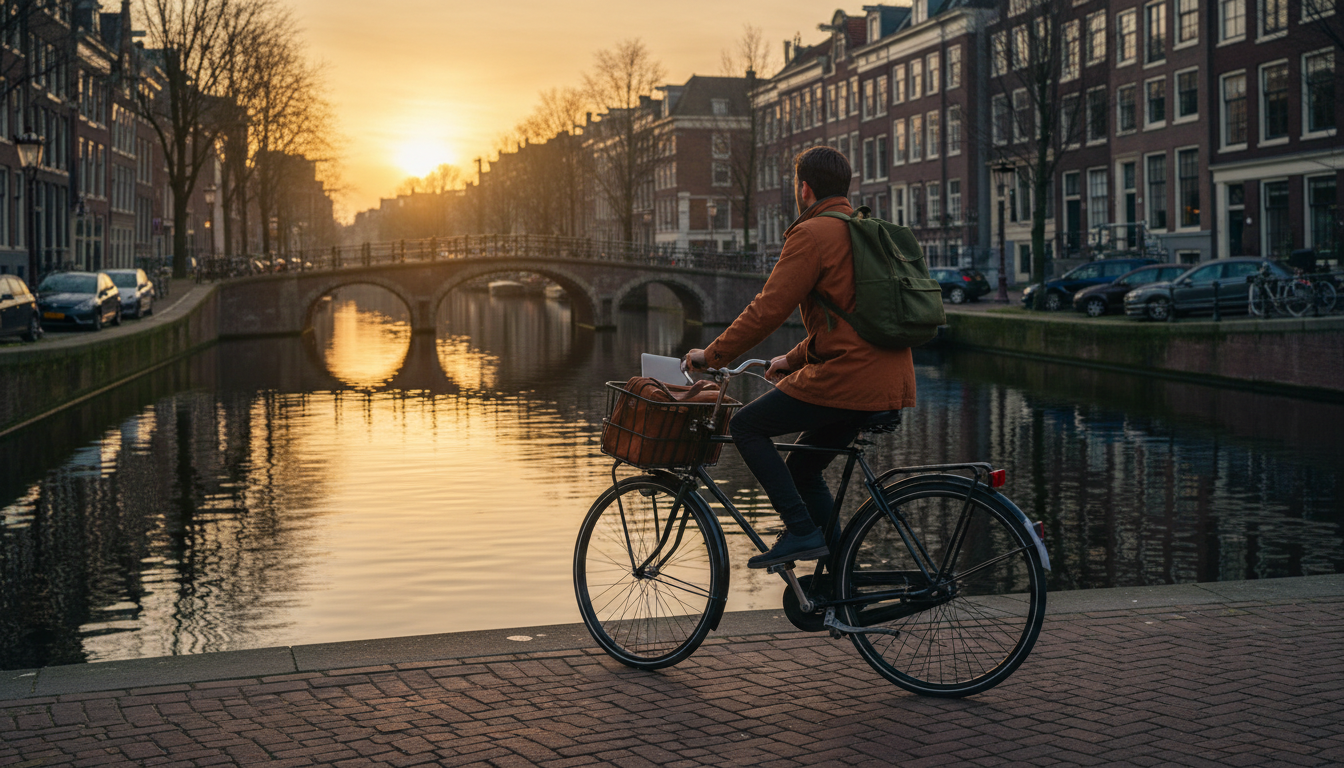 Person on a classic Dutch bicycle riding along a canal in morning light, laptop bag in front basket,
Beyond the Home Office: Amsterdam's Remote Work Ecosystem
Even with a perfect home exchange workspace, you'll want options. Amsterdam has a robust ecosystem for remote workers that complements your home base.
Coworking Spaces for Occasional Use
Most Amsterdam coworking spaces offer day passes, which is perfect for home exchange workers who need a change of scenery or have a big presentation day.
Spaces I've actually used and recommend: WeWork Metropool at Weesperplein runs about €35 for a day pass and is reliable for important calls. The Thinking Hut in Oost is smaller and quieter at €25/day with a great community vibe. Zoku near Amstel is part hotel, part coworking, with a gorgeous rooftop for €40/day. And B. Amsterdam in Oost has that startup hub energy at €30/day—interesting for networking.
I usually hit a coworking space once a week during longer stays—partly for the environment, partly to meet other remote workers.
Cafés That Actually Work for Work
Not all cafés want you camping out with a laptop. These ones do: Lot Sixty One in Jordaan has specialty coffee, good WiFi, and is laptop-friendly until 3 PM. Coffee & Coconuts in De Pijp has three floors, so you'll always find a spot. De Wasserette (multiple locations) is designed for laptop workers with all-day breakfast. Dignita in Jordaan and De Pijp is a social enterprise with great food and a work-friendly atmosphere.
Unwritten rule: buy something every 90 minutes or so. It's just good karma.
Libraries and Public Spaces
The Openbare Bibliotheek Amsterdam (Central Library) near Centraal Station is genuinely one of the best free workspaces in Europe. Seven floors, fast WiFi, café on the top floor with panoramic views, and a vibe that's somehow both productive and relaxed.
Get there before 10 AM for the best spots. After lunch, it fills up with students and tourists.
The Social Side: Meeting Other Remote Workers
One thing I didn't expect from my Amsterdam home exchanges: the community. Amsterdam has a thriving remote work scene, and it's surprisingly easy to tap into.
Meetup groups are active here—search for "Digital Nomads Amsterdam," "Remote Workers NL," or "Freelancers Amsterdam." Events range from casual coffee meetups to more structured networking.
Slack communities like Remote Workers Amsterdam and Dutch Digital Nomads have active channels for meetups, coworking buddy requests, and local tips.
And honestly? Just talk to people at cafés. The Dutch are direct—if you're both clearly working on laptops, striking up a conversation about remote work is completely normal. I've gotten some of my best local tips from random café encounters.
Practical Logistics for Extended Stays
If you're planning an Amsterdam home exchange for remote work lasting more than a few weeks, some practical considerations:
Legal Stuff
EU citizens can stay indefinitely. Everyone else gets 90 days in the Schengen zone without a visa. If you're American, Canadian, Australian, or from most other Western countries, that 90-day window is usually plenty for a remote work stint.
Important: you're not legally "working in the Netherlands"—you're working remotely for your existing employer or clients while traveling. This is a gray area that most countries tolerate for short stays. Don't advertise it, don't take local clients, and you'll be fine.
Banking and Money
The Netherlands is increasingly cashless, but not completely. Get a card with no foreign transaction fees (Wise, Revolut, or similar). Most places accept cards, but market vendors and some smaller shops still prefer cash.
ATMs (look for "Geldmaat") are everywhere. Avoid the tourist-trap exchange offices—they have terrible rates.
Health Considerations
Bring your own health insurance that covers international travel. The Netherlands has excellent healthcare, but accessing it as a tourist means private clinics and out-of-pocket costs.
Pharmacies ("apotheek") can handle minor issues and often have English-speaking staff. For anything serious, the OLVG hospital has an international department.
Getting Around
Rent a bike. I'm not being cute—this is genuinely the best way to experience Amsterdam as a resident rather than a tourist. Monthly rentals run €50-80 ($55-85 USD) from places like MacBike or Swapfiets.
The public transport (trams, buses, metro) is excellent if biking isn't your thing. Get an anonymous OV-chipkaart and load it up—way cheaper than buying individual tickets.
When Things Go Wrong
Real talk: not every home exchange is perfect. I've had a workspace that looked great in photos but had a chair that squeaked with every movement. I've dealt with WiFi that worked fine until my host's teenager started gaming.
Here's how I handle issues:
Minor problems (squeaky chair, slow WiFi at certain times): Adapt. Use a coworking space for important calls, work around the limitations. It's part of the adventure.
Medium problems (workspace unusable, major noise issues): Communicate with your host immediately. Most SwappaHome members want you to have a good experience—they'll often offer solutions like a different room or a nearby café they can vouch for.
Major problems (no WiFi at all, safety concerns): This is rare, but it happens. Have a backup plan—know which hotels nearby have day rates for workspace access, which coworking spaces can accommodate last-minute bookings.
The beauty of the SwappaHome credit system is that you're not financially locked in the way you would be with a paid rental. If something is genuinely unworkable, you can have an honest conversation about cutting the stay short.
Is Amsterdam Home Exchange Right for Your Remote Work Style?
After all these words, let me be honest: Amsterdam home exchange for remote work isn't for everyone.
It's great if you're comfortable with some uncertainty and adaptation, if you value authentic local experiences over predictability, have flexible work hours (or can schedule around timezone differences), want to save money on accommodation for longer stays, and enjoy the process of making a new space your own.
It might not be great if you have back-to-back video calls all day requiring perfect reliability, need absolute quiet and control over your environment, are traveling for a short trip (under 2 weeks) where setup time matters more, or prefer knowing exactly what you're getting before you arrive.
For me, the trade-offs are worth it. The money I save on Amsterdam home exchanges funds better experiences—nicer dinners, day trips to Haarlem or Utrecht, that random canal boat tour that turned into one of my favorite travel memories.
And there's something about working from someone's actual home, surrounded by their books and plants and slightly-too-many-bikes-in-the-hallway, that makes a city feel real in a way hotels never can.
If you're ready to try it, SwappaHome is where I find most of my Amsterdam exchanges. The credit system means you can host travelers at your place, earn credits, and use them for your Amsterdam workspace adventure—no direct swap required. Start with those 7 free credits new members get and see what's available in your target dates.
Amsterdam is waiting. And somewhere in De Pijp or Oost or maybe even Noord, there's a desk with your name on it—metaphorically speaking. The WiFi is fast, the coffee is strong, and the canals are doing that thing where they reflect the sky in ways that make you stop typing and just stare for a minute.
That's not a bad way to work.
Frequently Asked Questions
Is home exchange in Amsterdam safe for remote workers?
Amsterdam home exchange is generally very safe. The city consistently ranks among Europe's safest capitals, and SwappaHome's review system helps you vet potential hosts before committing. Most remote workers find Dutch hosts particularly reliable and communicative. Consider getting your own travel insurance for extra peace of mind during extended stays.
How much can I save with Amsterdam home exchange versus hotels?
Substantial savings are typical. Amsterdam hotels average €150-250 per night ($160-270 USD), meaning a month-long stay costs €4,500-7,500. With SwappaHome's credit system, you're exchanging hospitality rather than money—potentially saving $5,000+ monthly while getting larger spaces with proper workspaces.
What internet speed do I need for remote work in Amsterdam?
Aim for minimum 50 Mbps download and 20 Mbps upload for reliable video calls. Most Amsterdam residential connections exceed 100 Mbps. Always ask potential hosts to run a speed test before confirming your exchange. Dutch internet infrastructure is among Europe's best, so poor connections are rare.
Which Amsterdam neighborhood is best for remote workers?
De Pijp offers the best balance for most remote workers—good cafés, newer apartments with proper workspaces, central location, and a professional demographic. Oost provides more space for less, while Jordaan offers charm but requires more careful vetting of workspace setups. Noord suits creative workers who don't need constant center access.
How far in advance should I book an Amsterdam home exchange?
Start searching 6-8 weeks before your planned dates for the best selection of work-ready spaces. Shoulder seasons (March-May, September-November) offer the strongest inventory of professional hosts. Summer brings more vacation-focused swaps with fewer dedicated workspaces available.

Published by
SwappaHome
SwappaHome Editorial Team
Home Exchange & Slow Travel Editorial
The SwappaHome Editorial Team brings together travel research, home-exchange community insights, and platform data to produce practical guides for first-time and experienced home swappers. Every article cites real platforms, current market rates, and verifiable city-level facts so readers can make informed decisions without guessing.
Ready to try home swapping?
Join SwappaHome and start traveling by exchanging homes. Get 7 free credits when you sign up!
Related articles

Bachelor and Bachelorette Parties in Singapore: The Complete Home Swap Group Guide for 2026
Planning a bachelor or bachelorette party in Singapore? Discover how home swapping lets groups of 6-12 stay together in luxury condos, saving thousands while partying in Marina Bay.

Cycling in Lisbon: 7 Home Swap Bike Tour Itineraries for Every Rider
Discover the best cycling routes in Lisbon with these home swap bike tour itineraries—from waterfront paths to hilltop adventures, all starting from your borrowed home.

Graduation Trip to Barcelona: How Home Swapping Gives New Graduates the Ultimate Celebration
Planning a graduation trip to Barcelona? Discover how home swapping lets new graduates explore Spain's most vibrant city without the hostel crowds or hotel costs.