
Chevy Chase movie Christmas Vacation: Cast, plot, where to watch, and why it remains a holiday classic

SwappaHome Editorial Team
Home Exchange & Slow Travel Editorial
Key Takeaways National Lampoon’s Christmas Vacation is a 1989 holiday comedy led by Chevy Chase as Clark Griswold. Its story turns an ordinary family Christmas…
Key Takeaways
National Lampoon’s Christmas Vacation is a 1989 holiday comedy led by Chevy Chase as Clark Griswold. Its story turns an ordinary family Christmas into an escalating series of disasters. The film remains popular because its broad jokes sit alongside recognizable family tension and seasonal pressure. Streaming and rental availability can change, so viewers should check current listings before settling in. It is rated PG-13 and includes adult humor, profanity, suggestive references, and slapstick violence.
- The film is the third entry in the Vacation series.
- Clark Griswold’s perfect Christmas plans unravel almost immediately.
- Chevy Chase and Beverly D’Angelo anchor the family comedy.
- The movie’s chaotic set pieces have become familiar holiday rituals.
- Its content makes it better suited to teens and adults than young children.
What to know about the Chevy Chase movie Christmas Vacation
The chevy chase movie christmas vacation usually means National Lampoon’s Christmas Vacation, a holiday comedy built around one family’s determination to have a flawless celebration. The movie combines domestic frustration, physical comedy, and a very large number of Christmas lights. It is broad and sometimes crude, but its central anxiety is easy to recognize. Clark wants the kind of holiday everyone remembers fondly, even when the effort makes everyone miserable.
The official title and its place in the National Lampoon series
The official title is National Lampoon’s Christmas Vacation. It is the third film in the Vacation series, following the Griswold family on a holiday adventure that stays mostly at home rather than sending them across the country. A useful look at the film’s making and legacy places it within the wider series and its John Hughes connection.
When the movie was released
The movie was released in 1989 and directed by Jeremiah S. Chechik, from a story and screenplay associated with John Hughes. Its late-1980s setting gives the comedy a particular texture, from the clothes and interiors to the family rituals. That period detail now adds a layer of nostalgia to jokes that were already designed to feel timeless.
The basic premise of the Griswold family’s holiday
Clark Griswold decides to create a traditional, old-fashioned Christmas for his wife Ellen and their children. He approaches every detail as a personal project, from the tree and decorations to the hoped-for workplace bonus. The trouble is that his optimism does not come with much judgment, so each solution creates another problem.
Why the film became a seasonal tradition
The film became a seasonal tradition because its structure is easy to revisit: familiar preparations, mounting interruptions, and a finale that pushes everything past the point of reason. Viewers can remember the major disasters while still enjoying the timing of smaller jokes. It also offers a comforting thought for anyone whose own holiday has gone slightly wrong: things could be much worse.
The cast and characters
The cast gives the movie its rhythm. Chevy Chase plays Clark as a man whose confidence is always several steps ahead of reality, while Beverly D’Angelo provides Ellen with patience, warmth, and occasional exasperation. Around them, relatives and neighbors turn a private family gathering into a noisy public event.
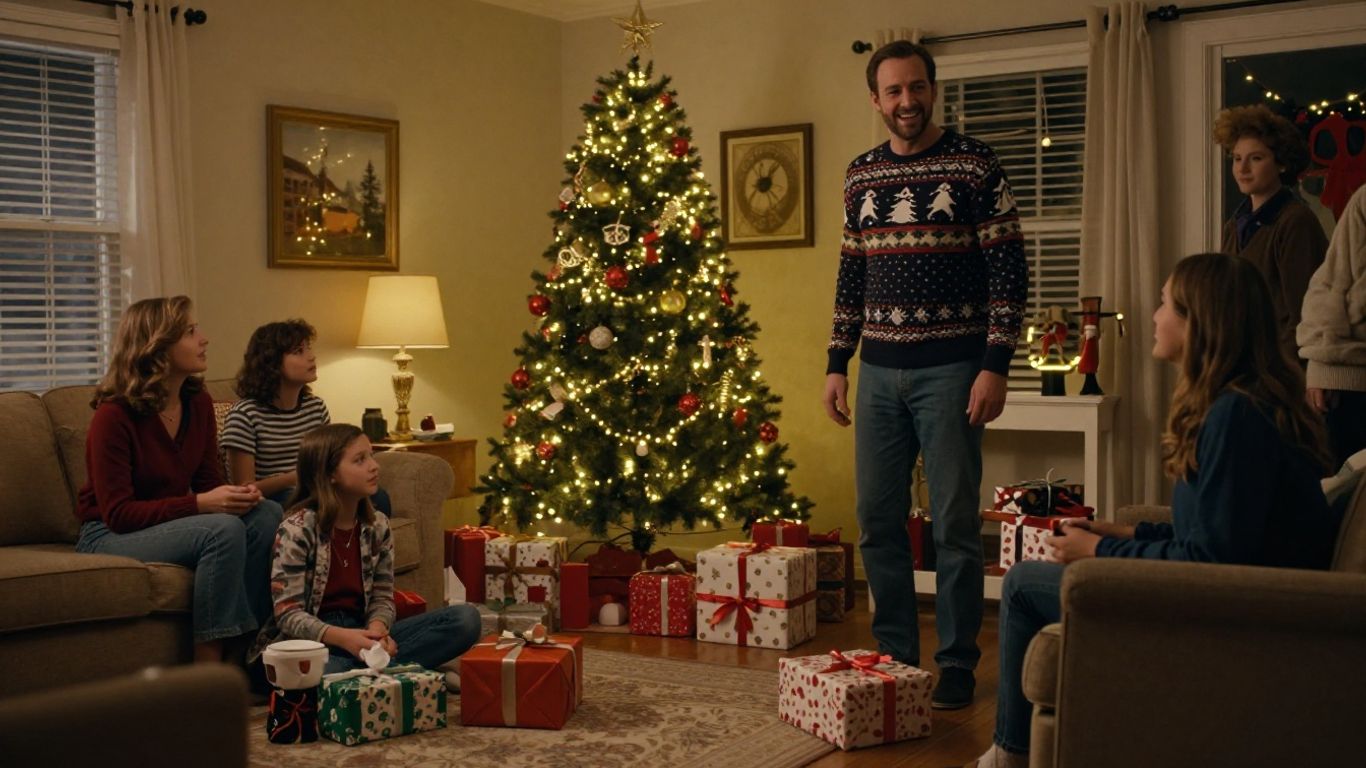 Chevy Chase and family in festive living room
Chevy Chase as Clark Griswold
Chevy Chase makes Clark both ridiculous and strangely sincere. Clark’s behavior can be selfish and reckless, but his wish to give his family a memorable Christmas is genuine. Chase’s performance works because the character never realizes how close he is to losing control until the situation has already become absurd.
Beverly D’Angelo as Ellen Griswold
Beverly D’Angelo’s Ellen is the steady center of the household. She understands Clark’s good intentions but is less impressed by his grand plans, especially when they create extra work for everyone else. Her reactions make the family’s exasperation legible without turning her into a mere straight character.
The Griswold children and their changing roles
Audrey and Rusty are played by Juliette Lewis and Johnny Galecki in this installment. As teenagers, they add their own embarrassment, sarcasm, and impatience to the family mix. The children’s changing performers across the series are part of the franchise’s unusual history, but here their role is clear: they are old enough to understand the chaos and young enough to be trapped inside it.
Supporting characters who drive the comedy
Randy Quaid’s Cousin Eddie is the most disruptive arrival, bringing his family, his shabby recreational vehicle, and an alarming lack of boundaries. The older relatives, neighbors, coworkers, and visiting family members widen the film’s comic circle. Each person applies a little more pressure to a household already struggling to contain Clark’s ambitions.
The family dynamics behind the film’s humor
The humor comes from affection colliding with obligation. Nobody gets to enjoy a quiet holiday because everyone carries a different expectation of what Christmas should be. Clark wants admiration, Ellen wants peace, the children want distance, and the relatives mostly want to be included on their own terms.
The plot and most memorable moments
The plot follows a straightforward line, but the interruptions keep multiplying. Clark starts with a plan for an ideal family Christmas and then encounters accidents, unwanted guests, financial disappointment, and household chaos. The movie’s memorable moments are less about surprise than escalation: each new problem makes the previous one seem manageable.
Clark’s ambitious Christmas plans
Clark wants to decorate the house, choose an impressive tree, host the extended family, and provide a generous holiday experience. He also expects a Christmas bonus that would help pay for a swimming pool. Those goals make the celebration feel less like a gathering and more like a campaign, with Clark refusing to retreat even when retreat would be sensible.
The search for the perfect Christmas tree
The tree search is one of the film’s clearest early signs that Clark’s idealized Christmas has little connection to practical reality. He takes the family out to find something grand and traditional, treating the outing as a meaningful ritual. The eventual result carries the movie’s familiar pattern: a sentimental goal produces discomfort, damage, and another problem to solve.
The house decorating disaster
Clark’s exterior decorations become a visual expression of his obsession. He keeps adding lights and equipment until the house looks less like a home than a glowing challenge to the neighborhood. The spectacle is funny because it is both childish and painstaking; he has worked very hard to create something that makes ordinary life impossible.
The unexpected arrival of relatives and guests
The arrival of relatives changes the scale of the story. Cousin Eddie and the other guests bring their own habits, needs, and unresolved tensions into the Griswold home. A family that was already crowded with expectations now has to share limited space, limited patience, and one increasingly fragile holiday plan.
How the chaotic finale unfolds
The finale gathers the movie’s separate frustrations into one prolonged breakdown. Financial worries, family resentment, holiday decorations, and outside authority all collide as Clark continues trying to force a happy ending. The resolution is deliberately excessive, yet it leaves room for the idea that togetherness can survive even a spectacularly bad celebration.
Where to watch National Lampoon’s Christmas Vacation
Where to watch National Lampoon’s Christmas Vacation depends on the time of year, the viewer’s location, and the licensing decisions of individual services. A listing that is accurate one month may be outdated the next. For a useful cast and availability reference, readers can consult this Christmas Vacation viewing guide, then confirm the current option directly in their preferred service.
 Christmas movie playing beside holiday decorations
Streaming availability and subscription options
The movie may appear on a subscription streaming service during a seasonal window, but those windows are not permanent. Search the exact title inside the service rather than relying on an old holiday article or a remembered listing. If a subscription option is available, check whether the film is included with the plan or offered as a separate rental.
Digital rental and purchase platforms
Digital storefronts commonly offer older holiday films for rent or purchase. Rental periods, playback windows, picture quality, subtitle options, and pricing can differ, so the cheapest headline price is not the only useful comparison. Buying may make sense for households that watch the film every December, while renting suits a one-night viewing.
Physical media and holiday television airings
A DVD or other physical edition can be dependable when streaming rights move around. Television airings are another seasonal possibility, especially for viewers who enjoy watching alongside a scheduled family broadcast. Both options can include advertisements or different edits, so expectations should be set before the opening scene.
How availability can vary by location
Streaming catalogs are often shaped by regional licensing. A movie available in one country may be absent from another, and the same title can move between services without much warning. Travelers using a home exchange service such as SwappaHome should also remember that the catalog available during a stay may reflect the host location rather than the viewer’s home market.
What to check before choosing a viewing option
Before pressing play, check the title, runtime, rating, language options, subtitles, and whether the listing is included in a subscription. Families may also want to confirm the content rating first, since this is not a children’s Christmas movie in the same sense as a gentle animated special. That small check can prevent an awkward surprise halfway through the evening.
Why the movie remains popular
The film has lasted because it understands that holiday cheer can become a performance. Clark’s decorations, gifts, and hosting plans are attempts to prove something about his family and himself. The comedy turns that pressure into spectacle, but the emotional situation remains familiar enough to keep the movie from feeling empty.
Relatable pressure to create a perfect Christmas
Many viewers recognize the desire to make one gathering feel unusually special. The movie exaggerates that desire until it becomes dangerous, but the original impulse is ordinary: a parent wants the children to remember a happy holiday. Clark’s failure is funny partly because his goal is so recognizable.
The balance of slapstick and family comedy
The slapstick is loud, physical, and often intentionally cartoonish. Yet the movie keeps returning to family disagreements, marriage, money, and embarrassment. That combination gives the disasters a little weight; the jokes are not happening in an empty world but inside relationships that have to continue after the credits.
Quotable scenes and memorable holiday imagery
The dialogue, decorations, tree, lights, and cramped gatherings have become part of the movie’s identity. Viewers often remember an expression, a reaction, or a visual gag as much as a line. The imagery is especially effective because it takes familiar Christmas objects and pushes them into spectacularly impractical territory.
Nostalgia for late-1980s Christmas entertainment
The movie carries the look and pace of late-1980s studio comedy. Its suburban interiors, clothing, cars, and workplace assumptions now give it a period flavor, even when the family frustrations remain current. That combination lets older viewers revisit a remembered era while younger viewers enjoy the film as a time capsule.
How annual rewatching turned it into a tradition
Repeated viewing changes the experience. The first time, the escalation may feel unpredictable; later, the pleasure comes from anticipating the next interruption and watching everyone react. Like many holiday favorites, it becomes attached to rituals outside the movie itself: a particular night, a familiar snack, or a gathering of relatives.
Content notes for families and first-time viewers
National Lampoon’s Christmas Vacation is rated PG-13 and is aimed more at teens and adults than small children. Its holiday setting can make it look gentler than it is, especially in a family streaming menu. A quick content check is worthwhile for anyone planning a mixed-age viewing.
Adult humor and comic situations
The film includes sexual humor, drinking-related material, rude behavior, and situations built around embarrassment. Much of the comedy depends on adults behaving badly in front of relatives or strangers. Viewers who prefer clean, quiet holiday stories may find its tone more aggressive than expected.
Profanity and suggestive references
Profanity appears throughout the movie, alongside suggestive comments and jokes. The language is part of the broader late-1980s comedy style rather than an occasional exception. Parents deciding whether to watch with teenagers should consider both the wording and the context in which it is used.
Physical comedy and chaotic scenes
There are falls, accidents, property damage, dangerous mishaps, and moments of comic peril. The action is played for laughs, with an exaggerated style that keeps it from feeling like realistic drama. Even so, younger or sensitive viewers may not enjoy the intensity of the household breakdown.
Themes involving family conflict and holiday stress
The story includes arguments, financial pressure, disappointment, crowded living conditions, and tension between relatives. Its positive thread is the persistence of family connection, but the route to that idea is noisy and uncomfortable. The film can prompt a useful conversation about how expectations make holidays harder when nobody is willing to adjust them.
How the movie compares with modern family comedies
Compared with many contemporary family comedies, this movie is less polished in its behavior and more comfortable with crude jokes. It does not offer a calm model of communication or carefully balanced screen time for every character. Its appeal comes from comic excess, which means viewers should choose it for that unruly style rather than expecting a soft seasonal story.
The film’s legacy in holiday pop culture
The movie has become one of the recognizable faces of modern Christmas comedy. Its appeal is not based on a perfect family or an ideal celebration; it comes from watching ordinary seasonal ambitions become impossible to control. A broader Christmas Vacation overview also helps explain why its production history and recurring characters remain part of the conversation.
Its connection to the broader National Lampoon franchise
The film belongs to a franchise built around travel, family embarrassment, and the gap between good intentions and actual results. This installment changes the setting but preserves the basic engine: Clark pursues a memorable experience while everyone around him pays the price. The Christmas framework makes the formula especially easy to revisit each year.
How Clark Griswold became a Christmas comedy icon
Clark is memorable because he is not simply a fool. He is energetic, hopeful, stubborn, and desperate to be seen as the person who delivers the perfect holiday. His confidence makes the disasters larger, while his affection for his family keeps him from becoming entirely unlikeable.
Merchandise, quotes, and holiday references
The film’s lights, tree, sweater-weather interiors, and Cousin Eddie references are easy to recognize outside the movie. Quotes and visual callbacks appear in seasonal conversations, decorations, and comedy routines. That familiarity allows people to participate in the tradition even when they have not watched the entire film recently.
Comparisons with other classic Christmas movies
Some Christmas movies offer romance, wonder, or gentle family reconciliation. This one offers exasperation, spectacle, and a household barely holding together. Its place among holiday favorites comes from that difference: it gives viewers permission to laugh at the parts of Christmas that are too crowded, expensive, or chaotic to feel magical in the moment.
Why audiences continue to revisit it each season
Annual viewers know the major beats, yet the movie remains comfortable background entertainment and a dependable group watch. Its jokes are tied to rituals that return every year, while its central frustration never becomes entirely outdated. Even people who would never copy Clark’s methods can understand why he keeps trying.
Conclusion
National Lampoon’s Christmas Vacation endures because it turns the pressure of a perfect holiday into a generous, unruly comedy about family, pride, and persistence. Chevy Chase’s Clark Griswold may create nearly every problem in sight, but his determination gives the film its warmest quality: beneath the wreckage, he really does want everyone together.
Frequently Asked Questions
What is the official title of the Chevy Chase Christmas movie?
The official title is National Lampoon’s Christmas Vacation. It is commonly shortened to Christmas Vacation in conversation.
When was National Lampoon’s Christmas Vacation released?
The film was released in 1989. It is the third movie in the Vacation series.
Who plays Clark Griswold?
Chevy Chase plays Clark Griswold, the enthusiastic father whose plans for a perfect Christmas repeatedly go wrong.
Who plays Ellen Griswold?
Beverly D’Angelo plays Ellen Griswold. Ellen is Clark’s wife and often the calmer, more practical presence in the family.
Is Christmas Vacation suitable for young children?
The movie is rated PG-13 and includes profanity, adult humor, suggestive references, and comic violence. Parents may prefer to preview it or watch it with older teenagers.
Why does Clark want a Christmas bonus?
Clark expects a workplace bonus and has already imagined how it could help pay for a swimming pool. The expected money becomes one of several pressures behind his increasingly frantic holiday behavior.
Where can viewers watch the movie?
Availability changes by country, service, and season. Viewers should check current subscription catalogs, digital rental stores, physical editions, and local television listings before watching.

Published by
SwappaHome
SwappaHome Editorial Team
Home Exchange & Slow Travel Editorial
The SwappaHome Editorial Team brings together travel research, home-exchange community insights, and platform data to produce practical guides for first-time and experienced home swappers. Every article cites real platforms, current market rates, and verifiable city-level facts so readers can make informed decisions without guessing.
Ready to try home swapping?
Join SwappaHome and start traveling by exchanging homes. Get 7 free credits when you sign up!