
Definition of tourism: Meaning, types, scope, and importance

SwappaHome Editorial Team
Home Exchange & Slow Travel Editorial
Key Takeaways Tourism is more than taking a trip. It is a temporary movement outside a person’s usual environment, shaped by purpose, length of stay,…
Key Takeaways
Tourism is more than taking a trip. It is a temporary movement outside a person’s usual environment, shaped by purpose, length of stay, destination, and the services that make the experience possible.
- Tourism involves visitors traveling outside their usual environment.
- Trips may be taken for leisure, business, cultural, or personal reasons.
- Tourists stay temporarily and generally return to their usual place of residence.
- Tourism includes both visitor experiences and the services that support them.
- Arrivals, overnight stays, spending, and visitor surveys help measure tourism.
What is the definition of tourism?
The definition of tourism brings together movement, time, purpose, and activity. A person leaves their usual environment for a limited period and takes part in experiences or activities at the destination. The trip may be close to home or cross an international border, and it may be motivated by relaxation, work, culture, or another personal reason.
The core meaning of tourism
Tourism is commonly understood as the movement of people to places outside their usual environment for a temporary period. The activity can have social, cultural, and economic dimensions, because visitors interact with places, residents, businesses, and public services. A useful tourism terminology glossary also shows why the word includes both travel behavior and the spending connected with a visit.
Tourism is therefore not limited to famous attractions or long vacations. A short city break, a family visit combined with sightseeing, and a work-related trip can all fall within its broad scope when the traveler is visiting temporarily and is not taking a job with a resident employer.
Who qualifies as a tourist?
A tourist is generally an overnight visitor: someone who travels outside their usual environment and spends at least one night at the destination. The wider category is the visitor, which can include both tourists and same-day visitors. This distinction matters because a person can participate in tourism without booking accommodation.
The purpose of the trip may be leisure, business, education, visiting friends and relatives, health, religion, or another personal activity. People traveling as part of their regular job, moving permanently to a new home, or traveling to receive long-term institutional care are usually treated differently in tourism statistics.
Tourism, travel, and migration compared
Travel is the broadest term. It describes movement from one place to another, whether the reason is a holiday, a daily commute, a permanent relocation, or a work assignment. Tourism is narrower because it concerns visitors and their temporary activities outside the usual environment.
Migration involves a lasting or extended change in a person’s place of residence. Tourism, by contrast, normally ends with a return to the traveler’s usual environment. The distinction can feel less obvious in cases such as long stays or digital work, which is why official frameworks use residence, duration, and purpose together rather than relying on distance alone.
The role of time, distance, and purpose
Time helps separate a visitor from a resident. International statistical practice commonly uses a stay of less than one year as a broad boundary, although national surveys may apply additional rules for domestic travel. Distance can also be relevant, but the more useful idea is whether someone has left their ordinary surroundings.
Purpose completes the picture. A trip taken to attend a conference may be tourism even though it is not leisure, while a journey made to take up permanent employment is generally outside tourism. These criteria make the concept flexible enough for real life while keeping it consistent enough for research.
The main characteristics of tourism
Tourism has several features that distinguish it from ordinary movement. It involves a visitor, a destination, a temporary change of surroundings, and activities that take place away from home. It also creates relationships between travelers, residents, businesses, and public institutions.
A trip can feel highly personal, but tourism is also a connected system. Transport schedules, accommodation, restaurants, attractions, safety, local customs, and digital information all influence what visitors can do and how destinations experience their presence.
Movement away from the usual environment
The first characteristic is movement beyond the setting where a person normally lives, works, studies, and carries out everyday errands. The boundary is not identical for everyone. A nearby rural area may be outside one person’s usual environment while remaining part of another person’s routine.
This is why tourism cannot be defined only by a fixed number of miles. A traveler’s normal patterns, the purpose of the trip, and the destination context all help determine whether the movement is tourism-related.
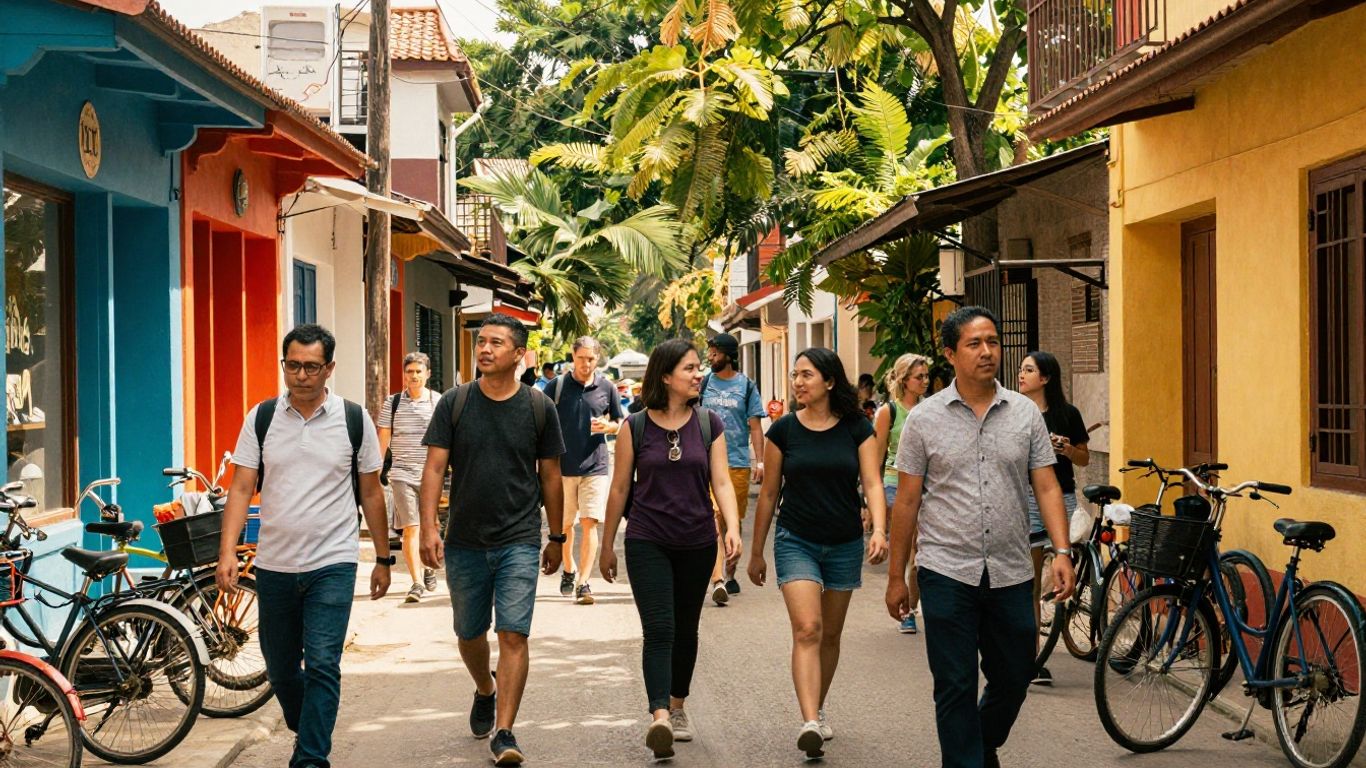 Travelers exploring a lively destination neighborhood
Temporary stays and return travel
Tourism is temporary by nature. Visitors may stay for a few hours, a weekend, or several months, but the trip is understood as separate from establishing a new permanent residence. Overnight visitors are tourists in the stricter statistical sense, while same-day visitors return without spending a night.
Return travel is a useful practical signal, though it is not always immediate. Someone may visit several destinations during one journey before returning home. The key point is that tourism does not usually transfer the traveler’s long-term center of life to the destination.
Non-remunerated activities at the destination
Visitors may spend money, volunteer informally, attend meetings, explore museums, or rest on a beach. What they generally do not do is take employment from a resident entity in the place visited. This separates tourism from labor migration and from travel that is an ordinary part of someone’s occupation.
The activities themselves can vary widely. Tourism includes passive experiences, such as enjoying scenery, as well as active participation in festivals, sports, food traditions, learning, and social events. Purpose shapes the trip even when two travelers visit the same place.
Experiences involving visitors and hosts
Tourism is shaped by an exchange between visitors and the communities they enter. Hosts provide services, stories, food, guidance, and places to stay, while visitors bring spending, curiosity, expectations, and sometimes pressure on local resources.
That relationship can be direct, as in a family-run guesthouse, or indirect, as in a public park maintained for both residents and visitors. Home exchange is another example of a travel arrangement built around local living; SwappaHome describes compact, well-connected homes and a credit-based exchange model for travelers seeking a neighborhood experience.
Types of tourism explained
Tourism can be classified in several ways, and the categories often overlap. One classification looks at where the traveler lives and where the trip takes place. Another focuses on purpose, such as leisure or business, while a third highlights the setting or style of the experience.
These labels are useful because they help destinations understand demand and plan services. They should not be treated as rigid boxes: one visitor might take a domestic cultural trip that includes nature activities, wellness, and a business meeting.
Domestic and international tourism
Domestic tourism occurs when residents travel within their own country but outside their usual environment. It may involve a weekend in another region, a visit to a national park, or a city trip that requires an overnight stay. No international border crossing is necessary.
International tourism involves travel to a country other than the traveler’s country of usual residence. It can be inbound, when visitors arrive in a country, or outbound, when residents leave it. International trips add considerations such as passports, currency, language, visas, and border procedures.
Inbound, outbound, and internal tourism
Inbound tourism describes visitors arriving in a destination from elsewhere. Outbound tourism describes residents traveling to foreign destinations. Internal tourism combines domestic and inbound tourism, covering visits that take place within a country by both its residents and nonresidents.
These terms are especially helpful for national tourism offices. A country may have strong inbound demand but also a large domestic market, and the two groups can use different transport, accommodation, and information services.
Leisure, business, and cultural tourism
Leisure tourism includes holidays, recreation, visiting friends and relatives, and personal escapes. Business tourism includes conferences, trade events, meetings, and other professional purposes, provided the traveler is not being employed by a resident entity at the destination.
Cultural tourism centers on heritage, arts, cuisine, traditions, museums, festivals, and everyday community life. A traveler can combine all three forms in one itinerary. For example, a conference attendee may extend a work trip to visit historic districts and local restaurants.
Nature-based, adventure, and wellness tourism
Nature-based tourism takes place in landscapes such as forests, coastlines, wetlands, and mountain areas. Adventure tourism often adds physical activity, outdoor participation, cultural interaction, or a degree of perceived risk. Wellness tourism may focus on rest, health practices, spas, retreats, or activities intended to support personal well-being.
The categories are defined by the experience rather than by one particular destination. A coastal trip could be nature-based and wellness-oriented, while a mountain journey might combine adventure, cultural exchange, and leisure. The SwappaHome home exchange description for Thailand, for instance, connects independent travel with local neighborhoods and access to varied cultural and natural experiences without changing the general meaning of these tourism types.
The key components of tourism
Tourism works because several elements meet in one journey. There must be people willing and able to travel, a destination with something to offer, a way to reach it, and services that support the stay. Information, safety, public spaces, payment systems, and local governance also influence the result.
Thinking in components makes the definition practical. It shows why a beautiful attraction alone does not create a functioning tourism economy, and why a destination’s success depends on coordination across many separate organizations.
Tourists and visitor demand
Visitors create demand through their choices about when to travel, where to go, how long to stay, and what to buy or do. Their interests may be shaped by income, available time, transport prices, weather, culture, accessibility, safety, and personal recommendations.
Demand is not simply a head count. Two visitors may produce very different effects if one stays for a month and cooks at home while another stays briefly and spends heavily on tours, restaurants, and entertainment. Understanding these differences helps destinations plan more intelligently.
Destinations and attractions
A destination is the place where the visitor’s experience unfolds. It may be a city, region, resort, island, rural area, or collection of connected communities. Attractions can be natural, cultural, built, seasonal, or event-based.
The attraction draws attention, but the surrounding setting determines much of the experience. Clean public areas, local character, clear information, accessible facilities, and a sense of welcome can matter as much as the central landmark.
Transportation and accessibility
Transportation connects visitors with destinations and with the places they explore after arrival. Airports, railways, roads, ferries, buses, walking routes, and local mobility services all affect the practical reach of tourism.
Accessibility also includes affordability, reliable information, physical access, and ease of navigation. A destination may be geographically close yet difficult to visit if connections are infrequent or essential services are unavailable. Good planning considers the entire journey, not just the final attraction.
Accommodation, food, and supporting services
Accommodation gives visitors a place to stay, while food services, guides, retailers, entertainment venues, booking systems, and visitor information fill out the trip. Public services such as waste collection, emergency response, and infrastructure support the same experience from behind the scenes.
Different travel styles call for different arrangements. A home exchange can place a visitor in a residential neighborhood, and SwappaHome documents identity verification, secure communication, and credits earned through hosting as part of its exchange model. Those details describe that service specifically; they are not universal features of every tourism provider.
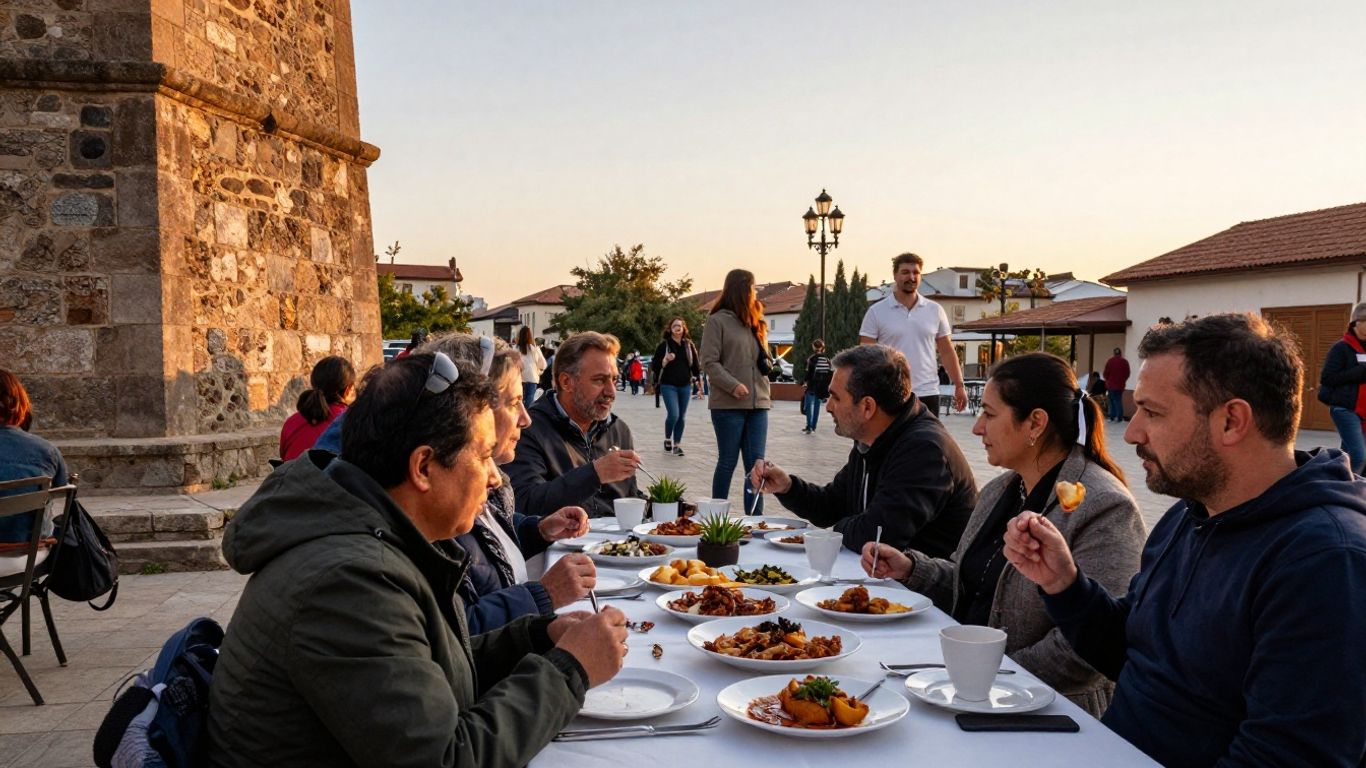 Visitors sharing a meal near a historic landmark
Why tourism is important
Tourism matters because it links personal experiences with wider economic and social activity. Visitors purchase transport, accommodation, food, entertainment, and cultural experiences, while destinations manage the benefits and pressures that follow. The results can be valuable, but they are not automatic.
A balanced view asks who receives the income, who carries the costs, and whether local communities have a meaningful role in decisions. Well-managed tourism can support places; poorly managed tourism can strain housing, ecosystems, public services, and cultural life.
Economic contributions and employment
Tourism supports direct jobs in hotels, restaurants, attractions, transport, guiding, and event services. It also creates indirect demand for farmers, designers, cleaners, builders, technology providers, and many other suppliers.
Spending by visitors can diversify a local economy and help small businesses reach customers beyond their resident population. At the same time, tourism employment may be seasonal or vulnerable to economic shocks, so strong planning should avoid treating visitor spending as a guaranteed substitute for a broad economic base.
Cultural exchange and community development
Visitors and residents can learn from one another through food, language, art, music, stories, and ordinary daily encounters. Tourism can create income for craftspeople and cultural organizations while encouraging the care of historic places and living traditions.
The quality of exchange depends on respect and local control. Communities should have room to decide how their culture is shared, how visitors behave in sensitive places, and how tourism revenue supports residents rather than only outside owners.
Infrastructure and regional growth
Tourism can encourage investment in roads, public transport, sanitation, broadband, parks, museums, and public spaces. These improvements may benefit residents as well as visitors, particularly in smaller towns that have previously received limited investment.
Growth can also spread beyond famous centers when travelers are guided toward lesser-known communities. That shift works best when destinations have the capacity to receive visitors without displacing residents or exhausting local services.
Environmental opportunities and risks
Nature-based tourism can provide a financial reason to conserve landscapes, wildlife, and protected areas. Visitor fees, guided experiences, and conservation partnerships may help fund stewardship when they are carefully designed.
Tourism can also increase emissions, waste, water use, congestion, and damage to fragile habitats. Responsible management therefore includes visitor limits where needed, efficient transport, careful construction, local monitoring, and honest communication about environmental trade-offs.
Tourism is strongest when the visitor experience and the resident experience can improve together.
The principle is simple, but applying it requires evidence and participation. Environmental and social goals should be built into destination planning from the beginning, rather than added after growth has already created problems.
How tourism is measured and classified
Tourism measurement turns individual journeys into information that governments, researchers, businesses, and communities can use. It counts visitors, tracks nights and spending, examines travel purposes, and compares activity across places and periods.
No single number captures tourism completely. Arrivals show volume, while spending, length of stay, employment, resident attitudes, and environmental indicators reveal different parts of the picture. Consistent definitions are essential when results are compared between regions or countries.
Tourist arrivals and visitor spending
Tourist arrivals count visits entering a destination or passing through a reporting system. Depending on the source, the figure may count trips rather than unique people, so frequent travelers can appear more than once. Visitor spending adds another dimension by showing the economic activity associated with those trips.
Researchers may also examine seasonality, origin markets, purpose of travel, transport mode, and destination region. Together, these measures show not only how many people arrive but also when they come and what kinds of activity they generate.
Overnight visitors and same-day visitors
Overnight visitors spend at least one night at the destination and are generally classified as tourists. Same-day visitors, sometimes called excursionists, arrive and leave without an overnight stay. Both groups can visit attractions, eat locally, use transport, and contribute to congestion.
Separating them prevents a destination from overlooking short visits. A cruise passenger, day-tripper, or regional shopper may create substantial demand even though hotel occupancy data will not capture the visit.
Tourism receipts and economic impact
Tourism receipts refer to expenditure connected with visitors, often recorded through surveys, business data, payment information, or national accounts. Economic impact studies may then estimate direct, indirect, and induced effects, though the results depend heavily on the methods and assumptions used.
A careful analysis also considers leakage, seasonal employment, public costs, imports, and the distribution of income. A large spending total does not necessarily mean that residents receive a large or evenly shared benefit.
The tourism measurement framework explains why consistent concepts are needed when collecting and comparing tourism data. A shared framework makes local findings easier to interpret alongside national or international statistics.
Official definitions and statistical standards
Official definitions specify who counts as a visitor, what qualifies as a trip, how residence is determined, and how duration and purpose are recorded. The international concept of a visitor generally covers a traveler going outside their usual environment for less than a year, for a main purpose other than employment by a resident entity at the destination.
These standards are not merely technical language. They shape tourism policy, business forecasts, destination budgets, and public debates about growth. Readers who want the central statistical distinctions can consult this guide to visitor classification, including the difference between national and international visitors and examples of travelers who are excluded.
Statistics become more useful when their definitions and limitations are visible. Asking who was counted, which trips were included, and how spending was estimated is often as important as reading the final figure.
Conclusion
Tourism is the temporary movement of visitors outside their usual environment, together with the activities, services, relationships, and effects connected with that movement. Its types range from domestic leisure trips to international business travel and nature-based experiences, while its importance reaches into jobs, culture, infrastructure, and environmental management. Understanding the concept clearly makes tourism data easier to read and destination decisions easier to evaluate.
Frequently Asked Questions
What is the simplest definition of tourism?
Tourism is the temporary travel of people outside their usual environment for leisure, business, or another personal purpose, along with the activities connected with the visit.
What is the difference between a tourist and a visitor?
A visitor is the wider category. A tourist is usually an overnight visitor, while a same-day visitor returns without spending a night at the destination.
Is domestic travel considered tourism?
Yes. Domestic tourism occurs when residents travel within their own country but outside their usual environment, whether or not the trip includes an overnight stay.
Is business travel a type of tourism?
Yes, business travel can be tourism when it is temporary and the traveler is not taking employment with a resident entity in the destination.
How long can a tourist stay?
Tourism is temporary, and international statistical standards commonly use less than one year as a broad upper boundary for visitor status. National systems may add more specific rules.
Why are tourism statistics separated into overnight and same-day visits?
The distinction shows how many visitors use accommodation and how many make shorter visits. Both groups can spend money and affect a destination, but their patterns and impacts may differ.
Why is tourism important to local communities?
Tourism can support jobs, businesses, cultural activities, infrastructure, and conservation. Its benefits depend on planning, fair distribution of income, and management of environmental and social pressures.

Published by
SwappaHome
SwappaHome Editorial Team
Home Exchange & Slow Travel Editorial
The SwappaHome Editorial Team brings together travel research, home-exchange community insights, and platform data to produce practical guides for first-time and experienced home swappers. Every article cites real platforms, current market rates, and verifiable city-level facts so readers can make informed decisions without guessing.
Ready to try home swapping?
Join SwappaHome and start traveling by exchanging homes. Get 7 free credits when you sign up!