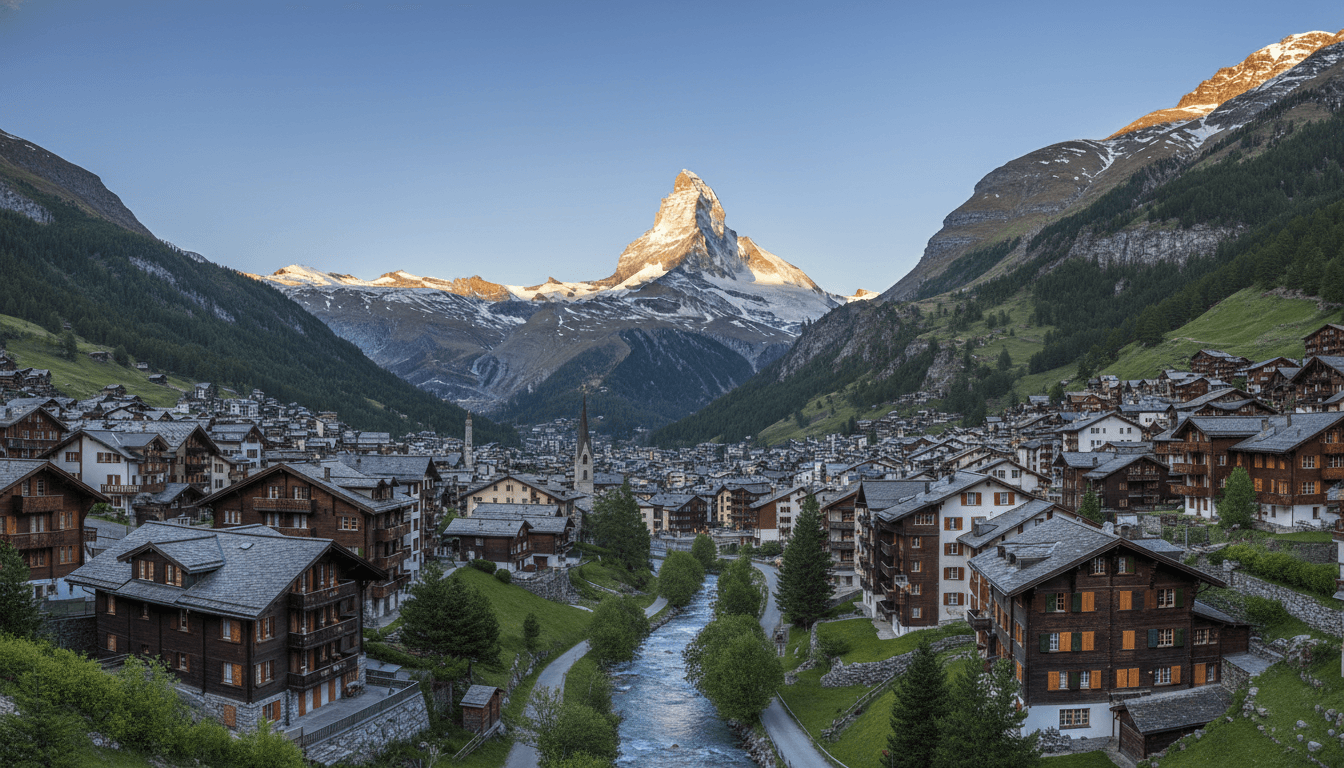
Digital Nomad Home Swap in Zermatt: Your Complete Guide to Remote Work in the Alps

SwappaHome Editorial Team
Home Exchange & Slow Travel Editorial
Discover how to work remotely from Zermatt through home swapping. Real tips on WiFi, coworking, costs, and living like a local beneath the Matterhorn.
The first time I saw the Matterhorn from a living room window, I was on a video call with a client in Singapore. They asked why I was smiling so much. I turned my laptop around to show them the view—14,692 feet of iconic Swiss peak, dusted with fresh snow, framed by wooden shutters that probably cost more than my first car.
That's the thing about doing a digital nomad home swap in Zermatt: it sounds almost too good to be real. A car-free Alpine village, world-class skiing, and you're supposed to believe you can actually get work done there? I was skeptical too. But after spending six weeks spread across two different home exchanges in this mountain town, I can tell you—it's not only possible, it might be the most productive remote work setup I've ever had.
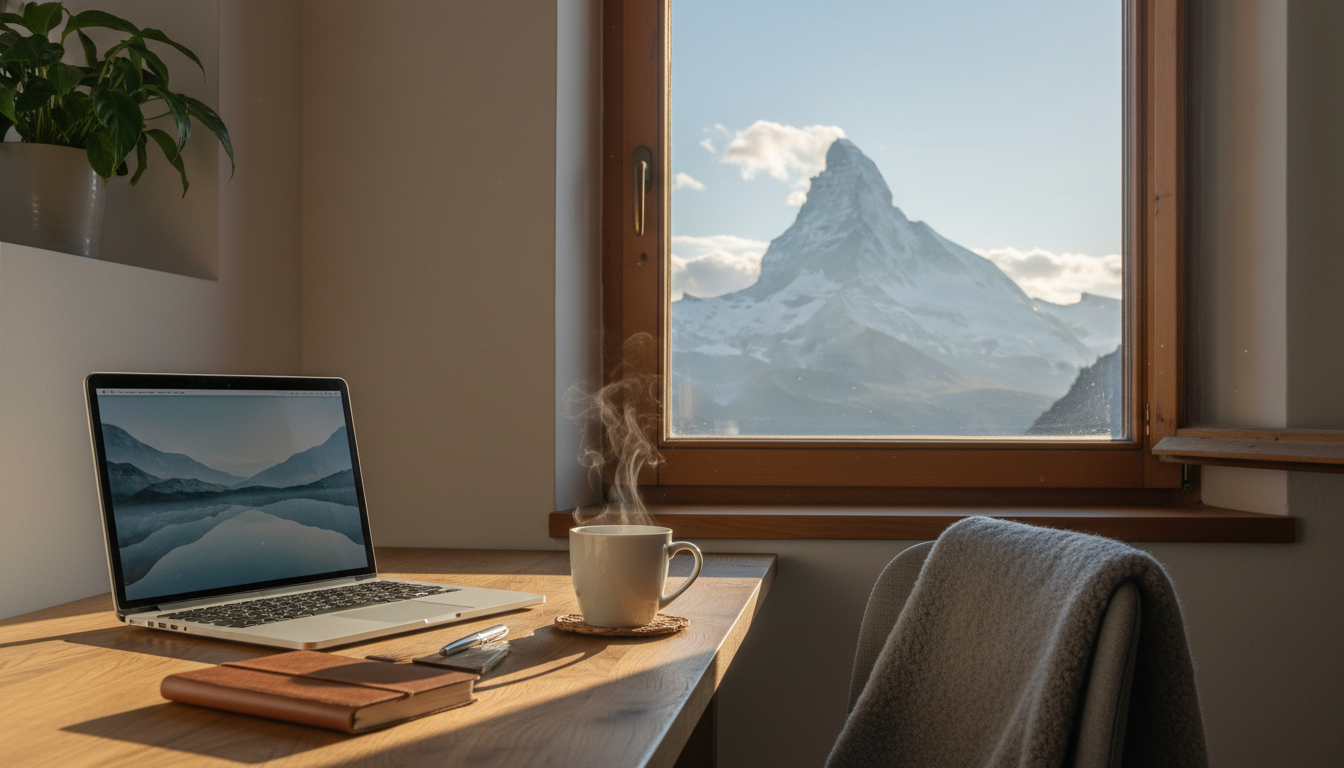 Morning view of the Matterhorn from a traditional Swiss chalet window, laptop open on a wooden desk
Why Zermatt Works for Digital Nomads (When It Shouldn't)
Let me be honest with you. Zermatt isn't an obvious digital nomad destination. It's expensive. It's remote. It's primarily known for skiing and mountaineering, not coworking spaces. Most articles about working remotely in Switzerland point you toward Zurich or Geneva—cities with startup scenes and networking events and all the usual nomad infrastructure.
But here's what those articles miss: sometimes the best remote work happens when you remove yourself from the typical nomad circuit entirely. No digital nomad meetups means no FOMO. No "influencer-friendly" cafés means you actually focus. And when your afternoon break involves riding a gondola up to 3,883 meters at Matterhorn Glacier Paradise? Your whole relationship with work-life balance shifts.
The secret is that Zermatt has surprisingly solid infrastructure for a village of 5,600 permanent residents. Tourism demands it. Hotels need fast WiFi for business travelers. Restaurants need reliable card payments. The whole town runs on the assumption that visitors expect modern connectivity, even if they're surrounded by 19th-century chalets.
Finding a Digital Nomad Home Swap in Zermatt: The Real Process
I'll walk you through exactly how I found my Zermatt exchanges, because the process is different from swapping in major cities.
The Timing Strategy That Actually Works
Zermatt has two distinct seasons: ski season (December through April) and summer hiking season (June through September). May and October-November are shoulder seasons when locals are more likely to travel—and more likely to want to swap their homes.
My first Zermatt swap happened in early May. The ski lifts had just closed, the hiking trails were still snowy, and the village was quiet. The Swiss family I swapped with wanted to visit California before their busy summer season. They were thrilled to have someone reliable staying in their apartment while they explored San Francisco.
For digital nomads, shoulder season is gold. Lower prices everywhere, fewer tourists, and homeowners who are genuinely excited about the swap because they're traveling during their own slow period.
What Zermatt Homes Are Actually Listed for Exchange
Forget visions of massive ski chalets—those exist, but they're typically owned by wealthy families who have no interest in home swapping. The realistic options fall into three categories.
Traditional apartments in the village center are your best bet. Usually 1-2 bedrooms in older buildings, many with partial Matterhorn views. They're owned by locals or long-term investors who actually use them and appreciate the swap model. Expect wooden interiors, compact European kitchens, and that particular Swiss coziness the Germans call "Gemütlichkeit."
Newer apartments in the Winkelmatten area—about a 10-minute walk from the main village—have more modern construction. Better insulation, larger windows, sometimes even proper home offices. Less "Instagram chalet aesthetic," more "actually comfortable for working."
Then there are studios and small apartments owned by hospitality workers. Zermatt employs thousands of seasonal staff, and some long-term employees own small properties. These are modest but functional, often with the fastest WiFi because the owners understand connectivity matters.
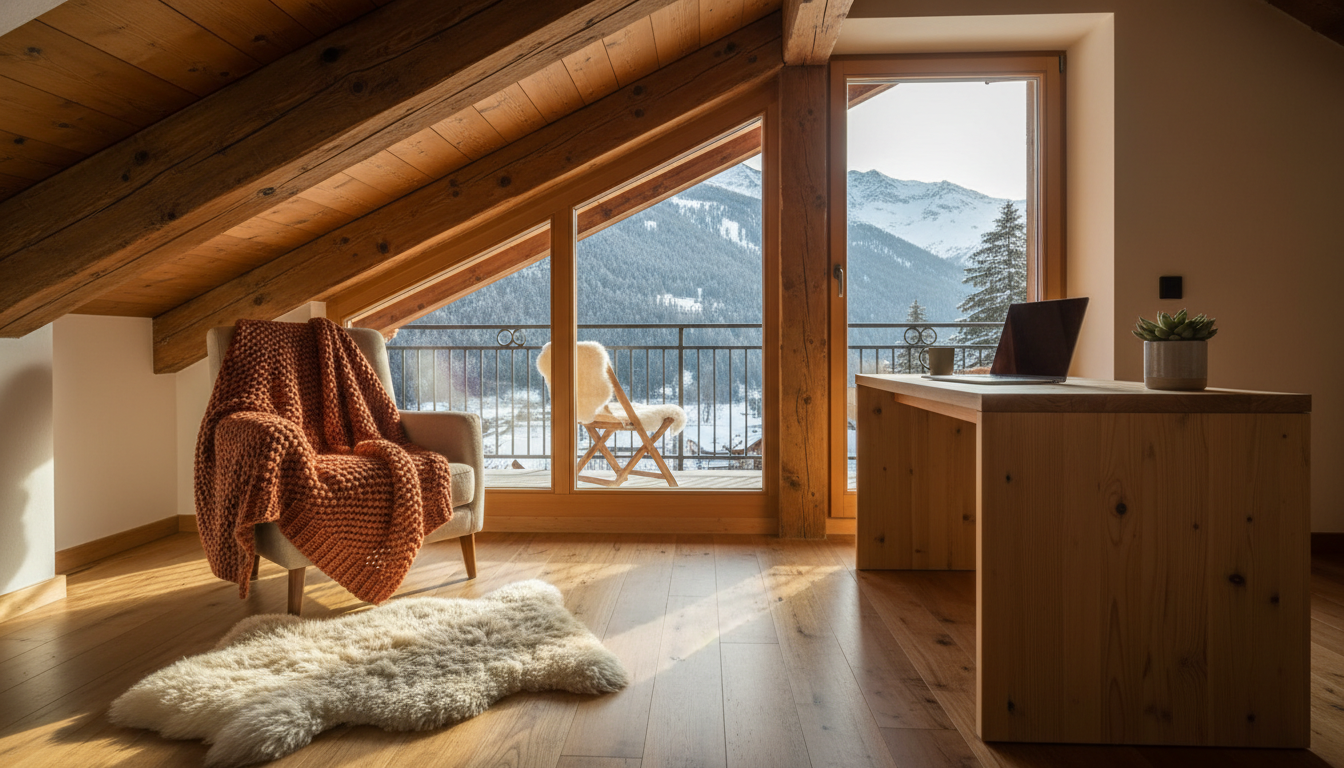 Interior of a cozy Zermatt apartment with exposed wooden beams, a compact desk setup near a window,
The SwappaHome Approach
On SwappaHome, the credit system makes Zermatt more accessible than you'd expect. You earn 1 credit per night when hosting guests at your place, and you spend 1 credit per night wherever you stay—whether that's a studio in Bangkok or a chalet apartment in Zermatt. No premium pricing for expensive destinations.
This is huge for digital nomads. I hosted three different guests at my San Francisco apartment over two months, earned enough credits, and used them for six weeks in Zermatt. The math doesn't work that way with traditional vacation rentals, where Zermatt prices can hit $300-500 per night during peak season.
Start your search 3-4 months ahead for shoulder season, 6+ months for peak periods. Zermatt listings aren't abundant, so you need time to find the right match and build rapport with potential swap partners.
The WiFi Situation: Honest Numbers and Backup Plans
I won't sugarcoat this—WiFi reliability should be your top concern when planning a digital nomad home swap in Zermatt.
What to Expect from Swiss Home Internet
Switzerland generally has excellent internet infrastructure. Most Zermatt apartments connect through Swisscom or local providers, with speeds ranging from 50 Mbps to 200 Mbps depending on the building's age and wiring.
My first swap had 80 Mbps download, 20 Mbps upload—perfectly fine for video calls. My second swap, in an older building near the church, topped out at 35 Mbps. Still workable, but I scheduled important client calls for mornings when fewer tourists were streaming Netflix.
Here's a critical step: before confirming any swap, ask your host to run a speed test (speedtest.net) and send you a screenshot. Also ask about their typical usage—do they work from home? Do they video call regularly? Someone who already works remotely from the apartment is your best indicator that the setup works.
Your Backup Options
Swiss mobile data is notoriously expensive, but it exists as a backup. Swisscom and Sunrise both offer prepaid SIM cards with data packages. Expect to pay around 2 CHF per GB ($2.25 USD) for prepaid data, or consider a monthly plan if you're staying longer.
I kept a Swisscom prepaid SIM as my emergency backup and used it exactly twice—once during a power outage and once when my host's router needed a restart while I was mid-presentation. Not ideal, but it saved me.
Several restaurants and hotels in the village center also offer WiFi to customers. The Vernissage Bar at the Backstage Hotel has reliable connectivity and doesn't mind laptop workers during off-peak hours. Just buy a coffee every hour or so and you're welcome to stay.
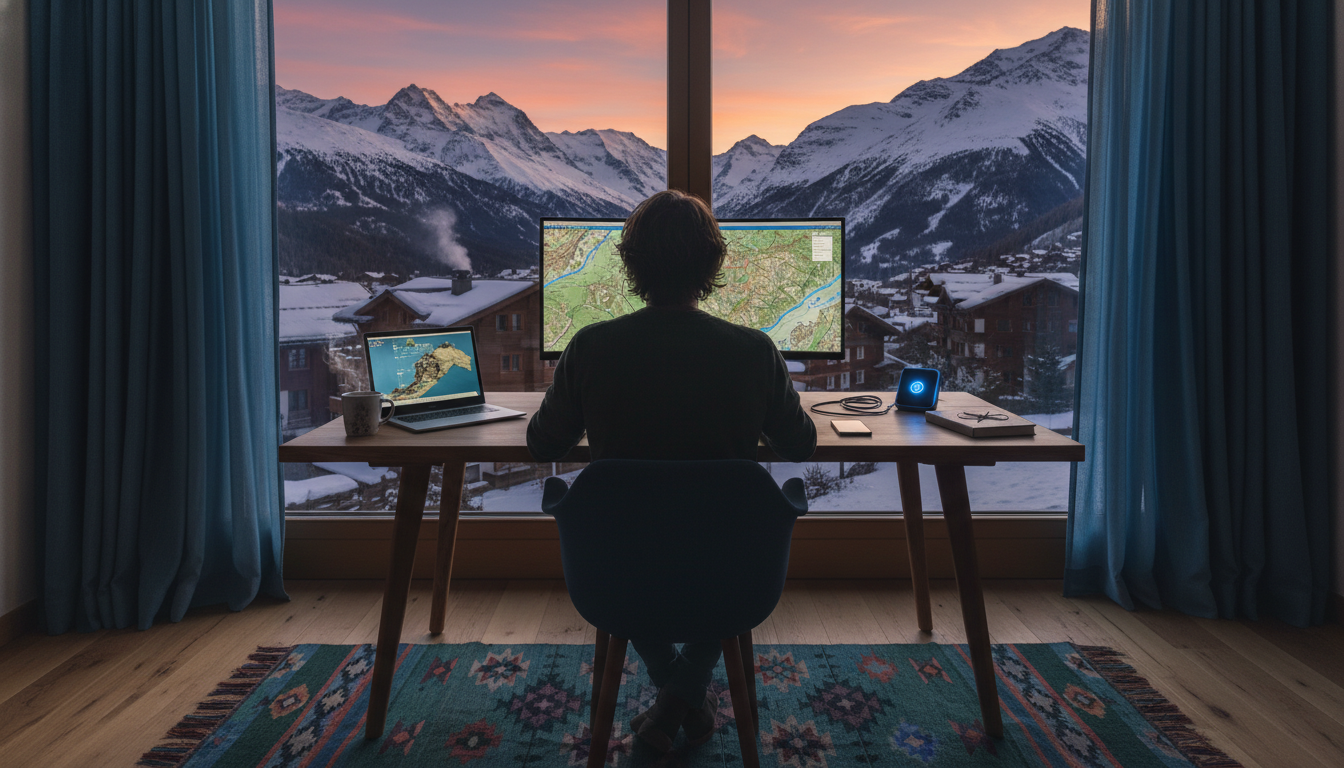 A digital nomad workspace setup in a Swiss apartment showing a laptop, external monitor, phone hotsp
Coworking and Alternative Workspaces in Zermatt
Zermatt doesn't have a WeWork. It doesn't have a dedicated coworking space at all, actually. This surprised me initially, but it makes sense—the village's economy revolves around outdoor activities, not desk work.
That said, I found several spots that work well for focused work sessions.
Hotel Lobbies and Lounges
Many Zermatt hotels welcome non-guests in their public areas, especially during shoulder season. The Grand Hotel Zermatterhof has a stunning lobby with mountain views and strong WiFi. Order a coffee (around 6 CHF / $6.75 USD), settle into one of their leather armchairs, and you've got a perfectly acceptable workspace for a few hours.
The Cervo Mountain Resort has a more modern vibe with a coworking-adjacent lounge area. It's pricier—expect 8-10 CHF for drinks—but the atmosphere feels more conducive to laptop work.
The Public Library Hack
Zermatt has a small public library (Gemeindebibliothek Zermatt) that most tourists never discover. It's quiet, has WiFi, and welcomes visitors during opening hours. The space is limited, but if you need absolute focus for a few hours, it's free and peaceful.
Your Apartment Is the Best Office
Real talk: after trying various public spaces, I did 90% of my work from my swap apartments. The Swiss take home comfort seriously. Heated floors, good lighting, comfortable furniture—these aren't luxuries in Zermatt, they're standard. Add a portable laptop stand and an external keyboard, and you've got a better setup than most coworking spaces.
The key is negotiating workspace needs upfront with your swap partner. I specifically asked about desk space, chair comfort, and lighting near windows. One host even left me their external monitor to use during my stay.
Daily Life as a Remote Worker in Zermatt
Here's what a typical workday looked like during my stays.
The Morning Routine That Changed Everything
6:30 AM: Wake up to alpenglow on the Matterhorn. This never gets old. The mountain turns pink and orange for about 20 minutes as the sun rises, and watching it from bed with coffee became my favorite ritual.
7:00 AM: Walk to Fuchs Bakery on Bahnhofstrasse for fresh bread and pastries. A croissant and coffee runs about 8 CHF ($9 USD). The morning air at 1,600 meters elevation is crisp enough to wake you up better than any espresso.
7:30 AM - 12:00 PM: Deep work block. This is when I scheduled nothing—no calls, no meetings, just focused work. The quiet of a Swiss morning, combined with knowing the mountains were waiting for me, created urgency I rarely feel in city environments.
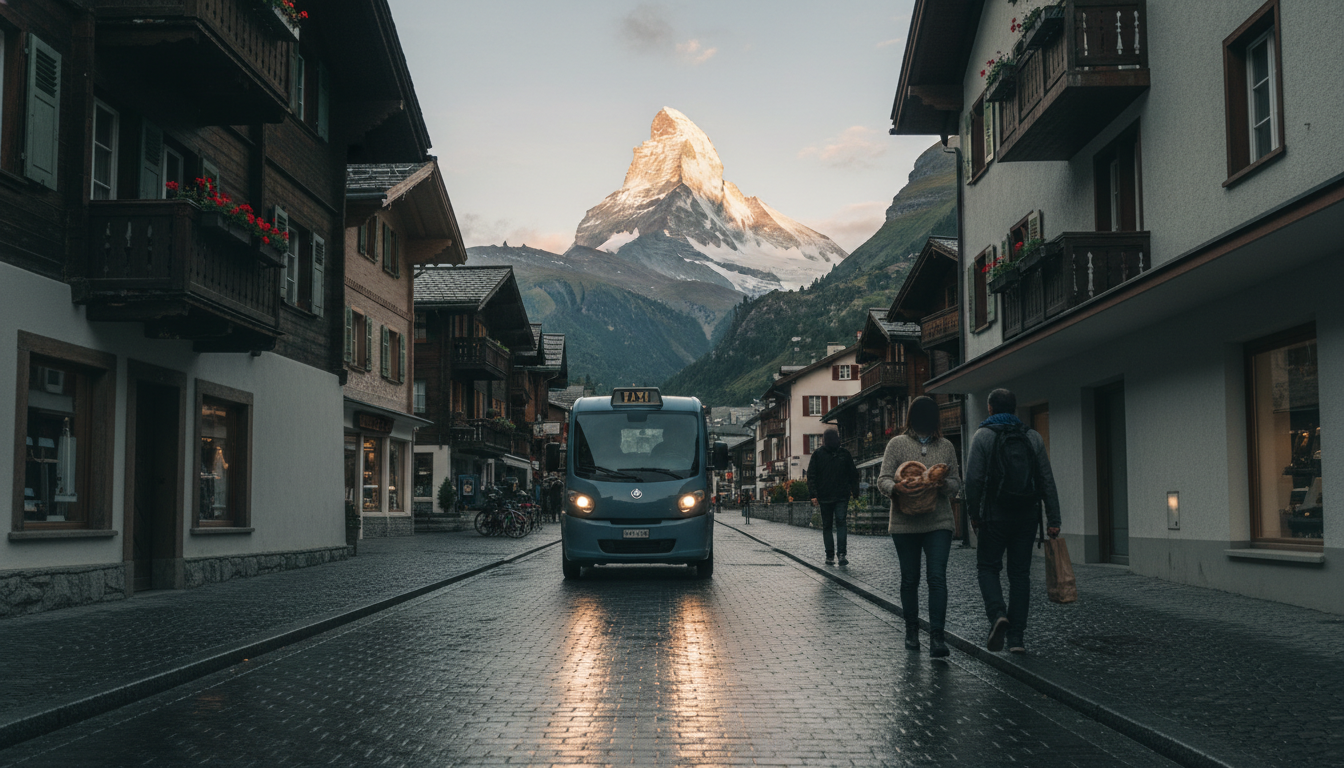 Early morning scene on Zermatts car-free main street, electric taxi passing by, a few locals walking
The Afternoon Adventure Block
12:00 PM - 1:00 PM: Lunch. Either cooking in the apartment (Swiss grocery stores are excellent, if expensive) or grabbing something quick. Migros and Coop have prepared foods, sandwiches, and salads for 8-15 CHF ($9-17 USD).
1:00 PM - 4:00 PM: This is when I'd ski, hike, or explore. Having a physical activity built into every workday transformed my productivity and mental health. Even a short hike to Sunnegga (accessible by funicular) resets your brain completely.
4:00 PM - 6:30 PM: Second work block. Catch up on emails, client calls with US time zones (morning in California), administrative tasks. The afternoon light in Zermatt is spectacular, and I'd often position my desk to watch the shadows lengthen across the valley.
Evening Wind-Down
Dinner at home most nights—Swiss restaurant prices are genuinely painful ($40-80 USD for a basic meal with drinks). But once or twice a week, I'd treat myself to fondue at Chez Vrony (accessible by hiking or gondola, around 45 CHF / $50 USD per person) or raclette at Whymper Stube (about 35 CHF / $40 USD).
The key insight: Zermatt's extreme beauty and outdoor access actually make you more productive, not less. You work harder knowing that adventure awaits, and you return from adventures with a clearer head.
The Cost Reality: What a Digital Nomad Home Swap in Zermatt Actually Saves
Let's do the math, because this is where home swapping becomes transformative.
Traditional Costs for 4 Weeks in Zermatt
Hotels at the mid-range level run $200-350 per night, which adds up to $5,600-9,800 for a month. Vacation rentals typically cost $150-300 per night, or $4,200-8,400 monthly. Airbnb options (which are rare in Zermatt) range from $180-400 per night, meaning $5,040-11,200 for four weeks.
Home Swap Costs for 4 Weeks
With SwappaHome, you're spending 28 credits (which you earn by hosting) plus your annual platform membership. That's it.
Your actual expenses become groceries at roughly $400-600 per month (Swiss prices are high), transportation to Zermatt via train from Zurich at about $150 round trip, ski passes if applicable at approximately $75 per day or $400 per week, occasional dining out at $200-400 monthly, and miscellaneous costs around $200 per month.
Total monthly cost with home swap: approximately $1,000-1,800 (excluding ski passes). Total monthly cost without home swap: approximately $6,000-12,000.
The savings are staggering. And unlike budget hostels or cramped Airbnbs, you're living in a real home with a full kitchen, proper workspace, and the comfort level of a local resident.
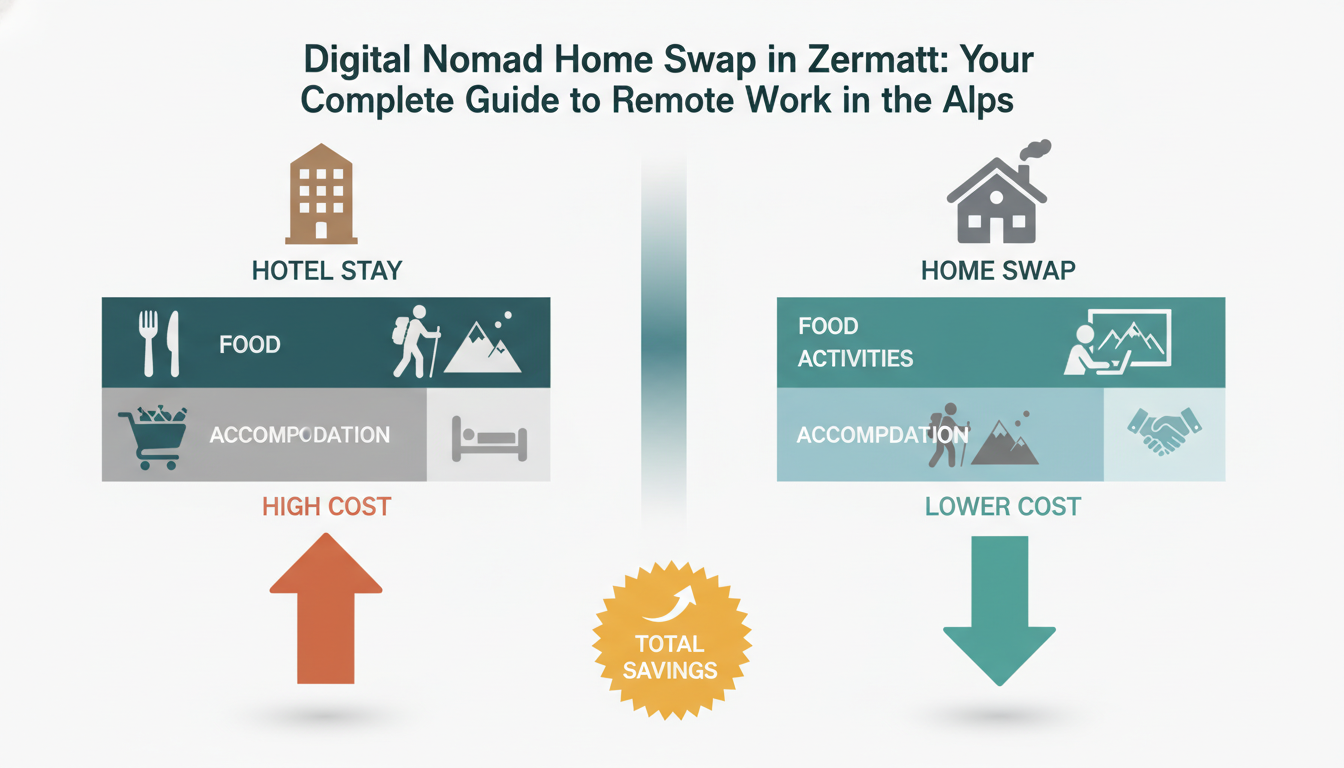 Comparison infographic showing cost breakdown of hotel stay vs home swap in Zermatt over 4 weeks, wi
Practical Tips for Your Zermatt Home Swap
Getting There Without a Car
Zermatt is car-free, which sounds challenging but is actually liberating. The only way in is by train from Täsch (5 minutes) or the longer scenic routes from Zurich (3.5 hours), Geneva (4 hours), or Milan (4 hours).
Book trains through the SBB app. Swiss trains are expensive but impeccably reliable. A half-fare card (185 CHF / $210 USD for one year) cuts all ticket prices in half and pays for itself in 2-3 trips.
Once in Zermatt, you walk everywhere or take electric taxis. Luggage transport from the station to your apartment costs about 15 CHF.
What to Pack for Remote Work in the Alps
Beyond normal travel gear, bring a laptop stand and external keyboard—essential for ergonomics during long stays. Noise-canceling headphones help for calls in cafés or when neighbors are loud. Pack a power strip with Swiss adapter since Swiss outlets are unique (Type J) and homes often have limited outlets near desks. A portable WiFi hotspot or local SIM serves as your backup plan. Blue light glasses matter because the bright Alpine sun plus screen time is intense. And layers, layers, layers—mountain weather changes fast, even in summer.
Cultural Notes for Living Like a Local
Swiss German greetings matter. Learn "Grüezi" (hello) and "Merci vilmal" (thank you very much). Shop owners and neighbors respond warmly to the effort.
Quiet hours are sacred. No loud noise between 10 PM and 7 AM, and reduced noise on Sundays. This is legally enforced, not just suggested.
Recycling is complex and mandatory. Your swap host should explain their building's system. Glass, paper, cardboard, PET plastic, aluminum, and compost all have separate collection points.
Tipping is minimal. Service is included in Swiss prices. Round up or add 5-10% for exceptional service, but don't feel obligated.
Building Trust for Your Zermatt Exchange
Swiss homeowners tend to be careful about who stays in their properties. Here's how to stand out as a swap partner.
Your Profile Matters More Here
Complete every section of your SwappaHome profile. Add multiple photos of your home, write detailed descriptions, and include information about yourself—your work, your interests, why you travel. Swiss hosts appreciate thoroughness.
Verify your identity through the platform. This builds trust immediately and signals you're serious about the exchange community.
The Initial Message
Don't send generic requests. Reference specific details about their home. Explain why you want to visit Zermatt (work + adventure balance resonates well with Swiss hosts). Mention your work schedule and that you'll be respectful of quiet hours.
I always offer a video call before confirming. It lets both parties assess compatibility and ask questions about the home, the neighborhood, and expectations.
Reviews Are Currency
If you're new to home swapping, start with easier exchanges to build your review history. A few positive reviews from previous hosts dramatically increase your chances of landing competitive listings like Zermatt apartments.
The Unexpected Benefits I Didn't Anticipate
After two Zermatt stays totaling six weeks, some things surprised me.
Physical health improved dramatically. Walking everywhere at altitude, hiking most afternoons, breathing clean mountain air—I lost weight, slept better, and had more energy for work.
Creative output increased. Something about the dramatic landscape unlocked ideas I'd been stuck on for months. I wrote more, brainstormed better, and approached problems from new angles.
My relationship with work shifted. When your afternoon "break" involves riding a gondola to a glacier, you stop resenting work as the thing keeping you from life. Work becomes the thing that enables this life.
I made actual friends. My swap hosts became genuine connections. We've stayed in touch, exchanged recommendations, and they've visited me in San Francisco. The community aspect of home swapping creates relationships that hotel stays never could.
Is a Digital Nomad Home Swap in Zermatt Right for You?
This setup isn't for everyone. You need work that's genuinely location-independent (reliable WiFi is available but not guaranteed). You need comfort with slower-paced, nature-focused environments. A home worth swapping matters too—Swiss hosts want interesting destinations. Flexibility with timing helps since Zermatt listings aren't abundant. And you'll need budget for Swiss daily expenses because groceries and dining are expensive.
But if those boxes check? I can't recommend this strongly enough. Working remotely from Zermatt through home swapping combines the best of digital nomad life—freedom, adventure, new experiences—with something most nomads never achieve: actually living somewhere instead of just passing through.
You learn the baker's name. You have a favorite bench for lunch. You wave to the same neighbors every morning. That's not tourism. That's temporary local life, and it's worth every credit you spend to get there.
My next Zermatt swap is already planned for October. The autumn colors in the Valais region are supposed to be spectacular, and I've got a project that needs mountain-level focus. If you're considering your own Alpine working adventure, start browsing SwappaHome listings now—the good Zermatt apartments get snapped up months in advance.
The Matterhorn will still be there when you arrive. But trust me, you'll want to see it from a living room window, not a hotel lobby.
Frequently Asked Questions
Is digital nomad home swapping in Zermatt realistic for full-time remote work?
Absolutely, with preparation. Most Zermatt apartments have WiFi speeds between 35-200 Mbps, sufficient for video calls and standard remote work. Request a speed test from your host before confirming, keep a mobile data backup, and schedule important calls during off-peak hours. I worked full-time for six weeks across two Zermatt swaps without major connectivity issues.
How much does a month in Zermatt cost with home swapping versus hotels?
With home swapping, expect $1,000-1,800 monthly for groceries, transport, and activities—your accommodation is covered by SwappaHome credits earned from hosting. Without home swapping, budget $5,600-12,000 monthly for hotels or vacation rentals alone. The savings typically exceed $4,000-10,000 per month, making extended stays financially viable.
What's the best time of year for a digital nomad home swap in Zermatt?
Shoulder seasons—May and October/November—offer the best combination of availability, lower costs, and willing swap partners. Locals travel during these quieter periods, making them more open to exchanges. You'll also face fewer tourists and lower prices at restaurants and activities, though some mountain facilities may have limited hours.
Are there coworking spaces in Zermatt for remote workers?
Zermatt lacks dedicated coworking spaces, but alternatives exist. Hotel lobbies like Grand Hotel Zermatterhof and Cervo Mountain Resort welcome laptop workers with coffee purchases. The public library offers free WiFi and quiet space. However, most digital nomads find their swap apartment the most productive workspace—Swiss homes typically have excellent comfort and lighting.
How do I find Zermatt home swap listings on SwappaHome?
Search for Zermatt or the broader Valais region on SwappaHome, filtering for your dates. Listings are limited, so start searching 3-6 months ahead. Complete your profile thoroughly, verify your identity, and send personalized messages referencing specific details about each property. Building positive reviews from other exchanges significantly improves your chances of securing competitive Zermatt listings.

Published by
SwappaHome
SwappaHome Editorial Team
Home Exchange & Slow Travel Editorial
The SwappaHome Editorial Team brings together travel research, home-exchange community insights, and platform data to produce practical guides for first-time and experienced home swappers. Every article cites real platforms, current market rates, and verifiable city-level facts so readers can make informed decisions without guessing.
Ready to try home swapping?
Join SwappaHome and start traveling by exchanging homes. Get 7 free credits when you sign up!
Related articles

Bachelor and Bachelorette Parties in Singapore: The Complete Home Swap Group Guide for 2026
Planning a bachelor or bachelorette party in Singapore? Discover how home swapping lets groups of 6-12 stay together in luxury condos, saving thousands while partying in Marina Bay.

Cycling in Lisbon: 7 Home Swap Bike Tour Itineraries for Every Rider
Discover the best cycling routes in Lisbon with these home swap bike tour itineraries—from waterfront paths to hilltop adventures, all starting from your borrowed home.

Graduation Trip to Barcelona: How Home Swapping Gives New Graduates the Ultimate Celebration
Planning a graduation trip to Barcelona? Discover how home swapping lets new graduates explore Spain's most vibrant city without the hostel crowds or hotel costs.