Free Activities in Savannah: How to Explore Georgia's Gem Without Spending a Dime

SwappaHome Editorial Team
Home Exchange & Slow Travel Editorial
Discover the best free activities in Savannah during your home exchange—from historic squares to secret gardens, this guide covers it all.
That first morning in a Victorian home in Savannah's Historic District, I made the classic rookie move. Coffee still too hot to drink, and there I was, thumb-scrolling through "things to do in Savannah," about to drop $35 on a trolley tour. Then Margaret—my host, a retired professor with opinions—sent me a message: "Skip the tourist traps, honey. The best free activities in Savannah are the ones most visitors walk right past."
She wasn't wrong.
Over the next ten days, I discovered this moss-draped Southern city offers an almost ridiculous abundance of riches for travelers who know where to look. And most of them? Won't cost you a single cent. That's the magic of pairing a home exchange with insider knowledge—you get the local perspective without the tourist markup.
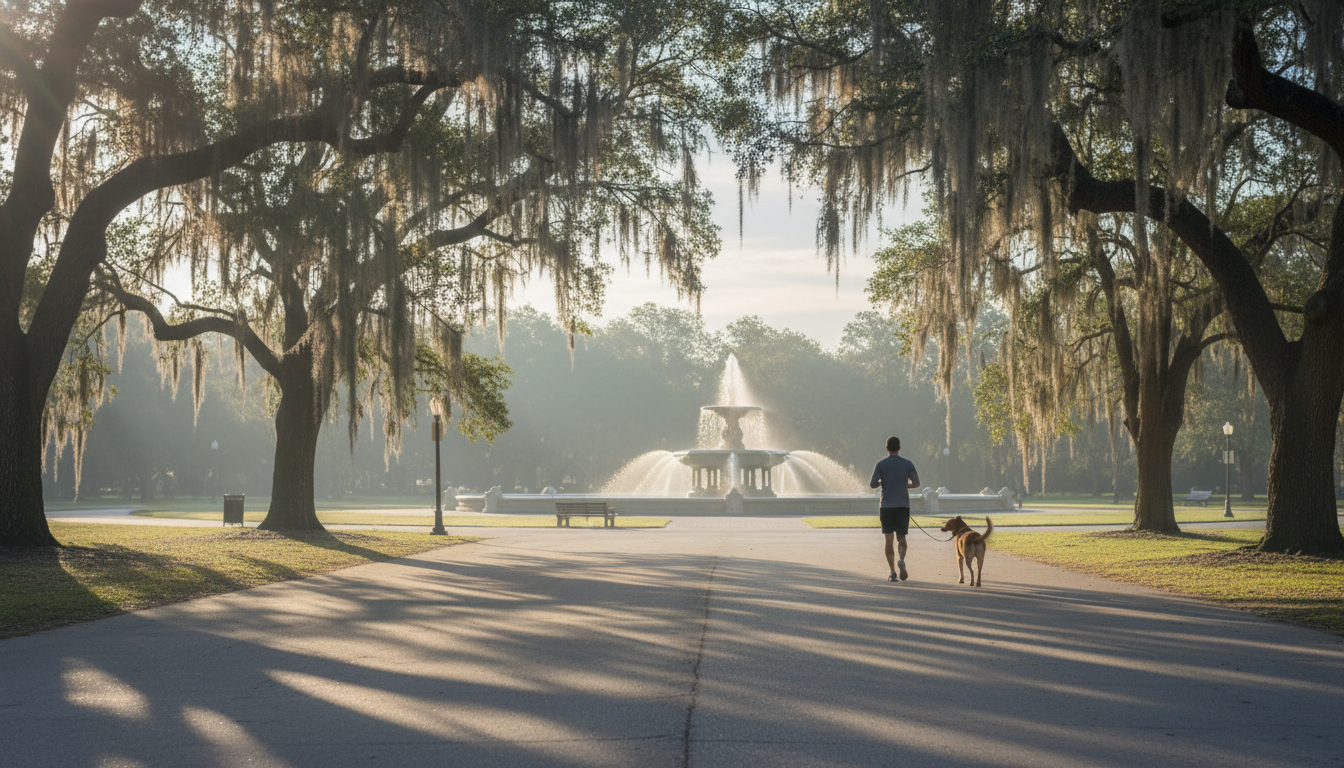 early morning light filtering through Spanish moss on oak trees in Forsyth Park, with a jogger and d
Why Savannah Works So Well for Budget-Minded Home Exchangers
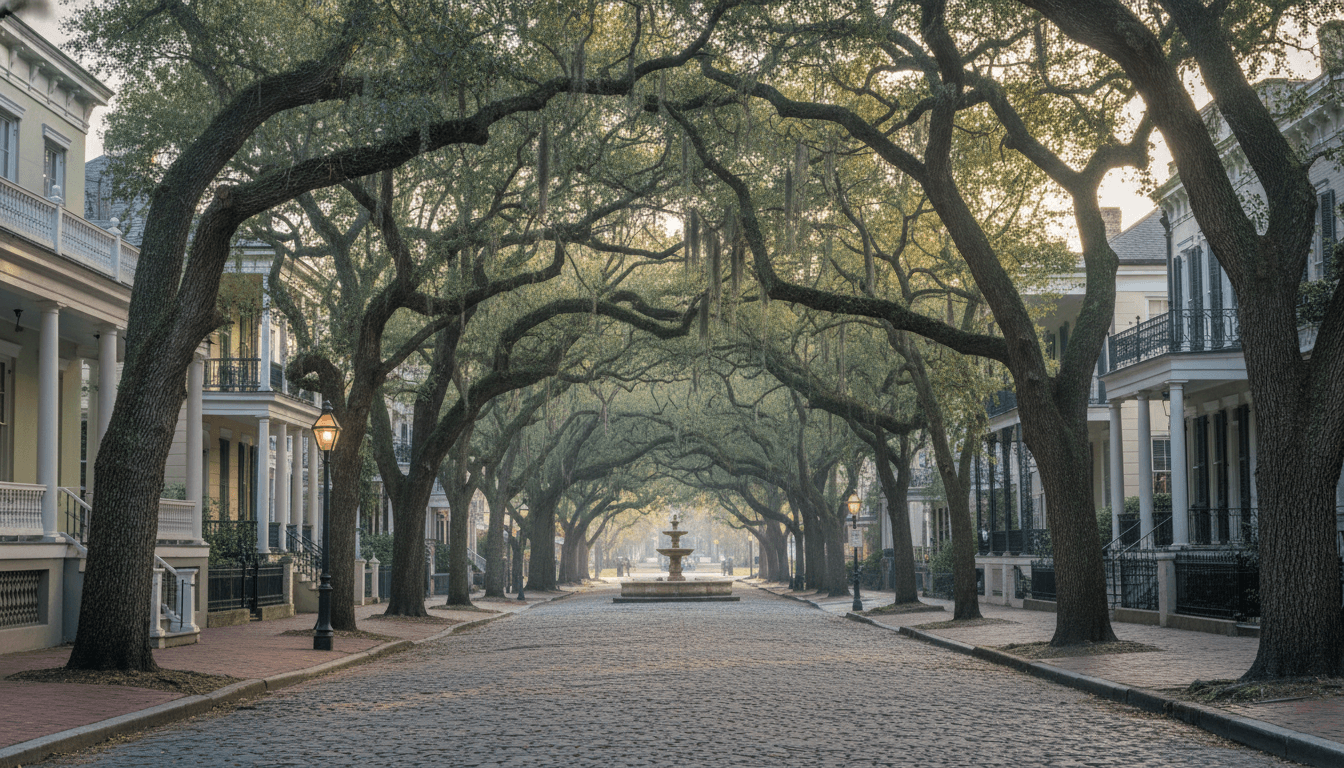
Here's something the guidebooks gloss over: Savannah was literally designed for walking. General James Oglethorpe laid out the city in 1733 with a grid of public squares—22 still exist—specifically so residents could gather, socialize, and enjoy their surroundings using nothing but their own two feet.
That 18th-century urban planning philosophy means you can spend an entire week exploring free activities in Savannah without repeating yourself. The Historic District alone covers 2.5 square miles of cobblestone streets, antebellum architecture, and hidden courtyards. And unlike some historic cities where everything interesting hides behind a velvet rope or ticket counter, Savannah's beauty is genuinely accessible.
Staying in someone's home through a platform like SwappaHome rather than a hotel puts you ahead from the start. No $250/night room charges eating into your budget. No $15 breakfast buffets. Just a kitchen where you can brew your own coffee and a neighborhood to explore. The credits you earn hosting guests at your place translate directly into nights in Savannah—one credit per night—which means your accommodation cost is essentially zero.
That financial breathing room? It changes everything about how you travel.
The 22 Squares: Savannah's Free Outdoor Museums
I'll be honest—I didn't visit all 22 squares. I tried. But somewhere around square 15, a particularly beautiful ironwork gate caught my eye and I spent an hour photographing it instead. That's the thing about Savannah: it rewards wandering.
Here are the squares that genuinely stopped me in my tracks:
Chippewa Square is where Forrest Gump sat on his famous bench. (The bench itself lives in the Savannah History Museum now, but the square remains gorgeous.) More importantly, it's surrounded by some of the city's most impressive architecture, including the Savannah Theatre—the oldest continuously operating theater in America.
Monterey Square feels like stepping into a Southern Gothic novel. The Mercer-Williams House anchors one corner—you might recognize it from "Midnight in the Garden of Good and Evil"—and the whole square carries this slightly melancholy elegance that's hard to describe but impossible to forget.
Lafayette Square became my personal favorite because it's where locals actually hang out. Sunday mornings, I'd grab a $3 coffee from The Coffee Fox on Broughton Street and just sit on a bench watching families, dog walkers, and the occasional street musician pass by. The Cathedral Basilica of St. John the Baptist looms over one side, and its architecture alone is worth the visit.
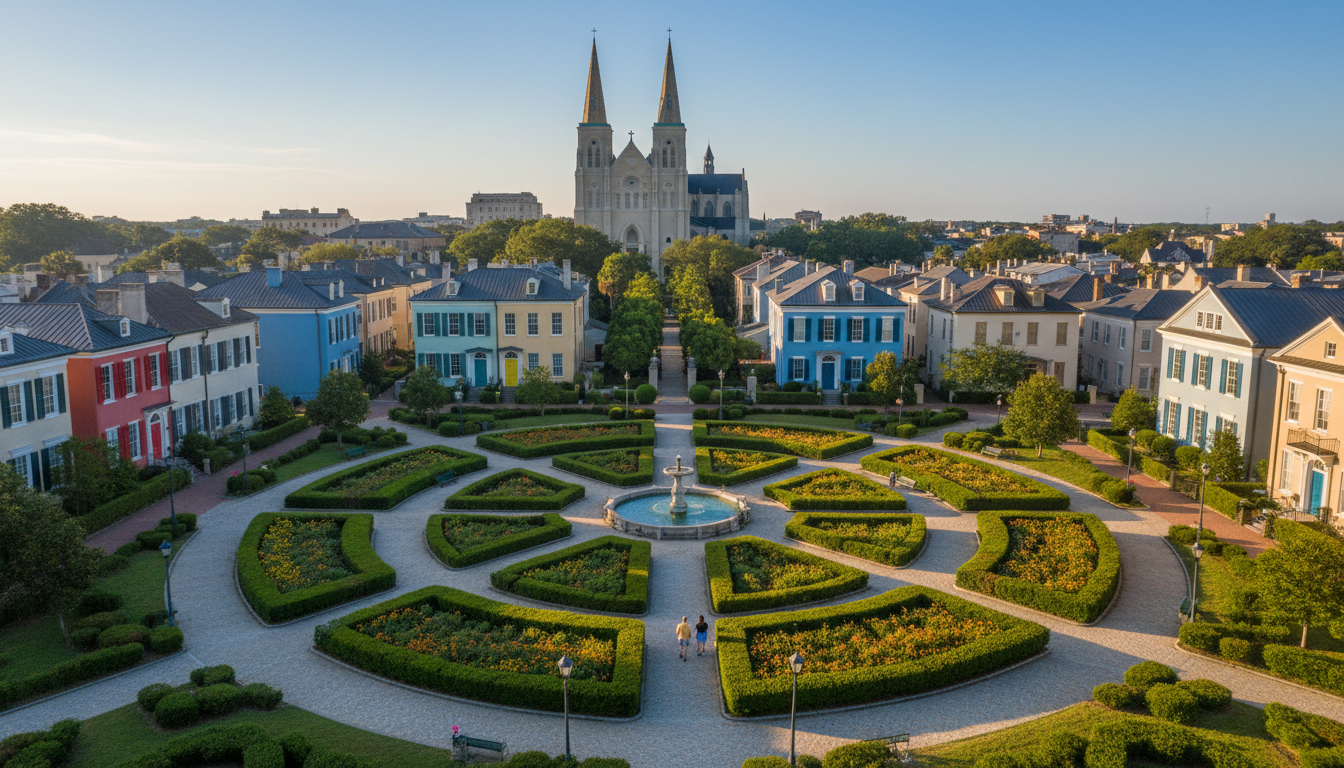 aerial view of Lafayette Square showing the geometric garden layout, surrounding historic homes with
Telfair Square is tiny but mighty—the oldest square in the city and home to the Telfair Academy. While the museum charges admission, the square and its surroundings are free to enjoy, and there's often live music on weekend afternoons.
My strategy was to pick 3-4 squares per day and really spend time in them rather than rushing through all 22 in a checklist frenzy. Bring a book. Bring a sketchpad. Bring nothing but your thoughts. Each square has its own personality, and you'll only discover it if you slow down.
Free Museum Days and Cultural Experiences
Savannah has a surprisingly robust arts scene, and several institutions offer free admission on specific days or for certain visitors.
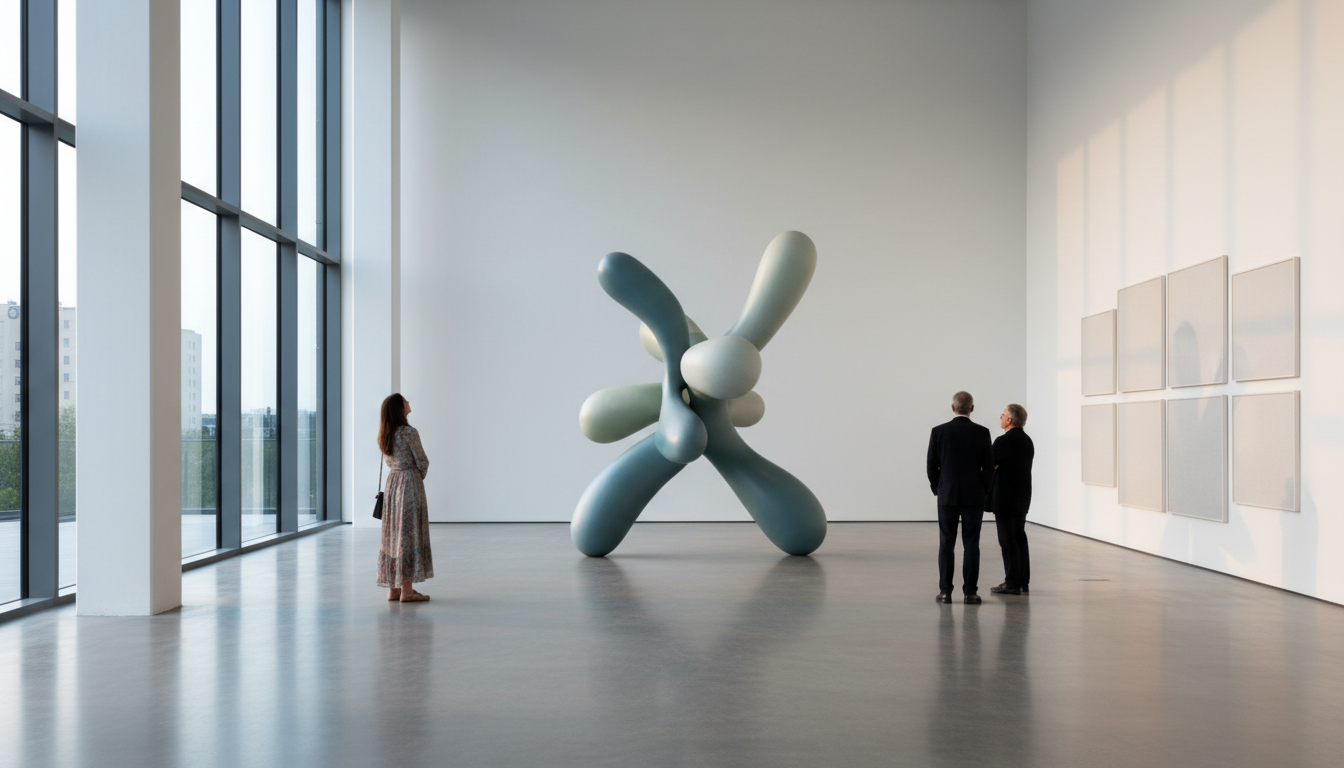
The SCAD Museum of Art offers free admission to Savannah residents—and when you're doing a home exchange, you're essentially a temporary resident. I showed my host's address on my phone and walked right in. The museum focuses on contemporary art with rotating exhibitions that are genuinely thought-provoking. During my visit, there was an installation about climate change and coastal erosion that felt particularly relevant given Savannah's location.
First Saturdays on the River happen monthly along River Street, with free live music, street performers, and an arts market. The performances range from jazz trios to solo acoustic acts, and the atmosphere is festive without being overwhelming. Pro tip: arrive around 5 PM to snag a spot near the main stage, then wander the market as the sun sets.
The Jepson Center occasionally offers free community days—check their calendar before your trip. Even when admission isn't free, the building itself is a stunning piece of modern architecture you can appreciate from outside.
Gallery Row on Whitaker Street is completely free to browse. These aren't tourist-trap galleries selling mass-produced prints; they're legitimate art spaces showcasing local and regional artists. I spent an entire afternoon wandering from gallery to gallery, chatting with artists, and pretending I could afford a $2,400 oil painting of the Savannah River.
 interior of a contemporary art gallery with high ceilings and white walls, featuring a large abstrac
Forsyth Park: Savannah's Crown Jewel of Free Entertainment
If you only have time for one free activity in Savannah, make it Forsyth Park.
I know that sounds like generic travel advice. But hear me out.
This 30-acre park is where Savannah actually lives. Not the tourist Savannah of ghost tours and praline shops, but the real city where people jog with their dogs, practice yoga on the lawn, and argue about college football. The iconic fountain—you've seen it in approximately 10,000 Instagram posts—is genuinely beautiful, especially in the early morning when light hits the spray just right.
But here's what most visitors miss: the park's southern end.
Walk past the fountain, past the café, past the tennis courts, and you'll find yourself in a quieter section with massive live oaks, winding paths, and far fewer people. This is where I did my morning writing during my home exchange, sitting on a bench with my laptop and a thermos of coffee from my host's kitchen. The Spanish moss creates this natural canopy that filters the light into something almost otherworldly.
Saturdays from 9 AM to 1 PM (March through November), the Forsyth Farmers' Market takes over the park's south end. While the market itself isn't free—you'll be tempted by fresh peaches, local honey, and artisan bread—the people-watching absolutely is. This is where you'll see Savannah's creative class in their natural habitat: artists, chefs, musicians, young families, retirees who've lived here for decades.
The park also hosts free concerts throughout the year, particularly during the Savannah Music Festival in spring.
Walking Tours You Can Do Yourself (For Free)
Commercial walking tours in Savannah run anywhere from $25 to $40 per person. Multiply that by a family of four, and you're looking at $100+ for a two-hour walk.
Here's the thing: you can do essentially the same tours yourself using free resources.
The Savannah Visitor Center at 301 Martin Luther King Jr. Boulevard offers free maps with self-guided walking tour routes. They have themed options—architecture, history, gardens, and yes, ghosts. The ghost tour map is actually pretty good, hitting all the allegedly haunted spots without the theatrical tour guide in a cape.
The Historic Savannah Foundation provides free downloadable audio tours through their app. The quality is excellent—these are the same researchers who've been documenting Savannah's history for decades—and you can go at your own pace, stopping for coffee or photos whenever you want.
My personal route: Start at City Market around 9 AM, when it's still quiet. Walk east to Reynolds Square, then meander through the Historic District squares until you hit Forsyth Park. Stop for a free gallery browse on Whitaker Street. End at the park for a rest before walking back along Bull Street. Total distance: about 3 miles. Total cost: zero dollars.
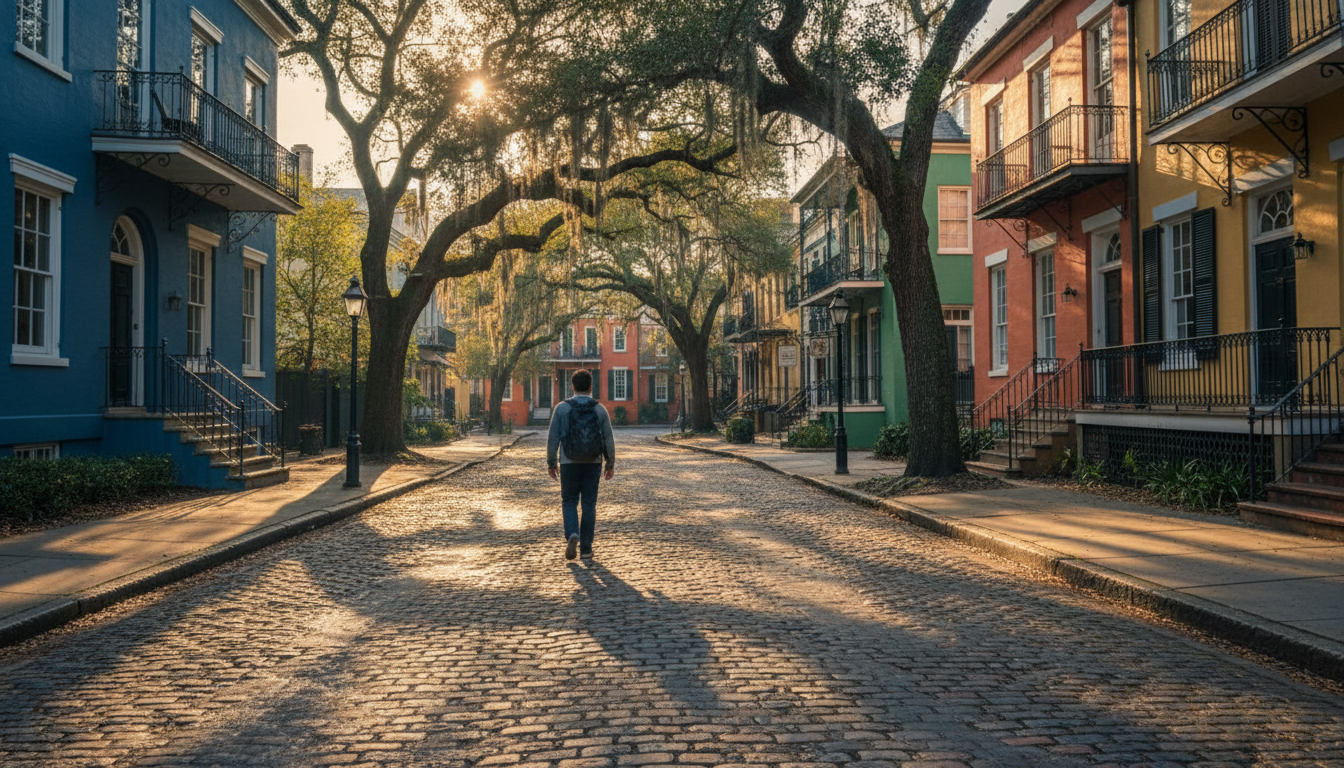 cobblestone street in Savannahs Historic District with a lone walker passing colorful row houses, mo
The Riverfront: Free Views, Free History, Free Entertainment
River Street gets a bad rap from locals as being "too touristy," and honestly? They're not entirely wrong. The cobblestones are packed with t-shirt shops and overpriced restaurants catering to cruise ship passengers.
But the riverfront itself is spectacular, and experiencing it costs nothing.
Walk along the Savannah River at sunset and watch massive container ships glide past, close enough that you could almost touch them. These ships are heading to and from the Port of Savannah—one of the busiest ports on the East Coast—and there's something mesmerizing about watching these steel giants navigate the narrow channel.
The Waving Girl Statue at the eastern end of River Street commemorates Florence Martus, who reportedly waved at every ship entering and leaving Savannah Harbor for 44 years. The statue is free to visit, and the surrounding area offers some of the best river views in the city.
Roanoke Island Park, just west of River Street, is a hidden gem most tourists never find. It's a small green space with benches overlooking the river, and it's almost always empty. I brought lunch here several times during my stay—sandwiches made in my host's kitchen—and had the place entirely to myself.
Bonaventure Cemetery: Hauntingly Beautiful and Completely Free
I almost didn't include this because it feels strange to call a cemetery an "attraction." But Bonaventure is different. It's a 160-acre Victorian garden cemetery that's been featured in films, novels, and countless photography collections—and it's completely free to visit.
The cemetery is about 15 minutes east of downtown by car, or you can take the free CAT Shuttle to Thunderbolt and walk the remaining mile. The walk itself is pleasant, passing through a quiet residential neighborhood with views of the marsh.
Once you're there, give yourself at least two hours. The live oaks here are even more dramatic than downtown, with Spanish moss hanging so thick it creates natural curtains between the graves. The Victorian-era monuments are works of art—angels, urns, broken columns symbolizing lives cut short.
The most famous grave belongs to "Little Gracie" Watson, a six-year-old girl who died in 1889. Her father commissioned an Italian sculptor to create a life-sized marble statue, and it's become something of a pilgrimage site. Visitors leave toys, flowers, and coins at her feet.
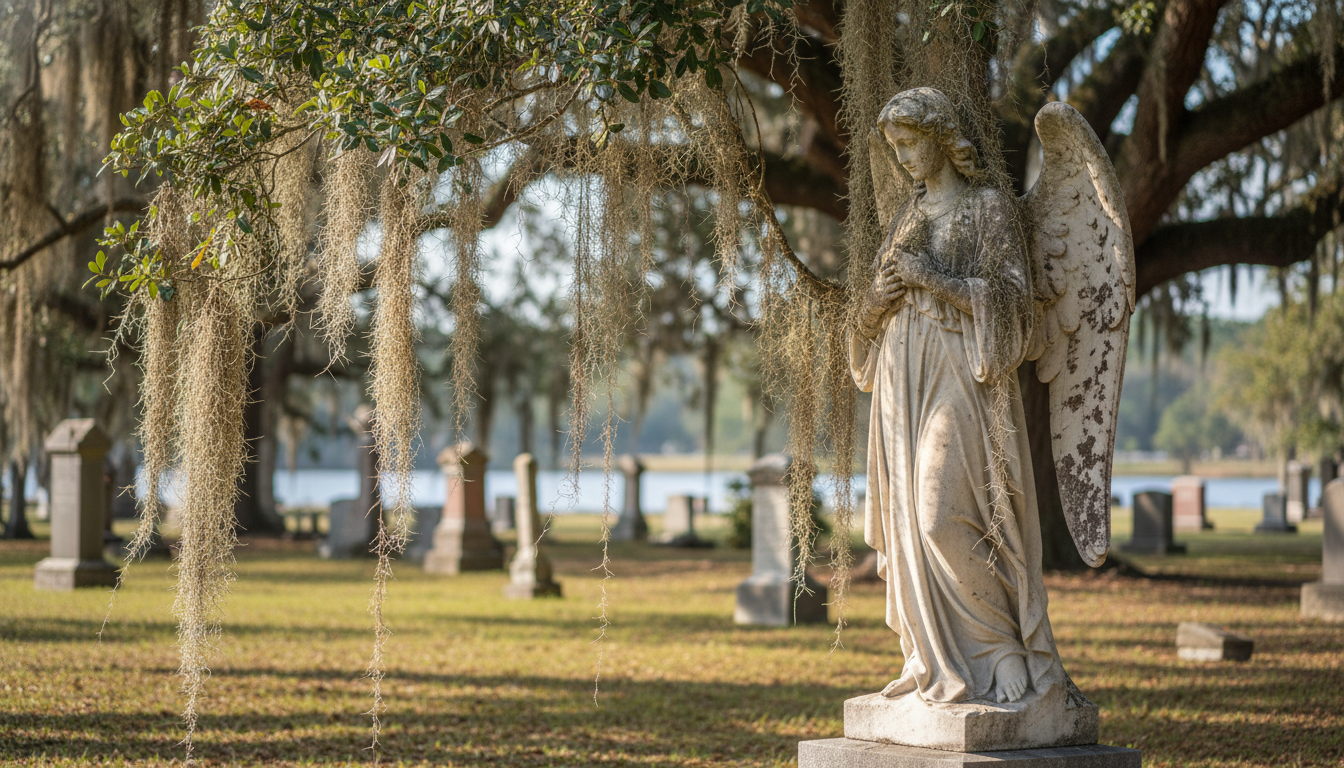 weathered marble angel statue in Bonaventure Cemetery, partially obscured by hanging Spanish moss, w
I found Bonaventure more moving than I expected. There's something about wandering through a place where Savannah's history is literally written in stone that puts your own life in perspective. I sat on a bench near the river section for almost an hour, just thinking.
Free Beach Access: Tybee Island Day Trip
Tybee Island is only 20 minutes from downtown Savannah, and beach access is completely free. No parking meters on the beach itself (though the lots near the pier charge $3-5), no entrance fees, no wristbands. Just sand, waves, and one of the most laid-back beach towns on the East Coast.
The South Beach area near the pier is the most popular, but I preferred the quieter North Beach, where you can walk for a mile without seeing another person. The lighthouse area—beach access is free; climbing the lighthouse costs $10—has dramatic rock formations and is popular with local photographers.
If you're doing a home exchange in Savannah, ask your host about their favorite Tybee spots. Margaret told me about a hidden path to the beach near the Marine Science Center that I never would have found otherwise. That's the beauty of staying in someone's actual home: you get the insider knowledge no guidebook can provide.
Pack a picnic from your host's kitchen, bring a beach chair if the house has one, and make a day of it. Total cost: gas money and maybe an ice cream cone on the pier.
The Savannah Belles Ferry: Free Transportation With a View
This is one of Savannah's best-kept secrets: the city operates a free water taxi service between downtown and Hutchinson Island. The Savannah Belles Ferry runs daily, and the ride takes about 10 minutes each way.
Why would you want to go to Hutchinson Island? Honestly, there's not much there except the convention center and a few hotels. But the ferry ride itself is the attraction. You get stunning views of the riverfront, the historic buildings, and the container ships—all for free.
I took the ferry at sunset during my stay, and it was one of the highlights of my trip. The light on the water, the breeze off the river, the slowly receding skyline of downtown Savannah—it felt like a $50 harbor cruise, but it was completely free.
The ferry departs from the dock near City Hall, with boats running every 15-20 minutes during peak hours.
Savannah's Free Festivals and Events
Savannah throws a party like few other cities, and many of the biggest events are free to attend.
First Friday Art March (monthly): Galleries throughout downtown stay open late with free wine, live music, and new exhibition openings. It's a great way to experience Savannah's art scene without spending anything.
Savannah Stopover Music Festival (March): While some shows require tickets, many performances are free and open to the public. The festival takes over downtown venues for three days of indie rock, folk, and everything in between.
Savannah Jazz Festival (September): Free concerts in Forsyth Park featuring national and local jazz artists. Bring a blanket and a picnic.
Rock 'n' Roll Marathon (November): Even if you're not running, the spectator experience is free and incredibly entertaining. Bands perform along the route, and the energy is infectious.
Check the Visit Savannah events calendar before your trip to see what's happening during your home exchange dates.
Making the Most of Your Home Exchange Kitchen
One of the biggest advantages of a home exchange over a hotel is having a full kitchen. In Savannah, where restaurant prices have climbed significantly in recent years—expect $15-20 for lunch, $30-45 for dinner at mid-range spots—cooking even half your meals can save hundreds of dollars.
The Forsyth Farmers' Market is your best friend here. Saturday mornings, load up on local produce, fresh bread, and whatever catches your eye. I made a point of buying at least one ingredient I'd never cooked with before—during my Savannah stay, it was muscadine grapes, which I turned into a surprisingly good jam using a recipe from my host's cookbook collection.
Parker's Market on Drayton Street is a local grocery chain that's more affordable than the downtown specialty shops. Kroger and Publix are both within a 10-minute drive if you need a full supermarket run.
My typical Savannah day looked like this: breakfast at the house (eggs, toast, fruit from the market), packed lunch for my explorations (sandwiches, cheese, crackers), and then either a home-cooked dinner or one splurge meal at a restaurant. That balance meant I could afford the occasional $18 shrimp and grits without feeling guilty.
A Sample Three-Day Itinerary
Day One: Historic District Immersion
- Morning: Self-guided square tour (Chippewa, Monterey, Lafayette, Madison)
- Midday: Packed lunch in Forsyth Park
- Afternoon: Gallery Row on Whitaker Street
- Evening: Sunset walk along River Street, Waving Girl Statue
Day Two: Nature and History
- Morning: Bonaventure Cemetery (allow 2-3 hours)
- Midday: Lunch at the house, rest
- Afternoon: Forsyth Park southern section, farmers' market if Saturday
- Evening: Free ferry ride to Hutchinson Island and back
Day Three: Beach and Relaxation
- All day: Tybee Island (pack breakfast and lunch)
- Evening: Home-cooked dinner using farmers' market finds
This itinerary costs essentially nothing beyond gas and groceries—and that's the power of combining free activities in Savannah with the savings from a home exchange.
Tips From a Home Exchange Veteran
After 40+ home swaps across 25 countries, I've learned a few things about maximizing free experiences.
Ask your host for recommendations. This seems obvious, but so many travelers don't do it. Your SwappaHome host knows their city intimately—the free concerts, the hidden parks, the best time to visit popular spots. Margaret gave me a hand-drawn map of her favorite walking route that I still have folded in my travel journal.
Check community calendars. Every city has free events that don't make it into tourist guides. Savannah's Connect Savannah newspaper has a comprehensive events listing, and the Savannah Morning News runs a weekly "things to do" feature.
Embrace the slow pace. The best free activities aren't activities at all—they're moments. Sitting in a square with a book. Watching the ships pass. Listening to a street musician. Savannah rewards those who slow down.
Get verified on SwappaHome. The platform's verification system helps build trust with potential hosts, which means more opportunities for exchanges in desirable locations like Savannah's Historic District. The review system works both ways—be a great guest, and you'll build a reputation that opens doors.
The Real Value of Free
Here's what I've realized after years of budget travel: free activities aren't just about saving money. They're about experiencing a place the way locals do.
When you're not rushing from paid attraction to paid attraction, trying to "get your money's worth," you notice things. The way the light changes in the squares throughout the day. The conversations happening at the next park bench. The rhythm of a city that's been welcoming visitors for nearly 300 years.
Savannah, more than almost any American city I've visited, rewards this kind of slow, attentive travel. The free activities in Savannah aren't consolation prizes for budget travelers—they're the main event.
My home exchange there cost me 10 credits (earned by hosting travelers at my San Francisco apartment), plus groceries and gas. In return, I got ten days in one of America's most beautiful cities, a friendship with Margaret that's continued via email, and memories that no amount of money could buy.
That converted barn in Tuscany is still my favorite swap, but Savannah comes close. Really close.
Ready to explore Savannah without breaking the bank? SwappaHome connects you with hosts in Savannah's most desirable neighborhoods—from Victorian homes in the Historic District to beach cottages on Tybee Island. Your first 7 credits are free when you sign up, which means your Savannah adventure could cost nothing but the plane ticket.
Frequently Asked Questions
What are the best free activities in Savannah for families?
Forsyth Park is perfect for families, with playgrounds, open lawns for running, and the iconic fountain. The Savannah Belles Ferry is free and kids love the boat ride. Tybee Island beach access is free, and the squares offer endless space for exploration without spending a dime.
Is it safe to walk around Savannah at night for free?
The Historic District is generally safe for evening walks, especially around the well-lit squares and River Street. Stick to populated areas, travel in groups when possible, and use the same common-sense precautions you would in any city. Many locals walk their dogs through the squares well after dark.
How much money can I save with free activities in Savannah?
A typical tourist spending on paid tours, attractions, and restaurants might spend $150-200 per day in Savannah. By focusing on free activities and cooking some meals during a home exchange, you can easily reduce that to $30-50 per day—saving $100+ daily, or over $1,000 on a ten-day trip.
When is the best time to visit Savannah for free outdoor activities?
Spring (March-May) and fall (October-November) offer the most comfortable weather for walking and outdoor exploration. Summer is hot and humid, while winter is mild but some outdoor events are reduced. The Savannah Music Festival in spring and Jazz Festival in fall add free entertainment options.
Are Savannah's historic squares really free to visit?
Yes, all 22 historic squares are public parks, completely free and open 24 hours a day. There are no entrance fees, no tickets required, and no restricted hours. This is one of Savannah's greatest assets for budget travelers—the city's most beautiful spaces cost nothing to enjoy.

Published by
SwappaHome
SwappaHome Editorial Team
Home Exchange & Slow Travel Editorial
The SwappaHome Editorial Team brings together travel research, home-exchange community insights, and platform data to produce practical guides for first-time and experienced home swappers. Every article cites real platforms, current market rates, and verifiable city-level facts so readers can make informed decisions without guessing.
Ready to try home swapping?
Join SwappaHome and start traveling by exchanging homes. Get 7 free credits when you sign up!
Related articles
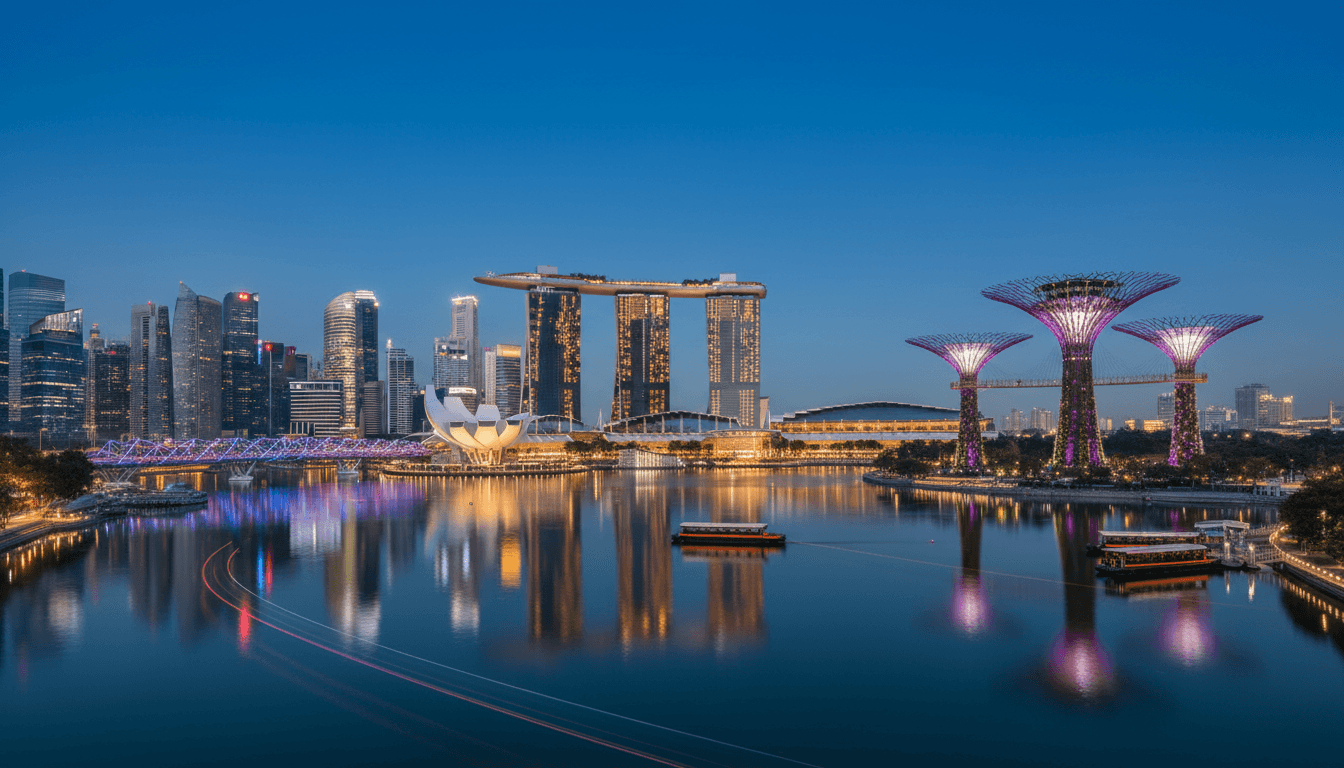
Bachelor and Bachelorette Parties in Singapore: The Complete Home Swap Group Guide for 2026
Planning a bachelor or bachelorette party in Singapore? Discover how home swapping lets groups of 6-12 stay together in luxury condos, saving thousands while partying in Marina Bay.
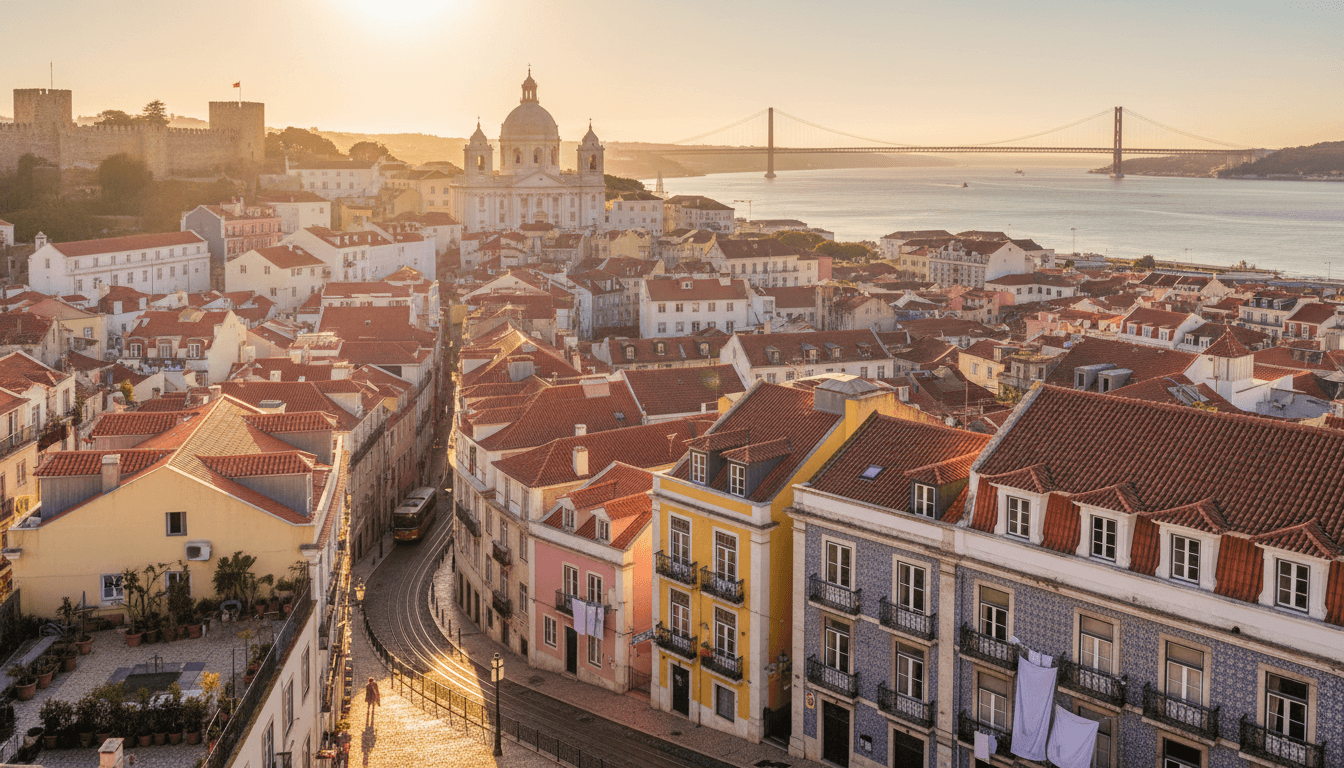
Cycling in Lisbon: 7 Home Swap Bike Tour Itineraries for Every Rider
Discover the best cycling routes in Lisbon with these home swap bike tour itineraries—from waterfront paths to hilltop adventures, all starting from your borrowed home.
Graduation Trip to Barcelona: How Home Swapping Gives New Graduates the Ultimate Celebration
Planning a graduation trip to Barcelona? Discover how home swapping lets new graduates explore Spain's most vibrant city without the hostel crowds or hotel costs.