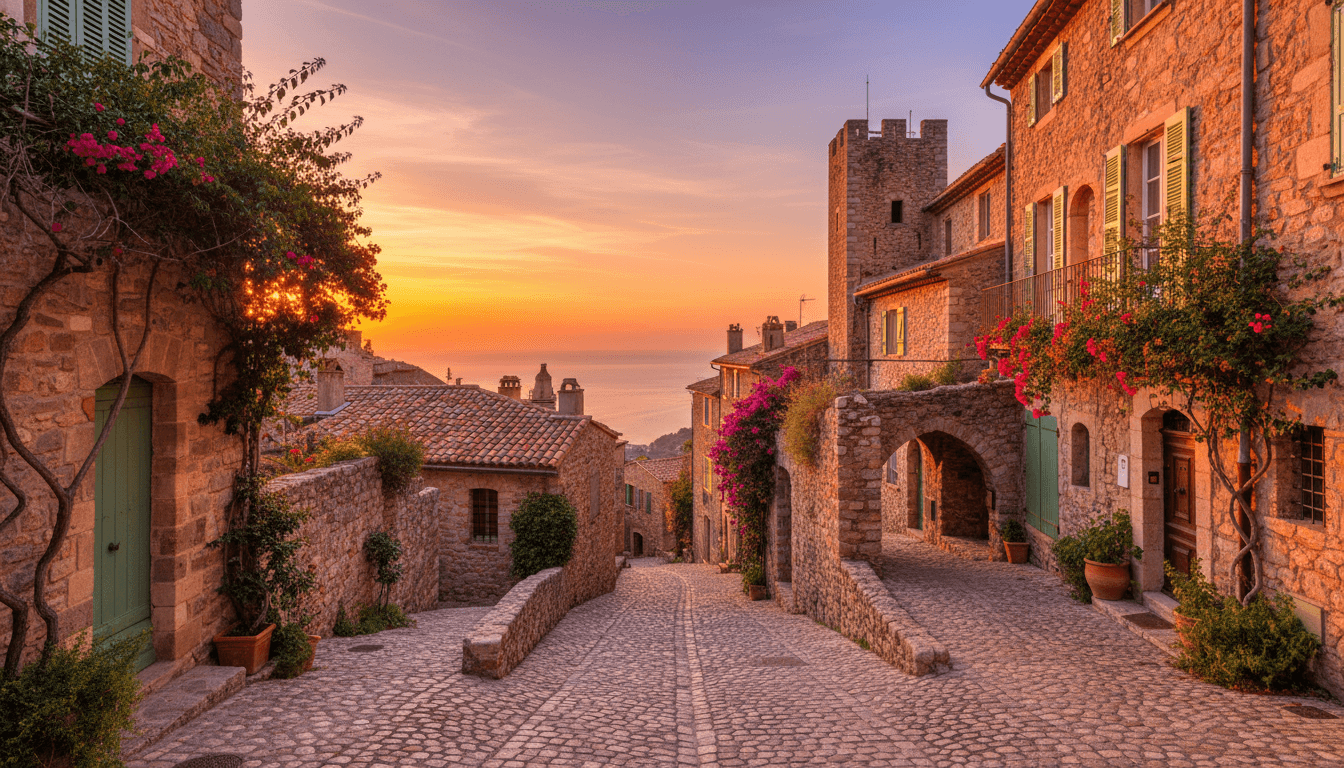
Historic Home Exchange: Stay in Castles, Manors & Heritage Properties for Free

SwappaHome Editorial Team
Home Exchange & Slow Travel Editorial
Discover how to swap your home for stays in centuries-old castles, Georgian manors, and heritage properties. Real tips from 7 years of historic home exchanges.
I still remember the moment I realized I was brushing my teeth in a bathroom older than my entire country. The mirror was slightly warped—original Georgian glass, my host had mentioned—and through the window I could see sheep grazing on land that had been part of this estate since 1743. My San Francisco apartment suddenly felt very, very young.
That was my first historic home exchange, a manor house in the Cotswolds that I'd swapped for my modest two-bedroom. And honestly? It ruined me for regular travel. Once you've woken up in a canopy bed that a duchess probably slept in, hotel rooms start feeling like cardboard boxes with better WiFi.
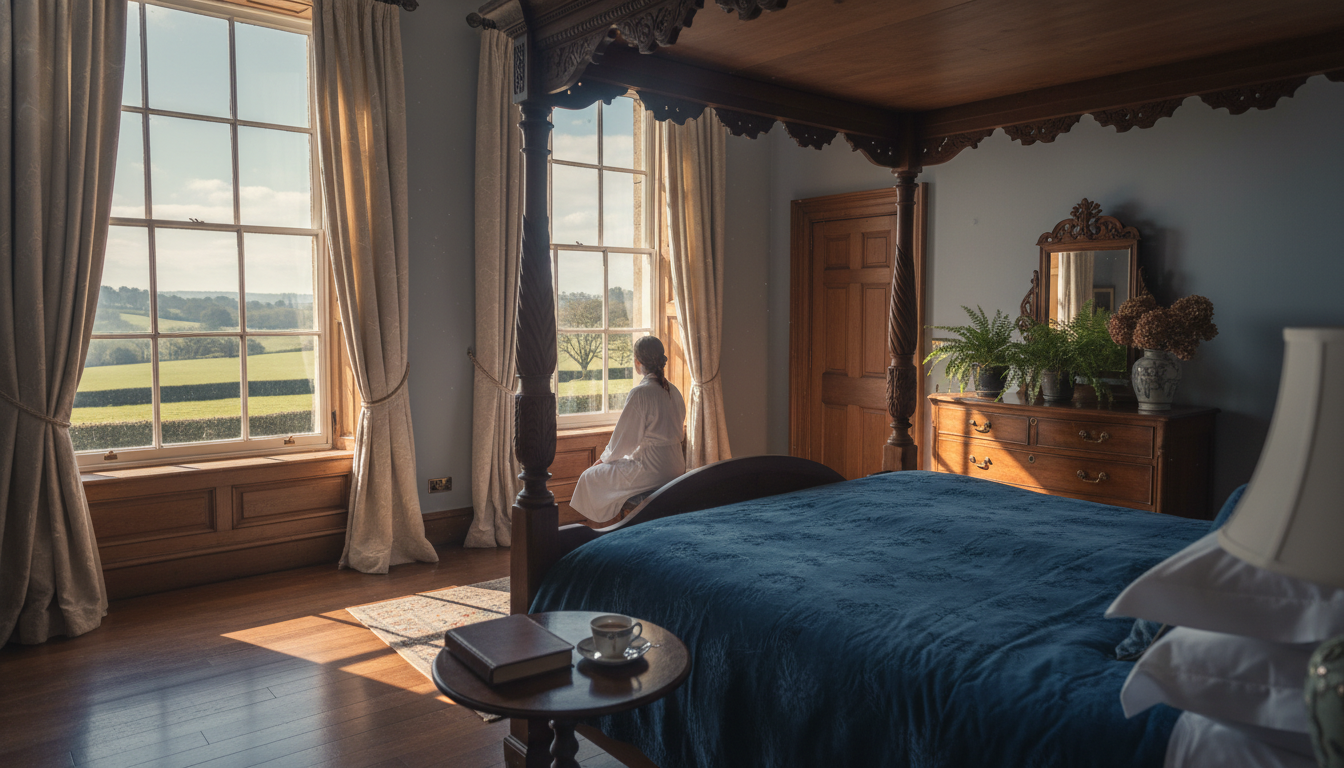 Morning light streaming through tall Georgian windows into a wood-paneled bedroom with a four-poster
Here's what most people don't realize about historic home exchange: these properties aren't museums. They're actual homes where real families live, raise kids, argue about whose turn it is to walk the dog. The owners of that Cotswolds manor? They were thrilled to spend two weeks in San Francisco, eating burritos in the Mission and hiking in Muir Woods. They didn't want my apartment because it was fancy—they wanted it because it was different.
That's the secret sauce of swapping for historic properties. You're not buying access to luxury. You're trading lifestyles with someone who's genuinely curious about yours.
Why Historic Home Exchanges Are More Accessible Than You Think
Let me bust a myth right now: you don't need a castle to swap for a castle.
I know, I know. Sounds too good to be true. But think about it from the castle owner's perspective. They live surrounded by centuries of history every single day. The novelty wore off somewhere around year three. What they crave is something completely different—a beach house in California, a city apartment in Tokyo, a cozy cabin in Vermont.
The family who owns a 16th-century château in the Loire Valley? They've seen enough tapestries and stone fireplaces for a lifetime. They're dreaming about your modern kitchen with the dishwasher that actually works, your proximity to good tacos, your neighborhood where they can walk to a coffee shop without crossing a moat.
On SwappaHome, the credit system makes this beautifully democratic. One night in a Scottish tower house costs exactly the same as one night in a Brooklyn brownstone: one credit. Period. The playing field is level in a way that traditional vacation rentals could never be.
 Split scene showing a medieval French chteau exterior on one side and a modern, sunlit San Francisco
Types of Historic Properties Available for Home Exchange
Over seven years and 40-plus swaps, I've stayed in properties spanning about 800 years of architectural history. Here's what's actually out there:
Medieval Castles and Fortified Houses
These are the showstoppers—the ones that make your friends' jaws drop when you post photos. I've stayed in a 13th-century Scottish castle near Inverness (complete with a resident ghost story, though I slept fine), and a fortified farmhouse in Tuscany that started life as a watchtower.
Expect thick stone walls that keep things cool in summer and... interesting in winter. Spiral staircases that'll give your calves a workout. Fireplaces big enough to roast a wild boar. Limited closet space—medieval people apparently owned three things.
Reality check: Heating bills for these places are astronomical, which is partly why owners love to travel during shoulder seasons. You might be swapping during October or March rather than peak summer.
Georgian and Regency Manors
These are my personal favorites—all elegant proportions, tall windows, and that particular English light that makes everything look like a period drama. Think Jane Austen vibes, but with plumbing.
I did a two-week swap in a Georgian rectory in Somerset that had me drinking tea in the garden every afternoon like I'd been doing it my whole life. The owner, a retired professor, spent those two weeks exploring San Francisco's used bookstores. Perfect match.
Expect high ceilings, original fireplaces (often decorative now), walled gardens, and that specific creaky-floorboard soundtrack. Usually better heating than medieval properties.
Victorian and Edwardian Townhouses
These are everywhere in the UK, Ireland, and parts of continental Europe—and they're often the easiest historic properties to swap for because there are simply more of them.
My swap in a Victorian townhouse in Edinburgh's New Town felt like living inside a novel. Bay windows, ornate cornices, a kitchen in what was once the servants' quarters. The owners wanted to experience "real American life" (their words), so they stayed in my decidedly un-historic apartment and loved every minute of it.
Expect more modern amenities than older properties, but still plenty of character. Narrow stairs, rooms that flow in unexpected ways, and usually excellent locations in historic city centers.
Châteaux, Villas, and Continental Estates
France, Italy, Spain, Portugal—these countries are absolutely loaded with historic properties whose owners are eager to travel. A friend of mine swapped her Portland bungalow for a Renaissance villa outside Florence. The villa had frescoed ceilings and a chapel. Her bungalow had a really nice deck. The Italian family was thrilled with the deck.
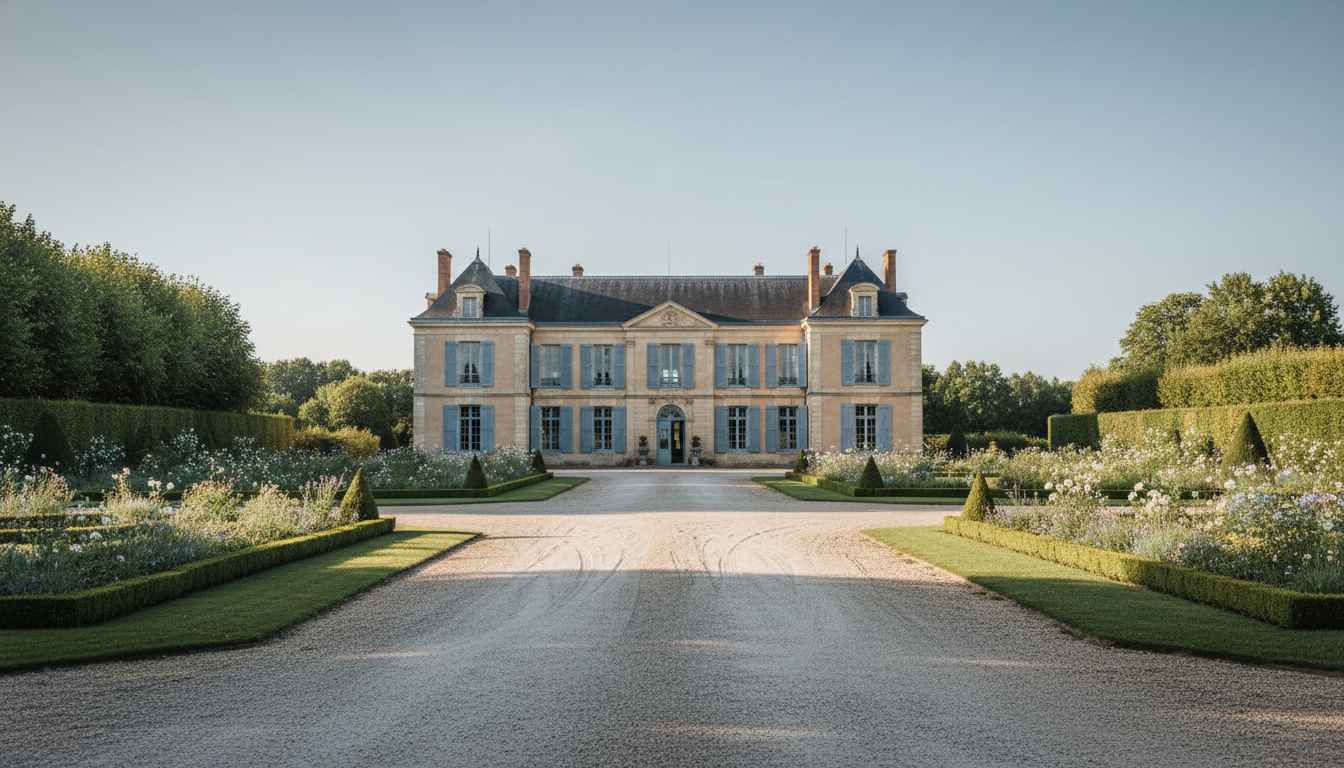 Honey-colored stone French chteau with formal gardens, gravel driveway, and blue shutters, afternoon
How to Find Historic Properties on Home Exchange Platforms
Alright, let's get practical. Here's exactly how I search for historic home exchanges:
Crafting Your Search Strategy
Most platforms let you filter by property type, but the categories can be broad. "House" might include everything from a 1990s subdivision home to a 400-year-old farmhouse. So I use keyword searches in addition to filters.
Search terms that work: "historic," "period," "listed building" (UK term for protected historic properties), "heritage," "manor," "château," "villa," "Georgian," "Victorian," "medieval," "century" (as in "18th century"). I also search by specific regions known for historic properties—Cotswolds, Loire Valley, Tuscany, Scottish Highlands, Provence, Andalusia, the Dordogne.
Reading Between the Lines
Historic property owners often undersell their homes because, to them, it's just where they live. I've seen listings that casually mention "the house dates from 1650" in the third paragraph, after discussing the garden and the proximity to the train station.
Look for mentions of "original features," "period details," or "character property." Photos showing thick walls, exposed beams, stone floors, or unusual architecture. Locations in historic town centers or rural estates. Any mention of the property being "listed" or "protected."
Making Your Listing Attractive to Historic Property Owners
This is crucial. If you want to swap for a castle, you need to make your place irresistible to castle owners.
Remember: they're not looking for historic. They're looking for different, convenient, and interesting. Emphasize modern amenities like a good kitchen, reliable heating and AC, fast WiFi. Highlight location benefits—walkable neighborhood, near attractions, good restaurants. Mention local experiences: farmers markets, hiking trails, cultural venues. Anything unique about your area that they can't get at home.
I completely rewrote my listing after my first few historic swaps. Instead of apologizing for my apartment's lack of character, I leaned into what it offers: a modern kitchen, a rooftop deck with city views, walking distance to some of the best food in San Francisco, and a neighborhood where you can hear three languages on any given block.
 Cozy modern apartment interior with large windows showing San Francisco skyline at dusk, warm lighti
What to Expect When Staying in a Historic Home Exchange Property
Let me be real with you: historic properties come with quirks. Charming, Instagram-worthy quirks—but quirks nonetheless.
The Heating Situation
I have never been colder than I was during a February swap in a 15th-century stone house in Brittany. The fireplace was magnificent. The fireplace also required constant feeding and only heated about a 10-foot radius. The rest of the house hovered around "see your breath" temperature.
Now I always ask: What's the heating system? Is there central heating, or just fireplaces and space heaters? Which rooms are heated? Is there a cost for heating I should know about?
Some historic property owners ask guests to contribute to heating costs during winter months, which is totally fair when you're talking about heating a 6,000-square-foot manor. Expect around $15-30 USD per day in winter for larger properties.
The Plumbing Reality
Retrofitting modern plumbing into buildings designed before indoor plumbing existed is... an adventure. I've encountered bathrooms in former closets (cozy!), hot water that takes a geological age to arrive, water pressure that's either a trickle or a fire hose with no in-between, and toilets in unexpected locations—down a hallway, up a different staircase.
None of this is bad, exactly. It's just different. Ask your host about the hot water situation and any plumbing quirks before you arrive.
Navigation and Layout
Historic houses weren't designed with open floor plans in mind. They were designed to keep servants separate from family, to retain heat in small rooms, to add on wings as families grew wealthy.
Result: You will get lost in your swap house. I guarantee it. That château in France? I spent the first two days accidentally ending up in the wrong wing. The Scottish castle? I never did figure out what was behind one particular door (it was locked, and I was too embarrassed to ask again).
Ask your host for a floor plan or a walkthrough video. Seriously. It helps.
Modern Conveniences (or Lack Thereof)
Some historic properties have been beautifully updated with modern kitchens, good WiFi, and smart TVs. Others... haven't.
I've stayed in places with no dishwasher (hand-washing dishes in a butler's sink is oddly meditative), no dryer (hello, clotheslines and radiator-drying), WiFi that works in exactly one room, a TV that requires a PhD to operate, and kitchen appliances from the 1970s that still work perfectly.
None of these are dealbreakers—they're just things to know in advance. Ask what modern amenities are available, and adjust your expectations accordingly.
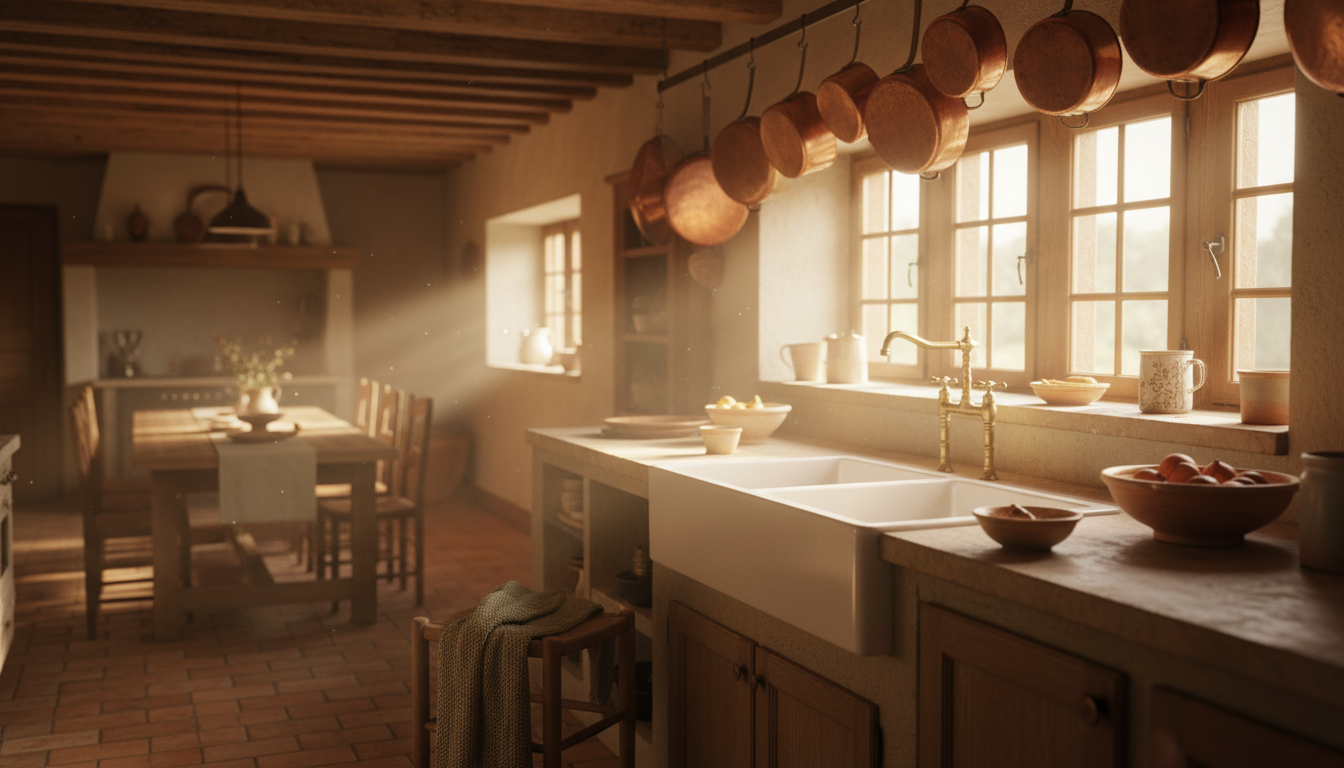 Rustic kitchen in a French country house with copper pots hanging from beams, a large farmhouse sink
Preparing Your Home for Guests When You Have a Historic Property
If you're on the other side of this equation—if you're the one with the historic home hoping to swap—here's what I've learned from hosts who do this well:
Create a House Manual That Assumes Nothing
Your guests have probably never operated a wood-burning Aga, figured out a gravity-fed water system, or navigated a house with three staircases. Write everything down. Include photos. Be specific about how to work the heating system, where the fuse box is (and what to do when something trips), any doors or windows that stick or require special handling, how to work any unusual appliances, and what to do if the power goes out.
Be Honest About the Quirks
The guests who'll love your historic home are the ones who know what they're getting into. Don't hide the fact that the third-floor bathroom is cold, or that the kitchen is a 30-second walk from the dining room, or that the house makes noises at night.
The guests who are bothered by these things will self-select out. The guests who find them charming will be your perfect match.
Stock the Essentials
Historic properties are often in rural locations where the nearest grocery store is a 20-minute drive. Leave your guests basic pantry items—coffee, tea, sugar, oil, salt. A bottle of local wine (this is practically mandatory in France). Information about the nearest shops and their hours. Recommendations for local restaurants and pubs.
The Best Regions for Historic Home Exchange Properties
After years of searching and swapping, here's where I've had the most luck:
United Kingdom
The UK is absolutely unmatched for variety and volume of historic properties available for exchange. The country has over 500,000 listed buildings, and a surprising number of their owners are on home exchange platforms.
Hot spots include the Cotswolds for honey-stone manors, Edinburgh and Bath for Georgian townhouses, Yorkshire for everything from medieval to Victorian, Cornwall for historic cottages and farmhouses, and the Scottish Highlands for castles and tower houses.
Best time to search: UK owners love to escape the grey winters, so you'll find the most availability for swaps during October through March. Summer swaps are possible but more competitive.
France
France has more châteaux than any reasonable country should have—over 40,000 of them. Many are family homes whose owners would love to spend a few weeks somewhere with better weather and fewer maintenance headaches.
Hot spots include the Loire Valley for classic châteaux, Provence for mas and bastides, the Dordogne for medieval villages and manor houses, Normandy for half-timbered manors, and Brittany for stone farmhouses and small castles.
Best time to search: French families often swap during school holidays—look for availability in February, April, and July through August.
Italy
Tuscany gets all the attention, but historic properties are scattered throughout Italy. Renaissance villas, medieval borghi (fortified villages), masserie (fortified farmhouses) in Puglia—the options are endless.
Hot spots include Tuscany (obviously), Umbria (the quieter alternative), Puglia for masserie and trulli, Piedmont for wine country estates, and Veneto for Palladian villas.
Pro tip: Italian historic property owners often speak excellent English and are incredibly welcoming to international guests.
Spain and Portugal
Underrated for historic home exchange. Both countries have stunning historic properties at lower price points than the UK or France, which means owners are often more motivated to swap.
Hot spots include Andalusia for cortijos and historic townhouses, Catalonia for masías, Alentejo in Portugal for quintas and historic estates, and Sintra for romantic palaces and villas.
Real Costs and Savings: Historic Home Exchange vs. Traditional Rentals
Let's talk numbers, because this is where home exchange gets really interesting.
A week in a historic property through traditional vacation rentals typically costs $3,000-8,000 USD for an English manor house, $4,000-15,000 USD for a French château, $3,500-10,000 USD for an Italian villa, and $5,000-20,000 USD for a Scottish castle.
Through home exchange? Zero dollars for accommodation. You're using credits you earned by hosting, or the 7 free credits you got when you joined SwappaHome.
Yes, there are still costs—flights, food, maybe some heating contribution, the membership fee for the exchange platform. But you're looking at savings of thousands of dollars per trip. Over seven years of swapping, I estimate I've saved somewhere north of $60,000 in accommodation costs. And that's a conservative estimate.
The math gets even better for longer stays. A month in a Provençal farmhouse through Airbnb? You're looking at $8,000-12,000 easily. A month through home exchange? Just the credits.
Tips for Your First Historic Home Exchange
If you're ready to take the plunge, here's my hard-won advice:
Start with Something Manageable
Your first historic swap probably shouldn't be a 30-room château. Look for smaller historic properties—a Georgian townhouse, a Victorian cottage, a converted barn. You'll get the experience of staying somewhere with history and character without the overwhelm of navigating a massive estate.
Communicate More Than You Think Necessary
Historic properties have more things that can go wrong (or just confuse you) than modern homes. Ask questions before you arrive. Send a message when you get there. Don't be embarrassed to text your host asking how to work the shower—they'd rather you ask than flood the bathroom.
Embrace the Imperfections
That door that doesn't quite close? The window that rattles in the wind? The mysterious stain on the ceiling that's probably from the 1800s? These are features, not bugs. You're staying in a place with stories. Let it have its quirks.
Leave It Better Than You Found It
This applies to all home exchanges, but especially historic ones. These properties are often irreplaceable. Treat them with respect. Follow the house rules. If something breaks or goes wrong, tell your host immediately—don't try to hide it.
Build Relationships
Some of my best repeat swaps have been with historic property owners. Once you've proven yourself a trustworthy guest, they're often happy to swap again. I've stayed in that Cotswolds manor three times now, and the owners have become genuine friends.
The Unexpected Joys of Historic Home Exchange
I want to end with something that's hard to quantify but impossible to ignore: the way staying in historic properties changes how you travel.
When you're in a hotel, you're a tourist. You go out, you see things, you come back to sleep. The accommodation is a base, nothing more.
When you're in a 300-year-old farmhouse, the house itself becomes part of the experience. You find yourself researching who built it, who lived there, what events it witnessed. You notice details—a date carved into a beam, a coat of arms above a fireplace, the way the floors slope toward the center of the house.
You start to understand a place differently. Not just its tourist attractions, but its daily rhythms. The way light moves through rooms designed before electricity. The sounds a house makes when it's been settling for centuries. The particular smell of old stone and wood fires.
Last year, I spent two weeks in a converted mill in the Scottish Borders. The building dated from the 1700s, and the mill wheel was still there, though it hadn't turned in decades. Every morning, I'd drink my coffee looking at that wheel, thinking about the generations of millers who'd worked there, the grain they'd ground, the bread that fed their community.
You can't buy that experience. You can only trade for it—your home for theirs, your life for a glimpse of another.
That's what historic home exchange offers. Not just free accommodation in fancy old buildings, but a different way of being in the world. A reminder that we're all just temporary residents, passing through spaces that existed before us and will exist long after.
If that sounds like your kind of travel, SwappaHome is a good place to start looking. The historic property owners are out there, dreaming about your neighborhood, your coffee shops, your entirely ordinary life that seems exotic to them.
All you have to do is offer it.
Frequently Asked Questions
Is historic home exchange safe for valuable antique properties?
Historic home exchange relies on mutual trust and the review system that builds accountability between members. Property owners choose their guests carefully, and the community aspect means everyone has incentive to be respectful. Many owners of valuable historic properties successfully swap regularly. Consider getting your own home insurance that covers hosting guests if you want additional peace of mind.
How much can I save with historic home exchange compared to renting a castle?
Historic property rentals typically cost $3,000-20,000 USD per week depending on size and location. Through home exchange, accommodation costs nothing—you use credits earned by hosting. A two-week château stay that might cost $10,000+ as a rental costs zero dollars through SwappaHome, saving thousands per trip.
Do I need a historic or luxury home to swap for a castle?
Absolutely not. Castle and manor owners often want something completely different from their daily life—a modern city apartment, a beach house, or a cozy suburban home. On SwappaHome, one credit equals one night regardless of property type, so your regular home can absolutely get you into extraordinary historic properties.
What should I ask before booking a historic home exchange?
Key questions include: How does the heating system work and what are typical heating costs? Are there any plumbing quirks? Which rooms are the warmest or most comfortable? Is there reliable WiFi? How far is the nearest grocery store? Are there any house rules specific to the historic nature of the property? Request a floor plan or video walkthrough for larger properties.
When is the best time to find historic properties for home exchange?
UK owners often seek swaps during October through March to escape grey winters. French families commonly swap during school holidays—February, April, July through August. Generally, shoulder seasons offer more availability since historic property heating costs make winter travel expensive for owners, motivating them to swap during cooler months.

Published by
SwappaHome
SwappaHome Editorial Team
Home Exchange & Slow Travel Editorial
The SwappaHome Editorial Team brings together travel research, home-exchange community insights, and platform data to produce practical guides for first-time and experienced home swappers. Every article cites real platforms, current market rates, and verifiable city-level facts so readers can make informed decisions without guessing.
Ready to try home swapping?
Join SwappaHome and start traveling by exchanging homes. Get 7 free credits when you sign up!
Related articles

Bachelor and Bachelorette Parties in Singapore: The Complete Home Swap Group Guide for 2026
Planning a bachelor or bachelorette party in Singapore? Discover how home swapping lets groups of 6-12 stay together in luxury condos, saving thousands while partying in Marina Bay.
Cycling in Lisbon: 7 Home Swap Bike Tour Itineraries for Every Rider
Discover the best cycling routes in Lisbon with these home swap bike tour itineraries—from waterfront paths to hilltop adventures, all starting from your borrowed home.

Graduation Trip to Barcelona: How Home Swapping Gives New Graduates the Ultimate Celebration
Planning a graduation trip to Barcelona? Discover how home swapping lets new graduates explore Spain's most vibrant city without the hostel crowds or hotel costs.