
Home Exchange in Zurich: Complete Guide to Utilities, WiFi & Everyday Essentials

SwappaHome Editorial Team
Home Exchange & Slow Travel Editorial
Master Zurich home exchange utilities, WiFi setup, and daily essentials. Insider tips on Swiss power outlets, recycling rules, and what your host won't tell you.
The electricity went out at 11 PM on my first night in Zurich.
I was standing in a gorgeous Kreis 4 apartment, jet-lagged and slightly panicked, staring at a fuse box labeled entirely in German. My host was somewhere over the Atlantic, unreachable. The neighbors were asleep. And I had absolutely no idea that Swiss apartments have individual circuit breakers for each room—or that I'd tripped one by plugging my American hair dryer into an adapter without a voltage converter.
Here's the thing about home exchange in Zurich: the city is clean, efficient, and drop-dead gorgeous. But Swiss apartments come with their own logic, their own systems, and their own unwritten rules that can trip you up (literally, in my case) if you're not prepared. After three separate home swaps here over the past four years, I've learned the hard way what works, what doesn't, and what questions you absolutely need to ask your host before you arrive.
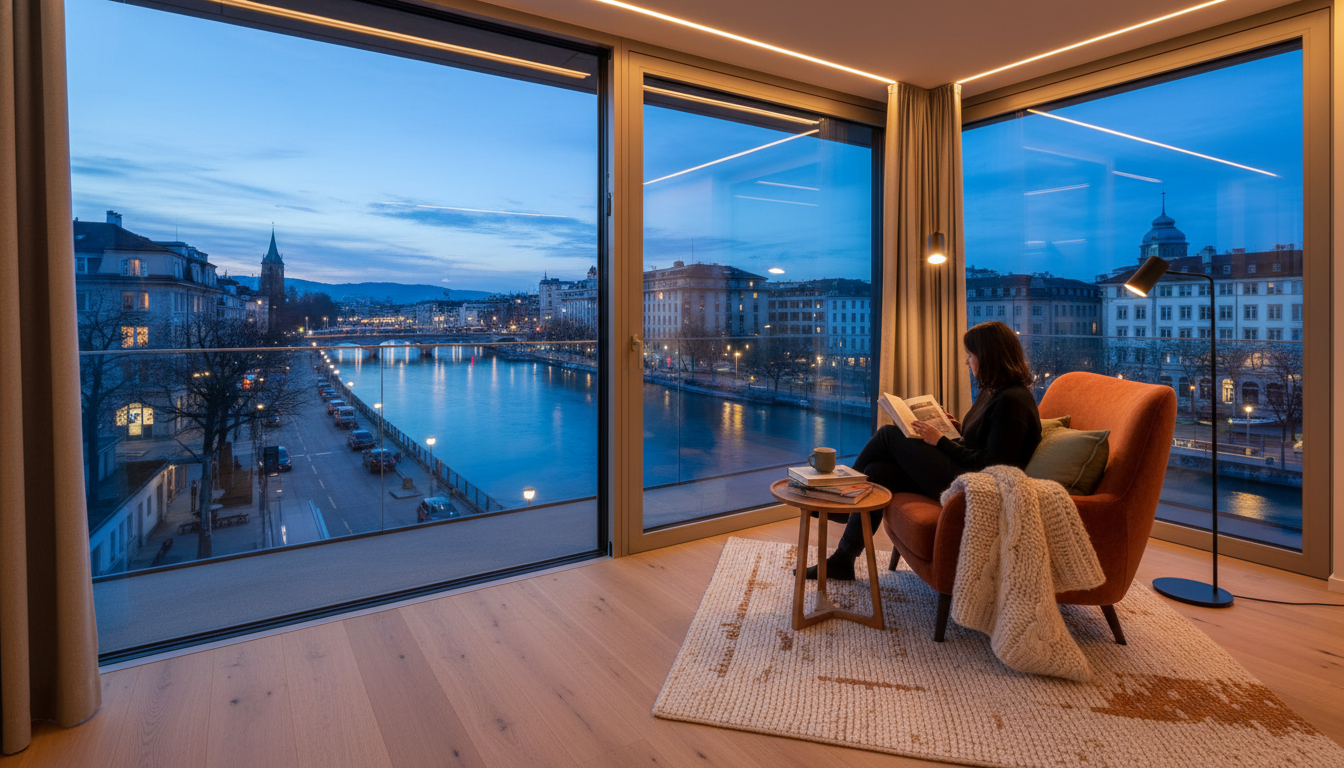 Modern Zurich apartment interior with large windows overlooking the Limmat river at dusk, warm light
So consider this your practical survival guide—everything from navigating Swiss utilities to finding reliable WiFi, understanding the recycling system that will make or break your neighborly reputation, and stocking up on essentials without blowing your entire travel budget at Migros.
Understanding Zurich Home Exchange Utilities Before You Arrive
Swiss utilities work differently than what you might be used to. Getting a handle on the basics before you land will save you from my fuse-box-at-midnight situation.
Electricity: Voltage, Outlets, and That Fuse Box
Switzerland uses 230V electricity at 50Hz—same as most of Europe, but different from North America's 120V. This matters more than you'd think.
Coming from the US or Canada? Your phone chargers and laptop adapters will work fine (they're typically dual-voltage—check the tiny print on the brick). But anything with a heating element—hair dryers, curling irons, electric razors—will either fry immediately or work at half power before dying a slow death. I learned this the expensive way. Twice.
Swiss outlets are their own thing entirely. They use the Type J plug—three round pins in a triangular pattern, slightly recessed into the wall. Most European Type C plugs (two round pins) will fit, but American plugs won't work at all. You need a Swiss-specific adapter, which you can grab at the airport Coop for about 15 CHF ($17 USD) or order ahead for much less.
Here's something nobody tells you: Swiss apartments often have a master switch near the entrance that controls power to most outlets (not the fridge or essential circuits). Your host might leave it off when they travel to save energy. So if you walk in and nothing works, check for a big switch or breaker near the front door before panicking.
The fuse box situation I mentioned? Most Swiss apartments have individual circuit breakers for different rooms or functions. They're usually in a utility closet or near the entrance. If something trips, you'll see one switch in the "off" position while others stay on. Just flip it back. But seriously—don't use high-wattage American appliances without a proper voltage converter.
Heating Systems: Radiators, Thermostats, and the Swiss Love of Fresh Air
Zurich gets cold. Like, properly cold. Winter temperatures regularly drop below freezing, and even spring and fall can be chilly. Understanding your temporary home's heating system isn't optional.
Most Zurich apartments use radiator heating, either connected to a central building system or individual gas boilers. The radiators typically have numbered dials (1-5 or similar)—3 is usually a comfortable room temperature around 20°C (68°F). Some newer buildings have digital thermostats, which are more intuitive.
One thing that confused me initially: many Swiss apartments have heating that's controlled building-wide during certain months. If you're visiting in late September and the radiators feel cold, it might be because the building hasn't switched on the central heating yet. Worth asking your host about.
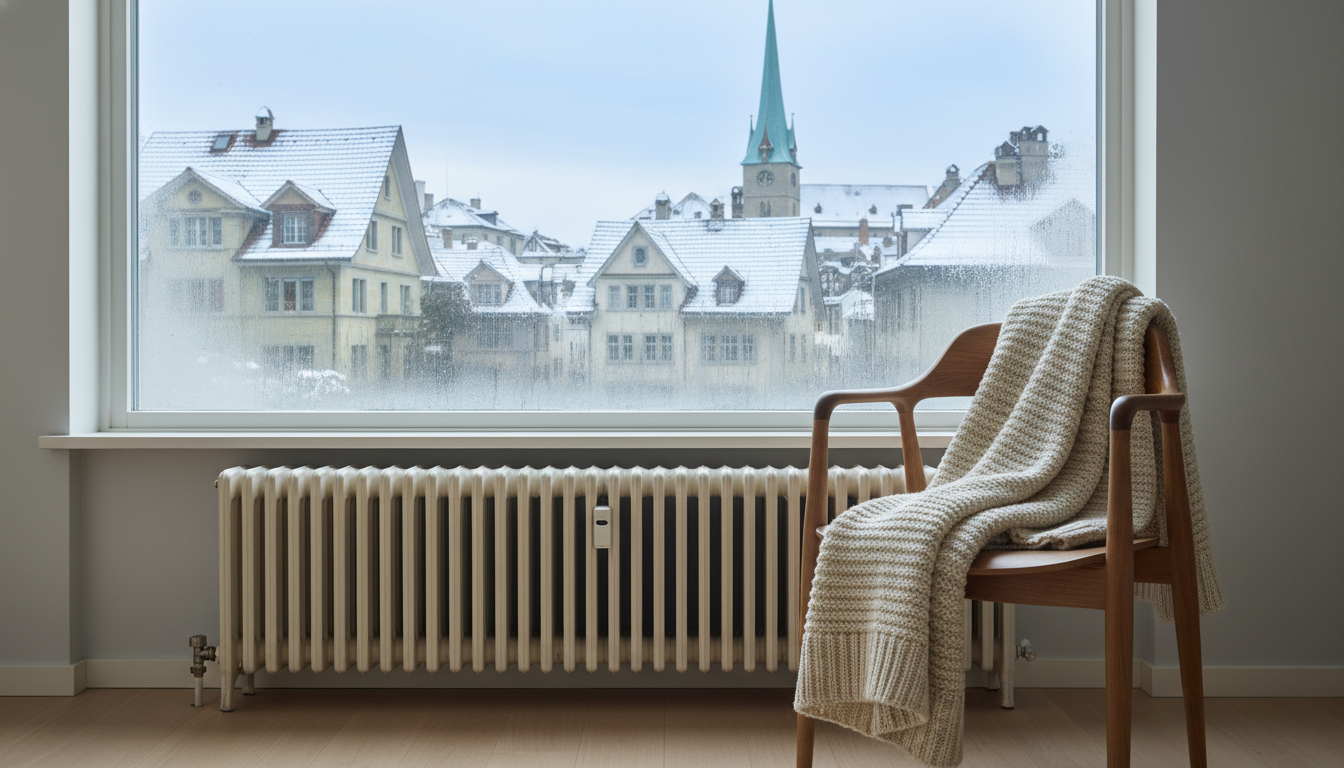 Traditional Swiss radiator under a window with condensation, winter view of Zurichs old town rooftop
Now, here's where it gets culturally interesting. Swiss people are obsessed with fresh air. You'll notice most windows have a "tilt" function—they open at an angle for ventilation without fully opening. Your host will probably mention "Stosslüften" (shock ventilation): opening windows wide for 5-10 minutes a few times daily, even in winter, then closing them completely. It's supposed to prevent mold and keep air quality good. Sounds counterintuitive when it's freezing outside, but it's deeply ingrained in Swiss culture. Your neighbors will notice if you leave windows cracked all day—it wastes building heat, and that's basically a social crime here.
Water: Hot Water Systems and What "Hard Water" Means for You
Zurich tap water is excellent—clean, safe, and honestly delicious. It comes from Lake Zurich and underground springs. No need to buy bottled water; just drink from the tap.
Hot water in Swiss apartments typically comes from one of two systems: a central boiler (instant hot water) or an electric boiler tank (limited supply). If your home exchange has a tank system, you might run out of hot water during a long shower. It usually recovers within 30-45 minutes. Ask your host which system they have so you're not caught mid-shampoo.
Zurich has moderately hard water, meaning mineral buildup is common. You'll notice it on glass shower doors, faucets, and in the kettle. Your host probably has a specific cleaning product for this—look for something labeled "Kalk" (limescale) remover. Don't scrub hard water stains with abrasive materials; you'll scratch the surfaces.
WiFi and Internet Access During Your Zurich Home Exchange
Reliable WiFi is non-negotiable for most of us, and Zurich home exchanges typically deliver excellent connectivity—Switzerland has some of the fastest internet in Europe.
Home WiFi: What to Expect and What to Ask
Most Zurich apartments have fiber or high-speed cable internet through providers like Swisscom, Sunrise, or UPC. Speeds of 100-500 Mbps are common, which handles video calls, streaming, and multiple devices without issues.
Before you arrive, ask your host for the WiFi network name and password (sounds obvious, but I've arrived to find it written on a sticky note that fell behind the router), the router location in case you need to reset it, any data caps or fair usage policies (rare, but some older contracts have them), and whether they use a mesh system with multiple access points.
Router reset is the universal fix for Swiss internet issues. The routers are usually small white boxes from Swisscom (looks like a rounded rectangle) or black boxes from UPC. Unplug for 30 seconds, plug back in, wait 3-5 minutes. Works 90% of the time.
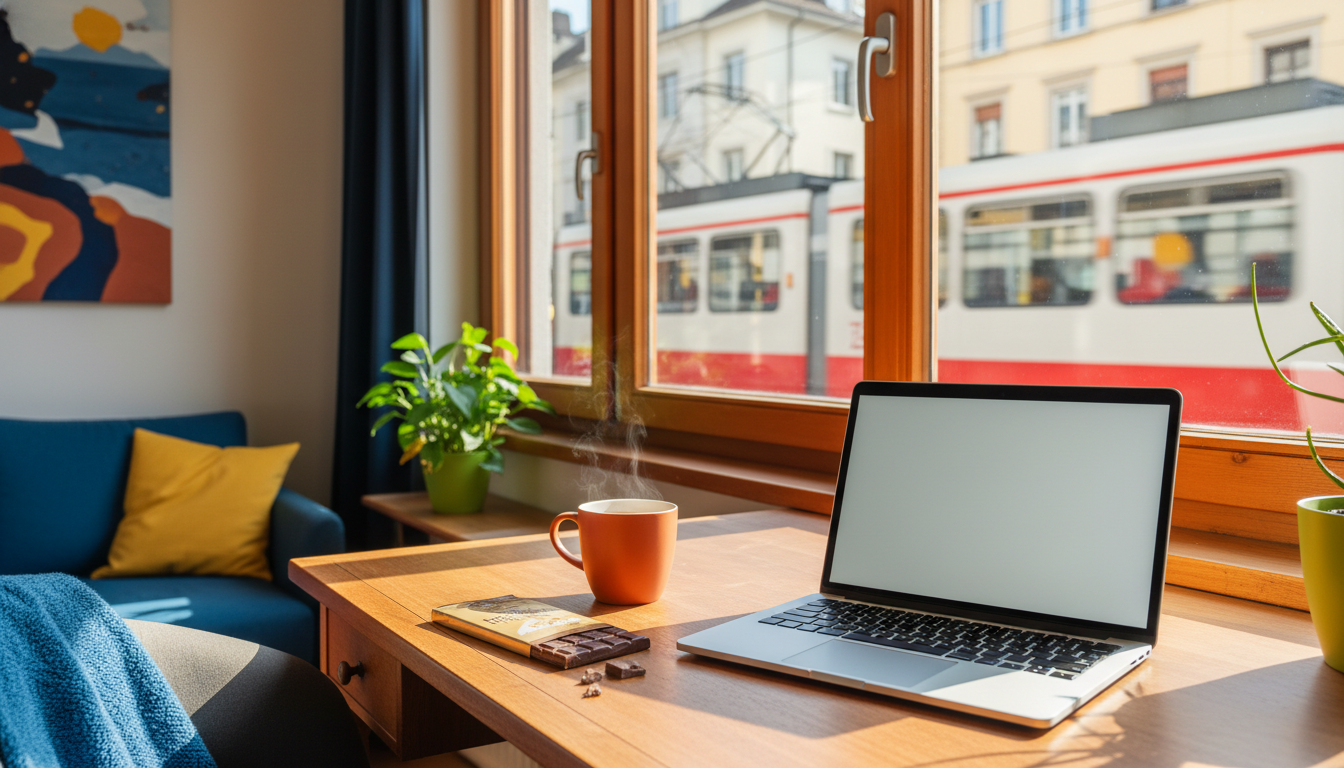 Cozy home office setup in a Zurich apartment with laptop open on wooden desk, view of tram passing o
Mobile Data and SIM Cards for Backup
Even with great home WiFi, having mobile data for navigation and on-the-go use makes life easier.
eSIM is the easiest option if your phone supports it. Services like Airalo or Holafly offer Swiss data packages starting around $10-15 USD for 5GB. Activate before you land.
Physical SIM cards from Swisscom, Sunrise, and Salt are available at the airport, train stations, and supermarkets. A basic data package runs 20-30 CHF ($22-33 USD) for 3-5GB. Bring your passport—Swiss law requires ID for SIM purchases.
Your home carrier might work too. Check international roaming rates. Some US carriers include Switzerland in their international plans. T-Mobile's Magenta plans, for example, include basic data roaming in Switzerland, though speeds are throttled.
Public WiFi in Zurich is decent but not ubiquitous. Train stations, some cafes, and public libraries offer free WiFi. The Zurich public transport (ZVV) has WiFi on some trams and buses, though it's spotty.
The Swiss Recycling System: Your Reputation Depends on It
I'm not exaggerating when I say that recycling in Zurich is serious business. Your neighbors will judge you. Your host will definitely care. And if you mess it up badly enough, you could actually get fined.
Swiss recycling is comprehensive, mandatory, and incredibly specific.
The Züri-Sack System
General waste (non-recyclable trash) in Zurich must go in official "Züri-Sack" bags—white bags with the city logo. These aren't free; they cost about 2-3 CHF each ($2.20-3.30 USD) depending on size and include the waste disposal fee. You buy them at supermarkets (Migros, Coop), kiosks, and some pharmacies.
Using any other bag for general waste is illegal and can result in fines up to 500 CHF.
I know this sounds extreme. It is. But it's also why Zurich is so clean.
Your host should leave you some Züri-Sacks, but ask before you arrive how many and where to buy more. Also ask which day trash gets collected on your street—it varies by neighborhood.
What Gets Recycled (and Where)
This is where it gets detailed. Deep breath.
Paper and cardboard get bundled separately with string (not in bags), collected every 2-4 weeks depending on the neighborhood. Your host will tell you the schedule. Cardboard must be flattened.
Glass is sorted by color (green, brown, clear) into public collection containers found throughout neighborhoods. No lids or caps—those go in regular trash. And here's the crucial part: glass recycling containers are closed on Sundays and after 8 PM to prevent noise disturbance. Yes, really.
PET bottles go in yellow bins at supermarkets and train stations. Crush them first.
Aluminum and tin cans have separate collection points, often near glass containers.
Organic waste goes in green bins for compostable stuff (food scraps, coffee grounds, eggshells)—many buildings have these. Some neighborhoods have public organic waste collection too.
Batteries go in collection boxes at supermarkets—never throw in regular trash.
Electronics need to go to designated collection points or back to retailers.
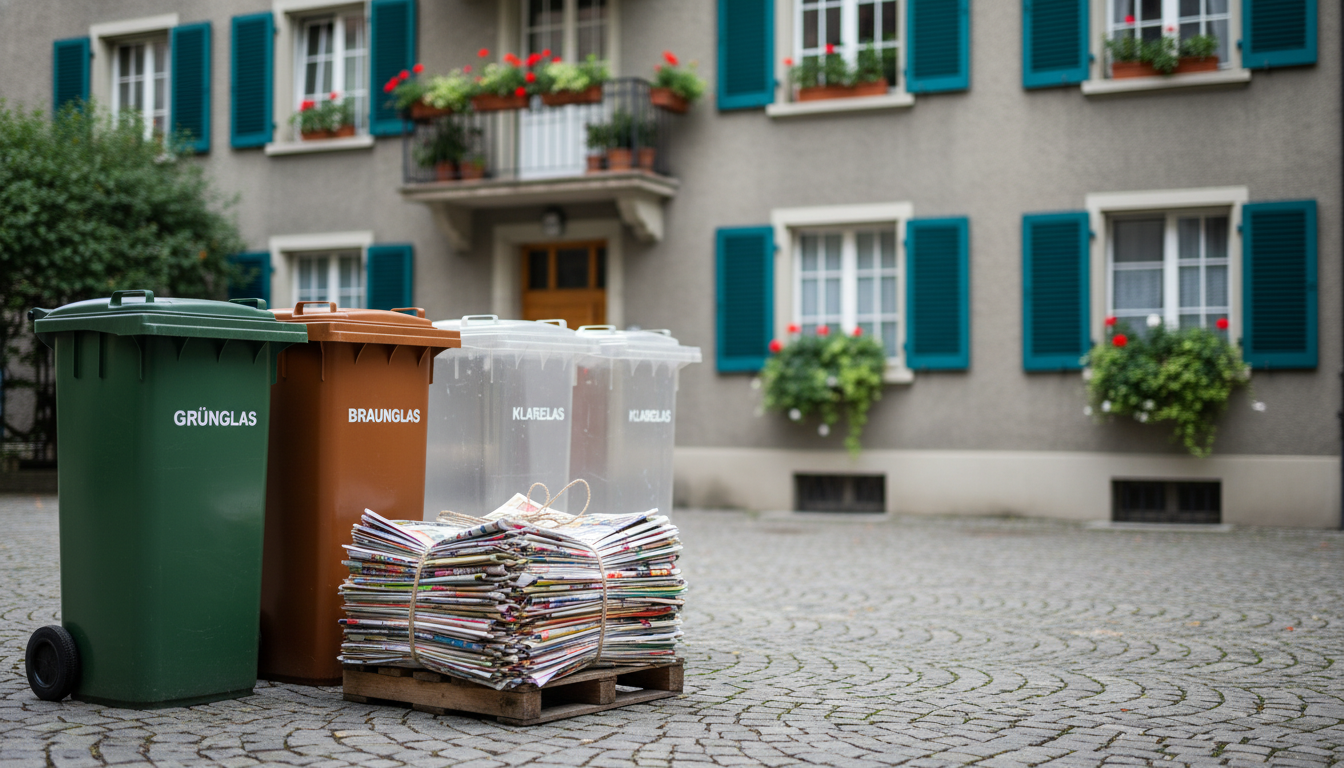 Colorful Swiss recycling containers in a Zurich courtyard - green, brown, and clear glass bins, pape
Ask your host for a quick rundown of where the nearest recycling points are. Most Zurich apartments have a designated recycling area in the building—usually in the basement or courtyard. Some buildings are stricter than others about sorting.
Essential Shopping: Where to Stock Up Without Going Broke
Zurich is expensive. Like, genuinely eye-watering for visitors from most other countries. A basic supermarket shop can feel shocking. But with some local knowledge, you can eat well without financial trauma.
Supermarkets: The Big Two and Budget Alternatives
Migros and Coop are the dominant Swiss supermarkets—you'll find them everywhere. Quality is excellent, but prices are high by international standards. A liter of milk runs about 1.60 CHF ($1.75), bread is 2-4 CHF ($2.20-4.40), and a basic pasta sauce is 3-5 CHF ($3.30-5.50).
Both chains have budget sub-brands: M-Budget (Migros) and Prix Garantie (Coop). Same quality standards, significantly cheaper. Look for the distinctive packaging—it'll save you a lot.
Denner and Lidl are the discount options. Denner is Swiss-owned and slightly cheaper than the big two. Lidl arrived in Switzerland in 2009 and offers the most competitive prices, though selection is more limited. There's a Lidl in Zurich's Sihlcity shopping center and several others around the city. Aldi Suisse is another discount option, similar to Lidl in pricing and approach.
For the best deals on fresh produce, hit the farmers' markets. The Bürkliplatz market (Tuesdays and Fridays) and Helvetiaplatz market (Saturdays) have gorgeous seasonal produce at prices that often beat supermarkets.
What to Buy Where
Some specific tips from my Zurich home exchange experiences:
Bread: Swiss bakeries are incredible, and most supermarkets have in-store bakeries. The half-price bread at closing time (usually after 6 PM) is a budget hack—perfectly good bread at 50% off.
Cheese: Switzerland. Obviously. Migros and Coop have good selections, but for something special, visit a dedicated cheese shop (Käserei) like Chäs Vreneli in the old town.
Coffee: If you're a coffee person, Migros and Coop sell excellent Swiss-roasted beans. Café Crème is the default Swiss coffee style—similar to an Americano but made with more water through the espresso.
Wine: Denner has the best wine selection at reasonable prices. Swiss wines are underrated—try a Fendant (white) or Pinot Noir from Valais.
Toiletries and basics: Müller and Import Parfumerie for cosmetics. For basics like toilet paper and cleaning supplies, the discount supermarkets (Lidl, Aldi, Denner) offer the best value.
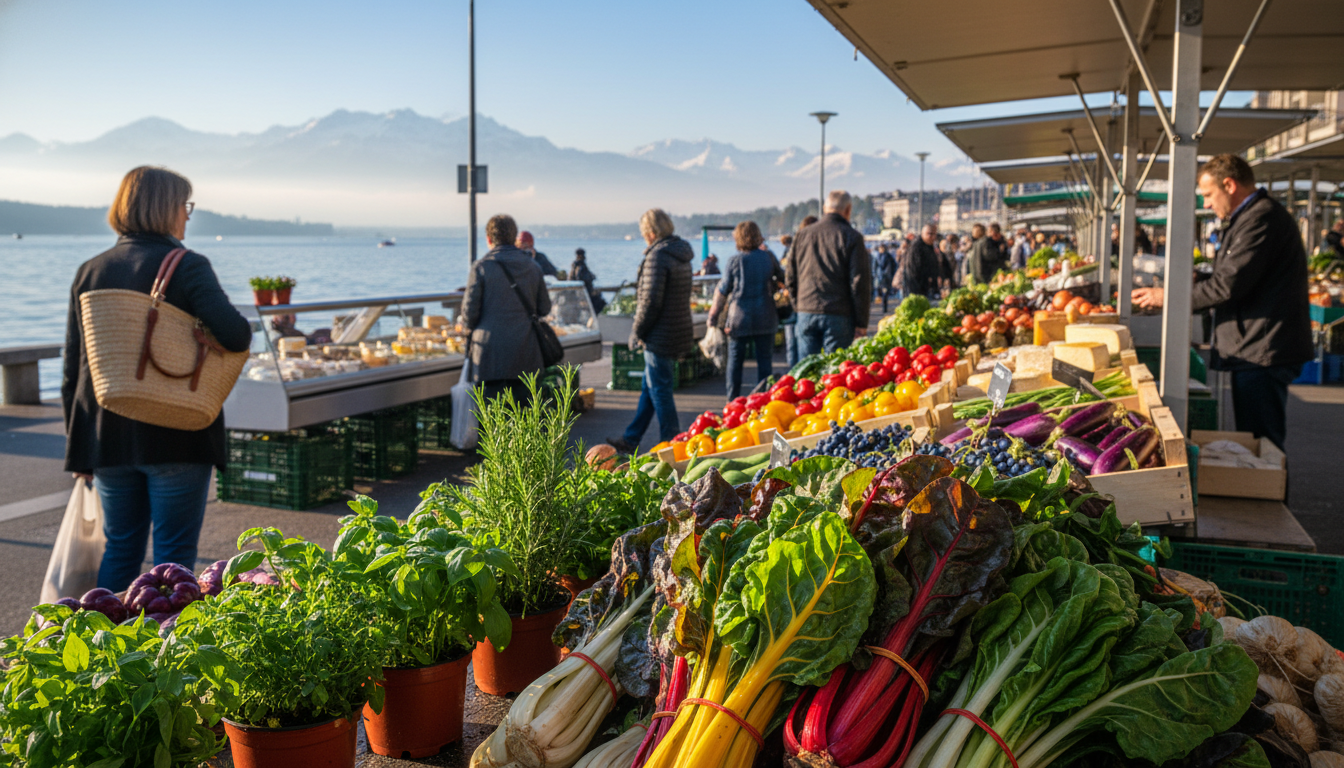 Vibrant Brkliplatz farmers market in Zurich with colorful vegetable stalls, Swiss chard and fresh he
Practical Zurich Essentials Your Host Might Forget to Mention
After multiple Zurich home exchanges, I've compiled the random-but-important details that make daily life smoother.
Sundays Are Sacred (and Everything Is Closed)
Switzerland takes Sunday rest seriously. Almost all shops, supermarkets, and businesses close on Sundays. This isn't just tradition—it's law. Plan your grocery shopping accordingly.
Exceptions: Train station shops (Zurich HB has a Migros and Coop open Sundays), airport shops, some kiosks, and restaurants. Gas station convenience stores (Migrolino, Coop Pronto) are open but have limited selection and higher prices.
Quiet Hours Are Real
Swiss quiet hours (Ruhezeiten) are legally enforced. Weekday nights: 10 PM - 7 AM. Saturday nights: 10 PM - 9 AM. Sundays and holidays: All day is considered quiet time.
During quiet hours, avoid vacuuming, laundry (especially in shared building facilities), loud music, parties, and yes—recycling glass (those containers are loud). Your neighbors will complain. Your host will hear about it.
Laundry in Swiss Apartments
Many Zurich apartments have shared laundry facilities in the basement, with a sign-up schedule. Your host should explain the system. You'll likely have designated time slots (often weekly). Bring your own detergent. Clean the lint filter and wipe down machines after use—this is expected, not optional. Some buildings charge per wash (coin-operated or card system).
If your home exchange has an in-unit washer, lucky you. Dryers are less common in Switzerland—most people air-dry, often on a drying rack (Wäscheständer) or in a designated drying room.
Getting Around: Public Transport Basics
Zurich's public transport (ZVV) is phenomenal—trams, buses, trains, and boats all integrated into one system. If you're staying more than a few days, consider the ZürichCARD (24 hours for 27 CHF/$30 or 72 hours for 53 CHF/$58, unlimited transport plus museum discounts), day passes (8.80 CHF/$9.70 for zones 110 in the city center or 13.60 CHF/$15 for zones 110+111 in greater Zurich), or a monthly pass if you're staying 3+ weeks—about 85 CHF ($94) for the city zones.
Buy tickets from machines at stops (credit cards accepted), the ZVV app, or SBB app. Ticket inspections are frequent and fines are 100 CHF ($110) minimum. Don't risk it.
Emergency Numbers and Practical Contacts
Save these in your phone: 112 for emergency (police, fire, ambulance—EU standard) or 117 (police), 118 (fire), 144 (ambulance). For non-emergency medical advice, there's a free hotline at 0800 33 66 55. To find open pharmacies, call 0900 553 554. And obviously, save your host's contact—plus get a backup local contact if possible.
Tipping and Payment
Switzerland is largely cashless—cards accepted almost everywhere, including small purchases. Contactless payment (Apple Pay, Google Pay) works widely.
Tipping isn't expected like in the US. Service charges are included in prices. Rounding up or leaving 5-10% for good restaurant service is appreciated but not obligatory.
Making Your Zurich Home Exchange Successful
Beyond the practical stuff, a few principles make home exchanges in Zurich work smoothly.
Communication with your host is everything. Before arrival, ask about any quirks with appliances (that coffee machine might need specific instructions), plants or anything that needs care, mail handling (packages might arrive), building rules you should know, and emergency contacts (building manager, helpful neighbor).
Leave the apartment as you found it—or better. Swiss standards for cleanliness are high. A thorough clean before departure, taking out trash and recycling properly, and leaving things tidy goes a long way for your review and the home exchange community.
Document any issues immediately. If something breaks or you notice damage, message your host right away with photos. Transparency protects everyone.
And honestly? Embrace the Swiss way of doing things. The recycling might seem excessive, the quiet hours restrictive, the Sunday closures inconvenient. But there's something lovely about a society that values rest, cleanliness, and consideration for neighbors. After a few days, it starts to feel less like rules and more like rhythm.
Finding Your Perfect Zurich Home Exchange
Zurich rewards travelers who take time to settle in. A home exchange gives you that time—plus a kitchen for those expensive-restaurant-avoidance meals, a washing machine for that mid-trip laundry crisis, and a neighborhood to call your own.
SwappaHome makes finding Zurich home exchanges straightforward. The platform's credit system means you can host guests at your place (earning 1 credit per night) and use those credits to book stays anywhere—including those gorgeous Zurich apartments with lake views and perfectly organized recycling systems.
My favorite Zurich swap was a compact studio in Wiedikon. Nothing fancy, but it had a balcony facing the Alps and a host who left detailed notes about everything from the temperamental espresso machine to the best shortcut to the tram stop. Those details made all the difference.
The fuse box incident from my first visit? I figured it out eventually (YouTube, bless it), and the rest of that trip was magical. Morning runs along the lake, evenings in cozy wine bars in Niederdorf, lazy afternoons reading in Rieterpark. The kind of trip that only works when you have a real home to return to.
That's what home exchange in Zurich offers—not just free accommodation, but a chance to live like a local in one of Europe's most livable cities. Even if the recycling takes some getting used to.
Frequently Asked Questions
What type of power adapter do I need for a Zurich home exchange?
Switzerland uses Type J outlets with three round pins in a triangular configuration. Standard European Type C plugs usually fit, but US/UK plugs require a Swiss-specific adapter. Purchase one at Zurich airport (Coop, around 15 CHF) or order online before your trip. Remember: Swiss voltage is 230V, so American appliances with heating elements need a voltage converter, not just an adapter.
How does the Züri-Sack trash system work in Zurich?
All non-recyclable waste must go in official Züri-Sack bags—white bags with the city logo that include the disposal fee. They cost 2-3 CHF each at supermarkets and kiosks. Using unauthorized bags is illegal and fines reach 500 CHF. Your home exchange host should provide some bags; ask where to buy more and which day collection happens on your street.
Is WiFi reliable in Zurich home exchanges?
Yes, Switzerland has excellent internet infrastructure. Most Zurich apartments have fiber or high-speed cable with 100-500 Mbps speeds. Before arriving, request the WiFi password and router location from your host. For backup, consider an eSIM (Airalo, Holafly) or Swiss prepaid SIM from Swisscom or Sunrise, available at the airport for 20-30 CHF.
What are the quiet hours I need to follow in Zurich?
Swiss quiet hours (Ruhezeiten) are legally enforced: weeknights 10 PM-7 AM, Saturdays 10 PM-9 AM, and all day Sundays and holidays. Avoid vacuuming, laundry, loud music, and glass recycling during these times. Your neighbors will notice violations, and repeated disturbances can result in complaints to your host or building management.
Can I do laundry during my Zurich home exchange?
Most Zurich apartments have shared basement laundry facilities with sign-up schedules—your host will explain the system. Bring your own detergent, clean machines after use, and respect designated time slots. Some buildings charge per wash. In-unit washers are less common; dryers are rare, so expect to air-dry clothes on a rack.

Published by
SwappaHome
SwappaHome Editorial Team
Home Exchange & Slow Travel Editorial
The SwappaHome Editorial Team brings together travel research, home-exchange community insights, and platform data to produce practical guides for first-time and experienced home swappers. Every article cites real platforms, current market rates, and verifiable city-level facts so readers can make informed decisions without guessing.
Ready to try home swapping?
Join SwappaHome and start traveling by exchanging homes. Get 7 free credits when you sign up!
Related articles

Bachelor and Bachelorette Parties in Singapore: The Complete Home Swap Group Guide for 2026
Planning a bachelor or bachelorette party in Singapore? Discover how home swapping lets groups of 6-12 stay together in luxury condos, saving thousands while partying in Marina Bay.

Cycling in Lisbon: 7 Home Swap Bike Tour Itineraries for Every Rider
Discover the best cycling routes in Lisbon with these home swap bike tour itineraries—from waterfront paths to hilltop adventures, all starting from your borrowed home.

Graduation Trip to Barcelona: How Home Swapping Gives New Graduates the Ultimate Celebration
Planning a graduation trip to Barcelona? Discover how home swapping lets new graduates explore Spain's most vibrant city without the hostel crowds or hotel costs.