
Home Exchange Sites: How the Best Platforms Transform Travel in 2027

SwappaHome Editorial Team
Home Exchange & Slow Travel Editorial
Home exchange sites let you stay in real homes for free by hosting other members in yours. We compare the main platforms, their models, and who each one suits best.
Home exchange sites let you stay in another member's home for free. In return, you host travellers in yours. The best-known home exchange sites include HomeExchange, Love Home Swap, Intervac, HomeLink, Kindred, ThirdHome and SwappaHome. They differ mainly in cost, swap style and the kind of traveller they're built for.
This guide explains how house swap websites work and compares the main platforms side by side. It also covers how to pick the right one for your situation and how to make your first exchange go smoothly. If you travel often, work remotely, or want to stretch a holiday budget, choosing the right site matters more than most people expect.
 Woman browsing home exchange platform
Key Takeaways
| Point | Details |
|---|---|
| Accommodation without nightly rates | Home exchange sites let you stay in real homes without paying per night for the stay itself. |
| Models differ a lot | Some sites charge an annual membership, some focus on luxury or a region, and a few are free. |
| Points beat perfect timing | Credit or points systems remove the need to swap at the same time as your partner. |
| Trust is built, not assumed | Verification, reviews and clear communication make swaps safe and rewarding. |
| Pick for your travel style | Families, retirees, luxury owners and remote workers are each better served by different platforms. |
What are home exchange sites and how do they work?
Home exchange sites are online platforms that connect people who want to trade stays in each other's homes, either at the same time or at different times. Your home becomes your travel currency. Instead of paying a host per night, you offer your own place to other members. For a fuller walkthrough of the concept, see our explainer on how home exchange works.
Most modern platforms run on credits or points. When another member stays at your home, you earn credits. You then spend those credits to stay somewhere else. This removes the biggest practical barrier of older, direct-swap models: two households having to travel on the same dates.
Here are the main swap types you'll find on most house exchange websites:
- Reciprocal swap: Both households stay in each other's homes at the same time.
- Non-reciprocal swap: You stay in someone's home at a different time, using credits you've earned by hosting.
- Points-based swap: Credits are earned and spent independently, which gives you the most scheduling freedom.
- Long-term swap: Extended stays of a month or more, which suit remote workers and sabbaticals.
| Feature | Reciprocal swap | Non-reciprocal (points) swap |
|---|---|---|
| Timing flexibility | Low (schedules must align) | High (use credits when it suits you) |
| Credit requirement | None | Yes, credits needed |
| Best for | Couples, retirees with flexible dates | Families, frequent travellers, remote workers |
| Availability | Limited by both parties' plans | Broader pool of options |
Pro Tip: When you create your listing, use bright, honest photos and spell out your amenities clearly. Hosts with detailed, welcoming profiles tend to get matched faster and attract more reliable guests.
Registration works much the same everywhere. You sign up, verify your identity, and list your home with photos and details. Then you browse available homes and send swap requests. Signing up and browsing has become much simpler over the years, which is a big reason home swapping has moved beyond a small circle of enthusiasts.
 Man photographing living room for home swap
The best home exchange sites in 2027 compared
No single platform is best for everyone. The best home swap websites for a retired couple in Europe are rarely the best ones for a remote worker who needs fast Wi-Fi, or for an owner of a luxury second home. Below we describe how each platform works and who it suits. Pricing changes often, so we don't quote fees. Check each site for current pricing before you join.
| Platform | Model | Cost to members | Best for |
|---|---|---|---|
| HomeExchange | Reciprocal swaps plus a points system | Annual membership fee — check current pricing on their site | Travellers who want a large, established network |
| Love Home Swap | Reciprocal swaps and points | Subscription — check current pricing on their site | Holiday-focused travellers, strong UK presence |
| Intervac | Traditional reciprocal swaps | Annual membership fee — check current pricing on their site | Experienced swappers, families, European travel |
| HomeLink | Reciprocal swaps, long-running community | Annual membership fee — check current pricing on their site | Members who value a long-established network |
| Kindred | Curated, credit-based community | Check current terms and per-stay fees on their site | City stays within a vetted network |
| ThirdHome | Luxury exchange for second homes | Membership and exchange fees — check current pricing on their site | Owners of high-end vacation properties |
| People Like Us | Family-focused swaps | Membership fee — check current pricing on their site | Families with children |
| Nomador | Home exchange and house-sitting | Free and paid options — check current pricing on their site | Pet owners and flexible travellers |
| SwappaHome | Credit system, reciprocal not required | Free: no subscription, no membership fee | Remote workers and travellers who need a work-ready home |
HomeExchange
HomeExchange is one of the longest-running and best-known home exchange sites. It supports classic simultaneous swaps and a points system, so you can host one member and stay with another later. Its main strength is choice: a broad international network gives you options in many popular destinations. It works on an annual membership, which pays off best if you swap more than once a year.
Love Home Swap
Love Home Swap offers reciprocal swaps and a points-based option, and it has a strong following in the UK. It suits holidaymakers who want a straightforward way to swap for annual breaks. Membership is subscription-based, so compare the plans with how often you actually travel.
Intervac
Intervac is one of the oldest names in home swapping and grew out of a traditional, reciprocal model. Many of its members are experienced swappers who plan holidays well in advance, often families and retirees. It's a good fit if you like the classic "you stay at mine, I stay at yours" approach and have flexible dates.
HomeLink
HomeLink is another long-established network with a reputation for a committed, community-minded membership. It leans toward reciprocal exchanges and planned holidays. It suits members who value a long history and a more traditional swapping culture.
Kindred
Kindred takes a curated approach. Members are vetted, and stays run on credits within that community. The focus on a smaller, trusted circle appeals to people who feel nervous about opening their home to the general public. Check its current terms for any per-stay costs.
ThirdHome
ThirdHome targets owners of luxury second homes and vacation properties. Its model is built around exchanging time in high-end homes rather than primary residences. If you own a premium holiday property you don't use year-round, it's worth a look. It isn't designed for everyday apartments.
People Like Us
People Like Us is aimed at families with children. Listings often highlight child-friendly features such as cots, toys and gardens. For parents, that focus saves a lot of filtering through homes that don't suit kids.
Nomador
Nomador combines home exchange with house-sitting. That works well if you have pets and want someone to look after them while you're away. It also suits travellers who are happy to care for a home in exchange for a stay.
SwappaHome
SwappaHome is a newer, free option built for remote workers and travellers who want a work-ready home. There's no subscription, no membership fee and no nightly fees between members. It runs on a simple credit system: hosting one night earns one credit, and one credit equals one night in any member's home, whatever the home.
New members get 7 free credits, which is a free week, when they join. A reciprocal swap isn't required, though direct swaps are possible. Listings show the home's internet speed, so you can check a place is good enough for video calls before you book. It's not the biggest network, but if cost and connectivity matter most to you, it's a practical place to start.
For a deeper look at a shortlist of platforms, see our guide to the best home exchange websites.
How to choose the best house swap site for you
With so many house swap sites available, the easiest way to decide is to work backwards from how you travel. These are the factors that matter most:
- Cost model. Annual memberships make sense if you swap several times a year. A free platform lowers the risk if you're trying home exchange for the first time.
- Swap style. If your dates are fixed, such as school holidays, a points or credit system gives you far more options than reciprocal-only swaps.
- Network fit. A big network helps in popular cities. A niche network, such as family-focused, luxury or remote-work-friendly, means fewer listings but better matches.
- Trust features. Look at how members are verified, whether reviews go both ways, and whether messaging stays on the platform.
- Practical filters. Remote workers should look for internet speed and workspace details. Families should look for child-friendly tags. Pet owners should look for pet policies.
It's fine to join more than one site. Many experienced members list their home on two platforms, at least at first, to see which community suits them. Keep your calendar up to date on each so you don't double-book.
Home swap apps: swapping from your phone
Many people now search for a home swap app rather than a website, and most major platforms offer one, or at least a mobile-friendly site. A good home swapping app lets you manage requests, message members and update your availability while you're travelling. That matters when a swap partner has a last-minute question about keys or parking.
When you compare apps, check whether messaging and booking requests happen inside the app and whether notifications are reliable. Also check whether you can edit your listing and calendar on the go. We compare the main options in our roundup of the best house swap apps.
Why home exchange sites matter: affordability, accessibility, and real-life impact
Accommodation is usually the biggest line in a travel budget. A week in a hotel or a short-term rental in a popular city can cost more than the flights. Home exchange removes the nightly rate for the stay itself, so your main costs are any membership fee, your travel, and preparing your home for guests.
The savings grow quickly for frequent travellers. Someone who takes several trips a year, or who spends weeks at a time working from another city, can redirect money that would have gone on rent into the trip itself. Our article on how travel networks unlock affordable home swapping looks at this in more detail.
Beyond saving money, these are the four benefits that matter most:
- Lower accommodation costs: Remove nightly fees and put that budget toward experiences.
- Living like a local: Stay in real neighbourhoods, use a full kitchen, and experience daily life in your destination.
- Space for families: A full home with several bedrooms and a kitchen usually works better than two cramped hotel rooms.
- More destinations within reach: Cities that felt too expensive become realistic when the stay itself costs nothing.
For remote workers, there's an extra benefit. A real home with a desk, a reliable connection and a washing machine makes a month away feel like normal life rather than an extended hotel stay.
How home swap websites build trust, safety, and community
Saving money matters, but so does peace of mind. Here's how responsible home swap sites make sure trust and safety aren't left to chance.
Most established platforms combine several layers of protection:
- Identity verification: Checks that confirm members are who they say they are. Depending on the platform, this might be an ID check or sign-in through a professional profile. SwappaHome, for example, verifies identity through LinkedIn sign-in.
- Listing standards: Some platforms review listings for accuracy and completeness.
- Two-way reviews: Hosts and guests both leave reviews after a stay, which creates accountability.
- Clear house rules: Written expectations on cleaning, keys, pets and shared spaces.
- Secure messaging: Keeping communication on the platform before and during a swap.
Coverage for damage varies widely between platforms. Some offer guarantees, and others, including SwappaHome, offer none. Whatever site you use, check with your own home insurer and travel insurer about how guests and home exchange stays are covered, and agree house rules in writing before anyone arrives.
New members often face a "trust gap". Without a review history, it can be harder to get your first request accepted. You can close that gap with a complete profile, a detailed listing, quick and friendly replies, and a short first stay. Starter credits also help, because you can travel before you've hosted. For a broader look at how these communities work, read our guide to homeowner travel networks and home swapping.
The community side is a real difference from renting. Members tend to treat each other's homes with care, because they know their own home is being looked after in return.
Pro Tip: Before confirming any swap, read the host's full profile and their recent reviews. Look for consistent comments about cleanliness, communication and how guests left the home.
Common challenges, solutions, and expert tips for maximizing success
Even on well-designed platforms, problems can come up. The right habits and platform features help you avoid most of them.
These are the four challenges new users run into most often:
- Date coordination: Finding a match when you and the other household want to travel at different times.
- Home value fairness: Worrying that a city flat isn't "worth" as much as a beach house.
- Cleaning and prep expectations: Disagreements about how the home should be left after a stay.
- Pet and allergy needs: Hosts with pets and guests with allergies need clear communication upfront.
Credit and points systems solve the first two. Because hosting and travelling are separate, you don't need matching dates. Where every night is worth the same, as with SwappaHome's one-credit-per-night model, a modest apartment earns the same as a larger home. Other platforms weight points by home size or location instead. Read the rules before you list so your expectations match.
Here's what helps the process run smoothly:
- Flexible swap models that separate your hosting from your travelling
- Profile tags and filters for pets, allergies, accessibility, workspace and home type
- A written cleaning checklist agreed with your swap partner
- On-platform messaging to confirm expectations before you accept
- Longer-stay options for remote work or sabbaticals
It's worth weighing the pros and cons honestly. The savings and local experience are real, but so is the effort of preparing your home, managing messages and building a review history. Most people find the trade-off worthwhile after their first successful swap.
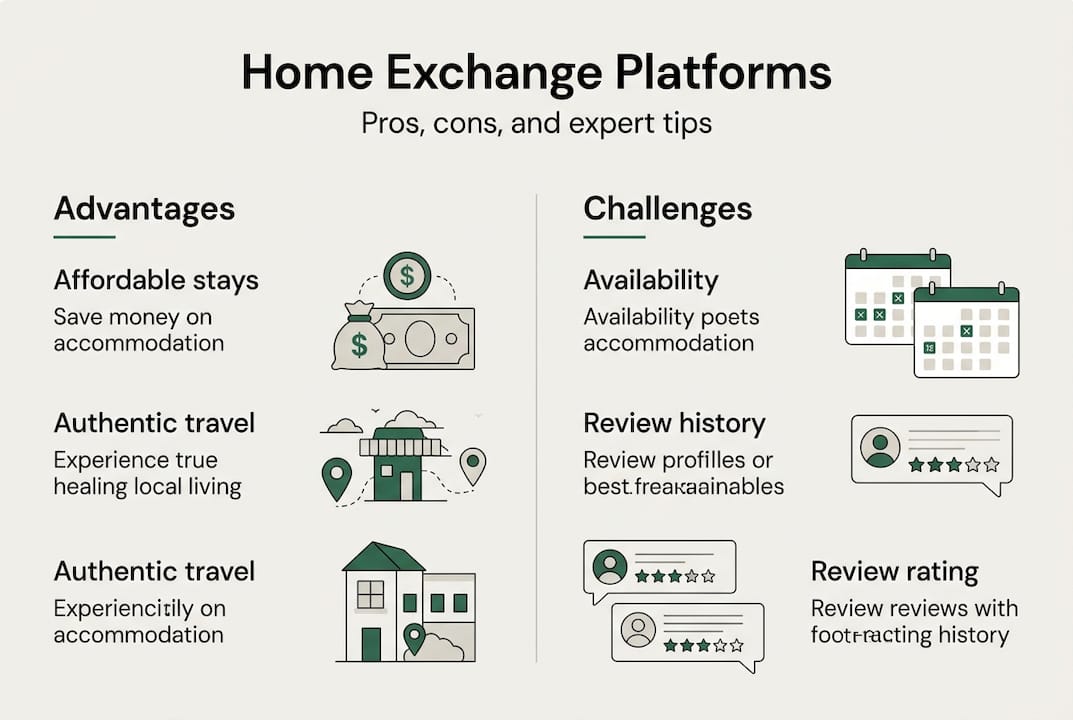 Infographic summarizing pros and cons of home exchange
Pro Tip: Use every filter and tag your platform offers. The more specific your profile and search, the faster you'll find a match that works for both sides.
Making the most of home exchange sites: actionable steps for your first swap
Once you understand the challenges and how to handle them, you're ready to start. Here's a roadmap for your first home swap.
Follow these five steps from sign-up to your first completed stay:
- Choose a platform that fits your travel style. Compare cost models, swap types and the kind of members each site attracts, using the comparison above.
- Create a detailed listing. Write an honest, warm description of your home. Add plenty of good-quality photos covering every room, the neighbourhood and any standout features. If you work remotely, include your workspace and internet speed.
- Vet potential swaps. Read profiles carefully, check reviews, and confirm the home suits your needs for space, location and amenities.
- Communicate and clarify. Message your swap partner before confirming. Discuss check-in times, keys, house rules, parking, Wi-Fi and any special needs.
- Confirm and prepare. Get your home ready the way you'd want to find it. Leave a welcome note, local tips and clear instructions for appliances.
A few extra tips make a real difference:
- Start with a shorter stay, a few nights, for your first swap to build confidence.
- Ask questions early. When it's your home involved, no question is too small.
- Use your platform's community spaces or guides to learn from experienced members.
- If you have pets or allergies in the family, filter for suitable homes from the start.
- Leave a thorough review after every stay. It helps the community and builds your own reputation.
Your first swap doesn't have to be a simultaneous trade. On credit-based sites you can host first, earn credits, and travel on your own timeline. On some sites you can even travel first using starter credits. That flexibility is what makes home swapping workable for people with ordinary jobs and schedules.
Start your exchange journey with SwappaHome
You've seen how home exchange sites work, how the main platforms compare, and how to plan your first swap. The next step is choosing the community that fits how you travel.
 https://swappahome.com
If you work remotely or want a home where you can work comfortably, SwappaHome is built around that need. It's free to join and use, with no subscription, no membership fee and no nightly fees between members. Hosting one night earns one credit, and one credit equals one night in any member's home. New members receive 7 free credits, a free week, to get started.
Listings show internet speed, members verify their identity through LinkedIn, and booking requests and messaging happen securely in the app. You can host and travel at different times or arrange a direct swap. Learn more about how SwappaHome credits work.
Frequently Asked Questions
What are the best home exchange sites?
The best home exchange sites depend on how you travel. HomeExchange offers a large, established network. Intervac and HomeLink suit traditional reciprocal swappers. ThirdHome focuses on luxury second homes, and People Like Us targets families. SwappaHome is a free, credit-based option for remote workers who need a work-ready home. Compare each site's cost model, swap style and verification before joining.
Are home swap websites free to use?
Most home swap websites charge an annual membership or subscription, and some add fees per stay or per exchange. A few are free. SwappaHome, for example, has no subscription, no membership fee and no nightly fees between members. Even on free sites, plan for travel costs, cleaning and preparing your home, and check your own insurance.
Is there a good home swap app?
Most major platforms offer a home swap app or a mobile-friendly site. A good app lets you message members, manage booking requests and update your availability while you're travelling. Check that messaging stays inside the app and that notifications are reliable. Our roundup of house swap apps compares the main options in more detail.
Do I have to swap homes at the same time?
No. Traditional reciprocal swaps happen at the same time, but most modern house swap sites use points or credits. You host members when it suits you, earn credits, and spend them on a stay elsewhere later. On SwappaHome, one hosted night earns one credit, and one credit equals one night in any member's home.
Is home swapping safe for first-time users?
Home swapping is generally safe when you use a platform with identity verification, two-way reviews and on-platform messaging. Read profiles and reviews carefully, agree house rules in writing, and start with a short stay. Damage coverage varies by platform, and some offer none, so check your home and travel insurance before hosting or travelling.
How do house exchange sites handle homes of different value?
Points and credit systems separate hosting from travelling, so you don't need a like-for-like trade. Some sites weight points by home size or location. Others, like SwappaHome, value every night equally, so a small flat earns the same as a larger house. Read each platform's rules so you know how your home earns credits.

Published by
SwappaHome
SwappaHome Editorial Team
Home Exchange & Slow Travel Editorial
The SwappaHome Editorial Team brings together travel research, home-exchange community insights, and platform data to produce practical guides for first-time and experienced home swappers. Every article cites real platforms, current market rates, and verifiable city-level facts so readers can make informed decisions without guessing.
Ready to try home swapping?
Join SwappaHome and start traveling by exchanging homes. Get 7 free credits when you sign up!