
How to use a travel itinerary planner to build a better trip

SwappaHome Editorial Team
Home Exchange & Slow Travel Editorial
Key Takeaways A well-built trip plan leaves room for both structure and spontaneity. Use a travel itinerary planner to organize the essentials, then keep…
Key Takeaways
A well-built trip plan leaves room for both structure and spontaneity. Use a travel itinerary planner to organize the essentials, then keep enough flexibility to enjoy the places between the bookings.
- Start with dates, priorities, travel style, and a realistic budget.
- Group nearby activities instead of zigzagging across a destination.
- Leave space for meals, rest, delays, and unplanned discoveries.
- Keep reservations, transport details, and backup options together.
- Review the plan with travel companions and update it as needed.
Define your trip goals and planning priorities
A useful itinerary begins before you open an app. First decide what kind of trip you want, how quickly you want to move, and which experiences would make the journey feel worthwhile. Those choices give every later decision a clear purpose. They also prevent a long list of attractive ideas from becoming an exhausting schedule.
Set your destination, dates, and travel style
Choose the destination and dates with the trip’s rhythm in mind. A long weekend in one walkable city can support a fuller schedule, while a multi-city journey needs more breathing room for transfers. Decide whether you prefer a quiet base, frequent changes of scenery, independent exploration, guided activities, or a mixture of all four.
Season, weather, public holidays, and school calendars may affect both price and availability. If your dates are flexible, mark a preferred window rather than treating one exact departure day as fixed. That small distinction makes it easier to compare transport and lodging without losing sight of the experience you want.
Establish a realistic budget
Build the budget around the full trip rather than the headline cost of a flight or room. Include local transportation, meals, entrance fees, tips, insurance, luggage, and a modest reserve for surprises. A home exchange can also change the accommodation portion of the calculation; practical home exchange budget advice may help when comparing different ways to stay.
A simple planning table makes trade-offs visible before you commit to bookings:
| Category | Estimate | What to check |
|---|---|---|
| Transportation | $___ | Fares, luggage, transfers, fuel |
| Accommodation | $___ | Taxes, cleaning fees, location |
| Activities | $___ | Tickets, tours, timed entry |
| Food and daily costs | $___ | Restaurants, groceries, tips |
| Contingency | $___ | Delays, changes, unexpected needs |
After filling in the numbers, compare the total with what you can comfortably spend. If the margin is too narrow, adjust the pace or number of paid activities rather than relying on optimism. A flexible budget is easier to live with than a precise one that leaves no room for real life.
Identify must-see experiences and flexible activities
Separate the trip into non-negotiables, strong preferences, and pleasant possibilities. A concert, family visit, or limited-time exhibition belongs in the first group; a neighborhood walk or casual market visit can usually move. This distinction gives your itinerary a backbone without forcing every hour into a reservation.
Try limiting each day to one or two anchor experiences. Around them, add activities that can be shortened, moved, or skipped. Keep a short list of nearby alternatives for rainy weather, low energy, or an unexpected change of mood.
Account for travelers’ needs and preferences
A group itinerary works only when it reflects the people taking the trip. Discuss walking tolerance, dietary needs, accessibility, preferred wake-up times, children’s routines, and how much solo time each person wants. These conversations may feel less exciting than choosing attractions, but they prevent friction later.
Give each traveler a chance to name one priority and one boundary. Then make the compromises explicit: perhaps one person gets an early museum visit while another joins later, or a demanding excursion is followed by an easy evening. A plan that acknowledges differences is usually more enjoyable than one that pretends everyone travels alike.
Choose the right travel itinerary planner
The best travel itinerary planner is the one that matches the way you actually research and travel. Some people need a visual map, while others mainly need a clean place for confirmations and times. Before comparing features, identify the problem you want the tool to solve. Too many functions can create as much clutter as too few.
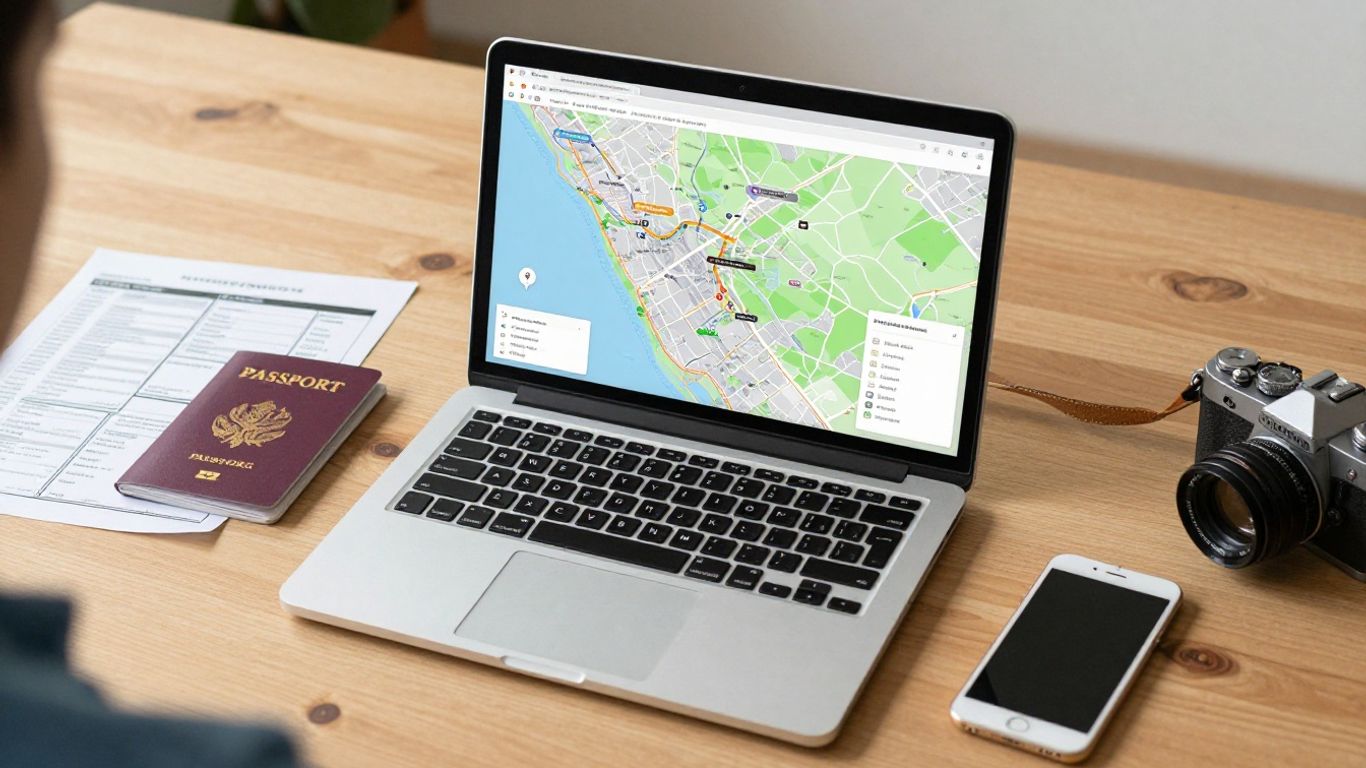 Travel planning workspace with maps and notes
Compare app-based and web-based planners
Apps are convenient when you are walking through a station, checking a reservation, or making a quick change on a phone. Web-based tools can be more comfortable for comparing destinations, moving many activities around, and working with a full keyboard and screen. If you plan on a laptop but travel with a phone, check whether the same itinerary stays current across both.
A visual itinerary planning workspace can be especially useful for road trips or destination research because stops and routes are considered together. The right format is less about fashion than friction: choose the one that makes adding, moving, and reviewing information feel simple.
Evaluate mapping, booking, and collaboration features
Read feature descriptions carefully and match them to your planning habits. You may want places plotted on a map, reservation details stored beside activities, shared editing for a group, or a route that can be reviewed at a glance. Do not assume that a tool offering one of these functions automatically includes the others.
For example, Wanderlog is described as a travel planner and itinerary builder that lets users create detailed trip plans, discover user-shared guides, and manage bookings, with an itinerary and map view shown together. Those capabilities fit travelers who want research and route planning in the same workspace. Check whether that combination suits your trip before building the whole plan there.
Check offline access and device compatibility
Connectivity is easy to overlook while planning from home. During the trip, you may have weak service on a train, expensive roaming, a drained battery, or no signal at a trailhead. Confirm what remains available offline, whether maps need to be downloaded separately, and whether attachments or confirmations can still be opened.
Also check the devices you and your companions carry. A tool that works well on a phone may be awkward on a tablet, and shared access may depend on account permissions. Save a basic export or printout as a fallback, especially for the day’s address, reservation time, and transport connection.
Consider free plans, subscriptions, and hidden costs
Compare the practical cost of completing your trip, not simply the price shown on a plan page. Look for limits on collaborators, saved places, offline use, exports, attachments, or the number of trips. Note renewal dates and check whether a free tier is enough after the research phase ends.
It can help to write down the features you need before comparing prices:
- A clear map with the places you intend to visit.
- Shared access for everyone making decisions.
- Offline access to essential reservations and directions.
- A simple way to export or copy the final plan.
This keeps a low price from becoming the only criterion. A modest tool may be perfectly adequate for a weekend, while a longer or more complicated journey may justify paying for convenience—but only when the added function solves a real problem.
Build a practical day-by-day itinerary
A day-by-day plan should feel like a sequence a person could actually live through. Give it enough detail to answer “what happens next?” without turning the trip into a performance schedule. Start with geography and fixed commitments, then add optional ideas around them. This order keeps the plan grounded.
Group activities by neighborhood or region
Place activities that are close together on the same day whenever possible. Check the map before assigning times; two attractions that look near each other in a city overview may be separated by a river, steep streets, or a slow transit connection. Grouping by area reduces backtracking and leaves more attention for the destination itself.
Use neighborhoods as loose themes rather than strict boundaries. A morning market, a nearby museum, and a restaurant in the same district can form a natural day, even if the order changes. For a home exchange, city-focused local neighborhood guides can also help you understand how a stay fits into the wider route.
Balance sightseeing with downtime
Busy days often look impressive in a draft and disappointing in practice. Alternate demanding outings with slower periods, and protect time for meals, laundry, naps, wandering, or simply sitting somewhere pleasant. Even travelers who enjoy full days need transitions between experiences.
A useful test is to imagine the least energetic person in the group following the plan. If that person would need to rush, skip meals, or recover for the next day, reduce the schedule. Flexibility is not wasted time; it is what lets you respond to a place rather than merely pass through it.
Plan around opening hours and reservation requirements
Check the official opening hours and booking rules for each fixed attraction. Museums may close on a particular weekday, popular sites may use timed entry, and restaurants may release tables only shortly before the visit. Put those constraints into the itinerary before adding nearby optional stops.
Record the local time zone, confirmation number, entry instructions, and cancellation deadline in the same place. If a ticket is mobile-only, make sure it can be reached without a connection. This kind of small preparation prevents a beautiful plan from failing at the door.
A short planning video can be useful for seeing how different travelers arrange maps, reservations, and daily pacing. Treat it as a source of ideas rather than a script to copy; your own distances, energy, and priorities still determine what belongs in each day.
Add realistic travel time between stops
Travel time includes more than the time shown by a route preview. Allow for finding a platform, waiting for a vehicle, walking from a station, storing bags, navigating unfamiliar streets, and gathering a group. Add a little extra space around airport, train, and ferry connections, where a missed link can affect the rest of the day.
Keep the number of major transitions low. If a day requires several cross-city journeys, ask whether one stop can move to another day or become optional. A slightly shorter list with reliable timing usually produces a richer experience than a packed itinerary that is always late.
Organize transportation and accommodations
Transport and lodging shape the trip’s practical rhythm. A cheap room far from the places you want to visit may cost more in time and fares, while an attractive route may be difficult with luggage or limited mobility. Bring these decisions together instead of booking each piece in isolation.
 Travel bags beside a train station platform
Map flights, trains, rental cars, and local transit
Enter every major movement with its departure point, arrival point, local time, and connection buffer. For flights, include the airport and terminal; for trains, record the station rather than only the city; for rental cars, note pickup rules, fuel arrangements, and return location. These details matter when a destination has several transport hubs.
Then check the first and last mile. A route may be straightforward on paper but difficult after a late arrival, with heavy bags, or during a local holiday. Save the address of the accommodation and a practical arrival option before leaving home.
Select accommodations that support your itinerary
Choose lodging by location and suitability, not just appearance. Consider the distance to your first morning activity, access to transit, grocery options, noise, stairs, kitchen facilities, and the check-in process. If the stay is part of a home exchange, compare the home’s practical features with the needs you listed at the start.
The accommodation can become a useful base rather than merely a place to sleep. A kitchen may make a long stay easier, and a location near frequent transit may be worth more than a slightly larger room elsewhere. Revisit the itinerary after choosing the lodging; its location may suggest a better order for your days.
Track check-in, check-out, and transfer details
Create one entry for each stay with the full address, host or property contact, check-in window, check-out instructions, and any access code. Add luggage storage details when a room is not available until later in the day. If you are changing cities, show the time between leaving one place and reaching the next.
Keep these practical notes separate from wish-list activities so they remain easy to find. A compact itinerary might show the day’s highlights first, followed by a clearly labeled logistics note. That arrangement is easier to scan while carrying bags or standing on a platform.
Create backup options for delays and cancellations
A backup does not need to duplicate the entire trip. Identify which elements are most vulnerable—an early connection, a timed ticket, a remote transfer—and decide what you would do if each one fails. Save alternative routes, a flexible activity nearby, and the relevant cancellation or rebooking information.
Do not fill every spare minute with a backup plan. Instead, protect a few movable blocks that can absorb disruption. If nothing goes wrong, those blocks become time for a slower meal or an unplanned discovery.
Optimize your itinerary with maps and reservations
Once the basic itinerary exists, review it as a connected route rather than a list of attractions. Maps reveal awkward crossings, while reservation times expose pressure points. Seasonal conditions and local events may change what is sensible on a particular day. Optimization is mostly the patient work of noticing conflicts early.
Use interactive maps to spot efficient routes
Plot accommodations, transport hubs, fixed bookings, and major activities together. Look for repeated crossings and days that begin far from where the previous day ends. A map also helps distinguish a pleasant walk from one that is too long in heat, rain, or hilly terrain.
Keep the map readable by separating confirmed stops from ideas. Use a consistent naming system and remove places you have ruled out. The goal is not to cover every visible point but to make the shape of the trip understandable at a glance.
Coordinate tickets, tours, and restaurant bookings
Place every timed commitment on the calendar before scheduling anything around it. Include the time needed to arrive early, pass security, find the meeting point, or travel from the previous stop. Restaurant bookings deserve the same care as tours, particularly when a late arrival could mean losing the table.
A reservation log can include the booking name, date, local time, address, cancellation terms, and payment status. Keep a note of which bookings are essential and which can be moved. That distinction helps you make quick decisions when the day runs differently than expected.
Check seasonal conditions and local events
Weather affects more than clothing. It can change ferry schedules, trail access, road conditions, daylight, and the comfort of a long walking day. Local festivals, public holidays, school breaks, and major sporting events may alter crowds, prices, and transport availability.
Review these conditions after drafting the route, not only before booking. A seasonal travel planning guide can provide useful inspiration, but confirm current conditions and operating details with the relevant local sources. Your itinerary should reflect what is likely to be open and workable during your dates.
Review the plan for timing conflicts
Do one final pass in chronological order. Check overlaps, unrealistic transfers, duplicate activities, meals that have disappeared between bookings, and arrival times that assume perfect conditions. Read the plan as if you had just landed and were unfamiliar with the city.
A simple table is helpful for spotting pressure points across several days:
| Day | Fixed commitment | Travel buffer | Flexible element |
|---|---|---|---|
| 1 | Arrival and check-in | 90 min | Nearby walk |
| 2 | Timed museum entry | 30 min | Market or café |
| 3 | Intercity train | 60 min | Evening neighborhood |
| 4 | Reserved tour | 45 min | Open afternoon |
After the review, remove anything that repeatedly creates a conflict. A plan becomes more useful when it reflects actual capacity rather than every appealing possibility.
Share, manage, and update your travel plan
A finished itinerary is a working document, not a monument. Share the information people need without forcing everyone to study every research note. Keep confirmed details distinct from suggestions, and decide who is responsible for checking changes. That makes updates calmer when the trip is underway.
Collaborate with travel companions
Invite companions into the decisions that affect them. Let people comment on preferences, suggest alternatives, and see the reasoning behind major bookings. For a group, use a shared naming convention for activities and mark who has confirmed each detail.
Avoid turning collaboration into an endless vote on every café. Agree on a few decision rules, such as rotating the choice of dinner area or allowing anyone to opt out of one optional activity. Shared ownership works best when the itinerary still has a clear shape.
Store confirmations and essential documents
Gather flight, train, lodging, rental, ticket, insurance, and emergency contact details in one accessible place. Record confirmation numbers and cancellation deadlines, and keep copies of documents that may be needed without internet access. Do not rely on a single inbox search during a stressful transfer.
TripIt is described as a travel planner that can automatically create a comprehensive itinerary when booking confirmations are forwarded to it, and its listed capabilities include offline access to reservation details, maps, directions, and travel documents. That makes this type of tool relevant when the main challenge is keeping confirmations together rather than designing a sightseeing route from scratch.
Prepare offline access and emergency information
Before departure, open the itinerary while connected and confirm that the important pages, addresses, tickets, and contact details remain reachable. Download maps where appropriate and carry a small written backup for the first arrival, accommodation address, and a trusted contact.
Include local emergency numbers, insurance information, medication details, and the nearest relevant embassy or consular contact when traveling internationally. Share these essentials with someone at home as well. The aim is not to anticipate every problem, only to avoid being entirely dependent on a live connection.
Adjust the itinerary when plans change
When something shifts, protect the fixed commitments first and move the flexible pieces around them. Recheck opening hours, transport times, and cancellation terms before making a replacement booking. Tell companions what changed and why, especially if the adjustment affects meeting points or costs.
Keep the original confirmation details until a change is final. Then update the shared version promptly and remove outdated times from the main view. A calm revision is often all that separates a minor delay from a day that feels lost.
Conclusion
A travel itinerary planner can bring order to research, bookings, routes, and shared decisions, but the strongest itinerary still leaves room for weather, curiosity, rest, and ordinary surprises. Begin with the trip you want to experience, build around the things that truly matter, and treat every schedule as a helpful guide rather than a demand.
Frequently Asked Questions
What should a travel itinerary include?
Include dates, destinations, transport, accommodation, fixed reservations, addresses, realistic travel time, estimated costs, and a few flexible options. Keep essential contact and confirmation details easy to find.
How far in advance should I plan a trip?
Start as early as needed for expensive or limited bookings, then refine the daily schedule closer to departure. The right timeline depends on destination, season, group size, and how much flexibility you want.
How many activities should I schedule per day?
Most days work well with one or two anchor activities plus optional nearby ideas. The number should account for opening hours, meals, walking, transit, and the energy of everyone traveling.
Should I book everything before leaving?
Book time-sensitive transport and experiences first, especially during busy seasons. Leave some meals, walks, and lower-priority activities open so the trip can respond to weather and changing interests.
How do I plan a multi-city trip without feeling rushed?
Limit the number of moves, group nearby destinations, and count transfer days honestly. Staying longer in fewer places often creates a more satisfying trip than collecting many short stops.
What is the best way to handle itinerary changes?
Separate fixed commitments from flexible ones, then move the flexible pieces around the new constraint. Keep current confirmations together and communicate changes to everyone involved.
How can I make an itinerary accessible for different travelers?
Discuss mobility, dietary, medical, sensory, age-related, and rest needs before booking. Check routes and facilities directly, and allow extra transition time wherever the group may need it.

Published by
SwappaHome
SwappaHome Editorial Team
Home Exchange & Slow Travel Editorial
The SwappaHome Editorial Team brings together travel research, home-exchange community insights, and platform data to produce practical guides for first-time and experienced home swappers. Every article cites real platforms, current market rates, and verifiable city-level facts so readers can make informed decisions without guessing.
Ready to try home swapping?
Join SwappaHome and start traveling by exchanging homes. Get 7 free credits when you sign up!