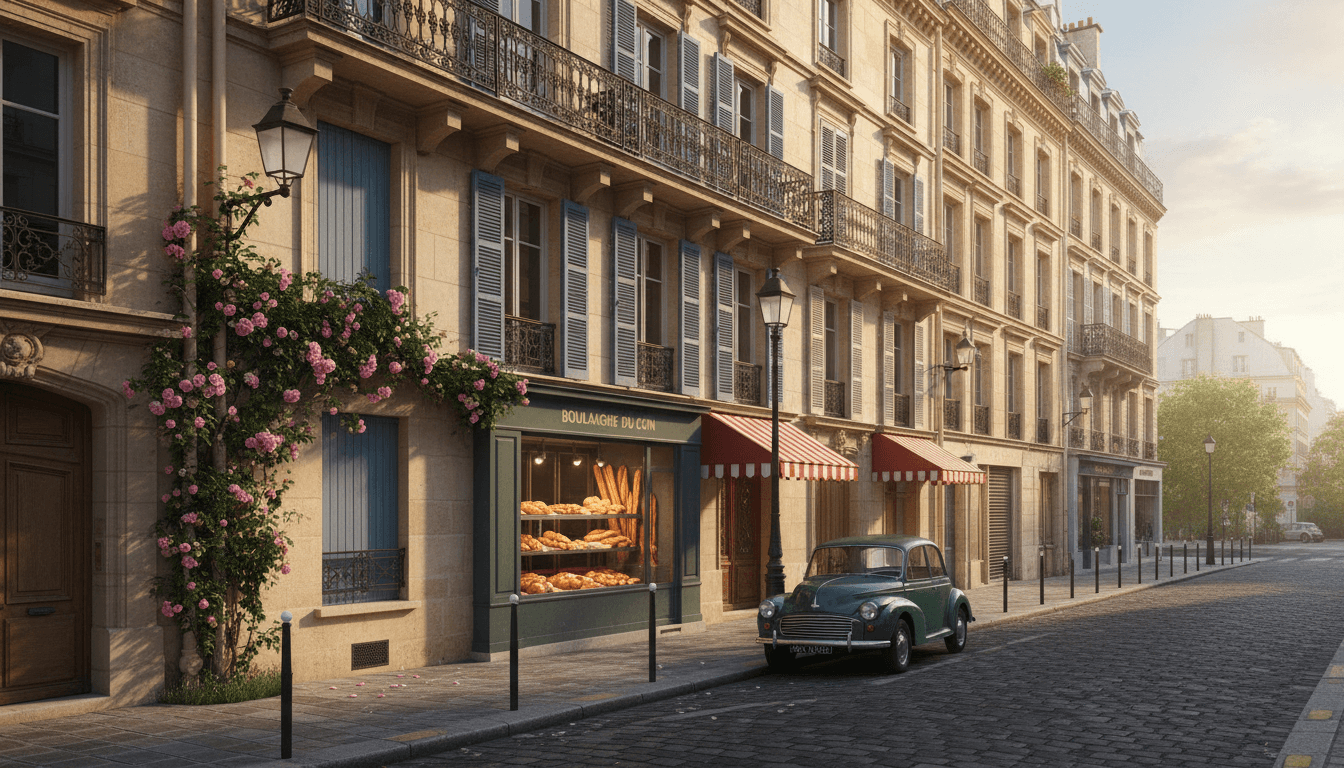
Paris with Kids: Why Home Exchange is Perfect for Family Travel

SwappaHome Editorial Team
Home Exchange & Slow Travel Editorial
Discover why home exchange in Paris transforms family travel—from kid-friendly neighborhoods to saving thousands on accommodation while living like locals.
My daughter was three years old when she had her first croissant meltdown in Paris. Not because she didn't like it—oh no, she loved it so much that when it was gone, the world essentially ended. We were sitting on the floor of a tiny, overpriced hotel room near Gare du Nord, crumbs everywhere, no kitchen to make her a snack, and I remember thinking: there has to be a better way to do Paris with kids.
That trip cost us nearly $4,200 for eight nights in a cramped space where my husband and I took turns sleeping on a rollaway bed. The following year, we discovered home exchange, and everything changed. Our Paris with kids experience went from survival mode to genuinely magical—and we spent a fraction of what hotels would have cost.
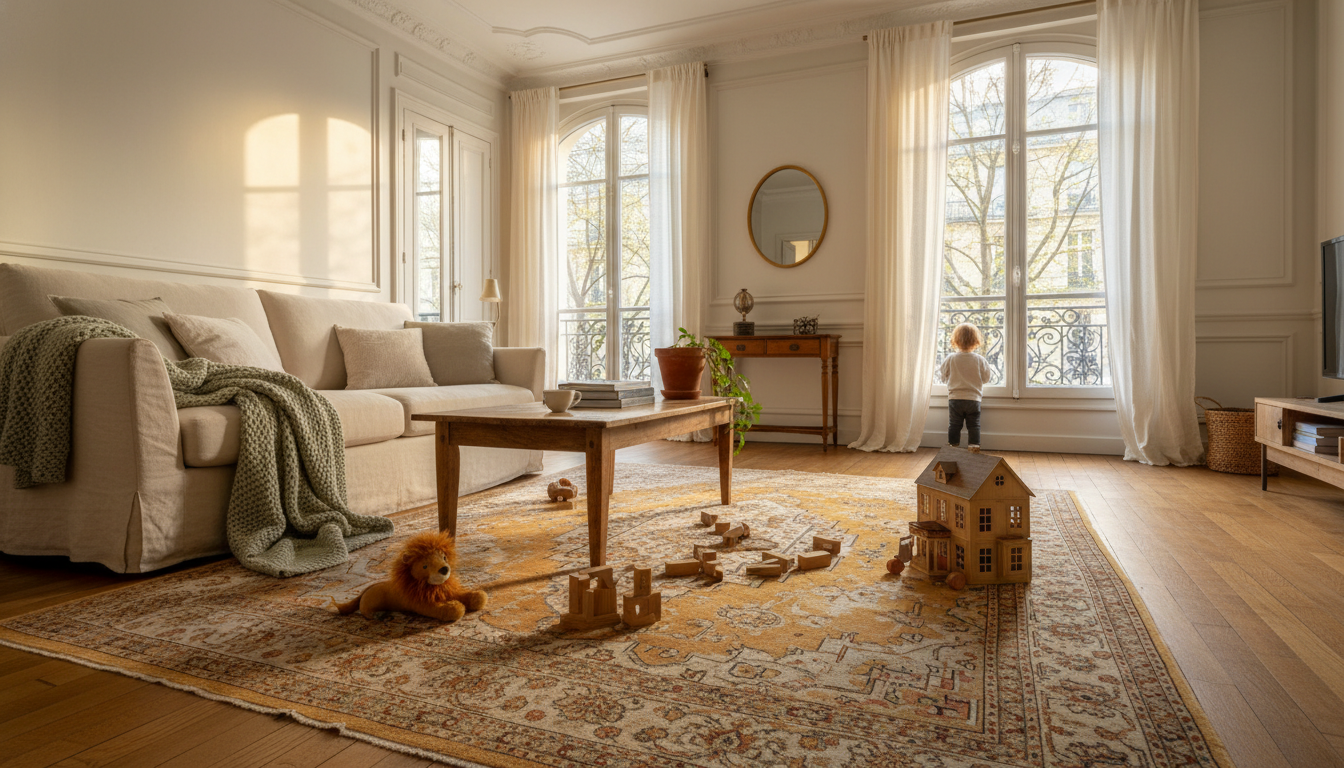 A sun-filled Parisian apartment living room with high ceilings, a childs toys scattered on a vintage
Why Home Exchange in Paris Makes Sense for Families
Here's what nobody tells you about traveling to Paris with children: the city isn't actually expensive. Hotels in Paris with kids are expensive. Restaurants three times a day are expensive. But the parks? Free. The playgrounds? Everywhere and free. The boulangeries where you can grab a baguette and some cheese for lunch? Shockingly affordable.
The problem is that traditional family accommodation in Paris forces you into a spending pattern that doesn't match how families actually want to travel. You're paying $350-500 per night for a hotel room that fits everyone uncomfortably, then eating out for every meal because there's no kitchen, then dealing with cranky kids who have no space to decompress.
Home exchange flips this equation entirely.
When you swap homes with a Parisian family, you're not just getting free accommodation—you're getting a washing machine for the inevitable juice box explosion. A kitchen where you can make pasta at 6 PM when everyone's hangry. Bedrooms with doors that close, so adults can have a glass of wine after the kids crash. Local toys, books, maybe even a stroller you don't have to lug through Charles de Gaulle.
I've done home exchanges in Paris four times now with my kids (now 7 and 4), and honestly? The difference in our family's stress levels is remarkable.
Best Paris Neighborhoods for Family Home Exchange
Not all Parisian arrondissements are created equal when you're traveling with small humans. After multiple trips and way too many hours on Google Maps, here's my honest breakdown of where to look for your family home swap.
The Marais (3rd & 4th arrondissements)
This is where we stayed on our first home exchange in Paris, and I'm a little obsessed. The Marais hits that sweet spot of being genuinely beautiful, walkable, and surprisingly practical for families.
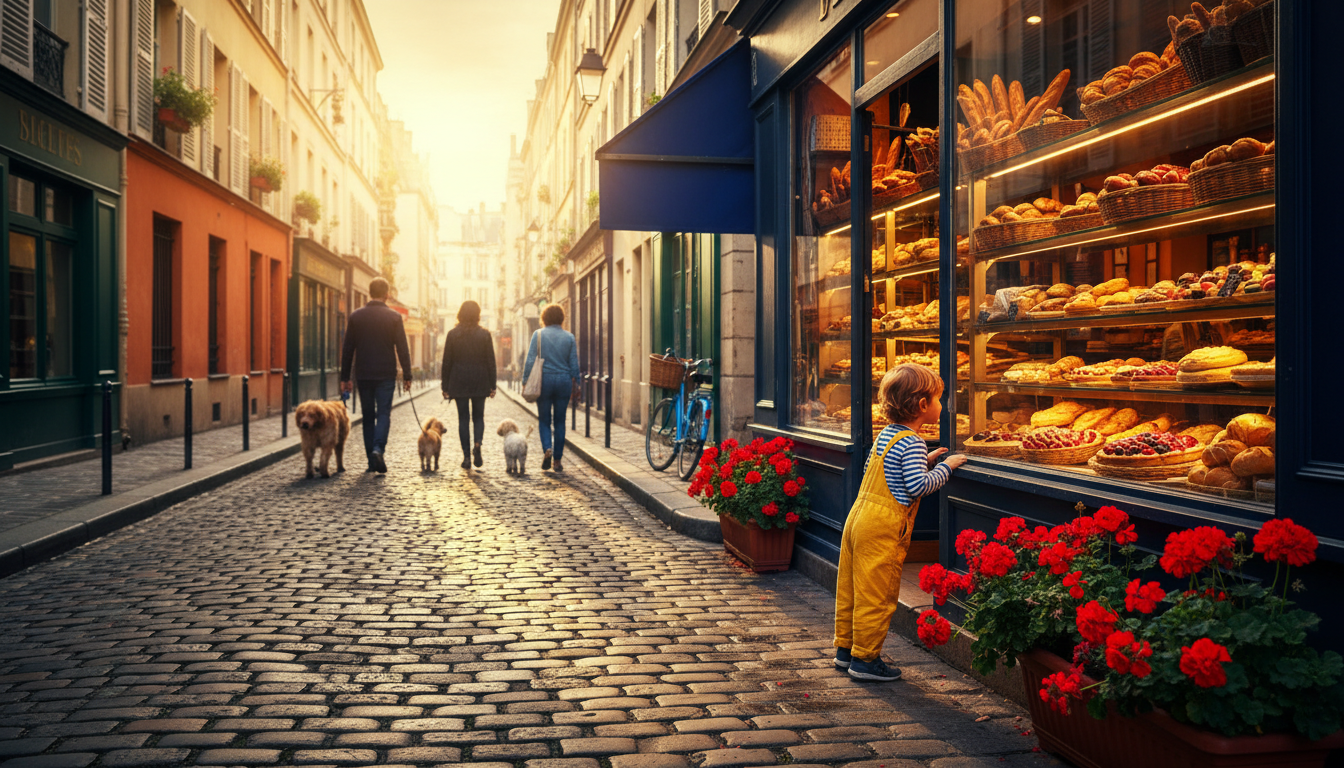 A cobblestone street in the Marais with a small child looking into a bakery window, morning light ca
The Place des Vosges has a gated playground right in the middle of the oldest planned square in Paris. Your kids can run around while you sit on a bench feeling extremely European. There's a fantastic toy store called Village JouéClub on Rue de Rivoli—about a 10-minute walk—that saved us during a rainy afternoon.
Grocery situation is solid. Multiple Carrefour City locations, plus the covered Marché des Enfants Rouges for fresh produce and prepared foods.
The downside? Apartments tend to be smaller and older, often walk-ups without elevators. If you're traveling with a stroller and heavy luggage, clarify the building situation before booking. Typical home exchange finds here are 2-bedroom apartments ranging from 50-75 square meters, often with charming but compact kitchens.
Batignolles (17th arrondissement)
This is my current favorite for family home exchanges, and it's criminally underrated. Batignolles feels like a village inside Paris—there's a central square with cafés, a twice-weekly organic market, and the gorgeous Parc Martin Luther King with a massive playground, splash pad, and even a small urban farm.
The families who live here tend to have kids, which means the homes available for exchange are often already set up for children. Our last swap here included a high chair, a pack-n-play, and a basket of bath toys. The mom we exchanged with even left us a list of her kids' favorite playgrounds.
Grocery situation is excellent—Bio c' Bon organic market, regular supermarkets, and the Marché Batignolles on Saturdays.
Real talk: it's not as "postcard Paris" as central neighborhoods. You won't walk out your door and see the Eiffel Tower. But after a few days, you stop caring, because your kids are happy and you're not hemorrhaging money. Metro Lines 2, 13, and the new Line 14 extension make getting around easy.
Montmartre (18th arrondissement)
I have complicated feelings about Montmartre with kids. On one hand, it's absolutely magical—the winding streets, the Sacré-Cœur, the artists in Place du Tertre. On the other hand, it's extremely hilly, often crowded, and some areas feel more tourist-trap than neighborhood.
If you're going to do a home exchange in Montmartre, look for places in the "back" of the neighborhood, closer to the Abbesses metro or toward Jules Joffrin. These areas have the Montmartre charm without the crowds, plus better playgrounds and more family-friendly restaurants.
The Square Louise Michel (the park below Sacré-Cœur) has a decent playground, and there's a wonderful carousel at the base of the hill.
But the stairs. So many stairs. If your kids are still in the "carry me" phase, your legs will hate you.
Luxembourg Area (6th arrondissement)
The Jardin du Luxembourg is hands-down the best park in Paris for children, and staying nearby is a legitimate strategy. The playground (€3.20 per child, worth every centime) is phenomenal. There's a puppet theater, pony rides, and a huge pond where kids can rent wooden sailboats.
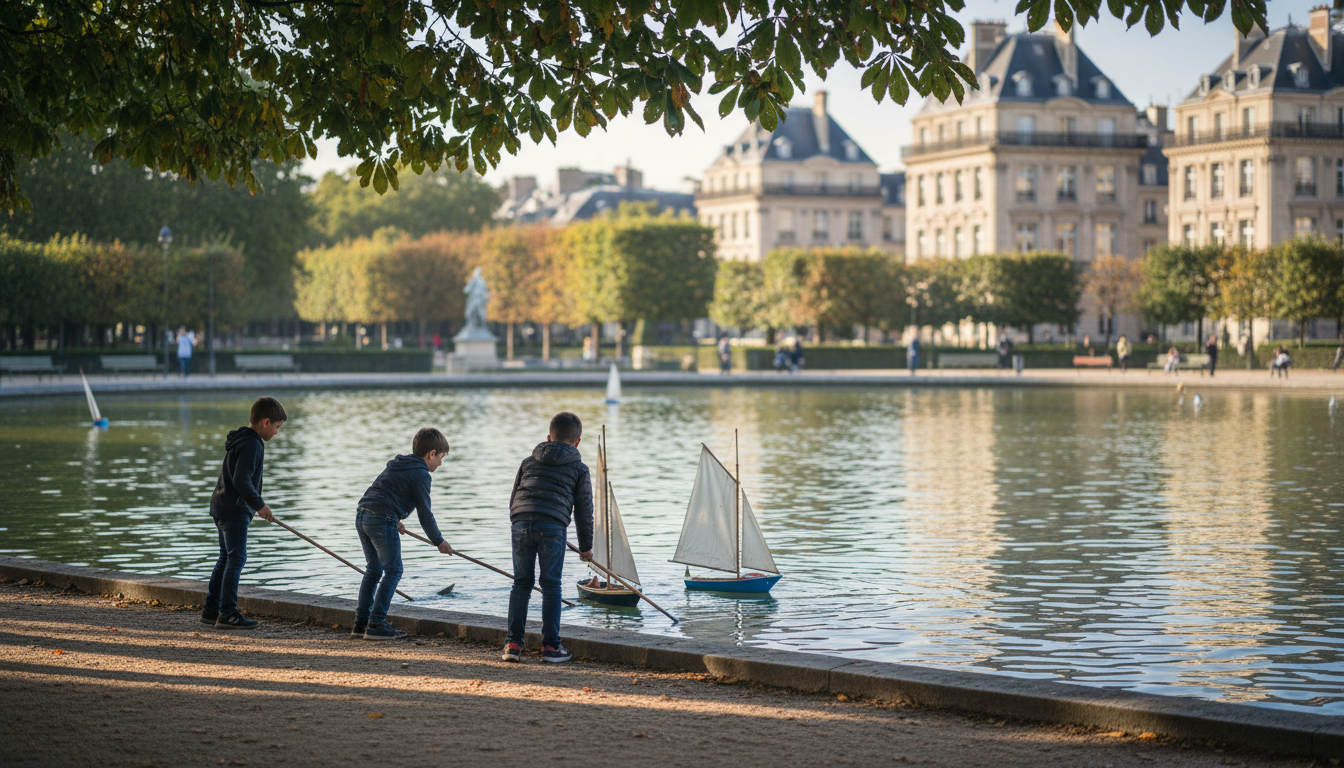 Children pushing wooden sailboats with sticks at the Luxembourg Gardens pond, dappled sunlight throu
Home exchanges in the 6th tend to be in beautiful Haussmann-era buildings—think high ceilings, herringbone floors, and marble fireplaces. They also tend to be smaller and more expensive (the families who live here often want to exchange for premium locations).
Here's the catch: this is one of the priciest neighborhoods in Paris, so the families looking to swap often want exchanges in places like New York, London, or San Francisco. If you're offering a home in a smaller city, you might have fewer matches.
How Much You'll Actually Save: Paris Hotels vs. Home Exchange
Let me break down real numbers from our trips, because I'm a spreadsheet person and this stuff matters.
Our 2019 Paris Hotel Trip (8 nights):
- Hotel room (family room near Gare du Nord): $2,800
- Restaurant breakfasts: $480 (yes, really—Parisian hotel breakfast is a racket)
- Restaurant dinners: $720
- Lunches out: $400
- Laundry service (one load): $45
- Total: approximately $4,445
Our 2023 Paris Home Exchange (10 nights):
- Accommodation: $0 (used SwappaHome credits)
- Groceries: $380
- Restaurant meals (we ate out 4 times): $340
- Laundry: $0 (used the apartment's machine)
- Total: approximately $720
That's not a typo. We stayed two nights longer and spent about $3,700 less. Even if you factor in the SwappaHome membership and the value of hosting guests at your own home, the math is absurd.
The real savings come from having a kitchen. In Paris, you can buy a rotisserie chicken from the boucherie for €8, grab a baguette for €1.20, pick up some salad and cheese, and feed a family of four an excellent dinner for under €20. Try doing that at a restaurant.
What Parisian Families Include in Their Home Exchange Listings
One of the things I love about exchanging with families who have kids is that they get it. They know what you need because they need the same things.
In our four Paris home exchanges, we've had access to high chairs and booster seats, strollers (game-changer for not bringing your own), kids' books in English—surprisingly common since many Parisian families are raising bilingual children—baby monitors, plastic plates and cups, folders with playground recommendations, pediatrician contacts, and favorite family restaurants. Sometimes Netflix logins. Sometimes bicycles with child seats.
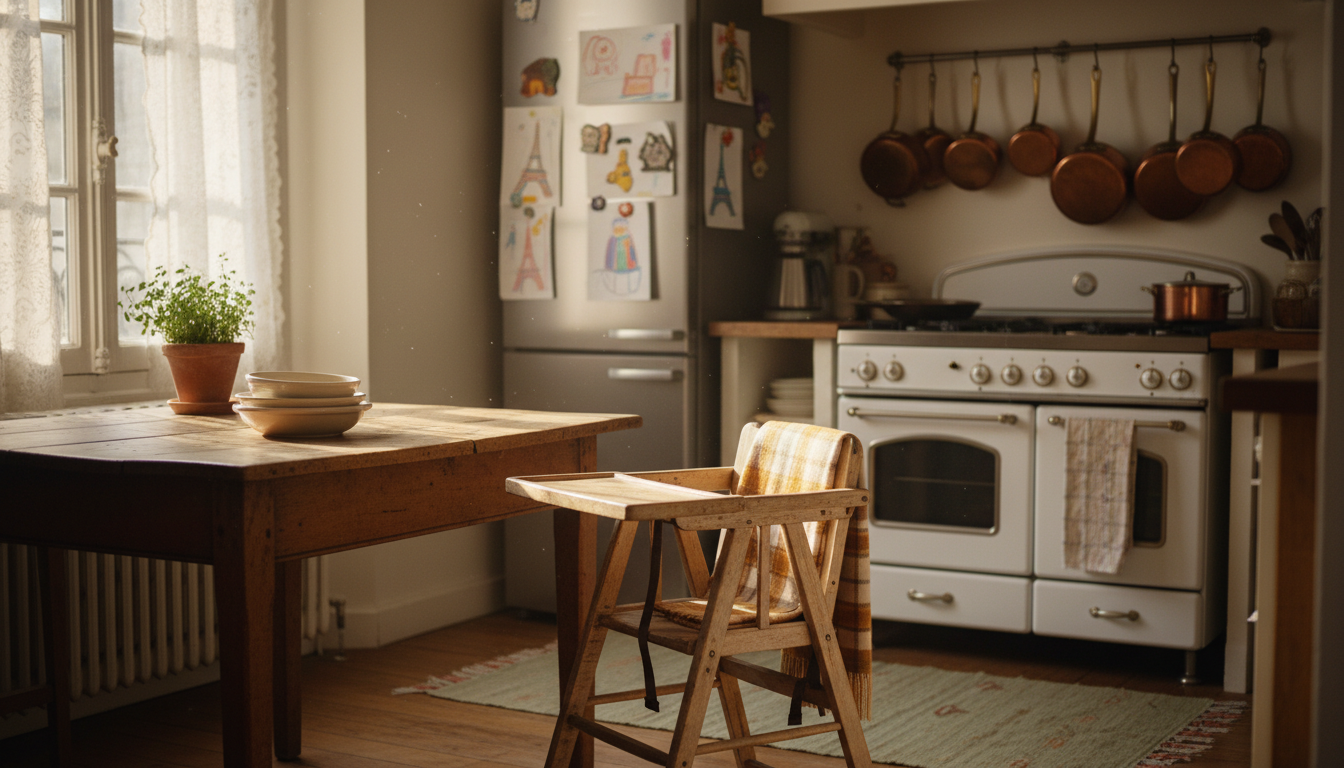 A cozy Parisian kitchen with a wooden high chair, childrens drawings on the fridge, copper pots hang
You can absolutely ask about these things before confirming an exchange. Most families are happy to specify what kid gear they have available—it helps them attract the right guests.
The Logistics: How to Set Up Your First Paris Family Home Exchange
I'm going to be real with you: your first home exchange takes some effort to set up. But once your profile is complete and you've done one swap, subsequent exchanges become much easier.
Create a family-friendly listing. When you list your home on SwappaHome, emphasize what makes it good for families. Do you have a yard? A playroom? Are you near good schools or parks? Is your neighborhood safe for kids to walk around? Include photos of kids' rooms, any baby gear you can offer, and your proximity to family-friendly attractions. Parisian families looking to visit your area want to know their kids will be comfortable.
Search strategically. Use filters to find listings in Paris that mention children or family amenities. Look at the photos—do you see evidence of kids living there? Toys, books, family photos? These are good signs. I also recommend reading the reviews carefully. Comments like "perfect for our family" or "our kids loved the toys" tell you a lot.
Start the conversation. When you reach out to potential exchange partners, be specific about your family situation. How many kids, what ages, any particular needs? Ask about their neighborhood—is it stroller-friendly? Are there parks nearby? What's the noise situation? I always ask: "What do your kids love most about your neighborhood?" The answers give you a real sense of whether the location works for your family.
Plan the details. Once you've agreed on dates, get specific about key handoff (will you meet in person, use a lockbox, have a neighbor help?), house rules (shoes off? certain rooms off-limits?), emergency contacts, WiFi password, and quirks of the apartment. You know—"the shower takes 30 seconds to get hot," "the front door sticks." That kind of thing.
Kid-Friendly Paris Activities You Can Actually Enjoy from a Home Base
Having an apartment changes what's possible in Paris with kids. You're not racing against hotel checkout times or trying to keep children quiet in a lobby.
Morning Routines That Don't Suck
Wake up. Make coffee in your own kitchen. Let the kids watch French cartoons (surprisingly educational—my daughter picked up "bonjour" and "merci" from Peppa Pig dubbed in French). Walk to the boulangerie for croissants. Eat breakfast in pajamas at the kitchen table.
This alone is worth the home exchange.
The Parks
Paris has over 400 parks, and many have excellent playgrounds. Beyond Luxembourg, check out Parc des Buttes-Chaumont in the 19th—dramatic cliffs, waterfalls, a temple on an island. Kids think it's an adventure movie set. Parc Monceau in the 8th is smaller but beautiful, with a good playground and a pond. Very Parisian. And Jardin d'Acclimatation in the 16th is an actual amusement park in the Bois de Boulogne with rides, a farm, and puppet shows. Plan a half-day here.
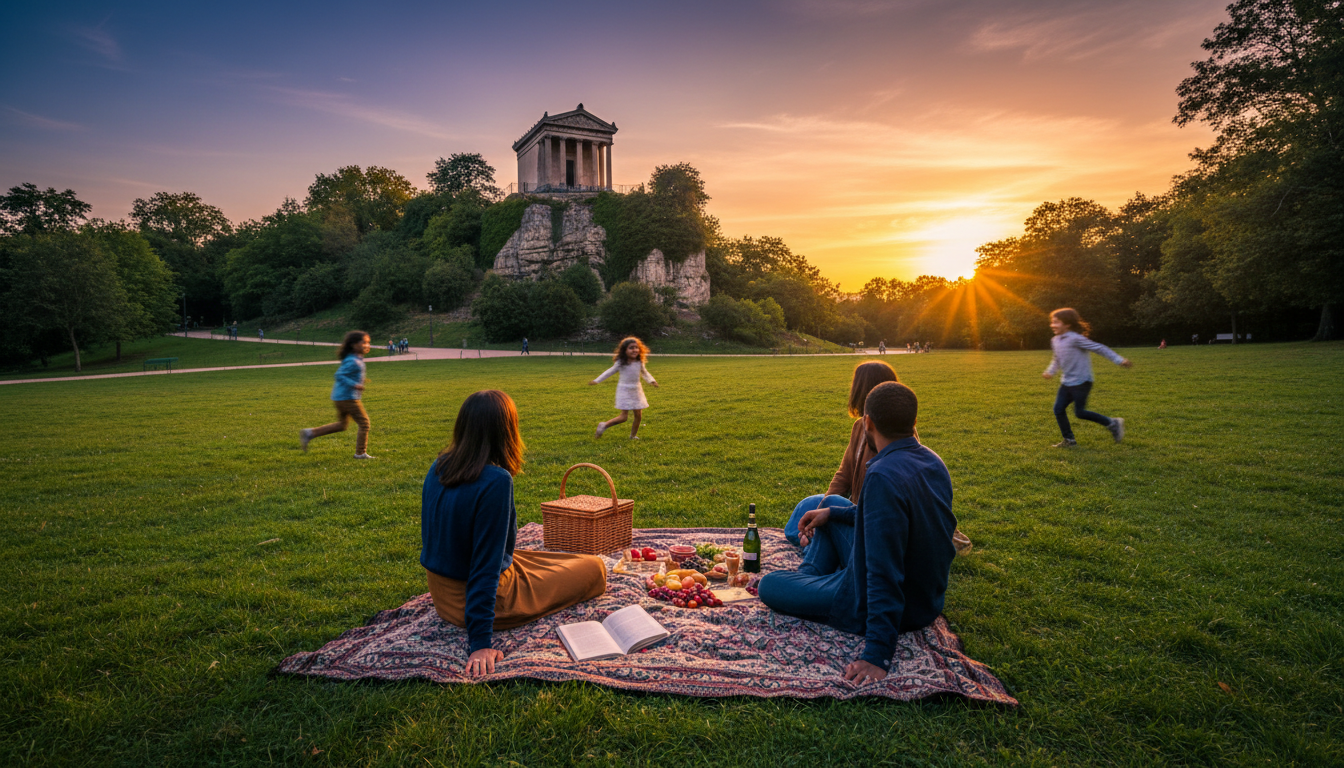 A family having a picnic on the grass in Parc des Buttes-Chaumont, the Temple de la Sibylle visible
Museums That Don't Bore Kids
The Louvre with a toddler is a special kind of torture. But these work:
Cité des Sciences et de l'Industrie is a massive science museum with a dedicated section for kids under 6. My kids could spend hours here. Musée en Herbe is an art museum designed specifically for children with rotating exhibits that are interactive and genuinely fun. Palais de la Découverte offers hands-on science, including a planetarium—good for ages 5 and up. And the Natural History Museum has dinosaur skeletons. Need I say more?
The Eiffel Tower (Yes, But Strategically)
You can't skip it, but you can be smart about it. Go at opening time (9:30 AM) or in the early evening. Book tickets online in advance—the line situation is genuinely terrible otherwise.
Honest take: The Champ de Mars (the park in front of the tower) is almost more fun for kids than going up. They can run around, you can picnic, and the views are still spectacular.
What to Do When Things Go Wrong
I'm not going to pretend home exchange is always perfect. We've had hiccups.
Once, we arrived at an apartment in the 11th to find that the washing machine was broken. The host hadn't known—it broke while they were traveling. We messaged them, they apologized profusely, and they sent us €50 via PayPal to use at a laundromat. It was fine, but it required flexibility.
Another time, our kids broke a small lamp. We replaced it immediately (found a similar one at BHV Marais for about €35) and left a note apologizing. The family was gracious about it. These things happen when real people stay in real homes.
My advice: build in some flexibility, bring a good attitude, and communicate openly. The vast majority of home exchangers are lovely people who want the same thing you do—a positive experience for everyone.
Making Paris Feel Like Home: Small Things That Matter
After four exchanges in Paris, I've learned that the best trips happen when you stop trying to "do" Paris and start trying to live in it, even temporarily.
Go to the same boulangerie every morning until they recognize you. Find a café where you become a regular for the week. Let your kids make friends at the playground—French children are often curious about English-speaking kids, and the interactions are adorable even without shared language.
Buy flowers at the market and put them on the kitchen table. Cook a real French meal one night, even if it's just roast chicken and haricots verts. Watch the sunset from your borrowed balcony while the kids play inside.
This is what home exchange gives you that hotels never can: the feeling, however briefly, of having a life somewhere else.
Getting Started with SwappaHome
If you're convinced (and honestly, I hope you are), here's the practical stuff.
SwappaHome uses a credit system that works beautifully for families. You earn 1 credit for each night you host someone at your home, and you spend 1 credit for each night you stay somewhere else. New members start with 7 free credits—enough for a solid Paris trip to test the waters.
The credit system means you don't need to find a Parisian family who wants to visit your exact city at the exact same time. You can host a family from London in March, then use those credits to stay in Paris in July. It's flexible in a way that traditional home swaps aren't.
The community aspect matters too. Members review each other, building a reputation over time. You can see how other families rated a home before you commit, and you can verify that potential guests have positive reviews from previous hosts.
Frequently Asked Questions
Is home exchange in Paris safe for families with young children?
Home exchange in Paris is generally very safe for families. You're staying in residential neighborhoods where local families live, which often means quieter streets and proximity to parks and schools. Always read reviews from previous guests, verify your exchange partner's identity through the platform, and communicate clearly about any safety features like window locks or balcony railings before confirming your swap.
How much can families save with home exchange in Paris compared to hotels?
Families typically save $2,000-4,000 on a week-long Paris trip through home exchange. A family hotel room in central Paris costs $300-500 per night, while home exchange accommodation is free (using credits). Add kitchen savings of $100-150 per day on meals, and the total savings are substantial—we spent $720 total on a 10-night trip versus $4,445 for an 8-night hotel stay.
What kid equipment do Paris home exchanges typically include?
Most Parisian family homes offer high chairs, cribs or pack-n-plays, strollers, children's books and toys, baby monitors, and child-safe dishes. Many families also provide local recommendations for pediatricians, playgrounds, and family restaurants. Always confirm specific equipment availability before finalizing your exchange.
Which Paris neighborhoods are best for home exchange with kids?
The Marais (3rd/4th), Batignolles (17th), and the Luxembourg area (6th) are excellent for family home exchanges. Batignolles offers a village feel with great parks and family-focused amenities. The Marais provides central location with the Place des Vosges playground. The 6th puts you near the Jardin du Luxembourg, Paris's best park for children.
How do I find family-friendly home exchanges in Paris on SwappaHome?
Search Paris listings and filter for properties mentioning children or family amenities. Look for photos showing kids' rooms, toys, or baby gear. Read reviews for mentions of "family-friendly" or "great for kids." When contacting hosts, ask specifically about their neighborhood's walkability, nearby playgrounds, and what children's equipment they can provide.
That croissant meltdown in the tiny hotel room feels like a lifetime ago now. Last spring, my daughter—now seven—sat at the kitchen table of our borrowed apartment in Batignolles, carefully spreading butter on her own croissant, chattering about the puppet show we'd seen at Luxembourg the day before.
She looked up at me and said, "I like staying in people's houses better than hotels."
Me too, kid. Me too.

Published by
SwappaHome
SwappaHome Editorial Team
Home Exchange & Slow Travel Editorial
The SwappaHome Editorial Team brings together travel research, home-exchange community insights, and platform data to produce practical guides for first-time and experienced home swappers. Every article cites real platforms, current market rates, and verifiable city-level facts so readers can make informed decisions without guessing.
Ready to try home swapping?
Join SwappaHome and start traveling by exchanging homes. Get 7 free credits when you sign up!
Related articles

Bachelor and Bachelorette Parties in Singapore: The Complete Home Swap Group Guide for 2026
Planning a bachelor or bachelorette party in Singapore? Discover how home swapping lets groups of 6-12 stay together in luxury condos, saving thousands while partying in Marina Bay.

Cycling in Lisbon: 7 Home Swap Bike Tour Itineraries for Every Rider
Discover the best cycling routes in Lisbon with these home swap bike tour itineraries—from waterfront paths to hilltop adventures, all starting from your borrowed home.

Graduation Trip to Barcelona: How Home Swapping Gives New Graduates the Ultimate Celebration
Planning a graduation trip to Barcelona? Discover how home swapping lets new graduates explore Spain's most vibrant city without the hostel crowds or hotel costs.