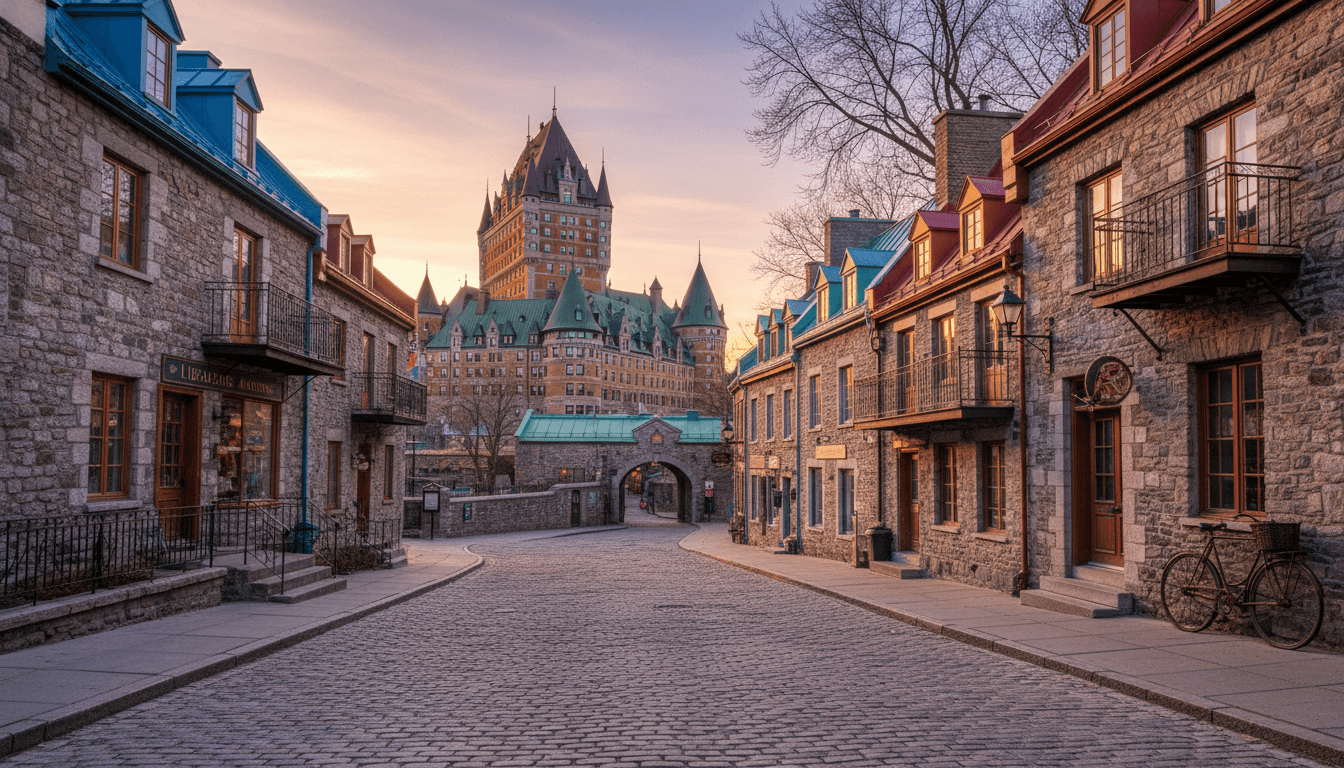
Quebec City for Remote Workers: Finding Home Exchanges with Perfect Workspaces

SwappaHome Editorial Team
Home Exchange & Slow Travel Editorial
Discover how to find Quebec City home exchanges with dedicated workspaces, fast WiFi, and the perfect blend of Old World charm and modern remote work amenities.
I was three hours into a video call with a client in Singapore when the church bells of Notre-Dame-des-Victoires started ringing. Not the gentle Sunday morning kind—the full-on, echoing-through-cobblestone-streets kind that makes you feel like you've time-traveled to 1650.
My client paused. "Is that... are you in Europe?"
"Quebec City," I said, grinning at my laptop screen. "Canada's best-kept secret for remote workers who want to feel like they're somewhere exotic without the 9-hour time zone headache."
That was two years ago, during my first Quebec City home exchange for remote work. I've been back three times since, and I've figured out exactly what makes a workspace work in this city—and what turns a dreamy French-Canadian escape into a WiFi nightmare. If you're hunting for Quebec City remote worker accommodations through home swapping, pull up a chair. I've got stories.
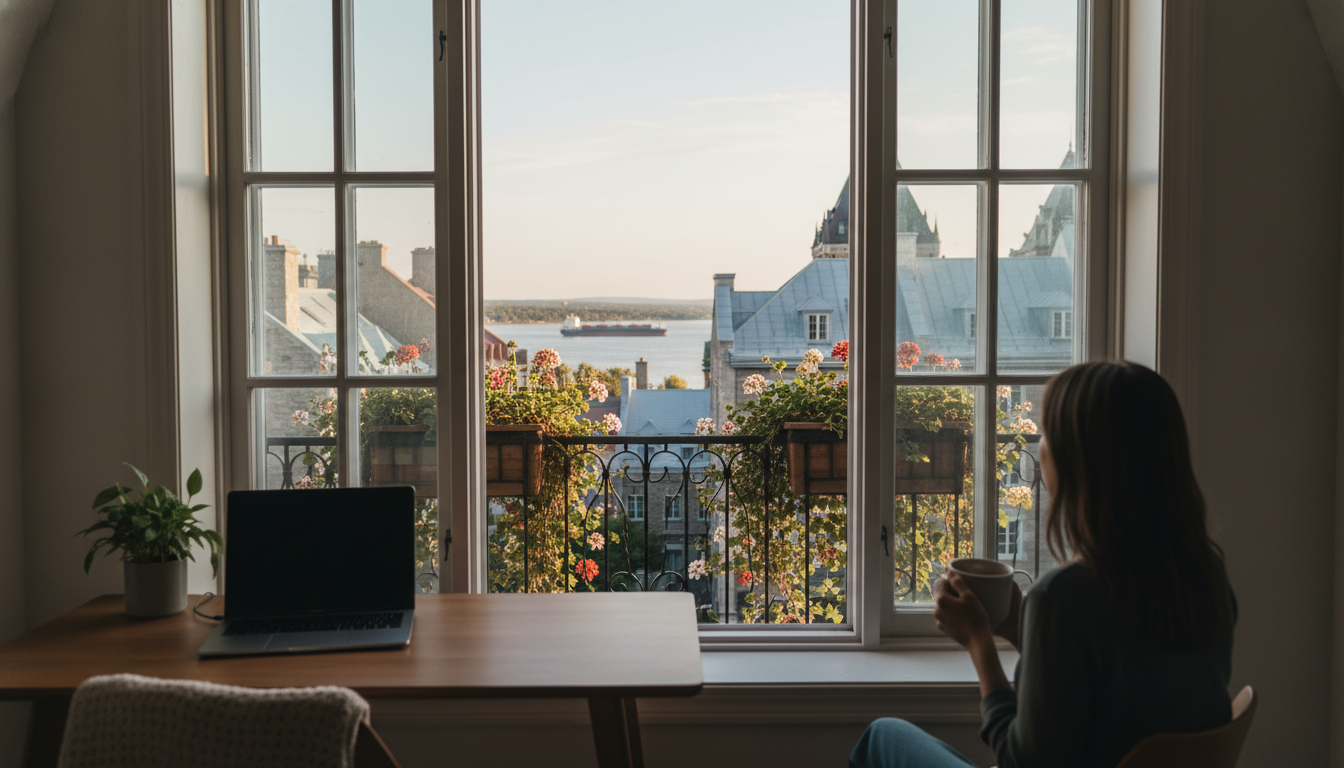 View from a home office window in Old Quebec, showing stone buildings, a wrought-iron balcony with f
Why Quebec City is Ideal for Remote Workers Seeking Home Exchanges
I'll be straight with you—I've worked remotely from 25+ cities, and Quebec City hits a sweet spot that's genuinely hard to find.
The practical stuff first. You're in Eastern Time, which means morning calls with London and afternoon meetings with LA don't destroy your sleep schedule. The internet infrastructure is solid (Canada takes connectivity seriously), and the cost of living runs roughly 30-40% lower than Montreal or Toronto. A coffee at Café Krieghoff? About $4.50 CAD ($3.30 USD). A full lunch with wine in Saint-Roch? Maybe $25 CAD ($18 USD).
But here's what really makes Quebec City work for remote professionals: the rhythm.
It's not a hustle city. People take two-hour lunches. They walk everywhere. The pace is European without the European price tag or the brutal jet lag. When your workday ends, you're not stuck in some generic downtown—you're wandering 400-year-old streets, eating poutine that would make you weep, listening to street musicians play Édith Piaf covers.
And the home exchange options? Genuinely special here. Quebec City residents tend to have character-filled properties—converted heritage buildings, apartments with exposed stone walls, townhouses with those iconic steep staircases. Many of them have already set up proper home offices because remote work caught on fast here during the pandemic.
Best Quebec City Neighborhoods for Remote Work Home Exchanges
Not all neighborhoods are created equal when you need reliable WiFi and a quiet space to think. Here's my honest breakdown after working from four different Quebec City swaps.
Saint-Jean-Baptiste: My Personal Favorite for Long Stays
This is where I always look first. Saint-Jean-Baptiste sits just outside the old walls, which means you get the historic charm without the tourist noise. The neighborhood is residential enough that you'll actually meet your neighbors, but walkable to everything.
The homes here tend to be Victorian-era townhouses or converted duplexes. Many have been renovated with modern amenities but kept their original hardwood floors and high ceilings. I did a three-week swap in a third-floor apartment on Rue Saint-Jean that had a dedicated office nook with a standing desk—the owner was a freelance translator who clearly understood the work-from-home life.
WiFi speeds in Saint-Jean-Baptiste typically run 100-300 Mbps. The neighborhood has excellent café backup options too: Café Cantook on Avenue Cartier has strong WiFi and doesn't mind if you camp out for a few hours.
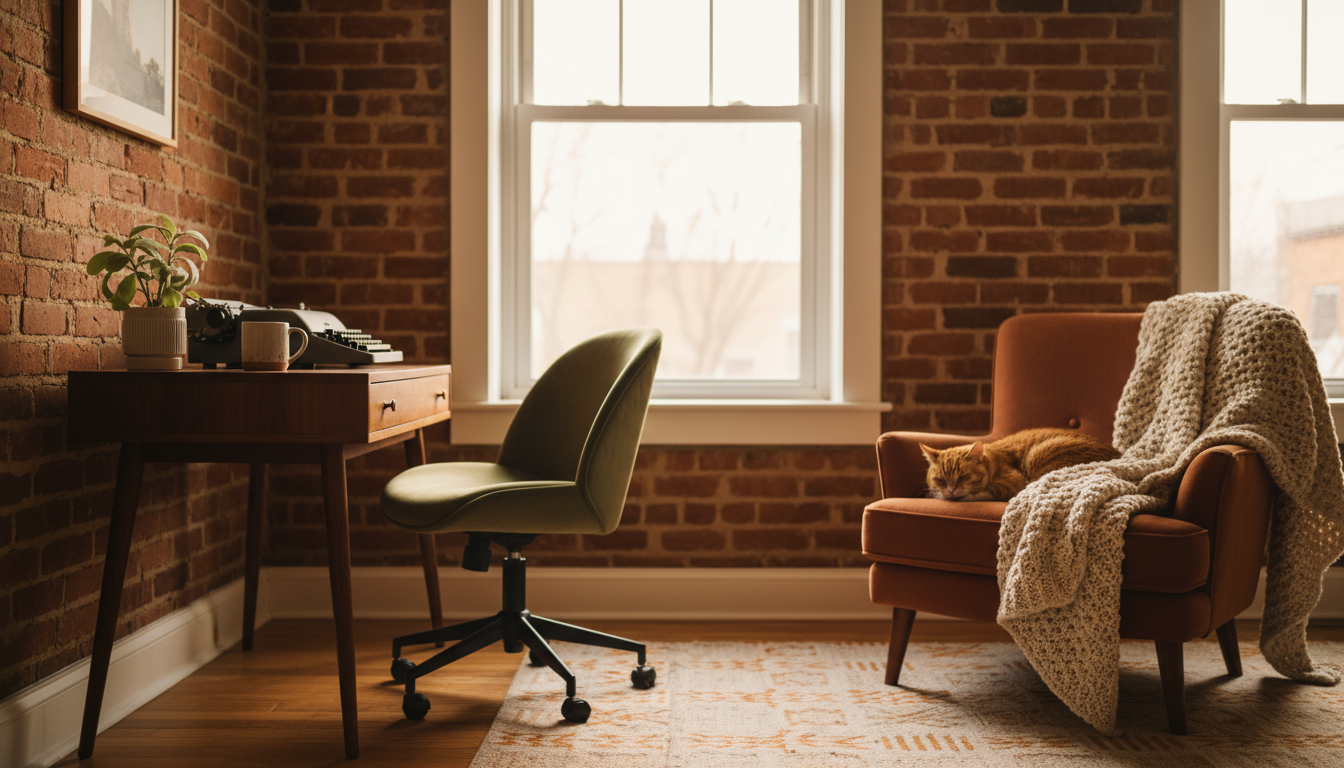 Interior of a bright Saint-Jean-Baptiste apartment with exposed brick walls, a mid-century modern de
Saint-Roch: The Tech Hub with Startup Energy
If you're in tech or creative fields, Saint-Roch will feel like home. This is Quebec City's innovation district—think converted warehouses, coworking spaces, and a younger demographic. The neighborhood went through a major revitalization and now has this interesting mix of old industrial buildings and modern lofts.
Home exchanges here tend to be more contemporary. Expect open-concept spaces, minimalist design, and dedicated home offices that look like they belong in a design magazine. The trade-off? Less historic charm, more functional workspace.
I stayed in a Saint-Roch loft last winter that had fiber internet (500+ Mbps), a motorized standing desk, and a second monitor I could use. The owner worked for a gaming company and had clearly invested in their setup. If you need serious bandwidth for video editing or development work, this is your neighborhood.
Café options: La Maison Smith in Saint-Roch is a local institution. Nektar Caféologue if you're a coffee snob (their pour-overs are exceptional).
Old Quebec (Vieux-Québec): Charm vs. Practicality
I know, I know—everyone wants to live inside the walls. And I get it. Waking up to those stone streets and fortress views is genuinely magical.
But here's my honest take: Old Quebec is better for a week than a month if you're actually working.
The buildings are heritage-protected, which sometimes means older electrical systems and inconsistent internet. The streets are cobblestone, which sounds romantic until you're hauling groceries up a steep hill in January. And the tourist density from May to October can make focused work... challenging.
That said, I've found gems here. A friend did a swap in a converted convent apartment near the Château Frontenac that had been fully modernized inside—fiber internet, heated floors, a proper desk setup. The key is asking specific questions about the workspace before you commit.
If you do choose Old Quebec, look for listings in the Upper Town residential areas away from Place Royale. Rue Sainte-Ursule and Rue Donnacona tend to be quieter.
Montcalm: The Quiet Professional Choice
Montcalm doesn't get much tourist attention, which is exactly why it works for remote workers. This is where Quebec City's professionals live—doctors, professors, government workers. The neighborhood has a refined, residential feel with tree-lined streets and elegant stone houses.
Home exchanges here often include proper home offices because the residents are working professionals themselves. The architecture is grand without being museum-piece fragile. You'll find spacious apartments in converted mansions, many with gardens or terraces.
The downside: it's a 15-20 minute walk to Old Quebec's attractions. For me, that's actually a plus—it creates separation between work mode and exploration mode. But if you want to pop out for a quick croissant in a 17th-century square, you'll need to plan for the walk.
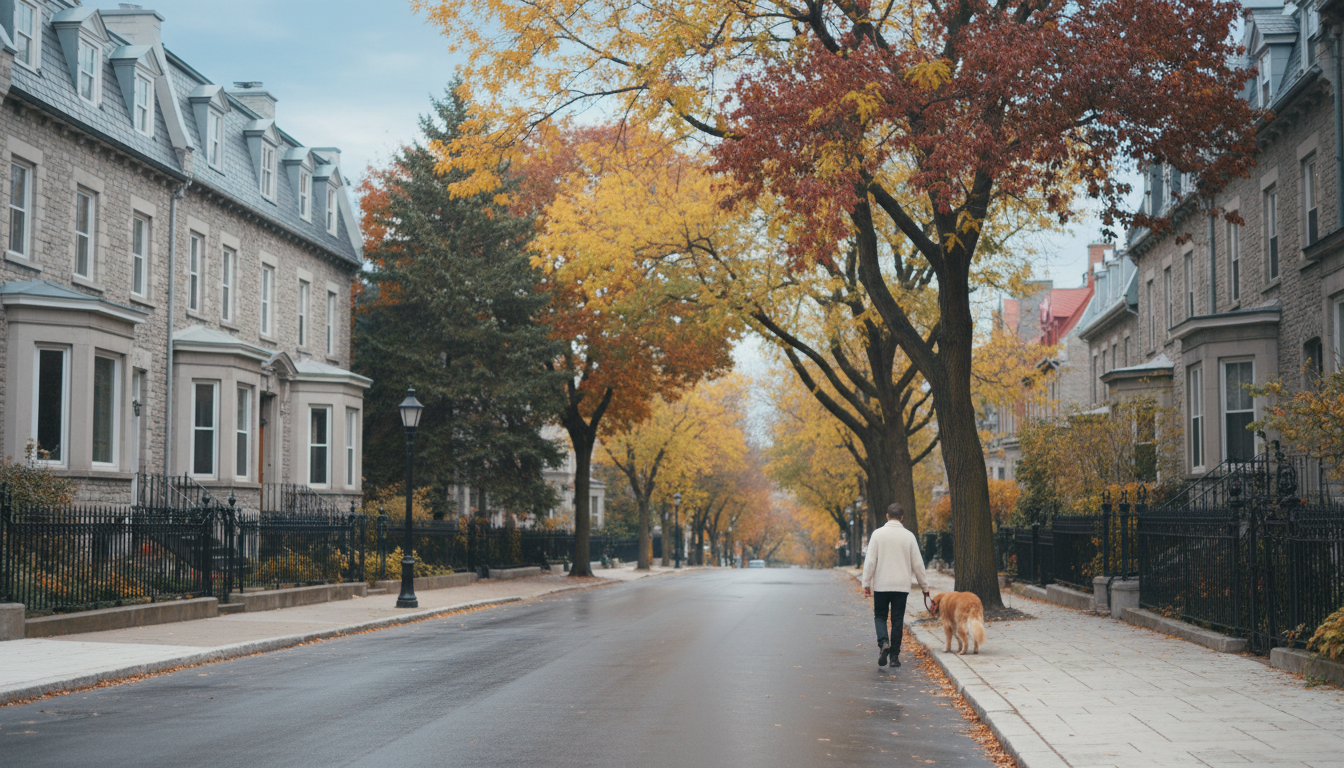 Tree-lined residential street in Montcalm with elegant stone townhouses, autumn leaves, and a person
How to Find Quebec City Home Exchanges with Proper Workspaces
This is where I've learned some hard lessons. Not every "home office" is actually a home office. I once showed up to a swap where the "dedicated workspace" was a wobbly card table in a hallway.
Never again.
Here's my vetting process for Quebec City remote work home exchanges:
Ask for workspace photos specifically. Not just the listing photos—ask the host to send you current pictures of where you'd actually be working. A real remote worker will understand why you're asking.
Get the WiFi speed in writing. Ask them to run a speed test (speedtest.net) and send you a screenshot. For video calls, you want at least 50 Mbps download and 10 Mbps upload. For heavy lifting like video editing or large file transfers, aim for 100+ Mbps.
Clarify the chair and desk situation. This sounds picky, but your back will thank you. Ask: Is there an ergonomic chair? Is the desk at proper height? Is there a second monitor available? These details matter for anything longer than a week.
Ask about daytime noise. Quebec City has a lot of construction in certain areas, and some neighborhoods have regular church bells (charming at first, distracting by week two). Ask the host what the typical daytime sound environment is like.
Check the backup plan. What's the nearest café with reliable WiFi? Is there a coworking space nearby? Even the best home setup can have an internet outage—knowing your options reduces stress.
On SwappaHome, I always message potential hosts with these questions before sending a booking request. The platform's messaging system makes this easy, and hosts who are serious about their listings appreciate the thoroughness.
Setting Up Your Remote Work Routine in Quebec City
Quebec City runs on a different rhythm than most North American cities, and honestly? It's made me a better remote worker.
The French-Canadian approach to work-life balance is real here. Shops close for lunch. People actually take vacation. The pressure to be constantly available just doesn't exist in the same way. I've found that leaning into this rhythm—rather than fighting it—makes me more productive, not less.
My typical Quebec City workday looks something like this:
7:00 AM - Wake up, walk to a local boulangerie for a croissant and café au lait. Most bakeries open early, and there's something about starting the day with fresh pastry that sets a good tone.
8:00 AM - Back at the home exchange, deep work time. Quebec City is quiet in the mornings—most tourists don't emerge until 10 or 11. This is when I tackle anything requiring serious concentration.
12:00 PM - Lunch break, and I mean a real break. Walk to a restaurant, sit down, eat slowly. Table d'hôte lunch specials run $15-20 CAD ($11-15 USD) and include multiple courses. Chez Temporel in Old Quebec does a legendary croque-monsieur.
1:30 PM - Back to work, but this is when I schedule calls and meetings. The afternoon energy in Quebec City picks up, and I find I'm more social and collaborative after a proper lunch.
5:30 PM - Done. Close the laptop. This is non-negotiable for me when I'm working from a beautiful place—if I don't set boundaries, I'll work through sunset and miss the whole point.
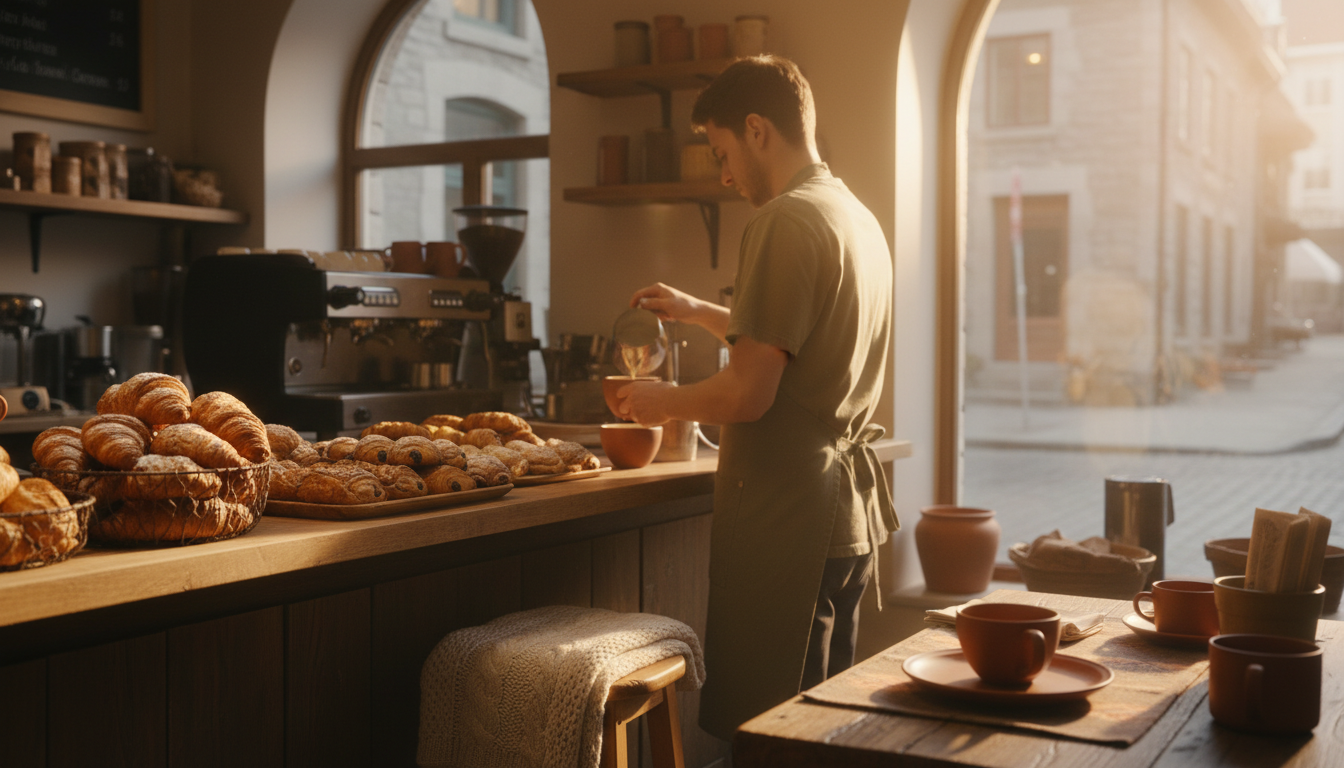 Morning scene at a Quebec City boulangerie counter, showing fresh croissants, pain au chocolat, and
Coworking Spaces and Backup Options for Remote Workers
Even with a perfect home exchange workspace, sometimes you need a change of scenery. Or your internet goes down. Or you just want to be around other humans for a few hours.
Quebec City's coworking scene is smaller than Montreal's but solid.
Espace CoWork in Saint-Roch is the biggest player. Day passes run about $35 CAD ($26 USD), and they have private phone booths for calls. The vibe is startup-y but not obnoxiously so.
La Halte 24-7 near the university offers 24-hour access, which is clutch if you're working with clients in Asia or Australia. Monthly memberships start around $200 CAD ($147 USD).
Bibliothèque Gabrielle-Roy is the main public library, and it's genuinely excellent for focused work. Free WiFi, quiet study areas, and a beautiful modern building. No cost, but you can't take calls here.
For café working, my favorites:
- Café Krieghoff on Avenue Cartier - relaxed atmosphere, strong WiFi, doesn't mind campers
- Nektar Caféologue in Saint-Roch - best coffee in the city, limited seating
- La Maison Smith (multiple locations) - reliable chain option when you need consistency
- Café Le Hobbit in Saint-Jean-Baptiste - quirky vibe, good for afternoon work sessions
What to Do When You're Not Working: Quebec City's Remote Worker Perks
This is the whole point, right? Working from somewhere interesting means actually experiencing that somewhere.
Quebec City rewards the curious. The old fortifications are free to walk anytime—I've done sunrise laps around the walls when I needed to clear my head before a big presentation. The Plains of Abraham is essentially a massive park perfect for lunch breaks or post-work runs.
The food scene punches way above its weight. Beyond poutine (though yes, get the poutine—Chez Ashton for classic, La Banquise if you're in Montreal for a day trip), you've got serious French-Canadian cuisine. Chez Boulay does incredible boreal-inspired dishes. Le Clocher Penché in Saint-Roch is perfect for a celebratory dinner after finishing a big project.
Winter is actually a selling point if you're the right kind of person. Fewer tourists, cozy café culture, and the city transforms into a snow globe. The famous Winter Carnival in February is genuinely fun, not just tourist bait. Just make sure your home exchange has good heating—ask about this specifically if you're coming between November and March.
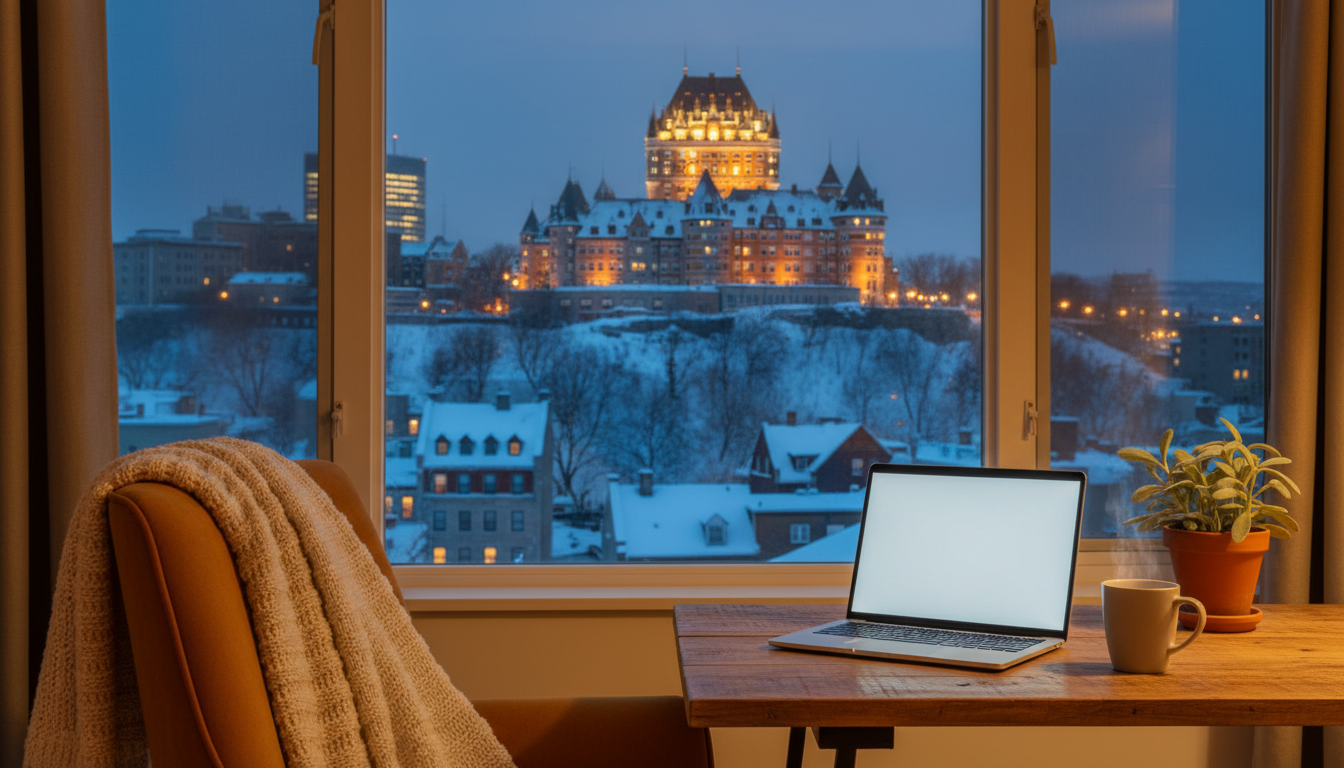 Evening view of Chteau Frontenac lit up against a snowy Quebec City skyline, seen from the terrace o
Practical Logistics for Quebec City Home Exchange Remote Work
A few things I wish someone had told me before my first Quebec City swap:
Language matters, but less than you'd think. Quebec City is more French than Montreal—you'll encounter people who genuinely don't speak English, especially in residential neighborhoods. But in my experience, a few basic French phrases and a smile go a long way. Google Translate handles the rest. For work purposes, all the tech infrastructure is bilingual.
Winter gear is non-negotiable. If you're coming between December and March, you need real winter boots, a serious coat, and layers. This isn't Toronto cold—it's "the wind off the St. Lawrence will freeze your face" cold. Budget $200-400 USD for gear if you don't have it.
The airport is small but well-connected. Jean Lesage International (YQB) has direct flights to major Canadian cities and some US destinations. For international travel, you'll usually connect through Montreal or Toronto. The airport is 20 minutes from downtown.
Grocery stores close earlier than you'd expect. Most close by 9 PM, and Sunday hours are limited. Plan accordingly if you're used to 24-hour options.
Healthcare is accessible. Canada's public system covers emergencies for visitors, but travel insurance is still smart. Walk-in clinics exist for non-emergencies.
Making the Most of Home Exchange Credits in Quebec City
Here's something I love about using SwappaHome for Quebec City stays: the credit system makes longer stays actually feasible.
Think about it—a decent hotel in Old Quebec runs $150-250 USD per night. A month-long stay would cost you $4,500-7,500 USD just for accommodation. With home exchange, you're using credits you've earned by hosting guests in your own home. One credit per night, regardless of whether you're staying in a studio or a heritage mansion.
I've found that Quebec City hosts are particularly active on the platform because there's genuine demand to visit San Francisco (where I live). I hosted a lovely couple from Montcalm for a week last spring, earned 7 credits, and used those same credits for a week in their neighborhood the following fall. The mutual exchange of local knowledge was almost as valuable as the free accommodation.
New to SwappaHome? You start with 7 free credits—that's 7 nights in Quebec City to test whether this whole home exchange thing works for you.
When to Visit Quebec City as a Remote Worker
Timing matters more here than in most cities.
September-October: My favorite window. The summer tourists have left, the fall colors are spectacular, and the weather is crisp but not brutal. Home exchange availability is good because locals are back from summer vacations and open to hosting.
November-March: Cold. Really cold. But if you're a winter person, this is magical. The city empties out, coworking spaces are quiet, and you'll have cafés mostly to yourself. Home exchange rates are highest during Winter Carnival (usually early February), so plan around that if you want the best selection.
April-May: Shoulder season with unpredictable weather. Can be slushy and gray, but accommodation availability is excellent and prices are low.
June-August: Peak tourist season. Old Quebec gets crowded, and some home exchange hosts prefer to stay in their own homes during the nice weather. That said, the long summer days are glorious for after-work exploration.
Red Flags to Watch for in Quebec City Home Exchange Listings
I've learned to spot warning signs in listings. A few things that make me hesitate:
"Cozy" without square footage mentioned often means tiny. Quebec City apartments can be small, especially in Old Quebec. Ask for actual dimensions.
No photos of the workspace usually means there isn't a dedicated one. If remote work is your priority, this is a dealbreaker.
Vague internet descriptions like "WiFi available" without speed details. Push for specifics.
Ground floor in Old Quebec can mean noise issues—those cobblestone streets amplify footsteps and rolling luggage.
"Recently renovated" without details might mean the work is ongoing. Ask if construction is complete.
On the flip side, green flags I look for: hosts who mention their own remote work setup, specific WiFi speeds listed in the description, photos showing a dedicated desk area with good lighting, reviews from other remote workers, and hosts who respond quickly and thoroughly to questions.
The Honest Truth About Working Remotely from Quebec City
I'm not going to pretend it's perfect. There are trade-offs.
The language barrier can be frustrating when you're trying to solve a practical problem quickly. My French is mediocre, and I've had moments of genuine confusion at the hardware store or the pharmacy.
Winter is no joke. If you're coming from somewhere warm, the adjustment period is real. I've had days where I just didn't want to leave the apartment because the wind chill was -25°C.
The city is smaller than you might expect. After a month, you'll have explored most of the main attractions. This is either a feature or a bug depending on your personality—I find it peaceful, but some people get restless.
And the home exchange market, while good, isn't as deep as Montreal or Toronto. You might not find your perfect listing immediately, especially during peak seasons.
But here's what keeps me coming back: Quebec City feels like a secret. It's a UNESCO World Heritage city with genuine history, excellent food, and a pace of life that actually supports deep work. The home exchange community here tends to be thoughtful, professional people who understand what remote workers need.
When I'm working from Quebec City, I feel like I'm living somewhere, not just staying somewhere.
That's worth a lot.
Getting Started with Your Quebec City Home Exchange
If you're convinced (or at least curious), here's my suggested approach:
Start browsing listings on SwappaHome filtered for Quebec City. Get a sense of what's available in different neighborhoods. Make a shortlist of 5-10 properties that look promising, noting which ones mention home offices or remote work amenities.
Send detailed messages to your top choices. Ask the specific questions I mentioned earlier about workspace, WiFi, and noise. Read reviews carefully—look for mentions of internet reliability and workspace quality from past guests.
Book your first stay for 1-2 weeks to test the waters. You can always extend or plan a return trip once you know the city. And arrive with realistic expectations. Your first remote work trip anywhere has a learning curve. Give yourself grace.
Quebec City has become one of my favorite places to work remotely—not because it's trendy or Instagram-perfect (though it is photogenic), but because it genuinely works. The infrastructure supports it, the pace encourages it, and the home exchange options make it affordable.
Those church bells from Notre-Dame-des-Victoires? I've learned to schedule around them now. They ring on the hour, which means I know exactly when to mute my mic.
Some things you just adapt to. Others, you learn to love.
Frequently Asked Questions
Is Quebec City good for remote workers?
Quebec City is excellent for remote workers, offering reliable high-speed internet (typically 100-300 Mbps in residential areas), affordable cost of living (30-40% lower than Toronto), and Eastern Time zone compatibility with both European and West Coast clients. The city's European pace and walkable neighborhoods create an ideal work-life balance for digital nomads and remote professionals.
How much does it cost to live in Quebec City as a remote worker?
Remote workers can expect monthly costs of approximately $1,500-2,500 CAD ($1,100-1,850 USD) excluding accommodation. This covers food ($400-600), transportation ($75-150 for a bus pass), coworking if needed ($200-350), and entertainment. With home exchange eliminating accommodation costs, Quebec City becomes remarkably affordable for extended stays.
What internet speed can I expect in Quebec City home exchanges?
Most Quebec City home exchanges offer internet speeds between 100-500 Mbps, with fiber connections increasingly common in neighborhoods like Saint-Roch and Montcalm. Always ask hosts for a current speed test before booking. Older buildings in Old Quebec may have slower connections (50-100 Mbps), so verify specifically if you need high bandwidth.
Is Quebec City safe for solo remote workers?
Quebec City consistently ranks among Canada's safest cities, with very low violent crime rates. Solo remote workers, including women, generally feel comfortable walking alone at night in most neighborhoods. The residential areas like Saint-Jean-Baptiste, Montcalm, and Saint-Roch are particularly safe and welcoming for long-term visitors.
Do I need to speak French to work remotely from Quebec City?
While Quebec City is predominantly French-speaking, you don't need fluency to work remotely here. Most tech and business infrastructure is bilingual, and younger residents often speak English. Learning basic French phrases improves daily interactions significantly. For work purposes, all coworking spaces and most cafés accommodate English speakers comfortably.

Published by
SwappaHome
SwappaHome Editorial Team
Home Exchange & Slow Travel Editorial
The SwappaHome Editorial Team brings together travel research, home-exchange community insights, and platform data to produce practical guides for first-time and experienced home swappers. Every article cites real platforms, current market rates, and verifiable city-level facts so readers can make informed decisions without guessing.
Ready to try home swapping?
Join SwappaHome and start traveling by exchanging homes. Get 7 free credits when you sign up!
Related articles

Bachelor and Bachelorette Parties in Singapore: The Complete Home Swap Group Guide for 2026
Planning a bachelor or bachelorette party in Singapore? Discover how home swapping lets groups of 6-12 stay together in luxury condos, saving thousands while partying in Marina Bay.

Cycling in Lisbon: 7 Home Swap Bike Tour Itineraries for Every Rider
Discover the best cycling routes in Lisbon with these home swap bike tour itineraries—from waterfront paths to hilltop adventures, all starting from your borrowed home.

Graduation Trip to Barcelona: How Home Swapping Gives New Graduates the Ultimate Celebration
Planning a graduation trip to Barcelona? Discover how home swapping lets new graduates explore Spain's most vibrant city without the hostel crowds or hotel costs.