
Zurich Bucket List: 47 Unforgettable Experiences to Enjoy During Your Home Swap

SwappaHome Editorial Team
Home Exchange & Slow Travel Editorial
Discover the ultimate Zurich bucket list for home swappers—from secret swimming spots to fondue rituals locals actually do. Save thousands while living like a true Zürcher.
I'll never forget the moment I realized I'd been doing Zurich wrong for years.
I was standing on the Lindenhof hill at 6 AM, watching the mist lift off the Limmat River, when an elderly Swiss man walking his dachshund stopped beside me. "You're staying in the city?" he asked. When I told him I was home swapping in Wiedikon for three weeks, his face lit up. "Ah, then you'll actually see Zurich. Not just the chocolate shops."
He was right. That moment—watching the city wake up from that ancient Roman lookout point—wasn't in any guidebook I'd read. It came from my home swap host's handwritten notes, tucked inside a kitchen drawer alongside recommendations for her favorite bakery (Kleiner, on Müllerstrasse) and the swimming spot where she'd proposed to her wife.
This is what home swapping unlocks. Not the tourist version of a city, but the lived-in one.
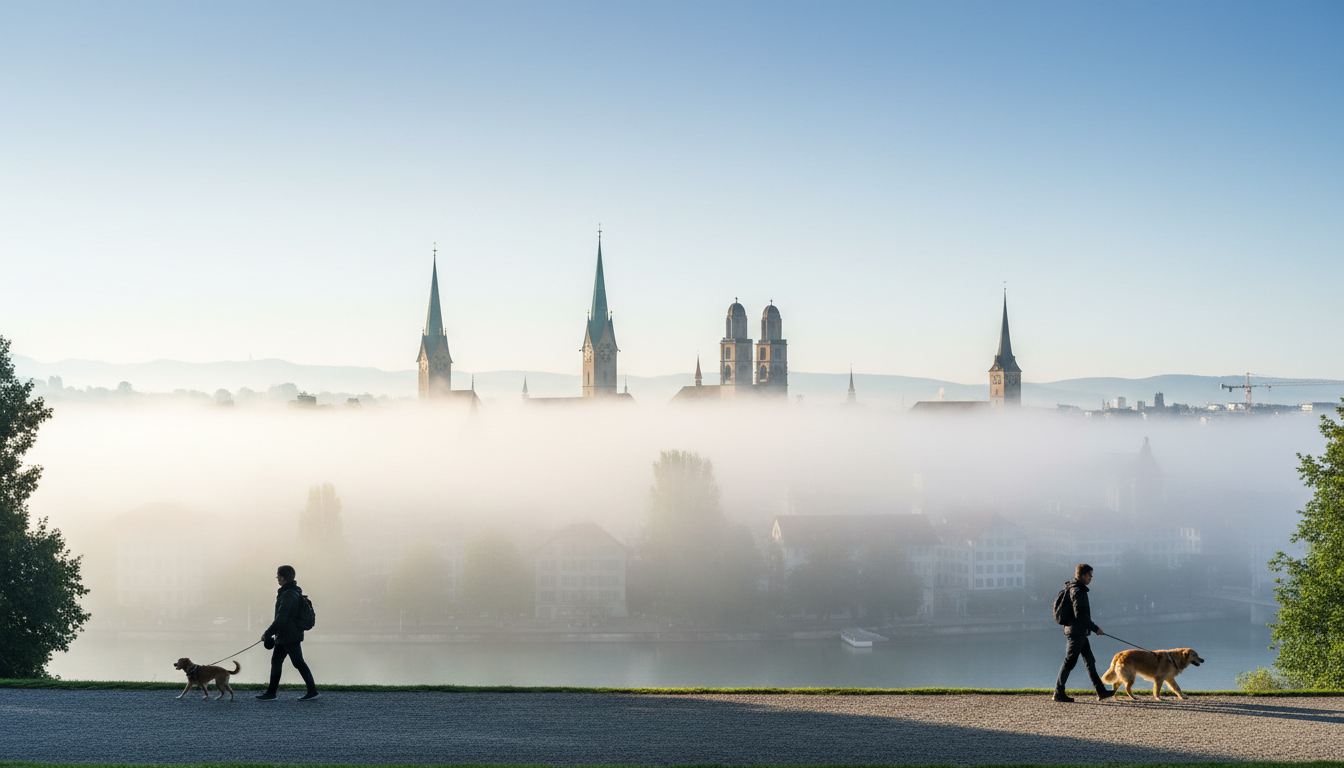 Early morning view from Lindenhof hill overlooking Zurichs old town with mist rising from the Limmat
I've been to Zurich four times now—twice in hotels that cost me roughly $350 per night, twice through home exchanges that cost me nothing but the pleasure of hosting Swiss travelers in my San Francisco apartment. The difference in my bank account was obvious. The difference in my experience was profound.
So here's my Zurich bucket list, built from those three-week stays where I actually grocery shopped at Migros, learned which tram line to avoid during rush hour, and discovered that the best rösti in the city isn't at a restaurant—it's at a food truck near Bürkliplatz that only appears on Saturdays.
Essential Zurich Bucket List Experiences for First-Time Visitors
These are the non-negotiables. Skip them, and you haven't really done Zurich.
Swimming in the Limmat (Yes, Really)
The first time my host mentioned swimming in the river that runs through downtown Zurich, I thought she was joking. Rivers in cities are for looking at, not swimming in—at least where I come from.
But Zurich's relationship with water is different. The Limmat is clean enough that locals swim in it daily from May through September. There are designated entry points called "Badis" (public baths) where you can rent a locker for 8 CHF (about $9 USD), change into your swimsuit, and literally float downstream through the city center. The Oberer Letten is the most popular spot—a former industrial area turned urban swimming paradise with a bar, sunbathing platforms, and a current strong enough to carry you several hundred meters if you let it.
I spent an entire afternoon there, drifting past centuries-old buildings, then walking back upstream to do it again.
Go on a weekday morning if you can. By 2 PM on summer weekends, you'll be fighting for towel space.
The Grossmünster Towers at Golden Hour
Yes, climbing the Grossmünster's 187 steps is on every Zurich bucket list. But here's the thing—timing matters more than the guidebooks let on.
The tower costs 5 CHF ($5.50 USD) and closes at 6 PM in summer, 5 PM in winter. Most tourists go midday. Rookie mistake. The view is fine then, but the light is flat and harsh.
Go at 5 PM in summer. The stone turns honey-gold, the Alps in the distance catch the last light, and you'll have maybe three other people up there instead of thirty. I've done this climb at noon and at golden hour—trust me, it's not even the same experience.
 View from Grossmnster tower at golden hour showing Zurichs terracotta rooftops, the lake stretching
Fondue, But Make It Local
I'm going to say something controversial: the famous fondue restaurants in Zurich's old town are fine, but they're not where locals actually go.
My host took me to Raclette Stube in Niederdorf on my second night. It's tiny—maybe twelve tables—and the menu is handwritten on a chalkboard. The fondue moitié-moitié (half Gruyère, half Vacherin) costs 28 CHF per person (about $31 USD), and they serve it with pickled onions, cornichons, and potatoes that arrive in a basket wrapped in a cloth napkin. The cheese is from a specific farm in Fribourg. The wine pairings are actually good. And the server will gently correct your fondue technique if you're doing it wrong.
Apparently, I was doing it very wrong.
Reservations are essential. I learned this the hard way when I tried to walk in on a Friday night and was laughed at—kindly, but still.
Hidden Zurich Bucket List Gems Most Tourists Miss
Now we're getting into the good stuff. The experiences that only emerge when you're staying in a neighborhood, shopping at the corner store, and asking your host "where do YOU actually go?"
The Secret Garden at Museum Rietberg
Everyone visits Museum Rietberg for the Asian and African art collections, which are genuinely world-class. But almost nobody goes to the garden behind the Wesendonck Villa.
It's free to enter. There's a path that winds through rhododendrons (spectacular in May), past a small pond, and up to a bench with a view of the lake that feels impossibly private for being five minutes from a major museum. I found it by accident, following a cat who seemed to know where she was going. Bring a book. Bring a picnic. Don't bring your phone—or at least, don't look at it.
Frau Gerolds Garten for Sunset Drinks
This urban garden/bar/restaurant/gallery space in Zurich West is technically in guidebooks now, but most tourists don't realize what makes it special: the containers.
Frau Gerolds Garten is built from repurposed shipping containers, each housing a different food vendor or shop. The garden itself is a jumble of mismatched furniture, string lights, and raised beds growing actual vegetables that end up in the kitchen. On warm evenings, half of young Zurich seems to be here, drinking Aperol Spritzes (16 CHF / $18 USD) and eating wood-fired pizzas. The vibe is Berlin-meets-California, which is not what you expect from Switzerland's financial capital.
Go around 6 PM, grab a drink, and stay until the lights come on.
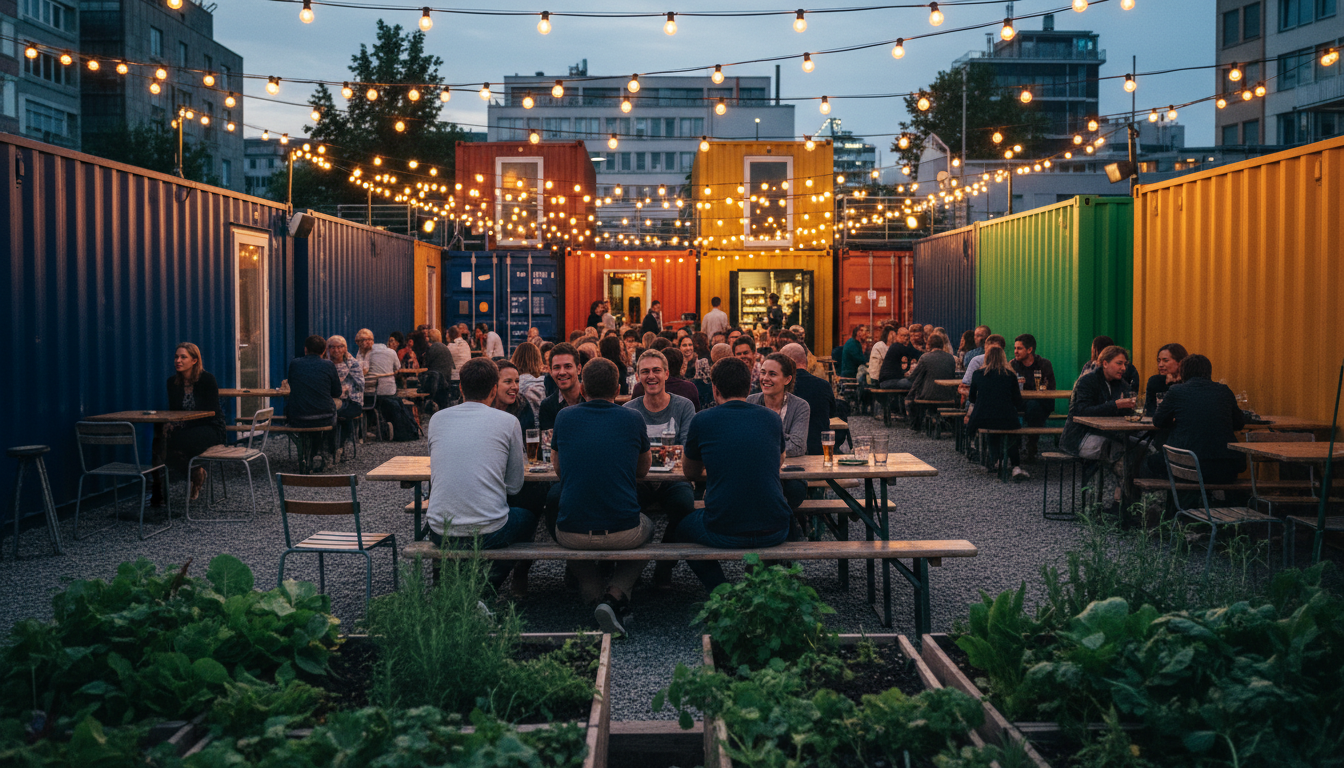 Frau Gerolds Garten at dusk with string lights illuminating colorful shipping containers, people gat
The Vinyl Record Stores of Langstrasse
Langstrasse has a reputation as Zurich's red-light district, which is technically true but also wildly outdated. These days, it's the city's most interesting neighborhood—a mix of dive bars, Ethiopian restaurants, vintage shops, and some of the best record stores in Europe.
Zurich Home Swap Tip: If your exchange home is in District 4 or 5 (Langstrasse area), you've hit the jackpot for nightlife and food diversity.
Start at Rec Rec (Langstrasse 85) for rare electronic and experimental vinyl. Then walk to Plattfon (Josefstrasse 55) for jazz and soul. End at Sounds (Müllerstrasse 63) for a curated mix of everything. Even if you don't buy anything, the owners are walking encyclopedias of music history.
Zurich Bucket List: Food Experiences Worth Every Franc
Switzerland's reputation for expensive food is... not wrong. A basic lunch can easily run 25-35 CHF ($28-39 USD). But when you're home swapping, you have a kitchen. You can shop at Migros or Coop like a local, cook most meals, and splurge strategically on the food experiences that are actually worth it.
Breakfast at Café Henrici
I don't usually recommend breakfast spots because breakfast is breakfast. But Café Henrici on Niederdorfstrasse is different.
The building dates to the 1300s. The ceilings are low and dark-beamed. The coffee comes in ceramic cups that don't match. And the Bircher müesli—invented in Zurich, by the way—is the best I've had anywhere, including at the hospital where Dr. Bircher-Benner actually created it. A full breakfast with müesli, bread, cheese, and coffee runs about 24 CHF ($27 USD). Expensive? Sure. But you'll skip lunch, and you'll remember it for years.
The Saturday Market at Bürkliplatz
Every Saturday from 6 AM to noon, the plaza at the foot of Bahnhofstrasse transforms into a farmers' market that would make any Californian jealous.
The cheese selection alone is worth the early wake-up. Small producers from the Alps bring wheels of Alpkäse (mountain cheese) aged in caves you've never heard of. There are stands selling fresh-baked Zopf (braided bread), seasonal fruits, flowers, and—this is the secret—prepared foods for immediate eating. Find the stand selling Älplermagronen (Alpine macaroni with cheese, potatoes, and caramelized onions). It's 12 CHF ($13 USD) for a portion that will destroy you in the best way.
Eat it on a bench by the lake. This is peak Zurich.
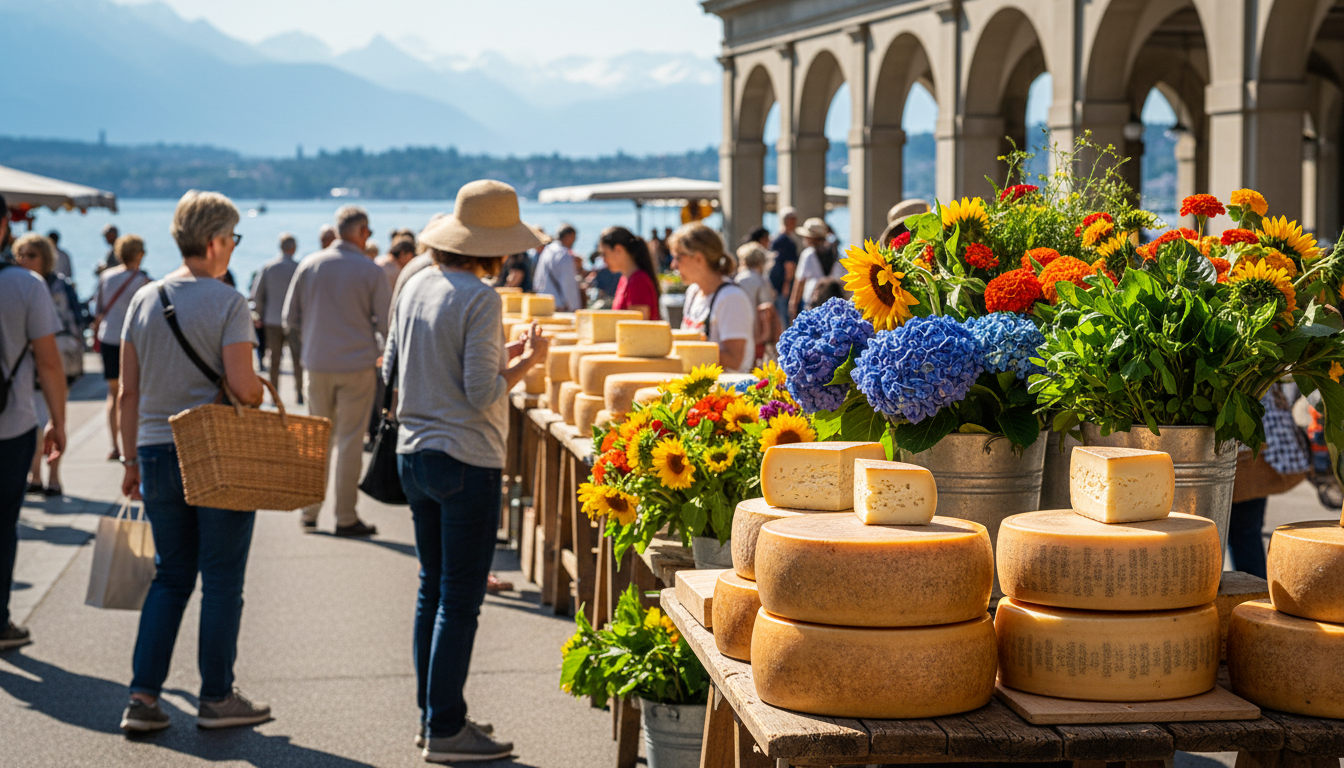 Brkliplatz Saturday market bustling with locals, wheels of Alpine cheese stacked on wooden tables, f
Zeughauskeller for Traditional Swiss Food Without the Tourist Trap Feel
This medieval armory-turned-restaurant has been serving food since 1487, which should make it a tourist trap. Somehow, it isn't.
The portions are enormous. The Zürcher Geschnetzeltes (veal in cream sauce with rösti) is 38 CHF ($42 USD) and could feed two people. The beer comes in half-liter steins. The servers are efficient to the point of brusqueness, which is actually a sign you're in a real Swiss restaurant. Go for lunch—it's slightly cheaper, and you'll share long wooden tables with Swiss businesspeople on their breaks. A much more interesting crowd than the dinner tourists.
Outdoor Zurich Bucket List Adventures
Zurich's location is absurd. You're in a major financial center, but the Alps are 90 minutes away by train. The lake is swimmable. The forests start at the city limits. This is a city that takes outdoor recreation seriously.
Uetliberg: Zurich's Backyard Mountain
The S10 train from Hauptbahnhof takes 25 minutes to reach Uetliberg, the 870-meter peak that serves as Zurich's backyard playground. The train costs about 9 CHF ($10 USD) each way with a regular ticket, but if you're staying long enough, the ZVV day pass (26 CHF / $29 USD) covers unlimited travel including this route.
From the top, you can see the entire city, the lake, and on clear days, the Alps from Säntis to the Bernese Oberland. There's a restaurant at the summit (overpriced, skip it) and a viewing tower (free, worth the extra climb).
The real Zurich bucket list move? Hike the ridge trail to Felsenegg (about 2 hours, moderate difficulty), then take the cable car down to Adliswil and the train back. You'll feel like you've been in the mountains all day, but you're home in time for dinner.
Lake Zurich by Paddleboard
Renting a SUP (stand-up paddleboard) from one of the lakeside rental spots costs about 25-30 CHF ($28-33 USD) per hour. It sounds like a tourist gimmick until you're floating past the opera house, watching the sun set behind the city, and realizing this is how locals actually spend their summer evenings.
The best rental spot is at Strandbad Mythenquai—a public beach on the west shore that also has swimming, a café, and grass for lounging. Entry to the Strandbad is 8 CHF ($9 USD), and you can spend an entire day there without spending another franc.
 Stand-up paddleboarders on Lake Zurich at sunset, city skyline in background, orange and pink sky re
The Forest Walks of Zürichberg
On the eastern side of the city, the Zürichberg forest offers walking trails that feel like they belong in a fairy tale, not 15 minutes from a major financial district.
Take tram 6 to Zoo and walk into the forest from there. The trails are well-marked, mostly flat, and lead to unexpected discoveries: a small cemetery where James Joyce is buried, a clearing with a view of the city, a wooden shelter where you can sit and listen to absolutely nothing. My host's recommendation? Bring a thermos of coffee and a pastry from Kleiner bakery. Find a bench. Stay until you've forgotten what day it is.
Cultural Zurich Bucket List: Museums, Art, and Architecture
Kunsthaus Zurich for the Giacometti Room
The Kunsthaus is Switzerland's largest art museum, and it's genuinely excellent—Monets, Picassos, the works. But the reason to go is the Alberto Giacometti collection.
Giacometti was Swiss, and the Kunsthaus has the world's most important collection of his work. An entire room is dedicated to his elongated bronze figures, arranged so you can walk among them. It's haunting and beautiful and unlike anything you'll see elsewhere. Admission is 23 CHF ($26 USD), free on Wednesdays after 5 PM. The new extension by David Chipperfield is worth seeing for the architecture alone.
The Pavillon Le Corbusier
Le Corbusier's last building, completed after his death in 1967, sits on the shore of Lake Zurich like a colorful Rubik's cube. It's a house, a museum, and a manifesto about how humans should live—all in one small structure.
The interior changes with temporary exhibitions, but the building itself is the main attraction. The way light moves through the colored panels, the relationship between indoor and outdoor space, the sheer optimism of the design—it's architecture as philosophy. Open April through November, 12 CHF ($13 USD) admission. Go in the late afternoon when the light is best.
Cabaret Voltaire: Where Dada Was Born
In 1916, a group of artists fleeing World War I gathered in this small bar on Spiegelgasse and invented Dadaism—the absurdist art movement that would influence everything from punk rock to contemporary art.
Today, Cabaret Voltaire is part museum, part bar, part performance space. You can have a drink where Hugo Ball first performed his sound poems, browse a small exhibition about the movement's history, and occasionally catch experimental performances that continue the Dada tradition. There's no admission fee—just buy a drink. The absinthe is appropriately strong.
Neighborhood-by-Neighborhood Zurich Bucket List
One of the best parts of a home swap in Zurich is getting to know a specific neighborhood intimately. Here's what to prioritize depending on where you're staying.
Niederdorf (Old Town East)
The medieval heart of Zurich, with narrow lanes, guild houses, and more fondue restaurants than you can count. It's touristy but genuinely charming. Don't miss the tiny Schipfe quarter along the river, the antique shops on Rindermarkt, and Schwarzenbach for coffee beans roasted on-site since 1864.
Wiedikon (District 3)
This is where I stayed on my longest Zurich home swap, and I fell hard for it. It's residential, slightly hilly, and full of the kind of neighborhood cafés and bakeries that don't appear in guidebooks. Don't miss the Saturday market at Idaplatz, Café Plüsch for weekend brunch, and the view from the top of Goldbrunnenplatz.
Zurich West (District 5)
The former industrial area has become Zurich's creative hub—galleries, design studios, and some of the city's best restaurants. Don't miss Frau Gerolds Garten (mentioned above), the Löwenbräu art complex, and Markthalle for international street food under one roof.
Practical Tips for Your Zurich Home Swap Bucket List
Getting Around
Zurich's public transport is expensive but excellent. A single ride costs 4.40 CHF ($4.90 USD), so if you're doing more than two trips a day, get a day pass (26 CHF / $29 USD for the city zone). Even better—ask your home swap host if they have a Halbtax card you can borrow. It cuts all fares in half.
The city is also extremely walkable. I did most of my exploring on foot and only used trams for getting to the edges of the city.
Money-Saving Strategies
Switzerland is expensive. There's no way around it. But home swapping already saves you the biggest expense—accommodation. A mid-range hotel in Zurich runs $250-350 per night. Over two weeks, that's $3,500-4,900 you're not spending.
Use that savings strategically: cook breakfast and lunch at your swap home (grocery shopping at Migros or Coop is reasonable), then splurge on one nice dinner experience every few days. Drink wine from the supermarket instead of at restaurants. Take advantage of free activities—swimming in the lake, hiking Uetliberg, wandering the old town.
Best Time to Visit
June through September is peak season—warm enough for lake swimming, long daylight hours, and outdoor dining everywhere. But Zurich in December is magical: Christmas markets, mulled wine, and the city decorated in lights. The shoulder seasons (April-May, October) offer smaller crowds and lower prices on everything except your home swap (which is free anyway).
Why Home Swapping Makes the Zurich Bucket List Better
I've done Zurich both ways, and honestly? The difference isn't just financial—though saving $4,000+ on accommodation certainly doesn't hurt.
When you're home swapping, you have a kitchen to cook that cheese you bought at the Saturday market. You have a living room to collapse into after a day of walking. You have a host who tells you about the swimming spot where she proposed to her wife. You're not a tourist. You're a temporary local. And Zurich—with its lakes and forests and absurdly clean public transport—is a city that rewards that kind of staying.
My last morning in Wiedikon, I walked to Kleiner bakery at 7 AM, bought a warm Gipfeli (Swiss croissant), and ate it on a bench in the park where I'd watched dogs play every morning for three weeks. An older woman I'd nodded to daily finally spoke to me: "You're leaving today?"
I was.
"Come back," she said. "You fit here."
That's not a comment you get at a hotel. That's the home swap difference.
If you're ready to experience Zurich like this—not as a tourist checking boxes, but as someone who actually lives there for a while—SwappaHome connects you with hosts all over the city. List your place, earn credits by hosting travelers, and use those credits to unlock a kitchen in Wiedikon, a balcony in Zurich West, or a garden apartment in Witikon with a view of the Alps.
Your Zurich bucket list is waiting. And trust me—it's better with a kitchen.
Frequently Asked Questions
What should be on my Zurich bucket list for a first visit?
Your essential Zurich bucket list should include swimming in the Limmat River, climbing the Grossmünster towers at sunset, eating fondue at a local spot like Raclette Stube, exploring the Saturday market at Bürkliplatz, and hiking Uetliberg for panoramic views. These experiences capture Zurich's unique blend of urban sophistication and outdoor culture.
How much does a Zurich bucket list trip cost?
A two-week Zurich trip typically costs $3,500-5,000 for accommodation alone at mid-range hotels. With home swapping, accommodation is free—you'll spend roughly $50-80 per day on food, transport, and activities. Budget $700-1,100 for two weeks of comfortable exploring, including splurge meals and museum entries.
Is Zurich worth visiting for a home swap?
Absolutely. Zurich is ideal for home swapping because the high accommodation costs (averaging $300/night) make free stays incredibly valuable. The city's residential neighborhoods offer authentic experiences, kitchens save money on expensive restaurant meals, and hosts provide insider tips for hidden Zurich bucket list gems tourists never find.
What is the best time to visit Zurich for bucket list experiences?
June through September offers the best Zurich bucket list experience—warm weather for lake swimming, outdoor dining, and long evenings. December brings magical Christmas markets and winter atmosphere. For fewer crowds and pleasant weather, visit in May or late September when locals still enjoy outdoor activities.
Can you swim in Lake Zurich?
Yes, Lake Zurich and the Limmat River are clean enough for swimming and locals do so regularly from May through September. Public swimming areas (Badis) like Strandbad Mythenquai and Seebad Utoquai offer facilities for 6-8 CHF ($7-9 USD). River swimming at Oberer Letten is a quintessential Zurich bucket list experience.

Published by
SwappaHome
SwappaHome Editorial Team
Home Exchange & Slow Travel Editorial
The SwappaHome Editorial Team brings together travel research, home-exchange community insights, and platform data to produce practical guides for first-time and experienced home swappers. Every article cites real platforms, current market rates, and verifiable city-level facts so readers can make informed decisions without guessing.
Ready to try home swapping?
Join SwappaHome and start traveling by exchanging homes. Get 7 free credits when you sign up!
Related articles
Bachelor and Bachelorette Parties in Singapore: The Complete Home Swap Group Guide for 2026
Planning a bachelor or bachelorette party in Singapore? Discover how home swapping lets groups of 6-12 stay together in luxury condos, saving thousands while partying in Marina Bay.
Cycling in Lisbon: 7 Home Swap Bike Tour Itineraries for Every Rider
Discover the best cycling routes in Lisbon with these home swap bike tour itineraries—from waterfront paths to hilltop adventures, all starting from your borrowed home.
Graduation Trip to Barcelona: How Home Swapping Gives New Graduates the Ultimate Celebration
Planning a graduation trip to Barcelona? Discover how home swapping lets new graduates explore Spain's most vibrant city without the hostel crowds or hotel costs.